Table of Contents >> Show >> Hide
- Theia, Explained Like You’re at a Science Museum Gift Shop
- Why Scientists Take the Giant Impact Hypothesis Seriously
- So Where Did Theia Go?
- Meet the Deep-Earth Giants: The Blobs at the Bottom of the Mantle
- The Big New Twist: Could Those Blobs Be Remnants of Theia?
- Does This Mean There’s Literally an “Alien World” Inside Earth?
- Why This Matters: Volcano Hotspots, Plate Tectonics, and Earth’s Long Game
- The Skeptic’s Corner: Other Explanations for the Deep Mantle Blobs
- What Scientists Will Test Next
- Hands-On Experiences: Ways to “Feel” the Theia Story for Yourself (About )
- Conclusion: Earth Might Be Keeping a Piece of Its Oldest Drama
Imagine Earth has a “fossil” from its wildest early-day crashexcept instead of a dinosaur bone, it’s a continent-sized chunk of another world.
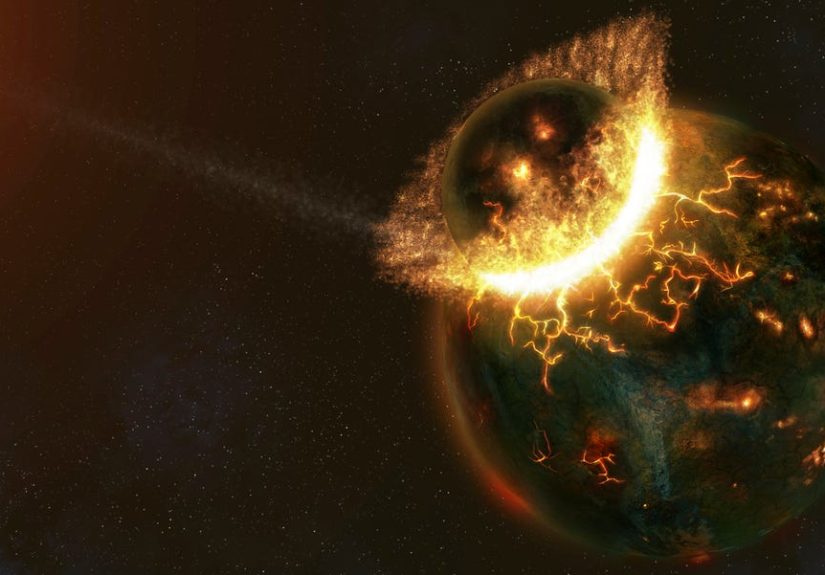
That’s the spicy idea behind Theia: a long-gone planetary body that may have collided with the young Earth and helped create the Moon.
And if some recent modeling is right, parts of that impactor might not be gone at allthey may be sitting deep inside our planet, parked near the core like
a forgotten suitcase in the basement you swear you’ll unpack “this weekend.”
Before you picture a full “alien planet” rolling around like a jawbreaker inside Earth (nope), this is about dense, chemically distinct rockpossible
remnants of Theia’s mantlepreserved in the deep mantle as gigantic structures that scientists can “see” only through the way earthquake waves travel.
It’s real geophysics, not hollow-Earth fan fiction.
Theia, Explained Like You’re at a Science Museum Gift Shop
Theia is a hypothetical early Solar System bodyoften described as roughly Mars-sized (though estimates vary)that may have collided with the
proto-Earth about 4.5 billion years ago. This collision is the heart of the giant impact hypothesis, the leading explanation for how Earth got its Moon.
In the classic version of the story, the impact blasted enormous amounts of molten and vaporized material into orbit. That debris eventually clumped together
and cooled into the Moon. The name “Theia” comes from Greek mythology (mother of Selene, the Moon goddess), because scientists are poets who also run simulations.
Why Scientists Take the Giant Impact Hypothesis Seriously
The Moon is weird in ways that practically beg for a dramatic origin story:
- It’s large compared with Earth (unusually large for a rocky planet’s satellite).
- Its orbit and Earth’s spin suggest a high-energy event shaped the system.
- Its iron core is relatively small compared with what you’d expect if it formed the same way Earth did.
- Moon rocks look a lot like Earth’s mantle in overall chemistry, which is a big clue that the Moon formed from material that was once part of Earth, Theia, or both.
The “Same-ish Chemistry” Puzzle
Here’s where it gets fun (in a “science is hard” kind of way). Many measurements show Earth and Moon rocks are strikingly similar in certain isotope ratios,
especially oxygen isotopesalmost like they were made from the same ingredients in the same kitchen. That’s tricky, because if Theia formed far from Earth,
it should have had a noticeably different isotopic “accent.”
One solution: the collision was energetic enough to mix the two bodies’ materials thoroughlylike dropping two paint cans into a blender and
hitting “puree.” Another solution: Earth and Theia formed in nearby regions of the early Solar System and started out chemically similar in the first place.
Researchers are still debating which combination of “similar beginnings” and “violent mixing” best fits all the evidence.
So Where Did Theia Go?
If Theia helped make the Moon, you’d expect it left behind some calling cardmeteorites, asteroids, something you could point to and say,
“Ah yes, that rock used to be part of the planet that headbutted Earth.” But we don’t have a confirmed Theia souvenir in the asteroid belt.
That “missing impactor” problem helped inspire a bold idea: maybe Theia didn’t leave. Maybe a lot of it got swallowed by the growing Earth.
The Moon could be made from debris that escaped, while much of Theia’s massespecially dense, iron-enriched materialended up inside Earth.
Meet the Deep-Earth Giants: The Blobs at the Bottom of the Mantle
Deep inside Earth, just above the core–mantle boundary (about 1,800 miles / 2,900 kilometers down), scientists have mapped two enormous regions where
seismic waves travel unusually slowly. These structures are often called large low-velocity provinces (LLVPs) or
large low-shear-velocity provinces (LLSVPs). They sit roughly beneath Africa and the Pacific Ocean and are so massive that each is
continent-scale.
How Do We “See” Something That Deep?
We can’t drill to the mantle’s basement. But Earth constantly sends us messages in the form of earthquakes. When a big quake happens, seismic waves ripple
through the planet. Different materialshotter rock, denser rock, partially molten rockchange wave speeds and bend paths, sort of like how light bends
when it passes through water.
By collecting earthquake data from many stations worldwide and using seismic tomography (think “CT scan for the planet”), geophysicists build 3D maps of
Earth’s interior. That’s how the deep mantle “blobs” were identified in the first place.
The D″ Layer: Earth’s Deep “Transition Zone”
The lowest part of the mantle is often called the D″ (D double-prime) layer. It’s a complicated region where temperature, chemistry, and
mineral phases can change rapidly. Scientists suspect it’s a major control center for mantle convection, plume formation, and heat flow out of the core.
In other words: it’s the planet’s basement workshop, and the LLVPs may be the biggest items on the shelf.
The Big New Twist: Could Those Blobs Be Remnants of Theia?
In 2023, researchers connected two mysteries in a single, dramatic sentence: the Moon-forming impactor may have become part of Earth’s deepest mantle anomalies.
The concept is simple to say and hard to model: after the giant impact, chunks of Theia’s mantle could have survived without fully blending into Earth.
Why Theia-Leftovers Would Sink
If Theia’s mantle material was slightly denser than Earth’s mantlepossibly due to higher iron contentthen after the collision it wouldn’t
float around forever. Over time, it would tend to sink, collecting near the base of the mantle above the core. Picture a lava lamp: blobs form, drift, and
gather in big, slow-motion globs. (Earth runs the world’s longest lava lamp, and the electricity bill is paid in radioactive decay and leftover formation heat.)
Why It Might Still Be There Today
Earth’s mantle moves, but it doesn’t churn like soup. The lower mantle is viscousmore like extremely slow taffy. If the post-impact lower mantle wasn’t
completely melted everywhere, then some Theia-derived blobs could have survived as coherent masses while slowly migrating downward.
Once parked near the core–mantle boundary, these dense “thermochemical piles” could be surprisingly stable. Mantle convection may flow around them, and
subducted slabs (old oceanic plates sinking from the surface) may act like giant conveyor belts that pile material nearby rather than fully remixing it.
Does This Mean There’s Literally an “Alien World” Inside Earth?
Not in the sci-fi way. There’s no intact planet inside Earth. The “alien world” framing is shorthand for something more realistic:
ancient, compositionally distinct rock that originated outside Earth and has been preserved inside the mantle.
If the Theia-remnant idea is correct, Earth contains a record of its own violent origin storylike a geological scar that never fully healed.
It’s less “hidden planet,” more “deep mantle memory.”
Why This Matters: Volcano Hotspots, Plate Tectonics, and Earth’s Long Game
The deep mantle isn’t just trivia for geology nerds (affectionately). It influences what happens at the surface over millions of years.
Scientists have long suspected that mantle plumescolumns of hot upwelling rock that can feed hotspot volcanismoften originate near the edges of LLVPs.
If LLVPs contain ancient material (whether from Theia, a primordial magma ocean, recycled crust, or a mix), then hotspot lavas may carry chemical fingerprints
that help identify the source. That’s why geochemistry (like helium and neon isotopes in some plume-related lavas) gets pulled into this story: it may reflect
reservoirs that have been isolated for a very long time.
There’s also a “deep-time domino effect” question: if large dense structures formed early, could they have influenced where subduction started, how early
continents stabilized, or how mantle convection organized itself? These are active research areas, and different models make different predictions.
The Skeptic’s Corner: Other Explanations for the Deep Mantle Blobs
Science doesn’t crown a single idea because it sounds cool. LLVPs have several competing (and sometimes compatible) explanations:
- Recycled oceanic crust: Over billions of years, subduction sends slabs downward. Some of that material may accumulate near the base of the mantle,
creating dense piles. - Primordial reservoirs: Early Earth may have had a magma ocean, and dense material could have crystallized and settled near the core–mantle boundary,
staying partially isolated since the planet’s youth. - Thermal effects plus chemistry: Hotter regions slow seismic waves, but sharp boundaries and density clues suggest chemistry matters too.
Many researchers suspect LLVPs are “thermochemical,” meaning both temperature and composition play roles.
The Theia-remnant model is compelling because it connects the Moon’s origin to a major deep-Earth feature. But it’s still a hypothesis that must compete
with alternativesand it may turn out that multiple processes helped shape what we see today.
What Scientists Will Test Next
This story is evolving fast because it sits at the intersection of multiple fieldsplanet formation, geochemistry, mineral physics, and seismology.
Here’s what could sharpen the picture:
- Sharper seismic imaging: Better global station coverage and improved modeling can refine LLVP boundaries and internal structure.
- Mineral physics experiments: Lab work helps determine how iron-rich mantle minerals behave at extreme pressures and temperatures.
- Geochemical “fingerprints”: Hotspot lavas may preserve signals of deep reservoirs, offering clues about isolation and composition.
- New lunar samples: More samples from different Moon regions (and deeper materials) can clarify how mixed Earth and Theia truly became.
The big question isn’t just “Was Theia real?”it’s “What does this collision tell us about how rocky planets organize their interiors?”
Giant impacts were common in early planet formation, so Earth may be a case study for processes happening (or having happened) elsewhere.
Hands-On Experiences: Ways to “Feel” the Theia Story for Yourself (About )
You don’t need a seismology lab or a billion-dollar spacecraft to connect with this topic. Theia is an epic science story because it mixes big ideasplanet birth,
deep Earth mysteries, and the Moon you can see from your backyard. Here are experiences you can try that make the concept stick in your brain (without requiring
you to memorize 12 layers of the mantle like it’s a pop quiz).
1) Do a “Giant Impact” Kitchen Experiment
Grab a shallow tray, pour in flour, and dust the top with cocoa powder. Drop a marble or small ball from a fixed height to create an impact crater.
You’ll see rays, ejecta patterns, and crater rims form instantly. Now vary the angle: drop straight down versus rolling in at a low angle.
It’s a simple way to visualize why impact angle mattersbecause some Moon-formation models depend heavily on how direct or glancing the collision was.
You’re not reproducing planetary physics (your flour does not have a molten iron core, sadly), but you are building intuition about how violent collisions
shape worlds.
2) Watch the Moon Like It’s Evidence (Because It Is)
Go outside on a clear night and watch a Moonrise. Notice how bright the Moon is compared with everything else in the sky and how quickly its position changes
over an hour. Then look up a basic Moon phase calendar and follow it for a month. The giant impact hypothesis isn’t just an abstract modelit’s a proposed explanation
for a real object with real orbital behavior you can track with your own eyes. The Moon’s existence is a “data point” you can literally point at.
3) Make a Mantle “Lava Lamp” to Understand Slow Mixing
Fill a clear bottle with water and a bit of oil, then drop in an effervescent tablet fragment. Watch blobs rise and sink as bubbles carry them upward.
It’s not the mantle, but it’s a helpful metaphor: motion can be steady and persistent without instantly homogenizing everything.
The deep mantle is incredibly viscous, and if dense blobs formed early, they could remain distinct for very long timesespecially near the core–mantle boundary,
where temperature and composition differences can reinforce separation.
4) Explore Earthquake Wave Visualizations
Many educational seismology resources show how P-waves and S-waves travel through Earth and how reflections and refractions reveal internal boundaries.
When you watch those animations, imagine the LLVPs as regions that slightly “bend the path” and slow certain waves. That’s the core idea of seismic tomography:
you infer the unseen interior from how waves behave. It’s like diagnosing a house by listening to how footsteps sound in different roomsexcept the house is the planet
and the footsteps are earthquakes.
5) Visit a Local Museum or Planetarium Exhibit (and Read the Labels)
If you have access to a science museum, a planetarium show, or a geology exhibit, spend time with displays about Moon formation, meteorites, and Earth’s layers.
The “experience” here is realizing how multiple lines of evidence converge: lunar samples, isotope measurements, computer simulations, and seismic maps all contribute
pieces to the same puzzle. Theia is a perfect example of modern science as teamwork across disciplineschemistry meets astronomy meets geology meets “math that makes
your calculator sweat.”
After you try even one or two of these activities, the phrase “alien world inside Earth” stops sounding like clickbait and starts sounding like what it really is:
a scientific hypothesis about ancient material, preserved in a place we can’t reach, but can still studybecause Earth constantly sends us clues.
Conclusion: Earth Might Be Keeping a Piece of Its Oldest Drama
Theia is not a confirmed planet you can put on a postcardyet. It’s a hypothesis built from physics, chemistry, and the stubborn fact that the Moon exists.
What makes the modern twist exciting is that it offers a possible answer to a long-standing question: if Theia hit Earth, where did it go?
If some of Theia’s mantle material survived and sank to the base of Earth’s mantle, then our planet may contain a preserved “foreign” reservoirancient, dense,
and detectable through seismic waves. That’s not a hidden planet in the fantasy sense, but it could be a genuine piece of another world embedded in our own.
Earth, it turns out, might be the ultimate cosmic recycler.