Table of Contents >> Show >> Hide
- Why resistance bands work so well for abs
- Before you start: gear, setup, and safety
- The 11 best resistance band ab exercises
- 1) Tall-Kneeling Pallof Press (Anti-Rotation)
- 2) Standing Pallof Press with Step-Out (Anti-Rotation + Balance)
- 3) Half-Kneeling Band Chop (High-to-Low “Woodchop”)
- 4) Half-Kneeling Band Lift (Low-to-High Diagonal)
- 5) Banded Dead Bug (Anti-Extension + Coordination)
- 6) Banded Reverse Crunch (Posterior Pelvic Tilt Focus)
- 7) Banded Leg Lower (Anti-Extension)
- 8) Banded Plank Shoulder Tap (Anti-Rotation)
- 9) Banded Mountain Climbers (Dynamic Core)
- 10) Seated Banded Russian Twist (Controlled Rotation)
- 11) Banded Side Plank Row (Anti-Lateral Flexion + Anti-Rotation)
- How to program your resistance band ab workout
- Common form fixes that change everything
- Conclusion
- Real-world experiences: what it actually feels like to build abs with bands (and why that’s a good thing)
If your current ab routine is basically “do a million crunches and hope for the best,” I have news:
your core is not a punch card. You don’t win a free latte after the 10,000th rep. What your abs
do love is smart tensionespecially the kind resistance bands create when they try to yank you
into rotation, extension, or questionable life choices.
A great resistance band workout for abs isn’t about lighting your hip flexors on fire and calling it “core.”
It’s about training your trunk (abs, obliques, deep core, hips, and even glutes) to stay strong while your arms and legs move.
Bands are perfect for that: they add constant tension, make anti-rotation exercises spicy, and travel better than your gym buddy who “forgets” to spot you.
Why resistance bands work so well for abs
Bands shine for core training because they let you dial in resistance without needing a cable machine or a full gym.
They also help you train core stability (anti-rotation, anti-extension, and anti-lateral flexion)the stuff your spine appreciates when you lift groceries,
run, or simply exist with a posture that doesn’t scream “I live at a laptop.”
- Constant tension: The band pulls the whole time, so your core stays “on.”
- Joint-friendly options: You can emphasize bracing and control instead of endless spinal flexion.
- Easy progressions: Step farther, shorten the band, slow the tempo, or add holds.
- Hits multiple core layers: Rectus abdominis (“six-pack”), internal/external obliques, and the deep transverse abdominis.
Before you start: gear, setup, and safety
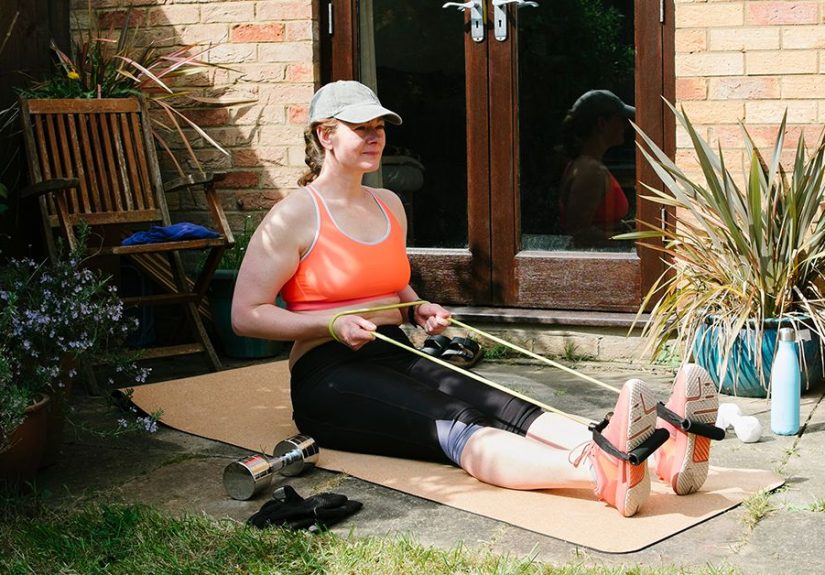
You’ll get the best results with a long loop band or a tube band with handles. You’ll also want a stable anchor (a closed door with a door anchor,
a heavy post, or a rack). If your anchor point moves, squeaks, or looks like it regrets being part of your workoutpick a different anchor.
- Rule #1: Keep ribs stacked over pelvis (no “rib flare”) and brace like someone’s about to tickle you.
- Rule #2: Move slow enough that your corenot momentumdoes the work.
- Rule #3: Stop if you feel sharp pain, numbness, or anything that makes you say “uh-oh” out loud.
The 11 best resistance band ab exercises
Mix and match these resistance band core exercises to build a routine that trains your abs from every angle: anti-rotation, anti-extension,
flexion, and rotation (the controlled kind… not the “I sneezed and my back left the chat” kind).
1) Tall-Kneeling Pallof Press (Anti-Rotation)
This is the MVP of “don’t let the band twist you.” Kneeling removes some leg cheating and forces your glutes and abs to cooperate.
- How: Anchor band at chest height. Kneel sideways to anchor, hold band at sternum, brace, then press straight out and return.
- Do: 2–4 sets of 8–12 reps per side, or 15–25 second holds.
- Make it harder: Pause 2–3 seconds with arms extended, or move farther from the anchor.
2) Standing Pallof Press with Step-Out (Anti-Rotation + Balance)
Same concept, but standing adds balance demandsbecause life is rarely done from a kneeling position (unless you dropped a contact lens).
- How: Press the band out, then step the outside foot away and back without letting hips twist.
- Do: 2–3 sets of 6–10 step-outs per side.
- Common mistake: Letting the shoulders rotate toward the anchorstay square.
3) Half-Kneeling Band Chop (High-to-Low “Woodchop”)
Chops train your obliques and core-to-hip connection. Think “rotate from the rib cage,” not “yank with the arms and hope.”
- How: Anchor band high. Half-kneel facing forward, hold band with both hands, pull diagonally down across your body.
- Do: 2–4 sets of 8–12 reps per side.
- Pro tip: Exhale as you chop to help lock in your brace.
4) Half-Kneeling Band Lift (Low-to-High Diagonal)
This is the “opposite chop.” It’s great for building strength through diagonal patterns used in sports and everyday twisting.
- How: Anchor band low. Pull diagonally up and across, stopping around forehead height.
- Do: 2–3 sets of 8–10 reps per side.
- Make it harder: Add a 1–2 second hold at the top without leaning back.
5) Banded Dead Bug (Anti-Extension + Coordination)
The dead bug is a classic for a reason: it trains deep core control while your limbs move. Adding a band boosts tension and focus.
- How: Anchor band behind you, hold it above chest. Flatten lower back gently toward floor, extend opposite arm/leg, return, switch.
- Do: 2–4 sets of 6–10 reps per side (slow).
- Common mistake: Lower back popping off the floorreduce range of motion.
6) Banded Reverse Crunch (Posterior Pelvic Tilt Focus)
Reverse crunches emphasize curling the pelvisgreat for lower-ab sensation without yanking on your neck.
- How: Loop band around a sturdy anchor behind you and around your feet. Knees bent, pull knees toward chest and curl hips slightly up.
- Do: 2–3 sets of 10–15 reps.
- Pro tip: Think “tailbone up,” not “knees to face.” Small motion, big burn.
7) Banded Leg Lower (Anti-Extension)
If your abs had a job title, this would be “keep the ribs down and the spine stable while the legs move.”
- How: Anchor band above/behind you, loop around feet. Start legs up, brace, slowly lower to a point where your back stays neutral, return.
- Do: 2–4 sets of 6–10 reps (3–4 seconds down).
- Scale: Bend knees more to make it easier.
8) Banded Plank Shoulder Tap (Anti-Rotation)
Shoulder taps already challenge hip stability. Add a band around wrists and your shoulders/abs will file a formal complaint.
- How: High plank, band around wrists. Tap opposite shoulder slowly without rocking hips.
- Do: 2–3 sets of 10–20 total taps.
- Make it harder: Slow it down and pause for 1 second each tap.
9) Banded Mountain Climbers (Dynamic Core)
This one mixes cardio vibes with core control. Keep it clean: hips level, shoulders stacked, knees drive under control.
- How: Band around feet (or ankles). In a high plank, alternate driving knees forward against band tension.
- Do: 2–4 rounds of 20–40 seconds.
- Common mistake: Hips hiking upkeep a strong plank line.
10) Seated Banded Russian Twist (Controlled Rotation)
Rotation is part of real-life core strengthwhen it’s controlled and your spine stays tall. Bands add smooth resistance without needing a heavy plate.
- How: Anchor band to your side at torso height. Sit tall, slight lean back, rotate hands from center away from anchor and back.
- Do: 2–3 sets of 10–16 reps per side.
- Pro tip: Rotate ribs, not just arms. Keep shoulders down.
11) Banded Side Plank Row (Anti-Lateral Flexion + Anti-Rotation)
Side planks train your obliques to resist bending. Add a band row and now your core has to stop twisting while your arm works.
- How: In side plank, anchor band in front of you. Row band toward ribs without letting hips rotate or sag.
- Do: 2–3 sets of 6–10 rows per side, or 15–30 second holds with tiny rows.
- Scale: Drop bottom knee for support.
How to program your resistance band ab workout
You don’t need all 11 moves in one session unless you’re training for a “Core Olympics” event nobody told us about.
Aim for 4–6 exercises per workout, 2–4 times per week, focusing on quality reps and progressive overload.
Option A: 15-minute core circuit (no nonsense, all tension)
- Tall-Kneeling Pallof Press 10 reps/side
- Banded Dead Bug 8 reps/side
- Half-Kneeling Band Chop 10 reps/side
- Banded Plank Shoulder Tap 16 total taps
- Banded Reverse Crunch 12 reps
Do 2–3 rounds. Rest 30–60 seconds between exercises as needed. If form slips, rest more. Your abs don’t get bonus points for ugly reps.
Option B: Strength-focused core finisher (after a full-body workout)
- Banded Side Plank Row 8 reps/side
- Banded Leg Lower 8 reps
- Standing Pallof Press Step-Out 8 step-outs/side
Do 2–3 rounds with 45–75 seconds rest between moves.
Common form fixes that change everything
- “Ribs down”: Keep the front of your rib cage stacked over your pelvis so your abs can actually do their job.
- Exhale with effort: A strong exhale can help you brace and control rotation.
- Slow eccentric: Lowering slowly (3–4 seconds) makes light bands feel heavy in a hurry.
- Own the range: If you can’t keep position, shorten the motioncontrol beats ego.
Conclusion
The best resistance band ab workout builds a core that’s strong, stable, and usefulwhether you’re lifting, running, or just trying to carry all the groceries in one trip.
Use these 11 exercises to train anti-rotation, anti-extension, and controlled rotation, then progress slowly by adding tension, time, and better form.
Your abs will get stronger, your posture will improve, and you’ll stop treating crunches like a personality trait.
Real-world experiences: what it actually feels like to build abs with bands (and why that’s a good thing)
Here’s the funny part about doing a resistance band workout for abs: the first time you do it right, you might not feel like you “destroyed” your midsection
and that’s exactly why it works. A smart banded core session is less “I can’t laugh for three days” and more “Wow, I suddenly know where my ribs are.”
Many people notice the difference in daily life before they notice it in the mirror: sitting taller at a desk, feeling steadier on one leg while putting on shoes,
and having fewer of those tiny back twinges that show up when you pick something up with zero plan.
The second thing you’ll probably experience: bands are brutally honest. With dumbbells, you can sometimes muscle through a rep with momentum or a weird body angle.
With bandsespecially in anti-rotation moves like the Pallof pressthe moment your focus drifts, the band tries to rotate you like a revolving door.
It’s not rude. It’s just physics. You learn quickly that “brace” doesn’t mean “suck in your stomach and pray,” it means creating full, 360-degree tension around your trunk.
You may also discover a new kind of fatigue: not the burning in your abs from endless flexion, but the deep, steady work of holding position.
In planks, dead bugs, and leg lowers, your core is basically running a background program: keeping your pelvis stable while your limbs move.
That’s why people often say banded core work makes them feel “athletic.” It’s training your body to transfer force, not just do ab reps in isolation.
A super common experience is realizing your glutes are part of the party. When your hips are loose and your ribs flare,
your lower back often tries to do the job your abs and glutes should be doing together. Once you start squeezing glutes during kneeling Pallof presses
or keeping hips stacked in side planks, everything tightens upin a good way. If you’ve ever felt your hip flexors takeover during ab work,
bands can help you spot it and fix it by forcing better alignment and slower reps.
And yes, there’s a learning curve. The first week, you may feel wobbly and weirdly challenged by “simple” moves.
That’s not weaknessit’s your nervous system figuring out how to coordinate stability. Stick with it for 2–4 weeks and you’ll likely notice cleaner reps,
longer holds, and better control. Progress doesn’t need to be dramatic: step a little farther from the anchor, add a 2-second pause, slow the lowering phase,
or reduce rest time. Tiny upgrades compound fast.
Finally, the most relatable experience of all: bands are easy to start and hard to fake. They make consistency simpler (they fit in a drawer),
but they also remove excuses (“I don’t have time” is less convincing when your equipment weighs less than a sandwich).
If you do 10–15 minutes of banded core training a few times a weekand keep the reps honestyou’ll build abs that are stronger, steadier,
and much more useful than the kind you only train for beach photos.