Table of Contents >> Show >> Hide
- What Is the 2012 Slow Love Life Ornament?
- The Backstory: Frances Palmer, “Slow Love Life,” and Why 2012 Hit Different
- Design Details: Why It Looks So Simple (and Why That’s the Point)
- How to Decorate With the 2012 Slow Love Life Ornament
- Caring for a Handmade Ceramic Ornament
- Collecting and Finding One Today
- Why This Ornament Still Resonates
- Real-World Experiences With the 2012 Slow Love Life Ornament (and the Kind of Ritual It Creates)
- Conclusion
- SEO Tags
Some holiday ornaments are loud about it: glitter, sparkle, a tiny LED light show that could guide ships through fog.
And then there are the quiet onesthe pieces that barely whisper from the branch, but somehow end up meaning the most.
The 2012 Slow Love Life Ornament sits firmly in that second category: minimalist, handmade, and tied (literally) to a moment in time when a lot of people were trying to turn sorrow into support and “more stuff” into something more human.
If you’ve stumbled across this ornament on an old wish list, a collector forum, or a memory-laden storage box labeled
“HolidayHandle With Care,” you’ve found a tiny object with an unusually big story. Let’s unpack what it is, why it mattered in 2012,
how it fits into slow living holiday decor today, and what people look for if they’re trying to find one now.
What Is the 2012 Slow Love Life Ornament?
The 2012 Slow Love Life Ornament is a handmade holiday ornament associated with
Frances Palmer Pottery and highlighted by the U.S. design site Remodelista during the 2012 season.
It was sold for $25 (with shipping included, as described at the time) and later became
discontinued, which is why it now pops up as a “the one that got away” item for collectors.
What set it apart wasn’t just the clean, sculptural look. It was also the intent: the ornament was presented as a
charity Christmas ornament, with proceeds directed to the United Way Sandy Hook School Support Fund.
In other words, it wasn’t only meant to decorate a treeit was meant to help a community recover.
In the language of today’s gift guides, you’d call it “meaningful,” “artisan-made,” and “minimalist.” In 2012, it was also something else:
an example of how design and craft can respond to real lifewithout turning tragedy into spectacle.
The Backstory: Frances Palmer, “Slow Love Life,” and Why 2012 Hit Different
Frances Palmer: pottery that looks calm because it is made slowly
Frances Palmer is an American ceramic artist known for handmade functional piecesvases, pitchers, platesthat are designed to be used
every day and to show the hand of the maker. Her work often lands in that sweet spot where it feels classic at a glance,
then slightly unexpected the longer you look (the curve that’s a little off-center, the edge that feels like it was finished by a person,
not a factory robot with perfect posture).
That “made by a human” quality matters for an ornament like this. A handmade ceramic Christmas ornament isn’t just a seasonal accessory.
It’s a small object that carries time inside it: time to shape it, fire it, string it, send it out into the world.
If you’re drawn to slow living, handmade holiday decor tends to feel less like shopping and more like choosing.
What “Slow Love Life” means (and why the phrase stuck)
“Slow Love Life” is tied to the broader idea of slowing down: practicing daily mindfulness, noticing beauty, and making room for what matters.
It’s associated with writer Dominique Browning, who wrote about finding meaning in a slower, more intentional paceespecially after life changes
that force a person to rethink what “success” is supposed to look like.
Put that phrase on a holiday ornament and you get a surprisingly powerful seasonal reminder: not “Buy More,” but “Be Here.”
Not “Do All the Things,” but “Do the ones that count.”
The charity layer: a small object answering a big moment
In December 2012, many people wanted to help the Newtown, Connecticut community in practical ways. One of the major efforts was the
Sandy Hook School Support Fund, created in partnership with United Way and local banking leadership, intended to support children, families,
first responders, teachers, and the community both short- and long-term.
Against that backdrop, the ornament wasn’t just aesthetically “clean.” It was ethically clear too: an ornament that didn’t ask you to look at pain,
but invited you to respond to it with support.
Design Details: Why It Looks So Simple (and Why That’s the Point)
The ornament’s look can be summed up in three words: quiet, modern, and handmade.
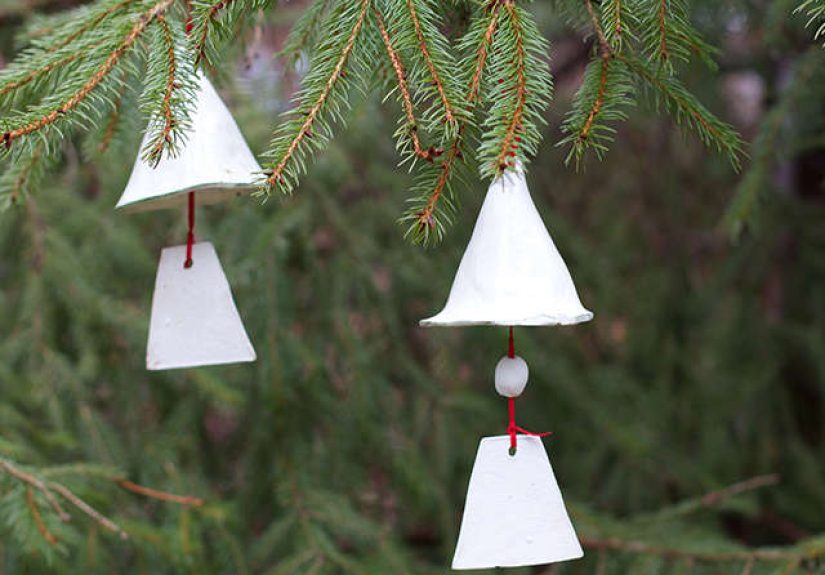
It reads as a minimalist ornamentwhite ceramic forms with a bright red cord that provides the only punch of color.
In photos from the time, the shapes resemble small bell-like cones, paired with a simple bead detail on the hanging string.
That kind of restraint is harder than it looks. Minimal design doesn’t give you a lot to hide behind.
There’s no glitter to distract from a wonky edge. No metallic paint to disguise a rough seam.
The form has to be good. The proportions have to feel right. And the materials have to do their job.
Practically, that also makes it incredibly flexible. It fits a traditional evergreen tree, surebut it also looks at home with
Scandinavian-style holiday decor, a modern farmhouse palette, or a “my home is mostly neutral because my brain is already busy” vibe.
How to Decorate With the 2012 Slow Love Life Ornament
If you’re lucky enough to own one (or you’re planning to hunt one down), the best styling advice is also the simplest:
give it air. Minimalist ornaments look best when they aren’t fighting for attention.
On a Christmas tree: let it be a pause, not a punchline
- Use spacing: place it where it has room around it, ideally against darker greenery so the white ceramic reads clearly.
-
Repeat the accent color: if the ornament has a red cord, echo that red once or twice elsewhere (a ribbon, a berry sprig),
then stop. The red is more powerful when it’s rare. - Pair with matte textures: wood beads, dried orange slices, paper stars, cotton ribbon, or felt ornaments complement the ceramic finish.
Beyond the tree: the ornament as small sculpture
- On garland: hang it from a mantel garland or stair rail where it can swing slightly and catch light.
- As a gift topper: tie it onto a wrapped present as a keepsake tagespecially fitting for a “slow love” message.
- In a window: a single ornament on a ribbon in a window can look intentional and modern, like a tiny winter installation.
- On a doorknob: a low-effort, high-impact styling trick for small spaces or minimalist holiday decorating.
Caring for a Handmade Ceramic Ornament
A handmade ceramic Christmas ornament is basically a tiny piece of functional artexcept its “function” is to survive a month of
enthusiastic decorating and then take a long nap in storage.
Storage rules that prevent heartbreak
- Wrap individually: tissue paper, soft cloth, or bubble wrap (if you’re not trying to impress anyone with eco points).
- Stabilize the box: don’t let ornaments knock into each other while you carry the bin like a holiday superhero.
- Avoid humidity swings: a dry closet beats a damp basement, especially for cords and finishes.
- Protect the cord: don’t knot it tightly for storage; gentle loops reduce fraying and tangles.
Handling on decorating day
Ceramic doesn’t love sudden impacts (shocking, I know). If you have pets, toddlers, or a cat who believes gravity is a personal insult,
place the ornament higher on the tree or in a spot that isn’t at “chaos level.”
Collecting and Finding One Today
Because the ornament was listed as discontinued, finding one now tends to be less “Add to Cart” and more “Casual detective work.”
Think of it like thrifting, but with fewer fun sweaters and more keyword variations.
Where collectors typically look
- Resale marketplaces: listings come and go; saved searches help.
- Design-focused resale shops: sometimes artisan ornaments show up in curated vintage/home categories.
- Estate sales and holiday clear-outs: the best finds often come from people who didn’t realize what they had.
How to sanity-check a listing
- Ask for clear photos: close-ups of the ceramic surface, the cord, and any packaging or labels.
- Compare shape and proportions: minimalist pieces are all about silhouette; mismatched angles can be a red flag.
- Confirm condition: hairline cracks, chips at edges, or repairs should be disclosed.
If you’re buying as a gift, remember that “rare” does not automatically mean “best.” The value here is emotional and aesthetic.
If the ornament’s meaning is the point, you can also honor it by choosing a contemporary handmade ceramic ornament from an artisan you love
especially one that supports a cause you care about.
Why This Ornament Still Resonates
It’s easy to treat ornaments like background noisesomething you hang while multitasking, then forget you even own.
But certain pieces become annual rituals: you take them out carefully, you remember the year you got them, you remember who was there.
The 2012 Slow Love Life Ornament resonates because it carries a few powerful ideas at once:
handmade craft, slow living, minimalist beauty, and charitable giving.
It doesn’t scream any of that. It just shows upquietlyand lets you bring the meaning.
In a world where holiday content can feel like a competitive sport (“My tree has a theme, and the theme is: winning”),
this ornament feels like a gentle refusal. It’s permission to keep things simple. To focus on people.
To remember that the season is bigger than the stuff.
Real-World Experiences With the 2012 Slow Love Life Ornament (and the Kind of Ritual It Creates)
When people talk about a beloved ornament, they’re rarely describing the object alone. They’re describing a recurring moment in their lives:
the box coming down from the closet, the familiar tissue paper, the tiny pause before it goes back on the branch. The
2012 Slow Love Life Ornament inspires that kind of story because it’s both understated and loaded with meaning.
Here are the kinds of experiences people often share when a minimalist, handmade ornament becomes part of their holiday routine.
One common experience is the “accidental tradition.” Someone buys the ornament because it’s beautifulsimple white ceramic with that small,
confident hit of red cordand only later realizes it has become the first thing they hang every year. Not because it’s flashy, but because it
sets the tone. The ornament becomes a starting signal: We’re doing the holidays differently this time. Slower. Kinder. More intentional.
It’s the opposite of the frantic “decorate in 20 minutes” energy. It’s a small ceremony that says: slow down.
Another experience is the “anchor ornament” for households that have been through a hard year. People often say that when life is chaotic,
they crave decorations that feel calm. A handmade ceramic Christmas ornament can do that because it carries a sense of steadiness:
it’s not trendy plastic, it’s not disposable, and it’s not trying to entertain you. It just existsquietlyand that quietness can feel like a relief.
In those homes, the ornament is placed where it can be seen easily: near the front of the tree, or on a mantel garland where it catches a bit of light.
The goal isn’t to impress guests; it’s to create a visual exhale for the people who live there.
People also talk about the ornament as a “giving reminder.” Because it was connected to charitable support in 2012, it can trigger a yearly habit:
when the ornament comes out, the household makes a donation to a local nonprofit, chooses a toy drive, or volunteers for something small but real.
The ornament becomes less “decor” and more “prompt.” Not guiltjust a nudge. It’s the kind of object that gently asks,
What does care look like this season? Sometimes the answer is money; sometimes it’s time; sometimes it’s dropping off groceries for a neighbor.
The key is that the ornament helps the question return each year.
Then there’s the “passed-along meaning,” which shows up when people gift the ornament (or gift something in the same spirit).
A minimalist ornament can be surprisingly emotional as a present because it doesn’t lock the recipient into a loud style.
It’s neutral enough to fit almost anywhere, but meaningful enough to feel personalespecially for a wedding, a first home, or a year when someone
needs encouragement. The best gifting stories are usually simple: a note in the box that says,
“For slow mornings and kinder days,” or “For a life built one calm moment at a time.”
Finally, many people describe the ornament as a tiny design lesson. It’s proof that holiday decorating doesn’t have to be maximal to feel warm.
A couple of clean shapes, a natural tree branch, and one bold cord color can feel more modern and more “you” than a cart full of trends.
For anyone burned out by endless holiday consumption, that lesson is basically a stocking stuffer for the soul.
Conclusion
The 2012 Slow Love Life Ornament is small, simple, andbecause it’s discontinuedslightly mysterious. But its story is clear:
a handmade ceramic ornament tied to a philosophy of slowing down and a moment when many people wanted to help a community through meaningful action.
If you own one, it’s worth treating like the tiny heirloom it has become. If you’re searching for one, it helps to know what you’re really chasing:
not just a rare object, but a feelingquiet beauty, intention, and carehung on a branch.