Table of Contents >> Show >> Hide
- How This Guide Was Built
- Why These 5 Basic Crotchet Stitches Matter
- Before You Start: Set Yourself Up to Win
- The 5 Basic Crotchet Stitches (Step-by-Step)
- Quick Stitch Height Cheat Sheet
- US vs UK Crochet Terms (Critical for Beginners)
- 7-Day Beginner Practice Plan
- Beginner Troubleshooting Guide
- Best Beginner Projects for Each Stitch
- Conclusion
- Beginner Experience Journal (500+ Words)
If you can make five crochet stitches, you can make about a million things: dishcloths, scarves, granny squares, hats, tote bags, cozy blanket borders, and at least one oddly shaped rectangle you will defend as “abstract textile art.”
This guide teaches the five beginner stitches that matter most: chain, slip stitch, single crochet, half double crochet, and double crochet. You’ll learn how each stitch works, when to use it, what mistakes beginners make, and how to fix them fast. The tone is friendly, the steps are practical, and yes, your yarn will tangle at least once. That is not failure. That is initiation.
How This Guide Was Built
This article synthesizes real beginner guidance from reputable U.S.-focused craft publishers, yarn organizations, and instructional platforms. No copy-paste tutorials, no fluff loops, no mystery jargon.
- Craft Yarn Council
- Crochet Guild of America (CGOA)
- Better Homes & Gardens
- Good Housekeeping
- The Spruce Crafts
- Martha Stewart
- Lion Brand
- Yarnspirations
- Annie’s
- Clover USA
- Interweave
- Crochet.com
Why These 5 Basic Crotchet Stitches Matter
Every beginner pattern is built from these core stitches. Once you know them, patterns stop looking like math from another galaxy and start making sense. You’ll also understand common crochet abbreviations: ch, sl st, sc, hdc, dc.
What each stitch does in real life
- Chain (ch): Starts projects, creates spaces, adds structure.
- Slip Stitch (sl st): Joins rounds, moves yarn without adding height, creates neat edges.
- Single Crochet (sc): Dense fabric, great for amigurumi, dishcloths, and tidy texture.
- Half Double Crochet (hdc): Slightly taller, faster fabric growth, balanced drape and warmth.
- Double Crochet (dc): Taller stitch, airy fabric, ideal for scarves, blankets, and quick wins.
Before You Start: Set Yourself Up to Win
Beginner-friendly materials
Start with medium/worsted-weight yarn and a comfortable hook around 5.0 mm (US H-8) for easy control. Pick a light-colored, smooth yarn so you can actually see stitches. Dark fuzzy yarn may look cute, but for beginners it behaves like a stealth mission.
Must-have tools
- Crochet hook (ergonomic if possible)
- Medium/worsted yarn
- Scissors
- Yarn needle
- Stitch markers (or a paperclip in a pinch)
Tension basics
Too tight = hard to insert hook. Too loose = floppy, uneven fabric. Keep your hands relaxed and let the hook glide. Your stitches should feel secure, not strangled.
The 5 Basic Crotchet Stitches (Step-by-Step)
1) Chain Stitch (ch)
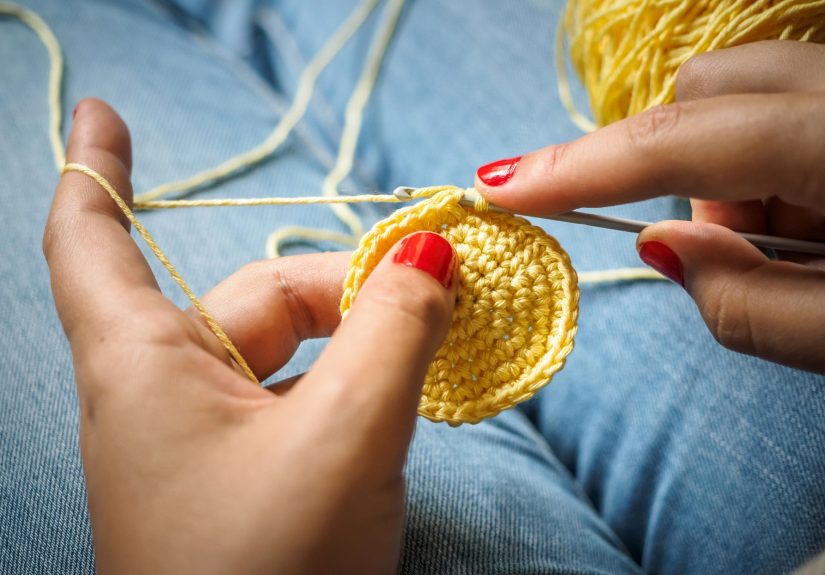
The chain is your foundation. Most projects begin with a slip knot and a chain.
- Make a slip knot and place it on your hook.
- Yarn over (wrap yarn over the hook from back to front).
- Pull through the loop on the hook.
- Repeat for the number of chains needed.
Beginner tip: Keep chain stitches even in size. If they’re too tight, go up one hook size temporarily for the foundation chain.
Common mistake: Counting the slip knot as a chain stitch. Usually, you do not count it as one.
2) Slip Stitch (sl st)
Slip stitch is short and subtle. It joins rounds, finishes edges, and helps move your working position.
- Insert hook into the target stitch.
- Yarn over.
- Pull through the stitch and immediately through the loop on your hook.
When to use it: Joining a chain into a ring, closing rounds, seaming simple pieces, edging.
Common mistake: Pulling too tightly and shrinking the edge. Relax your grip and keep loops easy to slide.
3) Single Crochet (sc)
Single crochet is one of the most useful stitches in crochet. It creates tight, sturdy fabric.
- Insert hook into the stitch (or into the second chain from hook for a first row).
- Yarn over and pull up a loop (2 loops on hook).
- Yarn over and pull through both loops.
Best for: Dishcloths, toys, bags, clean texture, detailed shapes.
Common mistake: Accidentally adding stitches at row ends. Count your stitches every row until your hands memorize the rhythm.
4) Half Double Crochet (hdc)
Half double is the “just right” stitch: not too short, not too tall.
- Yarn over.
- Insert hook into stitch.
- Yarn over and pull up a loop (3 loops on hook).
- Yarn over and pull through all 3 loops.
Best for: Beanies, scarves, baby blankets, textured but flexible fabric.
Common mistake: Forgetting the initial yarn over. If your stitch suddenly looks like single crochet, that’s usually why.
5) Double Crochet (dc)
Double crochet grows fabric quickly and creates a softer drape.
- Yarn over.
- Insert hook into stitch.
- Yarn over and pull up a loop (3 loops on hook).
- Yarn over, pull through 2 loops (2 loops remain).
- Yarn over, pull through last 2 loops.
Best for: Fast scarves, blankets, breathable projects, granny-style patterns.
Common mistake: Forgetting one of the two “pull through 2” steps, which distorts stitch height.
Quick Stitch Height Cheat Sheet
| Stitch | Abbreviation | Height | Typical Turning Chain | Fabric Feel |
|---|---|---|---|---|
| Chain | ch | Foundation | N/A | Base structure |
| Slip Stitch | sl st | Shortest | Usually none | Tight, flat join |
| Single Crochet | sc | Short | ch 1 | Dense and sturdy |
| Half Double Crochet | hdc | Medium | ch 2 | Balanced drape |
| Double Crochet | dc | Tall | ch 3 | Airy and fast |
US vs UK Crochet Terms (Critical for Beginners)
If a pattern feels wrong even when you follow every step, check terminology. US and UK names differ.
| US Term | UK Equivalent |
|---|---|
| single crochet (sc) | double crochet (dc) |
| half double crochet (hdc) | half treble (htr) |
| double crochet (dc) | treble (tr) |
7-Day Beginner Practice Plan
Day 1: Chains and tension
Make three chain strands (30 chains each). Focus only on consistency.
Day 2: Slip stitch control
Create a short chain, then slip stitch back into each chain. Learn gentle tension.
Day 3: Single crochet rows
Work 10 rows of single crochet. Count stitches every row.
Day 4: Half double crochet
Make a small swatch and compare it to your single crochet swatch. Notice height and drape.
Day 5: Double crochet speed practice
Make a rectangle in double crochet. Practice clean row turns and edge alignment.
Day 6: Mixed-stitch sampler
One row each: sc, hdc, dc, then repeat. This builds stitch recognition fast.
Day 7: Mini project
Use one stitch for a dishcloth or scarf section. Finishing one piece builds confidence more than endless swatches.
Beginner Troubleshooting Guide
Problem: Edges look diagonal
Fix: You’re likely adding or dropping stitches at row ends. Use a stitch marker in first and last stitch of every row.
Problem: Hook won’t go into stitches
Fix: Tension is too tight. Relax grip or move up one hook size for practice.
Problem: Stitch count changes every row
Fix: Learn where the true first stitch is after turning chains. Count out loud if needed. Yes, it helps.
Problem: Fabric curls too much
Fix: Tight chains and tight tension are common causes. Make a looser foundation chain and block the swatch lightly.
Best Beginner Projects for Each Stitch
- Chain + slip stitch: Practice rings and simple headband joins.
- Single crochet: Coasters, dishcloths, amigurumi practice squares.
- Half double crochet: Beanies, simple ear warmers, soft washcloths.
- Double crochet: Scarves, throw blankets, beginner granny blocks.
- Mixed stitches: Texture sampler panels and striped accessories.
Conclusion
If you master these five basic crotchet stitches, you’re not “just starting.” You’re already crocheting. The difference between beginner frustration and beginner progress is repetition with clear technique: learn stitch anatomy, keep tension relaxed, count stitches, and practice in small, finishable pieces.
Start with chain and slip stitch, lock in single crochet, then level up through half double and double crochet. In a surprisingly short time, patterns stop being confusing code and start reading like instructions your hands understand.
Beginner Experience Journal (500+ Words)
The first time I taught these five stitches to a true beginner group, everyone made the same face in the first ten minutes: equal parts excitement, confusion, and “why is my yarn trying to escape?” One student gripped the hook like a pencil, another like a drumstick, and one held it like they were about to sign a mortgage. By the end of the session, all three were making chainsuneven chains, sure, but real chainsand that moment matters more than perfection.
Day one is almost always about patience. Beginners expect crochet to feel natural immediately, but the hand coordination is brand-new. You’re controlling yarn tension with one hand, guiding a hook with the other, and learning stitch anatomy in real time. That’s a lot. In class, I usually say, “If your chain looks like a row of tiny snakes that got into a traffic jam, congratulationsyou’re learning.” People laugh, shoulders relax, and suddenly stitches get better. Humor helps because tension in your body becomes tension in your yarn.
The first breakthrough usually happens with single crochet. Chains can feel abstract, but single crochet creates visible fabric, and that feels like magic. A beginner makes ten rows of single crochet and suddenly holds a little square: not just yarn anymore, but a thing they made. That shiftfrom “I’m trying” to “I made this”is where confidence lives. I’ve watched beginners who nearly quit on day two come back on day three and crochet for an hour straight because they finally understood where to insert the hook.
Half double crochet is where speed and confidence start to pair up. It’s just different enough from single crochet to feel like progress, but not so complicated that it overwhelms. A lot of beginners call it their favorite because it builds fabric faster without feeling too loose. One learner told me, “Single crochet feels like careful handwriting; half double feels like I finally learned cursive.” Weirdly accurate.
Then comes double crochet, the “wow” stitch for most new crocheters. You can watch a scarf grow while you sit there. That immediate visual progress is motivating, especially for people who thought they were “bad at crafts.” The most common mistake is missing one of the two pull-through steps, but once they get the rhythm, double crochet becomes almost meditative. Hook in, yarn over, pull up, pull through two, pull through two. Repeat. Breathe. Repeat.
One of the best practical habits beginners develop is counting stitches every row. Nobody loves doing it at first, but everyone loves the results. Straight edges. Predictable shape. Less frogging. (For non-crocheters: frogging is ripping stitches out. It’s called frogging because you “rip-it, rip-it.” Craft people are very serious and very silly at the same time.) When beginners accept that counting is part of the craftnot a punishmenttheir projects improve quickly.
Another big turning point is learning that mistakes are information, not failure. A tight stitch means relax grip. A widening piece means extra stitches were added. A shrinking piece means stitches were skipped. Every “oops” tells you what to fix next. Once learners see mistakes as feedback loops, they stop panicking and start troubleshooting like makers.
By the time someone has practiced all five stitches for a week, the difference is dramatic. Their yarn handling is calmer. Their turning chains are cleaner. They can identify sc versus hdc versus dc by sight. Most importantly, they stop asking, “Am I doing this right?” and start asking, “What should I make next?” That’s the milestone. Not flawless tension. Not museum-grade edges. Just momentum, curiosity, and enough skill to turn yarn into useful, beautiful things.
So if you’re at the beginning: keep going. Learn these five stitches well, and you’ll unlock almost everything else in crochet. Start small, practice often, laugh at the tangles, and trust the process. Every experienced crocheter you admire once made a lumpy rectangle and felt weirdly proud of it. You will too.