Table of Contents >> Show >> Hide
- Why This Project Matters (Even If You Don’t Own a Paper Tape Reader)
- Meet the Cast: UNIX V1, PDP-11, and the DEC J-11 / DCJ11
- The Core Idea: Don’t Emulate the CPUEmulate Everything Around It
- How the FPGA “Brings UNIX V1” to Life
- Why Use a Real J-11-Class CPU Instead of a Full FPGA CPU Core?
- What You Can Actually Do Once UNIX V1 Boots
- Common Gotchas (AKA: The Retrocomputing Tax)
- Big Picture: What This Says About Modern Hardware Hacking
- Conclusion
- Hands-On Experiences: What It Feels Like to Bring Up UNIX V1 on a J-11 + FPGA (Approx. )
Imagine taking a legendary 1970s operating system, a classic DEC PDP-11-family CPU, and a modern FPGA board that costs less than a fancy lunchthen
wiring them together until UNIX First Edition boots like it never left the lab. That’s the magic trick behind a standout retrocomputing build:
pairing a real DEC J-11–class processor (the DCJ11 “Jaws-11” implementation of the PDP-11 instruction set) with an FPGA that plays “supporting cast”
for the rest of the computer. The result? Early UNIX vibes, real silicon timing, and enough blinking LEDs to make your inner engineer whisper,
“This is definitely practical and not at all an excuse to learn octal at midnight.”
This article breaks down how an FPGA can “bring UNIX V1 to the DEC J-11,” why that’s interesting beyond nostalgia, and what you can learn (or accidentally
re-learn) by rebuilding a 1970s-era system with 2020s toolswithout turning the whole thing into a software emulator.
Why This Project Matters (Even If You Don’t Own a Paper Tape Reader)
UNIX didn’t become iconic because it had great onboarding. It became iconic because its ideas scaled: hierarchical file systems, small composable tools,
and a clean model for processes and I/O. UNIX V1 is one of the earliest crystallizations of that thinking, and it lives close to the metalclose enough
that the hardware story is part of the software story.
Recreating that environment on real PDP-11-compatible hardware (or something very close to it) isn’t just cosplay for computers. It’s a practical way to:
- Understand why UNIX evolved the way it did (constraints shape design).
- See how early machines handled I/O (memory-mapped devices, interrupts, and timing quirks).
- Experience “system bring-up” the way engineers did before “just run it in Docker” was a sentence anyone could say.
Meet the Cast: UNIX V1, PDP-11, and the DEC J-11 / DCJ11
UNIX V1: The “First Edition” Era
UNIX First Edition (often called UNIX V1) dates to the early days when UNIX was written for the PDP-11 and documented in the first UNIX Programmer’s Manual
(dated November 3, 1971). It’s small by modern standards, but it already contains the DNA of what later became the UNIX family tree.
The PDP-11 Family: A 16-bit Legend With Surprisingly Modern Ideas
The PDP-11 line introduced a clean, programmer-friendly architecture with flexible addressing modes and a pragmatic approach to I/O. Instead of fancy
dedicated I/O instructions, many PDP-11 systems used memory-mapped I/O, making devices feel like special memory addresses. That design
plays beautifully with the “FPGA as peripherals” concept: if a device is “just registers,” an FPGA can impersonate those registers convincingly.
The DEC J-11 / DCJ11: PDP-11 Power in Microprocessor Form
DEC’s J-11 family was a high-performance PDP-11 implementation condensed into a small chip set, aiming to deliver features comparable to higher-end PDP-11
systems in fewer components. The DCJ11 is a microprocessor implementation associated with the “Jaws-11” generationstill speaking PDP-11 fluently, but
expecting a surrounding ecosystem (memory, console interface, clocks, device controllers) to feel like home.
The Core Idea: Don’t Emulate the CPUEmulate Everything Around It
Most “run old UNIX” projects go one of two routes:
(1) pure software emulation (fast, convenient, less visceral), or
(2) restoring original hardware (authentic, expensive, and occasionally powered by luck and contact cleaner).
This build takes a third route: keep the real CPU, but let an FPGA handle the things that are hardest to find, hardest to repair, or
hardest to wire up safely in 2026like memory subsystems, UARTs, disk controllers, and timing glue logic.
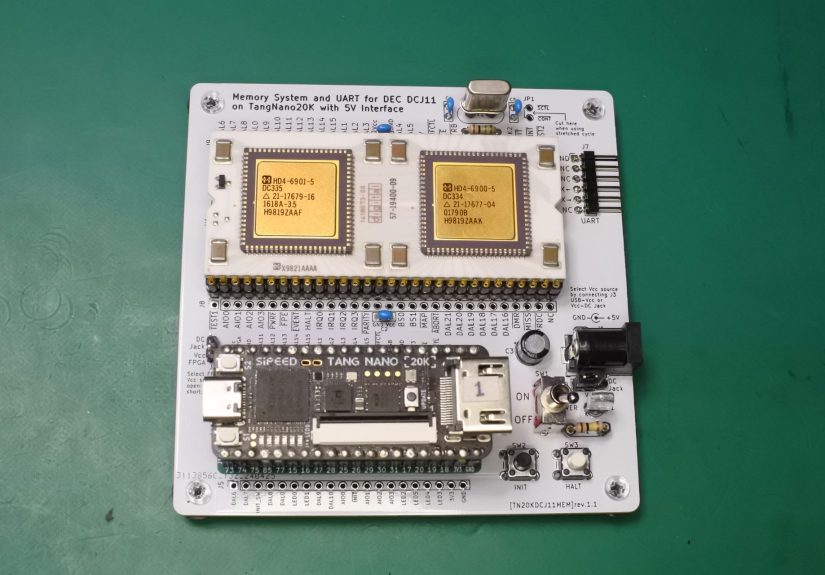
In the referenced implementation, a low-cost Tang Nano 20K FPGA board is used to implement the memory system and serial I/O, while the
actual DEC CPU runs unmodified. In other words, the FPGA isn’t pretending to be the PDP-11 processorit’s pretending to be the rest of the computer.
That’s a subtle distinction with big consequences: you get real instruction timing, real bus behavior, and real “why is this line floating?” debugging.
How the FPGA “Brings UNIX V1” to Life
1) Memory: The FPGA as a 1970s-Friendly RAM System
UNIX V1 doesn’t need gigabytes. It needs working memory that behaves like the machine expects. In this project, the FPGA implements a memory system
described as 32K × 16-bita historically plausible scale that keeps the build approachable while still enabling a real OS to load and run.
The key isn’t just size; it’s behavior. Early systems have expectations about bus cycles, address decoding, and how memory and devices share the address space.
A modern FPGA can meet those expectations preciselyoften more precisely than a pile of vintage TTL chips you found in a drawer labeled “maybe good?”
2) UART / Console: Because Every OS Needs to Talk (Even If It Only Speaks Teletype)
UNIX needs a console. Humans need a console. Debugging without a console is like cooking without tasting: you can do it, but you’ll deserve what happens next.
In this build, the FPGA implements a UART setup that supports console communication (with common serial settings like 115200 8N1 used in practice).
This matters because early UNIX versions assume a certain style of terminal I/O. Once you have a stable serial console, you can:
- Enter monitor/debug commands (hello, ODT).
- Boot and interact with the system like an actual timesharing machine, not a museum diorama.
- Do the most retro activity of all: stare at a cursor and pretend you’re making progress.
3) Bootstrapping: Paper Tape, Disk Images, and the Art of Getting to “Login:”
One charming step in the project’s development was validating the hardware with a PC-11 paper tape reader/punch emulator, used to load
and run a period-appropriate BASIC. It’s a smart strategy: prove the CPU + memory + console path works with a simpler target before you attempt an OS that
will happily stress every edge case you didn’t know you had.
Once the basics are stable, UNIX V1 becomes the next summit. To support that, the FPGA grows from “memory and UART” into “memory and UART and the devices
UNIX expects.” Specifically, the build adds emulation for classic PDP-11-era components needed for UNIX V1 operationsuch as disk subsystems and timing.
Disk images can live on modern storage (like an SD card) while presenting themselves to the CPU as vintage controllers and drives.
4) Disk and Device Emulation: RF11, RK11, KE11-A, KW11-LThe Supporting Characters
Operating systems are picky. UNIX V1 doesn’t just want “a disk.” It expects particular device behaviors. The referenced implementation includes FPGA-based
emulation of devices used by UNIX V1-era PDP-11 systems, including:
- Disk drive/controller emulation (e.g., RF11 and RK11-style devices)
- External arithmetic hardware (e.g., KE11-A)
- Clock/timer behavior (e.g., KW11-L)
Think of it like staging a period film: the CPU is the lead actor, but UNIX won’t believe the world unless the props are right. The FPGA becomes the
prop master, building enough believable hardware around the CPU that UNIX V1 stops protesting and starts multitasking.
Why Use a Real J-11-Class CPU Instead of a Full FPGA CPU Core?
A fair questionbecause yes, you can implement a PDP-11 core in FPGA. People do. But keeping a real DEC CPU in the loop changes what you learn:
Authenticity You Can Measure
With a real CPU, the instruction set isn’t “compatible,” it’s literal. Timing isn’t “close enough,” it’s driven by the chip’s actual microarchitecture.
When something breaks, you’re debugging a genuine hardware/software boundarynot just a bug in your emulator.
Hardware Skills, Not Just Software Skills
Bringing up a system like this forces you to face signal integrity, level shifting, clocks, reset sequencing, and bus protocol details. In the referenced
design lineage, PCB revisions even incorporate practical improvements like synchronization changes and dedicated level shifting so the FPGA board can be
connected cleanly and safely.
It’s a Time Machine With an Oscilloscope
Running UNIX V1 on a real DEC CPU feels different than watching it run in a window. It’s not “better” in every waybut it’s more tactile, more educational,
and occasionally more humbling (especially when you realize you’ve typed an address in octal wrong… again).
What You Can Actually Do Once UNIX V1 Boots
UNIX V1 isn’t modern Linux with a vintage skin. It’s small, sharp, and historically important. Once you’re in, you can explore:
- The early UNIX file system model and its command-line tooling.
- Process creation and simple multitasking in a minimal environment.
- The “toolbox” philosophy before it became a slogan on stickers.
For engineers, it’s also a living lab for ideas that still matter today:
interfaces, abstractions, debugging discipline, and the reality that constraints are not your enemythey’re your design brief.
Common Gotchas (AKA: The Retrocomputing Tax)
Octal Will Sneak Up on You
If you grew up thinking hex was “old-school,” the PDP-11 world has a surprise for you. Octal shows up everywhere. It’s not harduntil it’s 1:17 a.m.
and you’re convinced the machine is haunted when it’s actually just address 0177560, not 0177566.
Timing and Clocks Are Not “Details”
Early systems often assume certain timing characteristics. When you emulate devices, you’re not just matching register mapsyou’re matching behavior over time.
That’s where an FPGA shines: you can model timing, interrupts, and bus responses in a way software emulation sometimes glosses over.
“It Boots BASIC” Doesn’t Automatically Mean “It Boots UNIX”
BASIC running via a paper tape workflow proves your foundation is solid, but UNIX will stress your device layer: disk I/O, interrupts, clock ticks, and
edge cases. Expect a second wave of debugging when you jump from “demo program works” to “operating system lives here now.”
Big Picture: What This Says About Modern Hardware Hacking
There’s a delightful irony here: we use an FPGAone of the most flexible modern hardware toolsto recreate a system famous for its portability and clean
abstractions. In both cases, the underlying theme is the same: make the interface stable, and innovation becomes easier on top.
Projects like this aren’t just nostalgia; they’re reminders that:
- Great systems are built from clear contracts between parts (CPU, memory, devices, OS).
- Abstractions matter more than raw horsepower.
- Debugging is a skill, not a phase.
Conclusion
“FPGA Brings UNIX V1 to the DEC J-11” is a headline that sounds like a niche party trickuntil you realize it’s also a masterclass in system design.
By keeping the real CPU and using the FPGA to recreate the surrounding ecosystem, you get a build that is part restoration, part engineering experiment,
and part historical reenactment (but with fewer itchy costumes and more serial consoles).
If you’re into retrocomputing, FPGA design, operating systems, or just the joy of making old ideas run on new hardware, this kind of hybrid approach hits
a sweet spot: authentic enough to teach you something real, modern enough to be achievable, and quirky enough that you’ll definitely tell your friends
about itwhether they asked or not.
Hands-On Experiences: What It Feels Like to Bring Up UNIX V1 on a J-11 + FPGA (Approx. )
If you’ve never done a hardware bring-up like this, the first emotional beat is surprise: the “computer” doesn’t look like a computer. It looks like a CPU
and a small FPGA board having an awkward first date on a PCB. Then you power it up and realize the real UI is your terminal windowand your patience.
The early wins come fast and feel ridiculous in the best way. The moment you see a prompt over serial, you’ll celebrate like you just landed a rover on Mars,
even though all you really did was convince two voltage domains to stop arguing. Next, you’ll do the ritual: check clocks, resets, and whether the CPU is
executing anything that resembles your expectations. This is where the FPGA-as-peripherals approach shines. You can iterate quickly: tweak a UART,
adjust a timing parameter, rebuild the bitstream, and immediately see whether the CPU’s behavior changes.
The middle phase is where the project becomes a relationship. You learn the system’s moods. A clean reset sequence matters. A stable clock matters.
A single incorrectly handled bus response can transform “mostly working” into “why is it printing hieroglyphics?” You’ll develop a reflexive habit of
sanity checks: Is the console configured correctly? Are you interpreting addresses in octal? Is the device register map aligned with what UNIX V1 expects?
This is also where you discover that “emulating a disk” is not just storing bytes. It’s handling status bits, busy flags, interrupt conditions, and the kind
of timing assumptions that early kernels quietly depend on.
Once you attempt UNIX V1, the debugging changes flavor. With a BASIC loader, failures tend to be obviousno output, wrong output, crash. With an OS, the
system can fail in subtle ways: a command runs once and then hangs, the file system behaves oddly, or the clock tick drifts into nonsense. The best habit
here is incrementalism. Validate a small slice of device behavior, then move forward. If you have an FPGA logic analyzer view, you’ll use it. If you don’t,
you’ll invent one with LEDs, because retrocomputing teaches creativity through mild suffering.
And then comes the payoff: that first truly stable moment when the kernel finishes booting and you can actually use the system. It’s hard to
explain how satisfying it is to run a tiny command-line tool on an operating system designed when disk space was precious and memory was measured in
“do we have enough to fit the program?” You stop thinking of UNIX history as a timeline and start experiencing it as a living environment. You also gain
new respect for the original engineersbecause once you’ve chased a single off-by-one timing bug across a bus interface, you understand why “simple,
well-defined interfaces” isn’t a platitude. It’s survival.