Table of Contents >> Show >> Hide
- The Stable That Started the Daydream
- Why the Modern Bath Works So Brilliantly
- Why Italy Is Especially Good at This Kind of Reinvention
- Design Lessons Worth Stealing From a Converted Italian Stable
- The Bath as a Statement of Confidence
- What It Feels Like to Stay in a Place Like This
- 500 More Words on the Experience: Why This Kind of Place Stays With You
- Conclusion
Note: This article is an original, publication-ready synthesis based on real design reporting. Unnecessary citation artifacts and placeholder markup have been removed.
Some homes whisper. This one walks up, brushes hay off its shoulder, and says, “Yes, I used to be a stable. No, I’m not apologizing for it.” That is the magic of a converted stable in Italy, especially one bold enough to include a strikingly modern bath right in the middle of all that old-world texture. It is rustic, but not costume-rustic. It is refined, but not fussy. And it proves a point that great design people have known for ages: a building gets more interesting when you let its past and present argue a little.
The idea sounds almost mischievous. Take a former stable, keep the weathered shell, preserve the columns, honor the original walls, and then drop in a sleek, contemporary bath like a design mic drop. In lesser hands, that mix could feel gimmicky. In the right hands, it becomes unforgettable. The result is not merely a renovation. It is a conversation between centuries, with stone and concrete, timber and tile, memory and function all sharing one roof.
Across Italy, restored farmhouses, stables, and agrarian outbuildings have become some of the country’s most compelling homes and hospitality spaces. What makes this particular idea so irresistible is the contrast: the raw soul of a former work building paired with a modern bath that feels sculptural, practical, and just a little bit rebellious. It is the kind of place that makes you want to put your phone face down, pour a glass of wine, and stare at the walls as if they might tell you where the horses used to stand.
The Stable That Started the Daydream
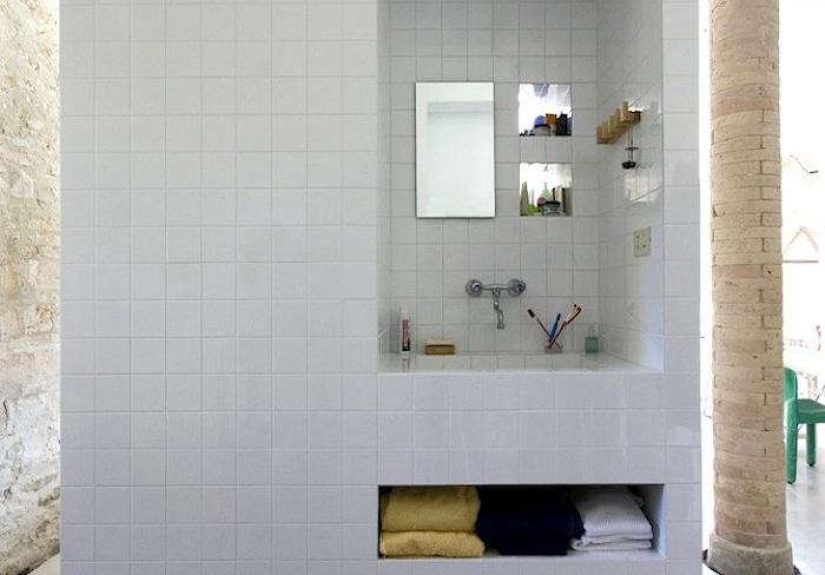
One of the most memorable examples of this approach comes from a restored stable in Val Parma, in Lasagnana, Italy, converted for a young couple by Karin Matz Arkitekt with Francesco Di Gregorio. The ground floor of the old stable was largely left intact. Existing windows, walls, and columns stayed. Instead of sanding the place into submission or pretending it was always meant to look like a glossy luxury condo, the designers inserted a freestanding modern bath structure into the historic shell. It is a wonderfully confident move, and confidence is half the game in adaptive reuse.
That bath element is the star for good reason. It reads like a cube placed inside the room, wrapped in white tile, with one side handling the shower and another incorporating the sink and storage. Around it, the stable remains visibly itself. The floor is new concrete, but it is carefully detailed, separated from the old walls and columns by a narrow gap edged in steel. That small move matters. It tells your eye exactly what is old and what is new. No fake nostalgia. No confusion. No trying to make 21st-century interventions dress up like 18th-century originals. It is honest architecture, and honest architecture tends to age well.
Inside the same space, simplicity rules. A pine bed keeps the sleeping area grounded. White curtains soften and divide the workspace from the bedroom. Utility becomes elegance almost by accident. The whole composition feels airy, quiet, and slightly monastic, though in a good way, not in a “please surrender your espresso” way. It is a lesson in restraint: when the bones are this good, you do not need a circus of decoration.
Why the Modern Bath Works So Brilliantly
1. It respects the original shell
The smartest converted stables do not erase their agricultural history. They keep the volume, the awkwardness, the old masonry, the irregular rhythm of the structure. That is exactly why the inserted bath works. It does not compete with the shell by trying to look equally ancient. Instead, it behaves like a clean, self-contained object placed inside a room with a long memory.
2. It turns function into sculpture
Bathrooms are usually hidden away, but in a compact adaptive-reuse project, a bath can become a design anchor. By treating the shower and sink as part of one freestanding volume, the bath becomes architecture rather than leftover plumbing. That is the difference between a bathroom that merely exists and one that gives the entire home its identity.
3. The material contrast is delicious
Old stone and worn surfaces bring weight, texture, and history. Concrete, steel, and glossy white tile bring crispness and control. Put them together and you get tension. Good design thrives on tension. Too much rusticity can feel stagey. Too much modernism can feel cold. But when rough walls meet a clean-lined bath cube, each makes the other look better.
4. Small spaces love strong ideas
Compact homes suffer when every decision is timid. A small converted stable needs one or two strong gestures, not twenty-seven mediocre ones. The bath cube solves the layout, defines zones, and creates visual drama all at once. That is efficient design, and efficient design is deeply attractive.
Why Italy Is Especially Good at This Kind of Reinvention
Italy has an unfair advantage when it comes to architectural romance. The country is full of farmhouses, stables, masserie, village buildings, towers, and country estates that carry layers of use on their surfaces. But the best Italian restorations are not successful just because the original buildings are beautiful. They work because there is a cultural comfort with patina, imperfection, craft, and slowness. In other words, Italians do not panic when a wall looks old. They call that character and move on with their day.
Recent design and travel coverage of Italy shows the same pattern again and again. Former farm buildings in Sardinia have been transformed into calm family retreats. Converted stable wings in restored farmsteads have become living areas that celebrate exposed stone rather than covering it up. Tuscan hospitality projects increasingly evolve from agriturismos and farm estates into elevated stays that still preserve a strong sense of place. The common thread is not luxury for luxury’s sake. It is continuity. The old building gets a second life without being stripped of its first one.
That matters because travelers and homeowners alike are tired of spaces with no biography. A converted stable in Italy offers biography in every direction. Maybe the walls are uneven. Maybe the window openings are smaller than modern builders would choose. Maybe a column stands in a place that would annoy a developer with a spreadsheet. Good. Those quirks are the point. They are the opposite of generic.
Design Lessons Worth Stealing From a Converted Italian Stable
Keep the structure legible
If the old walls, columns, beams, or openings survive, let them read clearly. The most compelling renovations do not blur the line between original structure and new intervention. They make that line visible and intentional.
Let one modern element lead
In this case, it is the bath. In another project, it could be a kitchen island, a stair, a fireplace, or a window wall. The trick is not to modernize everything at the same volume. Pick a focal element and let the rest support it.
Use natural materials with discipline
Wood beams, stone walls, plaster, tile, concrete, and metal all belong here. But the room works only when those materials are edited well. Better Homes & Gardens, The Spruce, HGTV, and other design sources keep returning to the same principle: warm wood, stone, and restrained fixtures create depth without clutter. That is exactly the recipe a converted stable needs.
Do not over-style the rustic mood
A stable conversion does not need fake antiques, ten baskets of lavender, and a ladder that holds exactly one decorative blanket. The architecture has already done the heavy lifting. Add a few tactile pieces, choose lighting with intention, and stop before the room starts auditioning for a themed restaurant.
Storage should be quiet but smart
Modern life still requires chargers, towels, shampoo, and all the miscellaneous objects we somehow accumulate by simply continuing to exist. Clever storage is what keeps the romance from collapsing under the weight of reality. Integrated shelving, concealed compartments, and compact bath storage allow the old shell to stay visually calm.
The Bath as a Statement of Confidence
There is something wonderfully cheeky about putting a refined modern bath inside a former stable. It says the owners are not interested in museum restoration alone. They want to live here. They want hot water, comfort, and a shower that does not feel like penance. And honestly, good for them.
The bath is also symbolic. In a building once devoted to utility, labor, and livestock, the most indulgent room in the house becomes the centerpiece. That reversal is part of the emotional appeal. A place that once served animals and agricultural work now serves rest, privacy, and pleasure. The transformation is not just visual. It is philosophical. The building has moved from survival to enjoyment.
That is why the best versions of this design feel so moving. They are not merely pretty. They are redemptive. They show what can happen when a forgotten structure is not flattened, mocked, or over-restored, but reinterpreted with care. The bath cube in the Italian stable is not just a cool design trick. It is the clearest expression of the building’s new life.
What It Feels Like to Stay in a Place Like This
Imagine arriving in the late afternoon, when the light in the Italian countryside goes full show-off. From outside, the building still looks humble, maybe even a little shy. Stone, old openings, a compact footprint, no desperate attempt to impress you from the road. Then you step inside and the air changes. The old shell holds a kind of quiet that modern construction rarely manages. It is cool, thick, and settled. You can almost feel time sitting in the corners.
Then your eye lands on the bath. Clean-lined, bright, deliberate, almost like an art installation that also happens to be excellent news for your shoulders after a long day. The contrast is thrilling. You notice the roughness of the walls more because the bath is so crisp. You notice the bath more because the room around it is so storied. That push and pull creates atmosphere, and atmosphere is what people are usually chasing when they say they want a home with character.
Morning would be just as persuasive. A beam of sun catches the tile. The old walls glow softly instead of sparkling obnoxiously like some overfiltered rental listing. You make coffee. You pad across concrete floors. You open a window and hear birds, distant conversation, maybe a scooter somewhere proving that Italy can never stay entirely silent. It is not hard to understand why restored stables, farm buildings, and countryside retreats have become such desirable places to stay. They offer something slick new properties often cannot: emotional temperature.
500 More Words on the Experience: Why This Kind of Place Stays With You
What lingers about a converted stable in Italy is not just the design, though the design certainly helps. It is the feeling that the building has kept enough of its former self to remain grounded. Many beautiful homes are impressive for an hour. A place like this tends to get better the longer you sit with it. First you notice the obvious things, like the stone, the tile, the clean geometry of the bath, the old columns, the slim gap where new concrete politely steps away from old walls. Then, slowly, the subtler pleasures begin to arrive.
You start to appreciate the acoustics. Thick walls do not throw sound around the way newer interiors often do. A conversation sounds warmer. Running water sounds gentler. Even the scrape of a chair feels less intrusive, as if the room has learned patience over decades. In the bath, that matters more than people think. A modern bathroom inserted into a historic shell can become an oddly luxurious place precisely because the surrounding architecture adds calm. The experience is not spa luxury in the flashy, cucumber-water-and-marketing-slogans sense. It is simpler. It is the luxury of being enclosed by something solid and real.
Then there is the light. Old rural buildings were not designed to behave like glass boxes, and thank goodness for that. Light enters in a more selective, dramatic way. It pools rather than floods. It brushes against the tile cube, catches on plaster, slides along timber, and settles into the unevenness of old stone. That measured light makes everyday routines feel cinematic. Washing your face becomes a scene. Taking a shower after a long walk becomes an event. Even drying a towel on a simple hook can look improbably elegant when the room around it has this much texture.
The emotional appeal also comes from contrast in daily habits. You are doing modern things in a building that was never intended for them. You charge a phone where animals were once housed. You lay out skin care products near a sink in a structure that used to be all function and no pampering. You sleep near columns that once divided working space. That overlap of old purpose and new comfort gives the place a quiet wit. It never feels cynical. It feels human. Buildings, like people, become more compelling after reinvention.
And then there is the larger Italian context, which deepens everything. Step outside and you are not stepping into a generic suburb with three matching mailboxes and a recycling bin trying its best. You are stepping into a landscape that understands weathered surfaces, local materials, slow meals, and the value of buildings that evolve instead of disappearing. The stable is not an isolated novelty. It belongs to a culture that has long known how to reuse, repair, adapt, and refine.
That is why a converted stable with a modern bath feels like more than a design trend. It feels like a small manifesto. Keep the past visible. Make the present useful. Let beauty come from contrast instead of perfection. And if you can manage all that while creating a bathroom that makes guests visibly jealous, well, that is just excellent project management.
Ultimately, the best thing about this kind of place is that it does not beg for approval. It does not need endless decoration, digital gimmicks, or a backstory inflated beyond reason. It simply stands there, old and new at once, doing what great spaces do: making ordinary life feel richer, slower, and more memorable. That is a rare skill in architecture. In a converted stable in Italy, modern bath included, it feels almost effortless.
Conclusion
A converted stable in Italy works because it refuses to choose between romance and practicality. It preserves weathered walls, honest structure, and rural memory while introducing the comforts that make contemporary life livable. The modern bath is not a contradiction. It is the clearest proof that adaptive reuse can be bold, elegant, and deeply human. When designers respect the shell, edit the materials, and let one strong modern gesture lead the story, the result is not just a stylish home. It is a place with soul, humor, and staying power. In a world full of interiors trying very hard to impress, this one simply has the confidence to be unforgettable.