Table of Contents >> Show >> Hide
- 2024 Was the Year SaaS Found Its New Normal
- Retention Became the Main Character
- Growth Slowed, But It Also Got Smarter
- Pricing Got More Interesting in 2024
- Benchmarks Became a Bigger Deal
- Product Updates Showed a Company Building for Discipline, Not Drama
- AI Hovered Over Everything, But Execution Still Won
- What ChartMogul 2024 Really Tells Us
- Experience: What 2024 Felt Like for SaaS Teams Living Through It
- Conclusion
In 2024, SaaS stopped acting like it had just downed three espressos and decided to behave like an actual business again. That, in one very tidy sentence, is the big story behind ChartMogul 2024: Year in Review. The year was not about reckless hypergrowth, vanity metrics, or pretending a free trial and a prayer counted as a go-to-market strategy. It was about subscription analytics, retention, pricing discipline, and the kind of grown-up revenue thinking that makes CFOs smile and founders sleep at least half a night.
ChartMogul spent 2024 in a fascinating position: part scorekeeper, part coach, part mirror held up to the SaaS industry. Its data and product updates told a clear story. Growth did not disappear, but it became steadier and harder won. Net new business became tougher for many companies. Expansion revenue mattered more. Annual plans looked smarter. Benchmarks became more valuable. And the companies that kept customers happy did not just survive the year; they often outperformed it.
If 2021 was the era of “grow at all costs” and 2023 was the era of “please find the brakes,” then 2024 was the era of “show me your retention, your margins, and your billing setup.” Not quite as sexy as a Super Bowl ad, sure. But a lot more useful.
2024 Was the Year SaaS Found Its New Normal
One of the clearest takeaways from the broader SaaS metrics landscape was that 2024 looked far more stable than the chaotic years surrounding it. Instead of the wild swings that followed the pandemic boom and the interest-rate reality check, software companies entered a more measured environment. That did not mean growth was spectacular. It meant growth was believable.
That matters for a company like ChartMogul because believable growth is where analytics platforms earn their keep. When the market is irrational, everyone has a story. When the market calms down, the numbers start talking louder than the pitch deck.
ChartMogul’s 2024 perspective aligned with the broader industry mood: modest growth returned, but it came paired with greater operational rigor. This was a leaner SaaS market, less distorted by easy money and more influenced by product quality, customer happiness, and commercial execution. In other words, the vibes got replaced by math.
Retention Became the Main Character
If there was one metric that strutted into 2024 wearing sunglasses and stealing every scene, it was net revenue retention. NRR was not exactly new, but in 2024 it felt less like a metric on a dashboard and more like a survival skill.
ChartMogul’s research made the point crystal clear: retention is now central to sustainable SaaS growth. Companies with stronger NRR kept growing faster, and expansion revenue played a bigger role than it did during the old land-grab days. For larger SaaS businesses, expansion became an increasingly important share of overall growth. That shift says a lot. When new logo acquisition gets harder, your existing customers stop being “the base” and start being “the engine.”
This is where the best SaaS operators separated themselves from the crowd. They did not just ask, “How do we acquire more customers?” They asked better questions: “Who is most likely to expand?” “Which plans retain best?” “Where are downgrades happening?” “Which customer segments love us enough to renew without drama?”
That is textbook ChartMogul territory. The platform is built for exactly this kind of thinking: analyzing recurring revenue, mapping churn, tracking upgrades and downgrades, and showing teams which growth levers actually move the business.
Why NRR Got Harder, Not Easier
Here is the mildly annoying truth about 2024: everyone agreed retention mattered more, but hitting elite retention levels did not magically become easier. In fact, it got tougher. ChartMogul’s 2024 findings suggested that crossing the 100% NRR mark was increasingly challenging across many ARR segments, especially as subscriber bases grew larger and more complex.
That makes sense. Small customer cohorts can still look gorgeous in a spreadsheet. Large, mature bases? They come with renewals, downgrades, budget scrutiny, procurement headaches, and the occasional customer who suddenly decides they can “build it in-house.” Good luck with that, by the way.
The practical lesson is simple: 2024 rewarded companies that treated customer retention as a revenue strategy, not a support function hidden in the corner with a Zoom license and a dream.
Growth Slowed, But It Also Got Smarter
ChartMogul’s midyear data showed a market that was steady, not sleepy. Median ARR growth hovered in a narrower band than in previous years, and that stability told a bigger story than a flashy growth spike ever could. The SaaS market was still moving forward, but the easy wins were gone.
That shift forced teams to sharpen their priorities. Leaders could no longer count on macro tailwinds to make mediocre execution look good. Product teams had to build features customers would actually use. Finance teams had to understand recurring revenue quality, not just top-line volume. Go-to-market teams had to care about expansion, churn, and plan architecture just as much as pipeline.
McKinsey’s long-running emphasis on the Rule of 40 suddenly felt less theoretical and more urgent. The strongest SaaS companies were not just chasing revenue; they were balancing growth and cash flow, pulling harder on retention, and using data to understand where efficient growth really came from. That broader discipline fits neatly with ChartMogul’s value proposition: reliable revenue analytics for companies that want fewer guesses and more evidence.
Pricing Got More Interesting in 2024
If 2024 had a side quest, it was pricing. Not the boring “should we charge $49 or $59?” kind, but the genuinely strategic question of how SaaS companies should charge in a world shaped by AI, automation, and closer CFO scrutiny.
Stripe’s subscription research showed a continued rise in usage-based pricing, with more companies offering it in 2024 than in 2023 and a large share planning even more usage-based options by early 2025. That trend matters for ChartMogul because the pricing model itself increasingly affects how growth looks, how revenue expands, and how dashboards should be interpreted.
A seat-based model tells one story. A hybrid model tells another. A usage-based model can make growth look more dynamic, more volatile, and more closely tied to customer value delivery. For SaaS operators, this means analytics tools cannot just count subscriptions anymore. They need to help explain the commercial logic underneath the billing.
That is why ChartMogul’s 2024 focus on billing, retention, and revenue quality felt timely. Billing is not back-office wallpaper. It shapes who converts, who upgrades, who sticks around, and who vanishes into the mist after a free month and two support tickets.
Annual Plans Quietly Won a Lot of Arguments
Another theme that kept surfacing in 2024 was the power of annual contracts. They are not glamorous. Nobody brags at dinner about invoice cadence. But annual plans often support stronger retention and more predictable recurring revenue, which becomes very attractive when markets are calmer and investors are pickier.
For finance and revenue leaders, that makes annual-versus-monthly analysis more than a bookkeeping exercise. It becomes a strategic decision about cash flow, churn risk, and how quickly customer relationships deepen. ChartMogul’s billing and subscription data work naturally fits this trend, giving operators a better way to see whether plan structure is helping growth or quietly sabotaging it.
Benchmarks Became a Bigger Deal
One underrated truth about SaaS is that most leaders are not just trying to answer, “How are we doing?” They are really asking, “How are we doing compared with everyone else who also claims to be doing great on LinkedIn?”
In 2024, ChartMogul leaned into that need by launching and expanding the role of Benchmarks, giving customers access to performance comparisons based on real revenue data from thousands of SaaS companies. That move was smart for two reasons.
First, it responded to operator psychology. Teams need context. A 23% growth rate can look weak, healthy, or heroic depending on segment, ARPA, market conditions, and company stage. Without benchmarks, dashboards can become expensive mirrors. With benchmarks, they become decision tools.
Second, benchmarks are especially valuable in a market like 2024. During times of excess, everybody can convince themselves they are exceptional. In a steadier market, context matters more. Founders, CROs, and finance leaders want to know where they sit by ARR, ARPA, retention, and growth quartile. ChartMogul turned that curiosity into product value.
Product Updates Showed a Company Building for Discipline, Not Drama
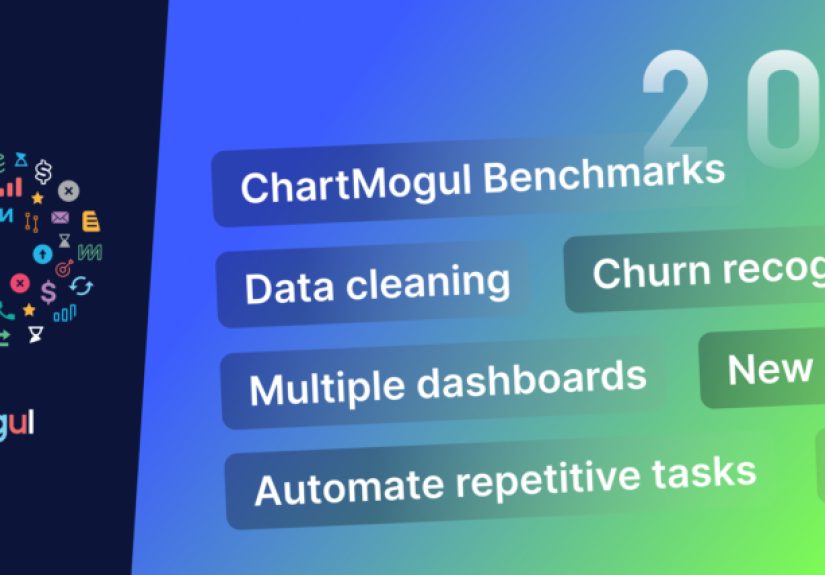
ChartMogul’s own product roadmap and updates throughout 2024 reinforced the same theme seen in its research: this was a year for practical leverage. The company highlighted a public roadmap, platform improvements, workflow automations, enhanced data cleaning, and upgraded integrations such as Braintree and Recurly.
That may not sound flashy if your definition of innovation is an AI assistant that writes six weak marketing emails and one decent haiku. But for SaaS operators, these are the kinds of product investments that matter. Better integrations improve trust in the numbers. Better automations reduce manual work and human error. Better data cleaning means fewer arguments in meetings that begin with, “Well, Finance has one number and RevOps has another.”
In a year where efficiency mattered, ChartMogul built for efficiency. In a year where reliable data mattered, ChartMogul built for reliability. That is not accidental. It is product strategy that matches market reality.
AI Hovered Over Everything, But Execution Still Won
Of course, no 2024 SaaS review would be complete without AI barging into the room and insisting it is the main event. AI shaped market narratives, cloud spending forecasts, product packaging, and investor attention. Gartner forecast strong cloud spending growth in 2024, with SaaS still the largest cloud segment and application modernization plus generative AI helping drive demand. Bessemer’s cloud outlook likewise framed 2024 as an AI-cloud moment, especially around agents, developers, and vertical software.
But the interesting part for ChartMogul’s world is this: AI may have changed the story, but it did not eliminate the need for fundamentals. If anything, it made them more important. When pricing models shift, when usage becomes harder to forecast, and when customers want quicker proof of value, companies need stronger analytics, not weaker ones.
AI may be shiny, but MRR, ARR, churn, ARPA, and NRR still decide whether the business is healthy. Even the coolest AI feature eventually has to answer an old-fashioned question: “Is it helping revenue stick?”
What ChartMogul 2024 Really Tells Us
The best way to describe ChartMogul’s 2024 is this: it was a year of clarity. The market clarified what kind of growth is still possible. Customers clarified that value matters more than noise. Finance teams clarified that recurring revenue quality is not optional. And ChartMogul clarified its role as a serious platform for subscription businesses that want trustworthy metrics and actionable context.
The old SaaS fantasy was simple: grow fast, raise more, worry later. The 2024 version is less cinematic but much more durable: keep customers, price intelligently, benchmark honestly, clean your data, and build a business that can explain itself in plain English and solid numbers.
Not quite a Hollywood ending. More like a business that still exists in five years, which is honestly nicer.
Experience: What 2024 Felt Like for SaaS Teams Living Through It
If you actually worked in SaaS during 2024, the year probably felt less like a heroic comeback montage and more like a very long series of meetings where everyone suddenly cared about the same five metrics. The tone changed. You could hear it in leadership updates, in investor conversations, in board decks, and in the way product, finance, and revenue teams started speaking each other’s language.
For many operators, one of the biggest experiences of 2024 was learning that “healthy growth” feels different from “fast growth.” Fast growth can hide mistakes. Healthy growth exposes them. If acquisition slows even a little, every crack starts to glow in the dark: onboarding friction, sloppy packaging, weak expansion motions, poor billing logic, shaky retention, duplicate customer records, and dashboards that tell three different stories depending on who exported the CSV.
That is why the ChartMogul story resonated so strongly in 2024. It mirrored the operator experience. Teams were no longer looking for magical hacks. They were looking for clearer numbers, better visibility, and fewer blind spots. A growth lead wanted to know why one segment upgraded more than another. A finance leader wanted confidence in MRR and ARR. A customer success team wanted earlier warning signs before churn hit. A founder wanted to know whether their company was genuinely strong or just temporarily less weak than its peers.
There was also a psychological shift. In the boom years, many teams operated with a kind of permanent adrenaline. In 2024, the mood was more thoughtful. Not pessimistic, exactly. Just less interested in theater. Operators wanted systems that reduced noise. They wanted automation that saved time. They wanted benchmarks that replaced guesswork. They wanted plan analysis, retention cohorts, and billing insights because those things made Monday mornings less chaotic.
And yes, AI was everywhere. Every product demo had a sprinkle of it. Every roadmap had at least one AI-shaped bullet point. Every company wanted to sound modern. But the lived experience inside many software businesses was that AI did not replace the need for revenue discipline. It often intensified it. The more complex pricing became, the more valuable clean analytics became. The more teams experimented, the more they needed a trustworthy scoreboard.
That is what made 2024 memorable. It was not just a year of market stabilization. It was a year when SaaS teams relearned the craft of running a subscription business well. Less hype. More retention. Less swagger. More systems. Less “we’ll fix it later.” More “show me the cohort.” In that environment, ChartMogul did not just look relevant; it looked like the kind of tool built for the moment.
Conclusion
ChartMogul 2024: Year in Review is ultimately the story of a maturing SaaS market and a platform that matured right along with it. The headline was not explosive growth. It was better growth. The real wins came from stronger retention, more thoughtful pricing, better context through benchmarks, cleaner data, and more disciplined execution across the customer lifecycle.
For SaaS leaders, the lesson is wonderfully unglamorous and therefore extremely useful: know your numbers, trust your data, and stop confusing activity with progress. In 2024, the businesses that performed best were often the ones that understood exactly where revenue came from, why customers stayed, and which levers could improve expansion without wrecking efficiency.
That is the kind of year-in-review worth remembering, because it is the kind that can actually help you plan the next one.