Table of Contents >> Show >> Hide
- Before You Start: A Few Smart Ground Rules
- 10 Home Exercises That Actually Work
- How to Turn These Moves Into a Simple Home Workout
- Tips for Staying Consistent at Home
- Why Home Exercise Mattered So Much During Coronavirus
- What the Experience of Home Exercise During Coronavirus Really Felt Like
- Conclusion
The coronavirus era changed a lot of things, including how people think about fitness. Suddenly, the gym was replaced by the hallway, the yoga studio became the living room, and the most loyal workout buddy in America was a dining room chair. The good news? You do not need a fancy setup, a monthly membership, or a suspiciously expensive neon water bottle to stay active at home.
Home exercise can be simple, effective, and surprisingly fun when you stop expecting your apartment to behave like a luxury fitness resort. A solid routine built around bodyweight movements can help you stay strong, protect your heart health, support your mood, and break up long stretches of sitting. That matters whether you are working from home, spending more time indoors, or just trying to rebuild healthy habits without overcomplicating everything.
This guide walks through 10 practical home exercises you can mix and match into a routine that fits real life. No celebrity trainer voice required. No garage full of equipment required. Pants are strongly recommended, though.
Before You Start: A Few Smart Ground Rules
If you are easing back into movement after being sick, inactive, or simply emotionally committed to your couch, start slowly. A shorter workout done consistently is better than an intense routine that leaves you questioning every life choice by minute six. Focus on form, breathe steadily, and keep water nearby.
If you currently have fever, chest pain, unusual shortness of breath, or feel faint, skip the workout and talk with a medical professional. And if you are returning to exercise after a coronavirus infection, think “gradual comeback tour,” not “training montage.” Your body usually appreciates patience more than drama.
10 Home Exercises That Actually Work
1. March in Place
Marching in place is the friendliest possible way to get moving. It raises your heart rate, warms up your hips and knees, and asks almost nothing from your equipment budget. Stand tall, swing your arms naturally, and lift your knees to a comfortable height. Keep your core lightly engaged and land softly.
Try it for 30 to 60 seconds to start. If you want more intensity, pump your arms harder or turn it into a light jog in place. If you want less, keep the pace easy and treat it as a warm-up. Either way, it beats sitting perfectly still while pretending your coffee counts as cardio.
2. Step Jacks
Traditional jumping jacks are great, but step jacks are often kinder to joints and neighbors living downstairs. Step one foot out to the side while raising both arms overhead, then return to center and repeat on the other side. The movement gives you a cardio boost without the pounding of repeated jumps.
This is a smart option for beginners, older adults, or anyone who wants a low-impact aerobic exercise that still feels like a real workout. Do 20 to 40 reps at a steady pace, and keep your shoulders relaxed instead of flinging your arms like you are directing airport traffic in a windstorm.
3. Bodyweight Squats
If home exercise had a greatest-hits album, squats would absolutely make the cover. They train your thighs, glutes, and core while also helping with everyday movements like standing up from a chair, lifting groceries, and surviving long lines. Stand with feet about shoulder-width apart, push your hips back, bend your knees, and lower as if sitting into a chair. Then press through your heels to stand tall.
Keep your chest lifted and your knees tracking in line with your toes. If full squats feel tough, use a chair behind you for guidance or perform sit-to-stands from a sturdy seat. Aim for 8 to 15 reps.
4. Reverse Lunges
Reverse lunges build leg strength and balance at the same time. Step one foot back, lower until both knees bend comfortably, then return to standing and switch sides. Stepping backward can feel more controlled than stepping forward, which is one reason many people prefer this variation at home.
Take your time. Hold onto a countertop or the back of a chair if balance is an issue. Keep your torso upright and avoid rushing the movement. Start with 6 to 10 reps per side. Slow and steady is not boring here; it is smart.
5. Wall Push-Ups
Wall push-ups are a beginner-friendly way to strengthen your chest, shoulders, arms, and core. Stand facing a wall, place your hands at chest height slightly wider than shoulder-width, and step your feet back a little. Bend your elbows to bring your body toward the wall, then push back to start.
The farther your feet are from the wall, the harder the exercise becomes. If wall push-ups feel easy, graduate to countertop push-ups, then knee push-ups, then floor push-ups over time. Fitness is a ladder, not a trapdoor. Go one rung at a time.
6. Glute Bridges
Glute bridges are excellent for waking up muscles that tend to switch off during long hours of sitting. Lie on your back with knees bent and feet flat on the floor. Press through your heels, squeeze your glutes, and lift your hips until your body forms a gentle line from shoulders to knees. Lower slowly and repeat.
Avoid arching your lower back too much. Think about lifting from your hips, not launching yourself like a startled seal. Perform 10 to 15 controlled reps. This move is especially helpful if your body has been spending too much time in “laptop goblin posture.”
7. Plank
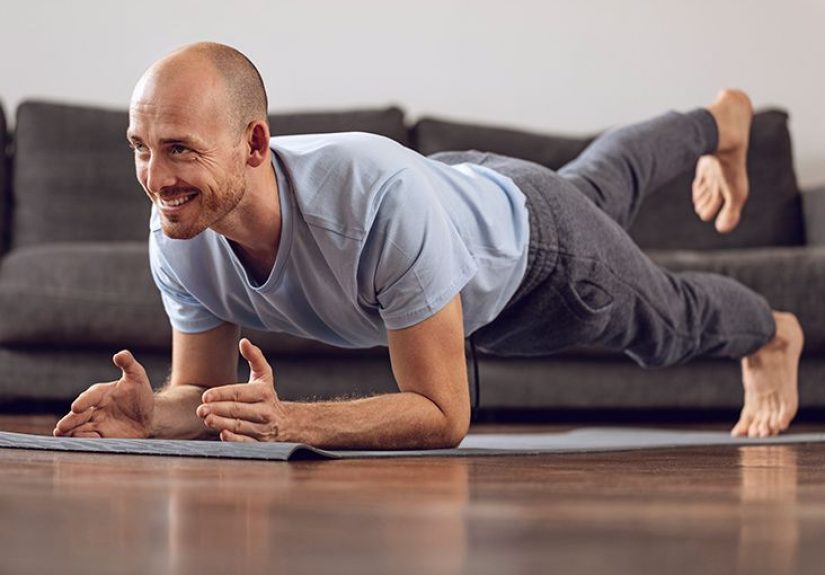
The plank is a classic core exercise because it trains stability, not just showy ab drama. Start on your forearms and toes, or keep your knees on the floor for an easier version. Maintain a straight line from head to heels or knees, and brace your midsection as if preparing for someone to poke your stomach.
The goal is quality, not suffering. Hold for 10 to 30 seconds with steady breathing. If your hips sag or your shoulders start writing complaint letters, stop and reset. A shorter, stronger plank is far more useful than a long, wobbly one.
8. Bird-Dog
This underrated move improves balance, coordination, and core control. Start on hands and knees. Extend one arm forward and the opposite leg back, pause briefly, then return to the start and switch sides. Move slowly enough that you are not tipping over like a folding table at a yard sale.
Keep your spine neutral and your hips level. If extending both arm and leg is too challenging, begin with just the arms or just the legs. Do 6 to 10 reps per side. It looks simple, but your core gets the memo very quickly.
9. Chair Sit-to-Stands
This exercise is as practical as it gets because it mirrors a movement most people do every day. Sit near the front edge of a sturdy chair, feet under your knees, and stand up without using your hands if possible. Lower yourself back down with control.
Chair sit-to-stands help build lower-body strength, improve function, and boost confidence for people who are restarting exercise. They are also easy to scale. Want it harder? Slow down the lowering phase or hold a pause at the bottom. Start with 8 to 12 reps.
10. Mobility Flow and Stretching
Not every useful exercise needs to leave you breathless. A short mobility flow can improve flexibility, reduce stiffness, and help your body feel less like a collection of angry hinges. Try a sequence of cat-cow stretches, shoulder rolls, calf stretches, gentle spinal rotation, and a hip flexor stretch.
Move deliberately and avoid bouncing. Stretching is not a competition, and your hamstrings do not award points for drama. Spend 5 to 10 minutes here, especially after cardio or strength work, or use mobility work as a standalone routine on low-energy days.
How to Turn These Moves Into a Simple Home Workout
If choosing exercises feels harder than actually doing them, keep it easy. Here is one beginner-friendly format:
- March in place – 1 minute
- Step jacks – 1 minute
- Bodyweight squats – 12 reps
- Wall push-ups – 10 reps
- Reverse lunges – 8 reps per side
- Glute bridges – 12 reps
- Plank – 20 seconds
- Bird-dog – 8 reps per side
- Chair sit-to-stands – 10 reps
- Stretching and mobility – 5 minutes
Run through the circuit once if you are just starting. Do it two or three times if you want more challenge. On busy days, even 10 to 20 minutes counts. On stressful days, five minutes counts too. Progress is not ruined just because your workout is shorter than whatever a fitness influencer did while smiling under perfect lighting.
Tips for Staying Consistent at Home
The hardest part of home exercise is often not the exercise. It is remembering to do it when your couch is nearby, your phone is sending nonsense notifications, and your kitchen keeps acting like an emotionally supportive snack center. Consistency becomes easier when you make activity small, obvious, and repeatable.
Try scheduling movement like an appointment. Leave a mat, towel, or pair of sneakers where you can see them. Use “exercise snacks” throughout the day, such as a one-minute march, a set of squats between meetings, or a stretch break after screen time. These mini sessions add up and help break the all-day sitting cycle.
Also, give yourself permission to adjust. Some days are for stronger workouts. Some days are for a gentle stretch, a few sit-to-stands, and the radical achievement of being a human who moved on purpose. That still counts.
Why Home Exercise Mattered So Much During Coronavirus
For many people, coronavirus did more than disrupt schedules. It changed routines, stress levels, social habits, sleep quality, and the general sense of what a normal day even looked like. Home workouts became important because they were practical, but also because they restored a little structure. A short session could mark the beginning of the workday, break up an anxious afternoon, or create a sense of momentum when everything else felt uncertain.
Exercise at home also removed some barriers. You did not need transportation. You did not need special clothing beyond something comfortable. You did not need to wonder whether the gym was crowded or whether the class schedule fit your life. You just needed enough room to take a few steps, bend your knees, and convince yourself that yes, the floor really was part of the program.
And perhaps most importantly, home exercise reminded people that movement does not have to be perfect to be meaningful. A routine built from bodyweight basics can still strengthen muscles, support cardiovascular health, improve balance, and boost mental well-being. That lesson is useful long after lockdown language has faded from headlines.
What the Experience of Home Exercise During Coronavirus Really Felt Like
Let’s be honest: the experience of exercising at home during the coronavirus years was not always elegant. It was less “private trainer in a sunlit loft” and more “trying to plank while the dog assumes this is now a group activity.” People were suddenly working, parenting, cooking, worrying, scrolling, and existing in the same few rooms all day. Under those conditions, fitness had to become flexible or it simply was not going to happen.
For some, home workouts were a lifeline. They created a sense of routine in days that otherwise blurred together. Morning stretches replaced commutes. A quick lunch-break circuit replaced the walk to a coffee shop. Ten minutes of movement became a mood reset when the news cycle felt relentless. Exercise did not solve every problem, obviously, but it gave many people one small area where effort still turned into progress. In uncertain times, that mattered more than many expected.
For others, the experience was awkward at first. People discovered muscles they had ignored for years. They learned that a hallway can be a cardio lane, that a chair can double as gym equipment, and that bodyweight squats become dramatically less theoretical around rep number twelve. Many also discovered that online workouts can be both helpful and humbling. Nothing builds character quite like following a cheerful instructor who says, “This is your recovery round,” while your legs submit a formal protest.
There was also something unexpectedly human about it. Home exercise stripped fitness down to the basics. Without the mirrors, machines, and social pressure of public spaces, people had to focus on how movement actually felt. Did their energy improve? Did their back feel better after mobility work? Did climbing stairs become easier? Those small, real-life wins became more meaningful than chasing some polished image of perfection.
Families adapted too. Parents exercised with kids wandering through the frame. Couples turned walks, stretches, or short circuits into shared routines. Older adults used simple chair exercises and balance work to stay active safely at home. Many people who had once believed exercise had to be long, intense, or highly organized realized that consistency mattered more than complexity. A few minutes here and there was still real movement. It still counted.
And then there was the mental side. During stressful periods, movement often became less about aesthetics and more about coping. A short workout could lower tension, improve focus, and provide a break from being mentally “on” all day. Even a brief routine made the body feel more awake and the mind a little less trapped. That is one reason home exercise became such a lasting habit for many people: it was not just about fitness goals. It was about feeling steadier, stronger, and more normal in a time that was anything but normal.
The biggest takeaway from that experience is still relevant now. You do not need ideal conditions to take care of your health. You need a workable plan, realistic expectations, and enough self-respect to start where you are. Some days that means a full circuit. Some days it means stretching for five minutes between video calls. Neither is a failure. Both are evidence that you are still showing up.
Conclusion
Home fitness became a practical solution during coronavirus, but it also proved a bigger point: effective exercise does not have to be complicated. With a handful of bodyweight movements, a little consistency, and a willingness to start small, you can build strength, improve endurance, and feel better without leaving home. The goal is not perfection. The goal is movement you can actually keep doing.
So pick three exercises. Then pick five. Then build your own routine from there. Your living room may never become a luxury gym, but it can absolutely become the place where healthier habits begin.