Table of Contents >> Show >> Hide
- What General Relativity Actually Says (In Normal Human Language)
- So Where’s the Problem? The Cracks in Einstein’s Masterpiece
- What Comes After Einstein? Attempts to Fix or Extend GR
- Einstein’s “Flawed” Theory and the Way Science Really Works
- Living With a Game-Changing but Incomplete Theory
- Experiences and Perspectives Shaped by General Relativity
When Albert Einstein unveiled his general theory of relativity in 1915, he didn’t just tweak physicshe detonated it and rebuilt the rubble into something beautiful. Space and time stopped being a boring, fixed stage and became an active, flexible fabric that bends, stretches, and even ripples. For over a century, general relativity (GR) has passed test after test with flying colors, from the strange orbit of Mercury to the detection of gravitational waves.
But here’s the twist: for all its brilliance, Einstein’s theory is not the final word on gravity. It breaks down in some of the most extreme places in the universe, refuses to play nicely with quantum mechanics, and forces us to accept mysterious concepts like dark matter and dark energy that we still don’t fully understand.
What General Relativity Actually Says (In Normal Human Language)
At its core, general relativity says that mass and energy tell spacetime how to curve, and curved spacetime tells matter how to move. Instead of thinking of gravity as a force that pulls objects together, GR describes it as geometry. Planets follow the curves in spacetime created by stars; light beams bend when they pass near massive objects because the “straight line” they travel along is itself curved. This idea is encoded in Einstein’s field equations, a set of nonlinear tensor equations that relate the curvature of spacetime to the distribution of energy and momentum.
These equations are notoriously hard to solve, but a few key solutionssuch as the Schwarzschild solution describing the spacetime around a spherical masshave become the backbone of our understanding of black holes, planetary orbits, and even the expanding universe.
From Mercury’s Orbit to Gravitational Waves: The Greatest Hits of GR
Einstein didn’t just propose an elegant theory; he offered concrete predictions that could be tested. The first “classic” tests of general relativity were:
- Mercury’s perihelion shift: Mercury’s closest point to the Sun slowly shifts over time. Newtonian gravity explains almost all of this, but not quite. GR accounts for the remaining discrepancy almost perfectly.
- Bending of light by gravity: During a 1919 solar eclipse, starlight passing near the Sun was observed to bend by exactly the amount GR predicted, instantly turning Einstein into a global celebrity.
- Gravitational redshift: Light climbing out of a gravitational field loses energy and shifts to longer (redder) wavelengths, another early prediction that was later confirmed by experiments.
Since then, the list of confirmations has exploded. Highly precise measurements using spacecraft, radio telescopes, and atomic clocks have all agreed with GR to an almost annoying degree of accuracy. Binary pulsars lose orbital energy in just the way GR predicts, and in 2015, LIGO detected gravitational wavestiny ripples in spacetime produced when massive objects like black holes collideexactly as Einstein’s math had suggested a century earlier.
GR doesn’t just live in observatories and particle accelerators, either. You interact with it every time you use your smartphone: GPS satellites must correct for both special and general relativistic effects in order to give you accurate location data. Without GR, your map app would be embarrassingly wrong within minutes.
So Where’s the Problem? The Cracks in Einstein’s Masterpiece
With a resumé like that, calling general relativity “flawed” sounds almost rude. But in science, “flawed” doesn’t mean “useless”it means “incomplete.” GR works astonishingly well in many scenarios, but it runs into serious trouble when we zoom in to the tiniest scales or look at the universe as a whole.
1. General Relativity Hates Quantum Mechanics
One of the biggest issues is that GR and quantum mechanics don’t currently fit into a single, unified framework. General relativity treats spacetime as smooth and continuous, modeled by differentiable geometry. Quantum theory, on the other hand, describes the world in terms of discrete, probabilistic eventsparticles that exist in superpositions, fields that fluctuate, and interactions that are fundamentally “grainy.”
When you try to apply standard quantum field theory techniques directly to spacetime itself, the math breaks downintegrals blow up to infinity, and you get nonsense instead of predictions. That failure is a loud hint that GR is not the final description of gravity, especially at extremely small scales or extremely high energies, such as near the Big Bang or inside black holes.
2. Singularities: When the Math Eats Itself
GR famously predicts singularitiespoints where density and curvature become infinite, such as at the center of a black hole or at the very beginning of the universe. The problem is that GR assumes spacetime is smooth and continuous, and a singularity is literally a place where those assumptions fail. In other words, the theory is predicting its own breakdown.
Most physicists interpret singularities as a sign that we need a better theorylikely a quantum theory of gravitythat “softens” these infinities and replaces them with something physically meaningful. GR is giving us a warning light on the dashboard; ignoring it would be irresponsible.
3. Dark Matter and Dark Energy: GR’s Invisible Friends
When astronomers use GR to study galaxies and the universe at large, the equations say there’s a lot more gravity than can be accounted for by visible matter. To make the math match the observations, scientists introduce dark matteran unseen form of matter that doesn’t emit light but does exert gravitational pull. Similarly, the observed accelerated expansion of the universe is explained by dark energy, often modeled using a cosmological constant term in Einstein’s equations.
Are dark matter and dark energy real substances, or are they signals that GR needs to be modified on very large scales? We don’t know yet. Many researchers treat GR as essentially correct and look for particle candidates for dark matter. Others explore alternative or extended theories of gravity that might reproduce the same cosmic behavior without invoking so much invisible stuff.
4. The Planck Scale: Where GR’s Passport Expires
GR has been tested over an enormous range of distances and energies, but not all the way down to the Planck scalea mind-bogglingly tiny scale (around 10−35 meters) where quantum effects of gravity are expected to dominate. At those scales, our current understanding of spacetime as a smooth fabric is almost certainly wrong. Many approaches to quantum gravity propose that spacetime becomes discrete, foamy, or fundamentally different from anything we can easily visualize.
GR itself doesn’t tell us what happens at that frontier. As powerful as it is, it’s a classical theorya kind of high-resolution, large-scale map of gravity that becomes unreliable once we zoom in too far.
What Comes After Einstein? Attempts to Fix or Extend GR
Physicists aren’t content to live with a split universe where gravity and quantum mechanics use separate rulebooks. Over the past decades, several ambitious programs have tried to reconcile GR with quantum theory or modify it to solve its cosmological puzzles.
Loop Quantum Gravity and String Theory
Two of the most prominent approaches to quantum gravity are loop quantum gravity (LQG) and string theory.
- Loop Quantum Gravity: LQG tries to quantize spacetime itself. Instead of a smooth fabric, spacetime is made of tiny, discrete “loops” that form a network. These quantum states of geometry could, in principle, eliminate singularities and give us a finite, well-behaved description of black hole interiors and the early universe.
- String Theory: String theory suggests that fundamental particles are not points but tiny vibrating strings, and gravity emerges as one of their vibrational modes. It naturally includes a quantum version of gravity and works in higher-dimensional spacetimes, but it’s mathematically complex and still waiting for clear, unique experimental confirmation.
Both frameworks aim to keep the successful large-scale predictions of GR while fixing its breakdown at small scales. Neither has yet delivered a final, experimentally verified theory, but they’ve significantly deepened our understanding of what a post-Einstein theory might look like.
Modified Gravity and Nonlocal Theories
In addition to quantizing GR, some researchers take a different tack: maybe GR itself needs to be modified, especially at very large (cosmological) scales. Approaches such as modified Newtonian dynamics (MOND), scalar–tensor theories, or nonlocal gravity attempt to tweak the gravitational law so that galactic rotation curves and cosmic acceleration can be explained without requiring so much dark matter or dark energy.
These models are still under active investigation. Some fit certain observations beautifully but struggle with others. The current consensus is that GR, plus dark matter and dark energy, remains the simplest overall fit to the data, but the debate is far from over.
Einstein’s “Flawed” Theory and the Way Science Really Works
Calling general relativity “flawed” can sound like a takedown, but it’s really a compliment. In science, a truly great theory isn’t one that lasts forever unchanged; it’s one that explains a huge range of phenomena, makes bold predictions, and clearly marks where it stops working.
GR is brilliant precisely because it is both powerful and diagnostic. It has guided the design of satellites, the interpretation of cosmic signals, and the construction of massive observatories. At the same time, it has led us straight to its own limitstoward singularities, incompatible quantum descriptions, and the mystery of missing mass and energy in the universe.
Einstein himself was famously uneasy with aspects of quantum mechanics, especially its probabilistic nature. Ironically, the path beyond his “flawed” theory of gravity almost certainly runs through a deeper quantum understanding of reality.
If history is any guide, the next big step won’t erase general relativity. Just as GR reduces to Newton’s law of gravitation in everyday conditions, any future theory of quantum gravity will reduce to GR when spacetime is gently curved and quantum effects are small. Einstein’s theory will remain our go-to tool for understanding planets, stars, and most of cosmology; it just won’t be the last word.
Living With a Game-Changing but Incomplete Theory
So where does that leave us? In a surprisingly exciting place. We have a theory of gravity that:
- Explains a vast range of phenomena with extraordinary precision.
- Is indispensable for modern technology like GPS and for interpreting astrophysical data.
- Openly reveals where it breaks down, pointing the way to new physics.
In that sense, Einstein’s general relativity is less like a finished cathedral and more like a beautifully constructed bridge that stops halfway across a river. It carries us far beyond what came before, but it also challenges us to figure out how to complete the crossing.
The search for that completionwhether through loop quantum gravity, string theory, modified gravity, or something entirely newis one of the defining scientific adventures of our time. And whatever theory eventually takes the baton, it will owe a massive debt to Einstein’s “flawed” masterpiece.
Experiences and Perspectives Shaped by General Relativity
Beyond the equations and experiments, general relativity has deeply influenced how scientists, students, and even the public experience the universe. Physics isn’t just about numbers on a chalkboard; it’s also about how those numbers change the way we think and live.
Experiencing Relativity in Everyday Technology
One of the most concrete “experiences” of GR happens quietly in the background every day. Engineers who work on satellite navigation systems must routinely account for both special and general relativistic time dilations. Without these corrections, a GPS receiver on Earth would drift by several miles in a matter of hours. For the engineers, relativity isn’t an abstract idea from a textbook; it’s a practical requirement, as real as voltage and battery life. Their experience of GR is one of constant calibrationtranslating a curved spacetime description into accurate coordinates so your phone can tell you where the nearest coffee shop is.
Students Meeting Curved Spacetime for the First Time
In university classrooms, general relativity often marks a turning point in a physics education. Students move from relatively familiar territoryforces, energy, and fieldsto a geometric picture where gravity is no longer a pull but a manifestation of curved spacetime. The first encounter with Einstein’s field equations can be intimidating: the math involves tensors, differential geometry, and concepts far beyond introductory physics.
Yet many students describe a moment when it “clicks”: realizing that what feels like a mysterious force can be reinterpreted as motion along geodesics in a curved manifold. That shift in perspective is an experience in itselfa cognitive reformatting of how the universe is structured. At the same time, as soon as students learn what GR can do, they also learn where it fails: singularities, quantum incompatibility, and dark sector puzzles. They experience GR not as a perfect final truth, but as a stepping stone toward deeper theories.
Astrophysicists Riding the Edge of Einstein’s Theory
Astrophysicists working with black holes, neutron stars, and gravitational waves spend much of their time at the boundary between GR’s triumphs and its weaknesses. When researchers analyze data from observatories like LIGO or the Event Horizon Telescope, they use GR-based models to interpret signals from extreme environments. The first image of a black hole’s shadow, for instance, was possible only because GR tells us how light bends and orbits in the vicinity of a supermassive black hole.
Yet those same scientists know that deep inside the black hole, GR predicts a singularity where it can no longer be trusted. Their day-to-day experience is a strange mix of confidence and doubt: the outer regions of spacetime behave exactly as GR predicts, but the inner core remains undefined territory. Every new observation is both a confirmation of Einstein and an invitation to look for subtle deviations that might hint at new physics.
The Public’s Experience: From Pop Culture to Philosophy
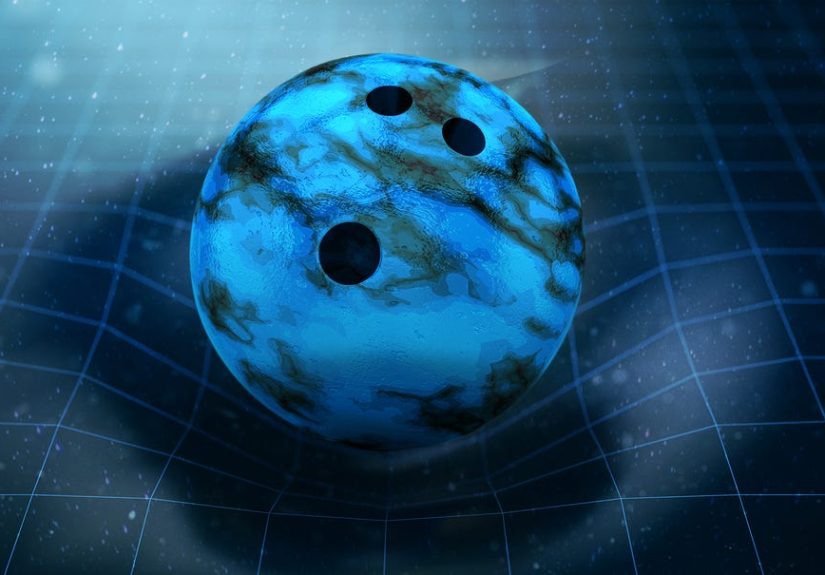
Thanks to documentaries, science fiction films, and popular science books, general relativity has also become part of cultural experience. Concepts like warped spacetime, black holes, and gravitational waves show up in movies and TV shows, sometimes faithfully, sometimes with creative liberties. For many people, their first “experience” of GR is visualseeing a rubber sheet bent by a heavy ball or a cinematic spaceship skimming the edge of a black hole.
These stories can spark genuine curiosity. People who may never touch tensor calculus still end up asking deep questions: What is time, really? Does gravity slow it down? Are black holes gateways to other universes? The idea that Einstein’s theory is both revolutionary and incomplete adds another philosophical layer: if even a theory this successful has limits, then our understanding of reality is always provisional, always open to revision.
In that sense, living in a universe described by a “game-changing but flawed” theory is oddly empowering. It reminds us that even our best ideas are starting points, not finish linesand that there is always more to discover, whether you’re steering a spacecraft, studying pulsars, or just wondering what’s really happening when you drop your keys and they fall to the floor.