Table of Contents >> Show >> Hide
- Why the clip blew up so fast
- The context many hot takes ignored
- Why some viewers called it inappropriate
- Why supporters saw something else entirely
- The hug explanation that kept the story alive
- What the moment revealed about JD Vance
- Why this went viral in the first place: the internet loves unresolved emotion
- Experiences that make this story feel so familiar
- Final takeaway
- SEO Tags
Some political moments are built for policy headlines. Others get bulldozed by the internet before the applause even dies down. That is exactly what happened when Erika Kirk took the stage at a Turning Point USA event, introduced Vice President JD Vance with a deeply personal remark, then shared a hug with him that social media promptly dragged into the center of the culture-war blender.
To critics, the moment looked too intimate, too symbolic, and just plain too online to ignore. To supporters, it was a raw expression of grief, faith, and gratitude from a widow trying to carry on her late husband's mission. And to the internet? Well, the internet did what it does best: freeze one emotional moment, replay it a thousand times, and act like a body-language degree from TikTok University is the same thing as context.
The viral clip did not explode in a vacuum. It happened at a campus event already loaded with emotion, political meaning, and succession drama. Charlie Kirk, the founder of Turning Point USA, had been killed weeks earlier. Erika Kirk had stepped into a much more public leadership role. JD Vance was not just another guest speaker. He was a close ally, a friend of Charlie Kirk, and increasingly seen as one of the political figures best positioned to inherit part of the broader movement Charlie helped build.
That is why this story caught fire. It was never only about a hug. It was about grief, optics, movement politics, internet suspicion, and the strange modern rule that every public moment must now survive being turned into a freeze-frame morality trial.
Why the clip blew up so fast
The moment went viral because it delivered the three ingredients social media loves most: emotion, ambiguity, and politics. Erika Kirk's introduction of Vance was heartfelt and personal. She told the audience that no one would replace her husband, but that she saw similarities between Charlie Kirk and Vance. That line alone was enough to send the online comment section into a dramatic tailspin. Add a long onstage embrace, visible hand placement, and a room already charged with memorial energy, and the internet basically treated the clip like it had been custom-made for dissection.
There is also the fact that viral politics now runs on seconds, not speeches. Vance actually spoke on policy during the event, including immigration. But the speech itself was quickly overshadowed by the intro and the embrace. That says less about the event than it does about the current media ecosystem. A ten-minute argument can disappear. A five-second hug? That gets ring lights, reaction videos, and a thousand people typing the word “yikes” like it is a constitutional principle.
The statement that sparked the loudest reaction
The phrase that triggered the most chatter was Erika Kirk's suggestion that she saw certain similarities between her late husband and Vance. On paper, that can be read as a tribute. In a grieving context, it can also sound like an attempt to explain why Vance mattered so much to her husband's cause and to the movement still reeling from Charlie Kirk's death.
But online, nuance tends to leave the building early. Critics labeled the remark “weird” because it blurred emotional, political, and personal language in a very public setting. Supporters heard something else: a widow acknowledging a trusted ally who had stood near the family in a devastating season. Both interpretations found fuel in the same sentence. That is usually how a viral political controversy works. One side hears loyalty. The other hears an eyebrow-raising overshare. Everybody grabs screenshots and declares victory.
The hug that became the main event
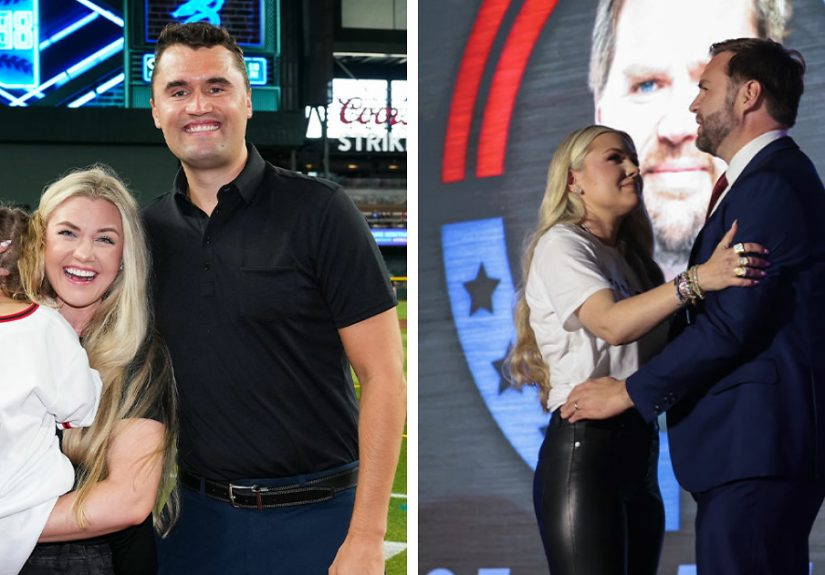
Then came the embrace. It was not a quick handshake, a polite side hug, or one of those awkward politician pats that looks like two people just met in a hotel lobby. It was emotional, close, and visibly tender. That was enough to trigger the usual online body-language autopsy. Some viewers called it inappropriate. Others said the outrage was absurd and cruel, especially given the grief hanging over the room.
What made the reaction even more intense was the visual symbolism. Erika Kirk had just delivered a personal tribute. Vance walked onstage as both a political heavyweight and a family ally. The embrace therefore became a stand-in for bigger questions: Who represents Charlie Kirk's legacy now? How close is Vance to that world? And why does the internet insist on turning every complicated human moment into either proof of sainthood or proof of scandal?
The context many hot takes ignored
Stripped of context, the clip invited speculation. Put back into context, it looks less like a tabloid bombshell and more like a public emotional release inside a movement still processing a major loss. Charlie Kirk's death had left a leadership vacuum and an enormous emotional shockwave. Erika Kirk had already vowed to continue the work and remain publicly involved. Reports in the weeks after the killing described her emerging as the face of continuity for Turning Point USA.
At the same time, JD Vance had become one of the most visible political figures associated with Charlie Kirk's legacy. Reporting and official materials described Vance as a close friend who helped honor Kirk publicly, accompanied his remains home, and moved quickly into a highly visible support role after the assassination. That matters. The hug did not happen between strangers. It happened between people already linked by grief, politics, and a shared public story.
The University of Mississippi event was also not some casual mixer with bad lighting and worse judgment. It was part of Turning Point's recalibrated campus push, and organizers expected a huge crowd. Erika Kirk's appearance carried symbolic weight because it connected mourning, continuity, and mobilization all at once. In that setting, emotional intensity should not have been surprising. The internet, of course, was still shocked that a grief-struck event looked grief-struck.
Why some viewers called it inappropriate
Let us be fair to the critics for a minute. Their discomfort did not appear out of nowhere. The moment landed awkwardly for some viewers because of three things: timing, optics, and political status. First, the event came not long after Charlie Kirk's death, so emotions were already heightened. Second, the embrace looked unusually intimate for a public political stage. Third, Vance is the vice president, a married public figure, and that means every gesture gets filtered through a celebrity-style lens whether anyone likes it or not.
There is also a broader cultural piece here. Americans are weirdly inconsistent about physical affection in public life. A candidate can stand onstage and promise to rewire the federal government, and half the country shrugs. But let somebody hold a hug one beat too long and suddenly everyone becomes a human-resources consultant with a podcast. That does not mean the criticism was meaningless. It means the criticism was shaped by a political culture that is hypersensitive to symbolism and utterly addicted to projection.
For some viewers, the problem was not that the hug happened. It was that the moment looked like it carried emotional meaning that felt too personal for a political rally. And once Erika Kirk's earlier statement about seeing similarities between her husband and Vance got paired with that hug, the internet stitched the two together into a much juicier story than the available facts actually supported.
Why supporters saw something else entirely
Supporters read the scene through a completely different lens. To them, Erika Kirk was a grieving widow thanking an ally who had stood near the family after a traumatic loss. The speech language was not romantic or scandalous in their view. It was movement language. She was saying Vance shared some of Charlie Kirk's gifts, especially his ability to connect with young conservatives and carry the cause forward. Within that interpretation, the hug was not inappropriate. It was a visible sign of solidarity.
This difference in interpretation matters because it explains why the reaction was so polarized. The people who disliked the moment saw blurred personal boundaries. The people who defended it saw compassion in public. Both camps were looking at the same video, but they were not watching the same story. One group saw gossip bait. The other saw a widow under pressure being comforted in front of thousands.
And honestly, that split is almost the whole story. Viral politics no longer asks what happened. It asks which emotional script people are already carrying into the clip.
The hug explanation that kept the story alive
If the moment had ended onstage, the story probably would have had a short half-life. But it lasted because Erika Kirk later addressed the controversy directly. She said physical touch is part of how she expresses care and explained that when she hugged Vance, he told her he was proud of her. She said she responded with a blessing and touched the back of his head in a way she associates with affection and faith.
That explanation did two things at once. It gave supporters a straightforward answer, and it gave critics fresh material to keep arguing. Social media is generous like that. Some people accepted her version and moved on. Others decided the explanation only made the whole thing stranger. Then when she was seen greeting another political ally warmly in a similar way, defenders pointed to it as evidence that the Vance moment had been overread from the start.
In other words, the explanation did not end the discourse. It simply changed the genre from “what was that?” to “do you buy this?” Welcome to the modern outrage cycle, where clarification is just another episode.
What the moment revealed about JD Vance
The viral embrace also said something important about Vance's current place on the right. He was not merely filling a speaking slot. He was operating in a symbolic space once closely associated with Charlie Kirk, and that gave the event a second layer of meaning. Coverage across major outlets has shown that Vance's ties to Kirk were not incidental. He was part of the mourning, part of the tribute machinery, and part of the discussion about who could help keep Turning Point's political energy alive.
That is why the clip mattered beyond gossip. It looked, to some observers, like a snapshot of political succession. Not in any formal sense, but in a visual, emotional, internet-ready way. Erika Kirk introducing Vance with that kind of reverence made the moment feel larger than a normal campaign-style appearance. Whether that was intentional or not, it fed the perception that Vance was stepping into a movement relationship that had once revolved around Charlie Kirk.
Put differently: social media was not only reacting to chemistry. It was reacting to hierarchy, symbolism, and the transfer of influence. The hug was the thumbnail. The real story underneath it was power.
Why this went viral in the first place: the internet loves unresolved emotion
A clean political moment is boring. A messy emotional one becomes content. That is the rule. The Erika Kirk and JD Vance clip was irresistible because it sat right in the middle of unresolved emotion. It was sad, intimate, public, and politically charged. Nobody could agree on what it meant, which guaranteed that everybody would keep talking.
And that uncertainty is exactly what platforms reward. A straightforward clip dies. An ambiguous one multiplies. It gets reposted with dramatic captions, cropped into reaction reels, narrated by amateur lip-readers, and repackaged as proof of whatever the poster already believed. The original event becomes almost secondary. What matters is the open space between what happened and what viewers think happened.
That is why the “inappropriate” label spread so fast, and why the “weird statement” criticism stuck. They were emotionally sticky descriptions. Accurate or not, they gave people an easy headline and a clear side to pick. In a digital economy built on instant certainty, the messiest interpretation is often the one that travels fastest.
Experiences that make this story feel so familiar
Part of why this moment resonated is that it did not feel entirely foreign. Most people, even far from politics, have lived some version of this misunderstanding. Maybe not under arena lights and not with millions of strangers watching, but in the ordinary theaters of human life: funerals, hospital hallways, church foyers, graduation parties, and family gatherings where emotion makes people act in ways that look different from the outside than they feel on the inside.
Anyone who has comforted a grieving friend knows there is no universal script. Some people want space. Some want practical help. Some want silence. Some want a hug that lasts longer than usual because, for five seconds, it holds the room together. To an outsider, that same hug can look dramatic, excessive, or oddly intimate. To the people inside it, it can feel completely normal. That mismatch is one of the oldest social problems around. The internet just industrialized it.
There is also the experience of saying something heartfelt and then realizing later that it sounded much stranger than it felt in your head. That happens all the time in emotionally loaded moments. A person tries to honor a mentor, a spouse, or a loved one by comparing them to someone who showed up in a difficult season. The intention is gratitude. The delivery lands weird. Everybody in the room understands the emotion. Everybody online hears only the phrasing. Suddenly one sentence becomes your entire personality for 72 hours.
Workplaces have their own version of this too. Think about farewell speeches, retirement toasts, or awkward introductions where someone gets emotional and says more than they planned. One colleague tears up, another gives a long hug, and three people in the back quietly decide they have discovered a scandal. Usually there is no scandal. There is just the uncomfortable truth that human beings are messy, and public moments make that mess visible.
Politics magnifies this dynamic because political figures are treated like symbols first and people second. In ordinary life, a complicated hug can remain just a hug. In politics, it becomes a referendum on character, marriage, loyalty, ideology, gender norms, and whatever else the comment section had for breakfast. That is exhausting, but it also explains why this story spread so quickly. It felt specific, yet strangely universal.
At the heart of it, the Erika Kirk and JD Vance moment reminds people of something they have seen before: emotion colliding with optics. One person is trying to express support. Another is trying to hold it together. A camera catches the exact second when private feeling spills into public view. Then the people who were not in the room decide what it meant. Sometimes they get it right. Sometimes they absolutely do not. Usually, they are a little too confident either way.
That is what makes this story sticky. It is political, yes. But it also taps into a familiar human experience: the uncomfortable gap between what a moment feels like and how it looks when replayed by strangers who were never there.
Final takeaway
Erika Kirk's viral hug with JD Vance and her much-discussed statement at the Turning Point event became a sensation because the moment sat at the intersection of grief, power, symbolism, and internet culture. Critics saw something inappropriate. Supporters saw something compassionate. The clip survived because it refused to settle neatly into either category.
What is clear is that the moment was bigger than gossip. It revealed how intensely Charlie Kirk's legacy still shapes the conservative movement, how closely Vance is tied to that orbit, and how quickly public grief gets repackaged into viral judgment. In the end, the most revealing part of the story may not be the hug itself. It may be how eagerly the internet tried to turn one complicated human moment into a complete explanation for everything.
That, more than the clip, is the truly weird part.