Table of Contents >> Show >> Hide
- The Headline Is Dramatic, but the Science Is Better
- Meet Nuna, the Supercontinent You Probably Forgot from Geology Class
- How a Broken Supercontinent May Have Changed the Climate
- The “Boring Billion” Was Probably Not Boring at All
- What About the Fossils?
- Why This Research Matters Beyond One Ancient Supercontinent
- Experiences That Make This Deep-Time Story Feel Real
- Conclusion
- SEO Tags
If that headline sounds like Earth science wearing a movie-trailer voice, fair enough. But the underlying idea is genuinely fascinating. Recent research suggests that when the ancient supercontinent Nuna began to break apart around 1.46 billion years ago, the planet’s coastlines, oceans, and atmosphere changed in ways that may have helped complex life get a real foothold. Not life-life in the sense of the very first microbes blinking into existence, but the rise of early eukaryotes, the complicated cells that eventually led to plants, animals, and fungi. In other words, Earth may not have gotten its first living residents from a geological breakup, but it might have gotten the environmental makeover that let life level up.
That is a much better story than the old nickname for this stretch of time: the “Boring Billion.” Geologists used that label for the period between about 1.8 billion and 800 million years ago because Earth seemed oddly stable. No planet-wide ice ages. No obvious biological fireworks. No blockbuster plot twists. Just a long, slow middle chapter in Earth history. But science has been taking another look, and it turns out the “boring” part may have been more of a branding problem than a scientific one.
The Headline Is Dramatic, but the Science Is Better
The most responsible way to frame the claim is this: experts are not saying a crumbling supercontinent created the very first life on Earth out of thin air like some kind of tectonic wizard trick. The earliest microbial life almost certainly appeared much earlier, billions of years before Nuna’s breakup. What the new work argues is that tectonic change may have transformed Earth into a friendlier place for more advanced forms of life to evolve, diversify, and persist.
That distinction matters. “Origin of life” and “rise of complex life” are not the same thing. The first is about how chemistry became biology on the young Earth. The second is about how simple living systems eventually developed the energy budget, ecological breathing room, and environmental stability needed for more elaborate cellular machinery. The new research is focused on the second question, and honestly, that is plenty exciting on its own.
Think of it this way: early Earth already had the cast. What Nuna’s breakup may have done is improve the stage lighting, lower the temperature in the theater, and add a much bigger set.
Meet Nuna, the Supercontinent You Probably Forgot from Geology Class
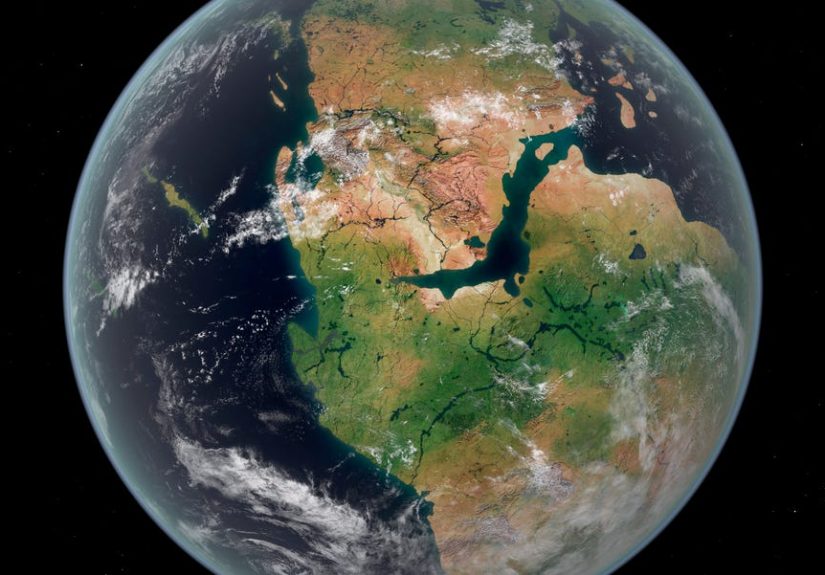
When most people hear “supercontinent,” they think of Pangaea, the celebrity version. But Pangaea was just the latest in a long line of giant landmasses that formed and fragmented over deep time. Nuna, sometimes called Columbia in scientific discussions, existed long before dinosaurs, trees, or anything remotely Instagrammable.
During the mid-Proterozoic, Earth’s continents were not fixed in place. They were moving, colliding, assembling, and breaking apart under the slow but relentless control of plate tectonics. According to the recent study, Nuna’s disintegration changed the geometry of the planet in a big way. As the supercontinent cracked and drifted apart, passive marginsthe broad continental edges that produce shallow seas and shelvesexpanded dramatically.
That matters because shallow marine environments are often biologically rich. They are better lit, more chemically dynamic, and more connected to nutrient delivery from land than the deep open ocean. In the new model, the total length of these shallow continental shelves more than doubled over roughly 350 million years, eventually reaching about 130,000 kilometers. That is an absurd amount of coastal real estate, and for early life, it may have been premium property.
Why More Shallow Seas Could Matter So Much
Shallow seas are the geological equivalent of fertile neighborhoods. They tend to have easier access to sunlight, more interaction between rock, water, and atmosphere, and more opportunities for nutrients to circulate. If you are a tiny organism trying to become something more sophisticated, that kind of setting can make a huge difference.
Researchers argue these shelf seas may have acted as ecological incubators for eukaryotes. Eukaryotic cells are much more complex than bacterial cells. They have nuclei, internal compartments, and the kind of cellular architecture that eventually made multicellular life possible. That complexity comes at a cost: it usually requires more energy and, in many cases, better environmental conditions.
So if Nuna’s breakup created broad, temperate, oxygen-friendlier shallow seas, then Earth may have accidentally built a sprawling network of starter homes for biological innovation.
How a Broken Supercontinent May Have Changed the Climate
The research is not just about more coastline. It also links Nuna’s breakup to changes in volcanic carbon dioxide emissions and long-term carbon storage. As continents dispersed and plate boundaries reorganized, subduction zones appear to have shortened overall. Because subduction helps drive volcanic activity, that likely meant less CO2 was being released from Earth’s interior over time.
Less volcanic outgassing can help cool the climate. At the same time, new ocean crust forming in young basins may have stored more carbon in altered seafloor rocks and carbonate minerals. In plain English: Earth may have started venting less carbon dioxide into the sky while also hiding more of it in the crust. That double punch could have moderated the climate and changed ocean chemistry in ways that improved habitability.
And habitability is the key word here. The study presents plate tectonics not as background scenery, but as a major actor in the story of life. Continents move, seas spread, carbon shifts, oxygen patterns change, and biology responds. Suddenly the “Boring Billion” sounds less like a geological nap and more like a slow-cooker recipe for complexity.
The “Boring Billion” Was Probably Not Boring at All
Scientists have been rethinking this era for years. Earlier work already suggested that the middle stretch of the Proterozoic was a strange time: warm, relatively stable, and low in oxygen compared with today. For a long time, that low-oxygen picture encouraged a gloomy view. Maybe complex life stalled because the planet simply did not offer enough breathable chemical opportunity.
But newer research has complicated that story. Some studies suggest the period saw subtle but meaningful gains in eukaryotic diversity. Others argue that changes in volcanism, nutrients, sulfur chemistry, and ocean circulation all helped shape what life could and could not do. There is also evidence that oxygen levels may have varied more regionally than older broad-brush models assumed. In short, Earth was not frozen in place. It was simmering.
That simmering matters because evolution does not always need a fireworks finale. Sometimes it needs a long stretch of environmental patience. Cells can experiment. Ecologies can stabilize. Metabolisms can become more intricate. The fossil record from this time is patchy, but it increasingly looks as if important biological groundwork was being laid while Earth was quietly rearranging its continents backstage.
Oxygen Was Important, but It Wasn’t the Whole Story
Oxygen gets most of the press in conversations about early complex life, and with good reason. Bigger, more complex organisms generally need more energy, and oxygen is a powerful way to unlock it. But the mid-Proterozoic story is not simply “oxygen low, evolution slow.” That is a decent bumper sticker, but not a complete science article.
Researchers have argued that nutrient availability also mattered. Nitrogen limitation may have constrained productivity in some oceans. Sulfide-rich waters may have been toxic to expanding eukaryotic ecosystems. The timing of volcanism, weathering, shallow-water habitat expansion, and carbon cycling likely all worked together. Complex life was not waiting on one magic switch. It was negotiating a whole checklist of planetary conditions.
That is one reason the Nuna breakup hypothesis is so appealing. It is not a one-variable story. It connects tectonics, carbon, ocean chemistry, habitat size, and biological opportunity into one integrated framework. Earth was not just gaining oxygen; it was redesigning the neighborhoods where life lived.
What About the Fossils?
Fossils from the Proterozoic do not exactly arrive with name tags and a dramatic soundtrack, but they do tell us something important: eukaryotes were around during this interval, and their story seems tied to environmental change. The earliest fossil evidence for certain complex eukaryotic forms appears around 1.05 billion years ago, well after Nuna began to fragment.
That does not prove cause and effect by itself. Fossil records are incomplete, and biology rarely follows a tidy schedule written for our convenience. Still, the timing is suggestive. If expanded shallow seas, altered carbon cycling, and more stable coastal ecosystems developed after Nuna’s breakup, then the later appearance and spread of eukaryotic life starts to look less like coincidence and more like a planetary setup.
And that is before we even get to the broader debate over early animals. Some scientists have proposed that low oxygen alone may not have been enough to prevent the earliest animal-like organisms from existing in localized pockets. Others think conditions were still too harsh and chemically unstable for anything beyond limited experiments in complexity. Either way, the mid-Proterozoic now looks less like dead air and more like the long rehearsal before the main performance.
Why This Research Matters Beyond One Ancient Supercontinent
The biggest takeaway is not just that Nuna broke apart. Continents have been doing the tectonic two-step for ages. The real takeaway is that deep Earth processes may have directly shaped surface habitability. Plate tectonics did not simply redraw maps; it may have nudged the atmosphere, ocean chemistry, climate, and ecological space into configurations that rewarded biological complexity.
That has implications far beyond Earth’s ancient past. It changes how scientists think about planetary habitability in general. When researchers look at distant rocky worlds, they are not just asking whether water existed. They are asking whether a planet can maintain the kind of long-term cycling between interior and surface that keeps environments chemically alive and evolutionarily interesting.
So yes, the idea sounds outrageous at first: a crumbling supercontinent helping life take off. But once you unpack it, the claim becomes less sensational and more elegant. Earth’s living story may depend not only on what floated in the oceans, but also on what happened deep below the crust, where continents cracked, plates shifted, and carbon quietly changed address.
Experiences That Make This Deep-Time Story Feel Real
For most people, “a supercontinent fell apart and helped complex life” sounds too gigantic to feel personal. It lives in the realm of diagrams, documentaries, and those museum timelines that make your lifespan look like a typo. But there are real-world experiences that make this ancient story easier to feel in your bones.
One of them is standing on a coastline and realizing that a continental shelf is not an abstraction. It is an actual place where land and sea negotiate with each other every minute. Walk a rocky shore, a tidal flat, or a broad beach at low tide and you see variety packed into a narrow strip: pools, channels, algae, shell fragments, changing sediments, bursts of light, and constant chemical exchange. It is messy, productive, and alive. When scientists talk about expanded shallow seas during Nuna’s breakup, they are talking about multiplying environments like that on a planetary scale. Not the exact same ecosystems, of course, but the same principle: edges are powerful.
Another useful experience is visiting a natural history museum and staring at fossil displays long enough for the labels to stop sounding like trivia and start sounding like biography. The more you learn, the stranger it gets. Life on Earth did not advance in a straight line from simple to complicated like a neat little school poster. It lurched, stalled, improvised, and waited. Entire chapters were spent preparing for the next chapter. The so-called Boring Billion is one of those chapters. It is the geological equivalent of a quiet training montage, except it lasted a billion years and involved oceans, carbon, and slowly moving continents instead of inspirational music.
There is also the experience of hiking through old rock landscapes where the scenery feels almost skeletalshield areas, canyon walls, exposed cratons, and ancient formations with very little greenery to soften them. Places like that make it easier to imagine Earth as a physical engine rather than just a scenic backdrop. Rock is not dead context. It stores chemistry, redirects water, influences climate, and creates the spaces where biology can either struggle or thrive. Once you start seeing the planet that way, the new supercontinent research stops sounding like an odd headline and starts sounding almost obvious: of course the shape of the planet mattered.
Even a simple classroom experience can make the point. Spread sand in a tray, pour water through channels, move barriers around, and suddenly the whole conversation about margins, basins, and circulation becomes visual. Change the boundaries, and the system behaves differently. Earth did that on an unimaginably larger scale. Nuna’s breakup may have rewritten circulation patterns, coastal area, and carbon storage all at once. No wonder life noticed.
That may be the most satisfying part of this story. It reminds us that habitability is not one ingredient but a relationship. Ocean meets rock. Atmosphere meets chemistry. Time meets opportunity. And somewhere in those long interactions, life finds a way to become more elaborate. That is not just ancient history. It is a lesson in how worlds work.
Conclusion
So, did a crumbling supercontinent start life on Earth? The careful answer is noat least not if we are talking about the very first microbes. But if we are talking about the rise of complex life, the answer becomes much more interesting. The breakup of Nuna may have expanded shallow seas, reduced volcanic CO2 outgassing, encouraged carbon storage, cooled the planet, and created marine environments where early eukaryotes could gain ground.
That does not mean the case is closed. Scientists are still debating how much oxygen existed, how nutrients were distributed, and how different environmental pressures interacted. But the broad picture is becoming clearer: Earth’s interior and surface were working together, and life responded. The “Boring Billion” may turn out to be one of the most important slow-burn chapters in our planet’s history.
Which is a nice reminder that on Earth, even the quiet eras can be doing something spectacular. Sometimes a broken world is exactly what opens the door to something new.