Table of Contents >> Show >> Hide
- Why Drawing Your Dream Space Works (Even If You “Can’t Draw”)
- Step One: Pick Your Mission
- How to Draw a Dream Bedroom That Actually Feels Dreamy
- 1) Start With a Simple Floor Plan (Top-Down View)
- 2) Place the “Anchor” First
- 3) Design Your Storage Like a Sneaky Genius
- 4) Layer Your Lighting (Because One Ceiling Light Is a Crime)
- 5) Pick a Color Palette That Matches Your “Vibe Words”
- 6) Add “Sleep-Friendly” Details (Because This Is a Bedroom, Not a Conference Room)
- Want It to Look “Real”? Try a Simple Perspective Drawing
- How to Draw a Dream House Without Turning It Into a Maze
- Three Dream Bedroom Examples You Can Copy (With Personality)
- Hey Pandas: Drawing Prompts to Make Your Post More Fun
- Common Mistakes (And Easy Fixes)
- Conclusion: Your Dream Space Is a StoryDraw the First Page
- Extra: of Real-Life “Hey Pandas” Experiences Around Dream-Room Drawing
There are two kinds of people in the world: the ones who can fall asleep anywhere, and the ones who can’t rest
unless their pillow is facing north, the closet door is closed, and the “mystery squeak” in the corner has been
investigated by a qualified team of detectives (you, at 1:47 a.m.).
That’s why the prompt “Hey Pandas, draw your dream house or bedroom” is weirdly perfect. It’s low stakes,
high imagination, and it turns “I wish my room felt better” into something you can actually see. No permit required.
No contractor scheduling. Just you, a pen, and a totally reasonable idea like a skylight above your bed that reveals
the Milky Way on command.
In this guide, we’ll turn that prompt into a fun, practical drawing challenge: how to sketch a dream bedroom (or an
entire dream home) that looks great on paper and makes sense in real life. Expect cozy vibes, clever layout tricks,
lighting that doesn’t scream “dentist office,” and a few examples you can steal shamelessly.
Why Drawing Your Dream Space Works (Even If You “Can’t Draw”)
Drawing a dream room isn’t about being a professional illustrator. It’s about turning fuzzy ideas“warm,” “calm,”
“I want storage that doesn’t look like storage”into something concrete. The moment you put a bed on paper, you
start noticing real questions: Where would I walk? Where would I toss my hoodie? Where does the light come from?
The best part: sketches are allowed to be messy. A dream bedroom can start as a rectangle with “BED??” written in
all caps. You’ll refine as you golike a designer, but with fewer invoices and more snack breaks.
Step One: Pick Your Mission
Option A: Draw Your Dream Bedroom
Bedrooms are the easiest place to start because they have a clear purpose: rest, recharge, and occasionally
become a laundry museum. You’ll focus on layout, comfort, storage, and mood.
Option B: Draw Your Dream House
This is the “whole cinematic universe” version. You’ll sketch zonessleep, cook, work, relaxand make choices
about flow, privacy, and where the snacks live.
Quick Trick: Choose 3 Vibe Words
Write three words at the top of your page. Examples:
cozy, airy, organized; or moody, minimal, quiet;
or bright, playful, creative. These become your “design rules” when you get stuck.
How to Draw a Dream Bedroom That Actually Feels Dreamy
1) Start With a Simple Floor Plan (Top-Down View)
Draw your room as a rectangle. Mark doors and windows. If you want to level up, use graph paper and pick a scale
(for example, 1 square = 1 foot). This keeps your drawing from becoming a fantasy where a king-sized bed fits in a
space the size of a phone booth.
Don’t know exact measurements? Estimate. The goal is proportion, not perfection. You can always revise after you
discover your closet is, in fact, larger than your optimism.
2) Place the “Anchor” First
In a bedroom, the anchor is usually the bed. Put it where it feels calm:
away from the door if possible, not jammed into a tight corner (unless you love climbing like a mountaineer), and
with enough clearance to walk around comfortably.
- Small room? Consider wall sconces or floating nightstands to free up floor space.
- Big room? Add a reading chair, a bench at the foot of the bed, or a small “landing zone” for clothes.
3) Design Your Storage Like a Sneaky Genius
Dream bedrooms look effortless because clutter has somewhere to go. In your drawing, label storage zones:
- Under-bed storage for off-season items
- Built-ins or tall shelving to use vertical space
- A storage bench for extra blankets (and the “I’ll fold it later” pile)
- Hooks and wall shelves to keep surfaces clear
If your room is tiny, “floating” pieces (like a shelf nightstand) can visually open things up. Also: mirrors can
bounce light and make a space feel biggerlike a legal optical illusion.
4) Layer Your Lighting (Because One Ceiling Light Is a Crime)
Cozy rooms aren’t lit like parking lots. They use layers:
ambient (overall glow), task (reading/desk), and accent (mood and highlights).
A bedside lamp or sconce instantly makes a bedroom feel more intentional. Bonus points for warm color temperature
lighting that doesn’t turn everyone into a ghost in family photos.
In your drawing, mark lighting points: a main fixture, two bedside lights, maybe an LED strip behind a headboard,
or a small lamp in a reading corner. (Yes, you can draw a tiny lightning bolt icon. You’re the architect now.)
5) Pick a Color Palette That Matches Your “Vibe Words”
You don’t need to be a color theorist. Try one of these reliable approaches:
- Neutral base + texture: creams, grays, taupe, wood tones, then add layered bedding and rugs.
- Warm cozy palette: earthy browns, soft terracotta, warm whites, brass accents.
- Moody cocoon: deep navy, inky green, chocolate tones, with soft lighting and plush textiles.
- Playful pop: mostly calm background + one bold accent wall or bright bedding pattern.
In your sketch, add quick swatches in the margins: “walls,” “bedding,” “rug,” “wood,” “metal.” It’s a mini mood
board without needing a thousand screenshots.
6) Add “Sleep-Friendly” Details (Because This Is a Bedroom, Not a Conference Room)
Lots of sleep experts recommend a bedroom environment that’s cool, dark, and quiet.
When you draw your dream setup, include details that support that vibe:
- Blackout curtains or shades
- Soft textiles (rug, curtains, upholstered headboard) to reduce echo
- Low-tech zone: books, plants, calm decor instead of a glowing screen shrine
- Airflow plan: fan placement, vent awareness, breathable bedding
If you want to get nerdy (the best kind of nerdy): many sources suggest a sleep-friendly bedroom temperature in
the ballpark of the low-to-mid 60s °F for many people, though comfort varies person to person.
Want It to Look “Real”? Try a Simple Perspective Drawing
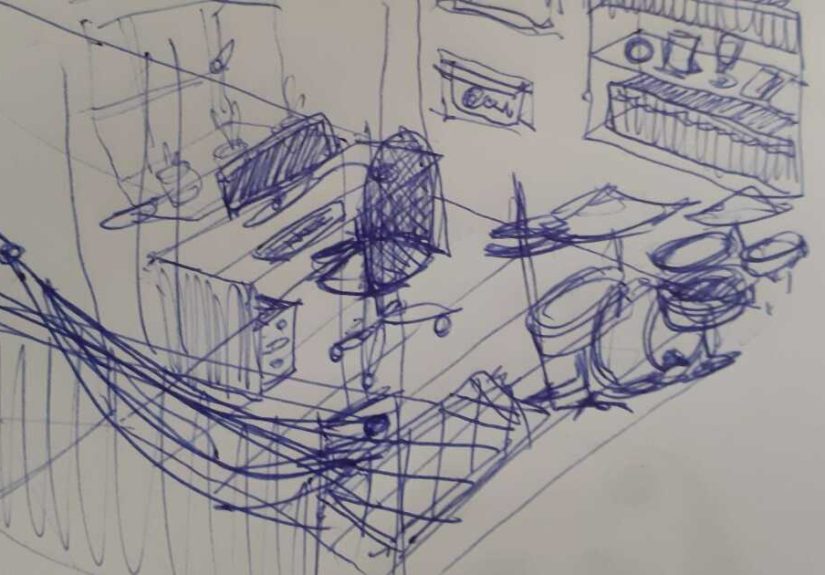
Floor plans are functional. Perspective drawings are the “wow, I want to live there” moment. The easiest method is
one-point perspective:
- Draw a horizontal line (horizon line) about 1/3 down from the top of your page.
- Put a dot in the center (vanishing point).
- Draw the back wall of the room as a rectangle.
- From each corner of that rectangle, draw light guide lines to the vanishing point.
- Add floor, ceiling, windows, bed, nightstandsanything that recedes toward the vanishing point follows those guides.
Don’t worry about perfection. Even a “good enough” perspective sketch makes your dream room feel instantly more
believable (and dramatically more shareable).
How to Draw a Dream House Without Turning It Into a Maze
1) Think in Zones, Not Rooms
A dream home usually has clear zones:
public (living/dining/kitchen),
private (bedrooms),
work (office/desk nook),
and utility (laundry, storage, mudroom).
Sketch circles first, then turn them into rooms.
2) Open Plan… With Boundaries
Open floor plans can feel bright and flexible, but “open” doesn’t have to mean “everything echoes forever.”
Use rugs, lighting, half walls, bookcases, or ceiling changes to define areas. In your drawing, show those visual
boundaries so the space feels intentional.
3) Put Storage Where Life Actually Happens
The most magical homes aren’t the fanciestthey’re the easiest to live in. Draw practical storage:
a drop zone near the entry, pantry space near the kitchen, linen storage near bedrooms, and closed cabinets for
the stuff you love but don’t want to see 24/7.
4) Design for Light Like It’s a Feature, Not an Afterthought
Mark window placement and note where morning vs. afternoon light hits. Then place the things that benefit from it:
a breakfast nook, a reading chair, plants, a desk. Light is free ambiance. Use it.
Three Dream Bedroom Examples You Can Copy (With Personality)
Example 1: The “Bookworm Cloud” Bedroom
Vibe words: cozy, soft, quiet.
Layout: bed centered on the longest wall, floating shelves as nightstands, a reading nook in the brightest corner.
Signature feature: a wall of bookshelves with a tiny rolling ladder (dramatic? yes. delightful? also yes).
Palette: warm whites, caramel wood, soft olive accents.
Lighting: two sconces + a small floor lamp near the chair + dimmable overhead.
Example 2: The “Moody Modern Sanctuary” Bedroom
Vibe words: calm, minimal, luxe.
Layout: bed with a statement headboard, low dresser opposite, a slim desk tucked into a closet nook.
Signature feature: a dark accent wall and layered textures (linen bedding, wool rug, matte metal accents).
Palette: deep navy or chocolate + warm neutrals.
Lighting: warm ambient lighting + hidden LED glow behind the headboard.
Example 3: The “Boho Sunlit Studio” Bedroom
Vibe words: bright, creative, collected.
Layout: bed near the calmest wall, art-making desk by the window, open shelving for plants and meaningful objects.
Signature feature: layered rugs and patterns that feel curated, not chaotic (pick 2–3 core colors and repeat them).
Palette: creamy base + terracotta + teal or mustard accents.
Lighting: paper lantern overhead + desk lamp + twinkle lights for pure “main character energy.”
Hey Pandas: Drawing Prompts to Make Your Post More Fun
- Draw your dream bed (canopy? built-in? floating? shaped like a spaceship? be honest).
- Draw the “cozy corner” you’d never leave (chair + lamp + blanket = happiness math).
- Draw your dream storage solution (secret drawers? hidden closet door? under-stair library?).
- Draw your lighting plan (show where warm lamps goyour future self thanks you).
- Draw your dream view from the window (city skyline, ocean, forest, or… a perfectly quiet alleyway).
- Bonus: draw one-point perspective of your room for extra “wow.”
Common Mistakes (And Easy Fixes)
Mistake: “Everything is against a wall.”
Fix: Pull a chair into a corner with a lamp. Add a rug that defines a mini-zone. Rooms feel designed when they have
destinations, not just furniture lined up like it’s waiting for a bus.
Mistake: “The room has one light and it’s rude.”
Fix: Add at least two more light sourcesbedside + corner lamp is the easiest combo.
Mistake: “The drawing is cute… but where does the stuff go?”
Fix: Label storage. Every dream room needs a plan for real life: baskets, drawers, shelves, closets, and a landing
zone for the daily chaos.
Conclusion: Your Dream Space Is a StoryDraw the First Page
The whole point of the “Hey Pandas” prompt is that it’s playful. Your dream house or bedroom can be realistic,
ridiculous, or both. Start with a quick floor plan, add lighting and storage like you’re designing for your future
self, and sprinkle in personality until your drawing feels like a place you’d actually want to exist.
Then share it. Caption it. Invite opinions. Borrow ideas. Because sometimes the fastest way to upgrade your space
is to let your imagination build it first.
Extra: of Real-Life “Hey Pandas” Experiences Around Dream-Room Drawing
If you’ve ever scrolled a “Hey Pandas” thread, you know the vibe: someone posts a drawing that looks like it took
five minutes, and the comments treat it like a museum exhibit. “Love the window placement!” “That reading nook is
elite!” “Where do I order the cat-shaped chair?” It’s wholesome, slightly chaotic, and surprisingly motivating.
People who swear they “can’t draw” still jump inbecause the goal isn’t perfect perspective, it’s sharing a vision.
One of the most common experiences is the messy-first-sketch glow-up. Someone starts with a plain rectangle
and a bed blob, then comes back with version two: a scaled floor plan on graph paper, labeled storage, lighting
points, even little arrows showing walking paths. That’s the quiet magic of drawing a dream room: your brain starts
solving problems while you doodle. It goes from “I want a bigger room” to “Ohif I float the nightstand and move
the bed, I can fit a chair.” That’s not just art. That’s design thinking.
Another classic moment is the identity reveal. Dream rooms are basically personality quizzes with furniture.
The minimalist draws clean lines, a neutral palette, and a single plant that looks emotionally stable. The maximalist
draws patterned walls, layered rugs, string lights, wall art everywhere, and a cozy corner that clearly hosts at least
three hobbies. The “cozy-core” person draws blankets like they’re designing a cloud. The gamer draws cable management
so neat it deserves its own trophy. And almost everyone adds one “impossible” featurelike a skylight, a secret door,
or a window seat with built-in storagebecause dreams don’t need to pass an inspection.
A lot of people also describe the surprise calm of the process. You sit down to draw, and suddenly you’re
choosing lighting and colors and where a rug would go. It’s oddly soothinglike organizing your thoughts, but with
pillows. Even if you never redecorate, you still get the feeling of “I made something.” And that matters, especially
when life feels loud.
Then there’s the community feedback loop. Someone comments, “Add a lamp here!” Another person suggests a
storage bench. Someone else says, “Try a moody wall color.” It’s brainstorming without the awkward group project
energy. You get ideas, you refine, you repostsometimes you even end up using the drawing as a mini plan for real
changes. A shelf. A new lamp. A better layout. A room that feels more like you.
In the end, the best “Hey Pandas” experience is simple: you share a dream on paper, and people respond like it’s
possible. Because honestly? With the right layout, lighting, and a little creativity… it kind of is.