Table of Contents >> Show >> Hide
- Why “The Most Beautiful Place” Is Never Just About the View
- What Makes a Place Visually Stunning?
- 10 Beautiful Places Travelers Love to Talk About
- How to Choose Your Own “Most Beautiful Place”
- Responsible Travel Makes Beautiful Places Stay Beautiful
- What People Really Mean When They Say a Place Is Beautiful
- Personal Travel Experiences: The Kind of Beauty That Follows You Home
- Conclusion
Ask a room full of travelers, “What’s the most beautiful place you’ve ever visited?” and you will not get one answer. You will get a weather report, a family story, a near-spiritual monologue about sunlight, and at least one person pulling out 486 vacation photos while saying, “Just one more.” Beauty is like that. It refuses to stand still, put on a name tag, and behave politely.
For some people, the most beautiful place in the world is a giant natural wonder: the Grand Canyon glowing like a layered cinnamon cake at sunset, Yosemite Valley wearing waterfalls like jewelry, or Banff’s turquoise lakes looking suspiciously edited by Mother Nature’s Instagram department. For others, beauty is smaller and quieter: a cobblestone alley in an old city, a fishing village at dawn, a beach where the waves sound like the planet breathing, or a mountain trail where the only notification is a bird yelling at another bird.
This article explores what makes a place unforgettable, highlights some of the world’s most beautiful places to visit, and celebrates the kind of travel memories that stay with you long after the suitcase has returned to its regular job as a closet obstacle.
Why “The Most Beautiful Place” Is Never Just About the View
Beautiful travel destinations are rarely beautiful because of scenery alone. Yes, dramatic cliffs help. So do waterfalls, glaciers, coral reefs, ancient ruins, and skies that look like they were painted by someone with excellent taste and too much coffee. But the emotional punch usually comes from a combination of setting, timing, people, and surprise.
A place becomes unforgettable when it catches you off guard. Maybe you arrive tired, hungry, and mildly suspicious of your travel planning skills, then suddenly the clouds part over a mountain range. Maybe you walk through a quiet temple courtyard and realize your phone has been in your pocket for twenty minutes, untouched, which in modern life is basically a miracle. Maybe you stand at the edge of a canyon and feel very small, but in a comforting way, like the universe just handed you a warm cup of perspective.
What Makes a Place Visually Stunning?
While beauty is personal, certain landscapes seem to stop almost everyone in their tracks. These places usually share a few qualities: contrast, scale, color, movement, and atmosphere.
Scale That Makes You Whisper
The Grand Canyon is a perfect example of scale doing all the talking. Its vastness is difficult to understand from photos because the human brain sees an image and says, “Nice hole.” Then you stand there in person and realize the “hole” contains millions of years of geologic history, shifting shadows, deep side canyons, and rock layers that turn gold, red, purple, and brown depending on the hour. Suddenly your brain apologizes.
Color That Looks Almost Unreal
Some destinations are famous because their colors seem too intense to be natural. Banff National Park in Canada is known for Rocky Mountain peaks and glacial lakes that can appear turquoise due to fine rock flour suspended in the water. The Great Barrier Reef dazzles with coral gardens, blue lagoons, and marine life. Santorini, Greece, charms visitors with whitewashed buildings, deep blue domes, and sunsets that cause entire crowds to fall silentuntil someone starts clapping, because apparently the sun needed encouragement.
Movement That Gives the Landscape a Pulse
Waterfalls, waves, clouds, and wildlife make a beautiful place feel alive. Yosemite’s waterfalls are not just decorative; they add sound, mist, motion, and drama to the granite cliffs. Iguazú Falls on the Argentina-Brazil border overwhelms visitors with hundreds of cascades, while Iceland’s waterfalls, black-sand beaches, glaciers, and volcanic scenery create a landscape that looks like Earth is still deciding what genre it wants to be.
10 Beautiful Places Travelers Love to Talk About
No list can settle the question of the most beautiful place ever visited, but some destinations keep appearing in travel stories for good reason. They combine natural beauty, cultural depth, and the kind of visual impact that makes people say, “Photos don’t do it justice,” which is travel-speak for “I tried, but my camera gave up.”
1. Grand Canyon National Park, Arizona
The Grand Canyon is one of America’s most iconic natural landmarks and one of the best places to understand the power of time. Its layered rock walls, carved by the Colorado River and shaped by erosion, create a view that changes constantly with the light. Sunrise feels soft and sacred; midday reveals endless detail; sunset turns the canyon into a glowing cathedral of stone.
For many visitors, the first look from the South Rim becomes a lifetime memory. The experience is not just visual. It is physical. The air feels wide. The silence feels huge. Even people who normally talk through everythingmovies, museum tours, other people’s sentencesoften pause here.
2. Yosemite National Park, California
Yosemite is a masterpiece of granite, water, forest, and sky. Yosemite Valley is world-famous for cliffs such as El Capitan and Half Dome, along with meadows, waterfalls, and dramatic rock formations. Spring and early summer often bring powerful waterfall flow, while autumn offers golden leaves and crisp air.
What makes Yosemite special is how grand and intimate it can feel at the same time. One minute you are staring up at a wall of rock so massive it seems to have its own weather system; the next, you are walking beside a quiet river reflecting trees and cliffs like a polished mirror.
3. Banff National Park, Canada
Banff looks like a place designed by a committee of mountains that refused to compromise. Located in the Canadian Rockies, it offers sharp peaks, glacial lakes, forests, wildlife, and alpine roads that make every passenger become a professional window-gazer.
Lake Louise and Moraine Lake are especially famous for their blue-green water and mountain backdrops. But Banff’s beauty is not limited to postcard viewpoints. It also lives in trail bends, cold morning air, pine-scented paths, and that tiny moment when clouds move away from a peak as if revealing a stage curtain.
4. Machu Picchu, Peru
Machu Picchu combines natural drama with human achievement. Set high in the Andes, the ancient Inca site sits among steep green mountains, cloud forest, and stone terraces that seem to belong to the landscape rather than interrupt it. The beauty here is layered: architecture, history, mystery, and mountain weather all working together.
Arriving at Machu Picchu can feel surreal, especially when mist drifts through the ruins. It is one of those places where visitors often lower their voices without being told. The setting does the instructing.
5. Great Barrier Reef, Australia
The Great Barrier Reef is beautiful in a different way because so much of its wonder lives underwater. Coral formations, reef fish, sea turtles, and shifting blue water create a living landscape. Snorkeling or diving there can feel like floating through a stained-glass window that learned how to swim.
It is also a reminder that beautiful places need protection. Coral reef ecosystems are delicate, and responsible travel matters. The best visitors are not just collectors of pretty views; they are respectful guests.
6. Santorini, Greece
Santorini’s beauty is famous, and yes, it knows. The island offers cliffside villages, white buildings, blue domes, volcanic views, and sunsets over the Aegean Sea. It is romantic, photogenic, and sometimes crowded enough to make you wonder if half the planet received the same sunset invitation.
Still, Santorini earns its reputation. Wander early in the morning, before the day-trippers arrive, and the island becomes softer: narrow lanes, quiet cats, church bells, sea wind, and sunlight warming the walls.
7. Iceland’s South Coast
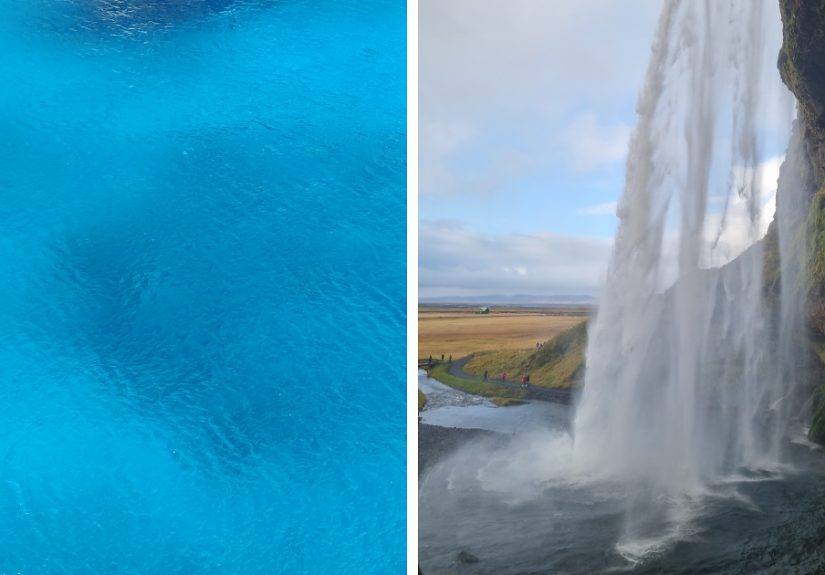
Iceland often feels less like a destination and more like a conversation between fire, ice, water, and wind. Along the South Coast, travelers can experience waterfalls, glaciers, lava fields, black-sand beaches, and dramatic cliffs. The landscape is raw, cinematic, and occasionally moody in a way that makes you forgive the weather for being dramatic.
Places like Skógafoss, Reynisfjara, and glacier lagoon areas show how powerful natural contrast can be: white ice against black sand, green moss on dark volcanic rock, silver waterfalls dropping from cliffs, and skies that change their mind every fifteen minutes.
8. The Dolomites, Italy
The Dolomites in northern Italy offer jagged peaks, alpine meadows, reflective lakes, and villages that look like they were placed carefully for maximum charm. The mountains glow pink and gold at certain times of day, creating a phenomenon often called alpenglow.
This is a place where hikers, photographers, skiers, and food lovers can all agree on one thing: beauty improves when followed by pasta. The Dolomites blend outdoor adventure with culture, making them visually spectacular and deeply enjoyable.
9. Kyoto, Japan
Not all beauty needs to shout. Kyoto is beautiful in a quieter, more composed way. Its temples, gardens, bamboo groves, seasonal blossoms, and traditional streets reward slow attention. A moss garden, a wooden gate, a stone path after rainKyoto’s details can be just as moving as a mountain range.
Spring cherry blossoms and autumn maple leaves are especially beloved, but Kyoto’s beauty is not only seasonal. It is found in balance, restraint, and the feeling that every corner has been shaped by centuries of care.
10. New Zealand’s South Island
New Zealand’s South Island is a greatest-hits album of natural scenery: fjords, mountains, lakes, beaches, forests, and wide open roads. Fiordland, Aoraki/Mount Cook, Lake Tekapo, and Queenstown are only a few highlights. The island often feels cinematic because, frankly, it has been cinematicmany travelers recognize its landscapes from films and still find the real thing more impressive.
What makes the South Island memorable is the sense of space. The roads open into valleys, clouds move over peaks, and lakes reflect the sky so perfectly that you may briefly suspect reality has excellent graphic design.
How to Choose Your Own “Most Beautiful Place”
The best destination for you depends on the kind of beauty that moves you. Some travelers want dramatic landscapes. Others want architecture, food, history, wildlife, or peace and quiet. Before planning a trip, ask yourself what kind of moment you are actually chasing.
If You Love Big Nature
Choose national parks, mountain regions, coastlines, deserts, or islands. Places like the Grand Canyon, Yosemite, Banff, Patagonia, Iceland, the Dolomites, and New Zealand are ideal for travelers who want scenery that makes them feel tiny in the best possible way.
If You Love Culture and History
Look toward places like Kyoto, Rome, Cusco, Istanbul, New Orleans, Charleston, Mexico City, or ancient sites such as Machu Picchu. These destinations offer beauty through architecture, traditions, food, music, and stories that have been accumulating for generations.
If You Love Water
Beaches, reefs, lakes, and waterfalls may be your happy place. Consider the Great Barrier Reef, Hawaii, the Maldives, the Amalfi Coast, the Florida Keys, the Pacific Northwest, or the lakes of the Canadian Rockies. Water adds movement, reflection, color, and soundthe full spa package, minus the cucumber slices.
Responsible Travel Makes Beautiful Places Stay Beautiful
One of the biggest responsibilities of modern travel is remembering that beautiful places are not backdrops. They are ecosystems, communities, sacred spaces, homes, and fragile environments. A destination does not exist just to upgrade our profile pictures.
Responsible travel can be simple: stay on marked trails, respect local customs, avoid disturbing wildlife, reduce waste, support local businesses, visit during less crowded times when possible, and learn a little about the place before arriving. Beauty deepens when you understand what you are looking at.
Travelers should also be honest about overtourism. Some famous places struggle with crowding, environmental pressure, and rising costs for local residents. Choosing slower travel, lesser-known viewpoints, shoulder seasons, or community-based experiences can make a trip more rewarding and less harmful.
What People Really Mean When They Say a Place Is Beautiful
When someone says, “That was the most beautiful place I’ve ever visited,” they may be describing more than scenery. They may mean they felt peaceful there. They may mean they were with someone they loved. They may mean the trip happened at a time when they needed wonder badly, and the place delivered it like a dramatic but reliable friend.
Beauty is often memory wearing a landscape costume. A beach becomes more beautiful because it was where you laughed until your stomach hurt. A mountain becomes more beautiful because you reached the viewpoint after a hike that made your legs file a formal complaint. A city becomes more beautiful because you got lost and found the best meal of the trip by accident.
Personal Travel Experiences: The Kind of Beauty That Follows You Home
One of the most powerful travel experiences is arriving somewhere famous and discovering that the cliché is true. The Grand Canyon really is grand. Yosemite really does make you look up until your neck negotiates a break. Banff’s lakes really are that color. The first reaction is often disbelief, followed by the very human urge to take a photo that will later look disappointingly small. This is not the camera’s fault. Some places are simply too big for rectangles.
Another unforgettable experience is finding beauty where you did not expect it. A traveler might plan a trip around a landmark, then remember a quiet side street more vividly. Maybe the most beautiful moment is not the famous cathedral but the bakery around the corner where morning light falls across the counter. Maybe it is not the popular overlook but the empty trail just before rain. Travel has a funny way of handing out bonus scenes when you stop trying to control every minute.
There is also a special kind of beauty in discomfort that turns into a story. Not danger, not recklessness, but the harmless chaos of real travel: wet socks, wrong turns, delayed buses, surprise stairs, and meals ordered with great confidence and limited understanding. At the time, these moments may feel inconvenient. Later, they become the texture of the trip. The view was beautiful, yes, but so was the ridiculous laughter after realizing the “short walk” was uphill for forty-five minutes.
Some of the best travel memories happen at sunrise or sunset because light changes everything. A place you saw at noon can become completely new when the sun drops lower. Rock turns amber. Water becomes silver. Buildings glow. Faces soften. Even a crowded viewpoint can feel quiet for a few seconds when everyone turns toward the horizon. Then phones rise into the air like a tiny digital forest, but stillthe moment counts.
Food can also make a place feel beautiful. A bowl of soup after a cold hike, fresh fruit by the sea, coffee in a mountain town, or street food eaten while sitting on a curb can become part of the scenery. Taste anchors memory. Years later, you may forget the name of the square but remember the smell of bread, the sound of scooters, or the lemony dessert that made you briefly consider moving abroad and becoming “mysterious.”
The most beautiful place someone has ever visited may not win any international award. It might be a lake near their hometown, a quiet farm road, a small beach, a grandmother’s garden, or a city park after snow. Travel teaches us to notice, but beauty does not require a passport. Sometimes the real magic is learning to look at familiar places with the same attention we give famous ones.
So, hey pandas, what is the most beautiful place you’ve ever visited? Maybe it was a world wonder. Maybe it was a national park. Maybe it was a tiny corner of the planet no travel guide has ever described properly. The best answer is not the one with the most dramatic view. It is the one that still lights up your memory when someone asks the question.
Conclusion
The most beautiful place in the world is not always the most famous, expensive, or difficult to reach. It is the place that makes you pause, breathe differently, and remember that the planet is wildly generous with wonder. From the Grand Canyon and Yosemite to Machu Picchu, Banff, Kyoto, Iceland, and the Great Barrier Reef, beauty takes many forms: scale, color, culture, silence, movement, and memory.
Whether your dream destination is a dramatic national park, a peaceful temple garden, a coral reef, a mountain village, or a beach that makes you forget what day it is, the best travel experiences come from paying attention. Go slowly when you can. Respect the places you visit. Take photos, surebut also take a moment without the screen. The view deserves it, and honestly, so do you.