Table of Contents >> Show >> Hide
- Why “Homer³” Still Feels So Weirdly Scary
- The Origin Story: From The Twilight Zone to Springfield
- Why David X. Cohen Was the Perfect Writer for “Homer³”
- How 3D Homer Simpson Was Actually Made
- The Live-Action Ending Is What Pushes It into Legend
- Why “Homer³” Became One of the Most Important Treehouse of Horror Segments
- What Watching “Homer³” Feels Like Now: A 500-Word Experience
- Final Thoughts
There are scary Simpsons moments, and then there is “Homer³”the segment from Treehouse of Horror VI that took America’s favorite donut-powered dad, shoved him through a secret wall, and dropped him into a glowing digital nightmare. For a show famous for couch gags, blunt-force slapstick, and the occasional accidental fire, this was something else entirely. It was eerie. It was ambitious. It was a little goofy. It was also the kind of thing that made viewers in 1995 sit upright on the couch and mutter, “Wait, cartoons can do that?”
That is exactly why this segment still matters. Long before every streaming show could casually throw a character into a multiverse made of expensive pixels, The Simpsons turned a Halloween short into a mini technological stunt. But the real trick was not the novelty of the 3D animation. The trick was making that novelty feel unsettling. “Homer³” is funny, yes, but it is also unnerving in a way that lingers. Its empty space, unnatural geometry, strange silence, and black-hole ending make it one of the most distinctive and quietly terrifying Treehouse of Horror stories ever made.
So how did 3D Homer Simpson happen? The answer involves The Twilight Zone, a writers’ room full of overachievers, a computer animation company willing to work for what was basically couch-cushion money, and a production team determined to do something TV animation had barely attempted. In other words: Halloween magic, but with more math jokes.
Why “Homer³” Still Feels So Weirdly Scary
When people talk about terrifying Treehouse of Horror segments, they usually start with the obvious nightmare fuel: killer clowns, dream murders, zombies, vampires, and children being chased by things that absolutely should not be chasing children. “Homer³” sneaks into that conversation from a different angle. It is not scary because something jumps out from under the bed. It is scary because it makes the whole world feel wrong.
The segment appears at the end of Treehouse of Horror VI, which first aired in 1995, and that placement matters. By the time it arrives, the episode has already primed viewers with a giant-monster parody and a Freddy Krueger riff. Then the show pivots. Instead of another monster, it gives us emptiness. Instead of blood, it gives us abstract space. Instead of a traditional villain, it gives us the horror of being trapped in a universe that does not obey the rules of Springfield, physics, or common sense.
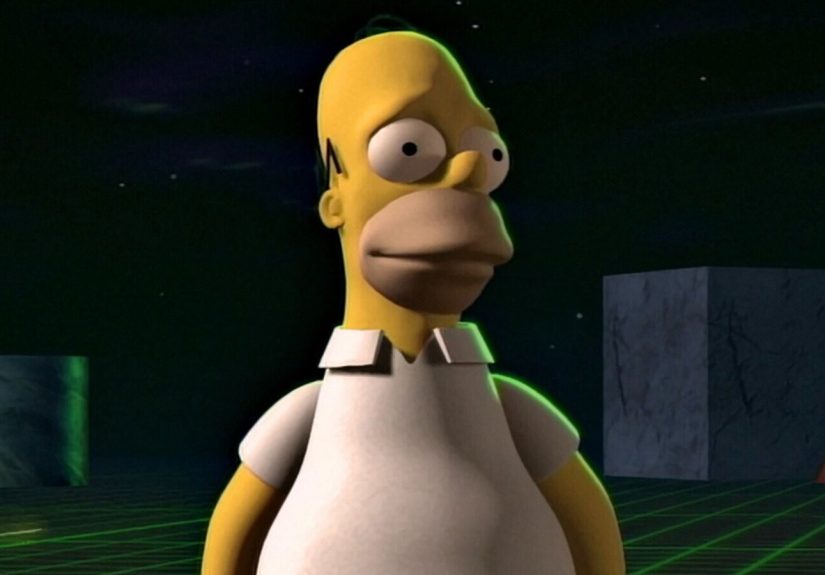
That is what makes the segment haunting. Homer is not just in danger. He is out of place. His rounded, familiar, hand-drawn body suddenly becomes a bulging digital object wandering through a sterile green grid. The setting looks playful at first, like a tech demo somebody left on during a sugar rush. Then it starts to feel lonely. Then it feels cosmic. Then a cone punctures the floor, a black hole opens, and suddenly the joke has turned into an existential crisis wearing clown shoes.
And because it is Homer, the whole thing gets even stranger. Homer is a character who normally survives everything: explosions, electrocutions, car crashes, ill-advised inventions, and diets that qualify as cry-for-help performance art. Seeing him genuinely disoriented gives the segment an emotional charge. He is still funny, but he is also vulnerable. That combination lands harder than you expect.
The Origin Story: From The Twilight Zone to Springfield
A portal, a bookcase, and one very good idea
The seed of “Homer³” came from The Twilight Zone, specifically the classic episode “Little Girl Lost.” That story involved a child slipping into another dimension, and the concept clicked for the Simpsons team almost immediately. If a little girl could vanish into another dimension, why not Homer? And if Springfield is already flat on the screen, why not make the gag literal by sending him from the “second dimension” into the third?
It is one of those ideas that feels obvious only after someone smarter than the rest of us already thought of it. That is often how the best Simpsons jokes work. They take something absurd, phrase it in the calmest possible way, and suddenly it sounds inevitable. Of course Homer would accidentally discover higher-dimensional terror while hiding from Patty and Selma. That is practically science.
The version that never happened
At one point, the concept was even bigger. The writers considered having Homer move through multiple animation styles, including cutout and clay-like worlds. That version sounds amazing, and also like the kind of production schedule that causes seasoned animators to stare blankly into the middle distance. Eventually, the team made the right call and simplified the concept. One dimension. One big swing. One very memorable visual leap.
That decision gave the segment clarity. Rather than becoming a sampler platter of animation gimmicks, “Homer³” became a focused story about entering a forbidden space. It is cleaner, funnier, and creepier because the writers did not try to cram in every clever possibility. Sometimes restraint really is the best special effect.
Why David X. Cohen Was the Perfect Writer for “Homer³”
Once the premise was locked, the segment went to David X. Cohen, who was especially well-suited to write it because the story needed more than jokes. It needed a brainy layer. Cohen brought the science-and-math flavor that makes “Homer³” feel like it belongs to the rare branch of comedy where a punchline can also wink at theoretical physics.
That is why the segment contains floating equations, visual nerd bait, and one of the slyest mathematical gags in Simpsons history. The famous near-Fermat equation was designed to look true on an ordinary calculator, which is exactly the kind of joke that makes math people cackle and everybody else nod politely while pretending they totally got it. “P equals NP” also appears in the background, which is the show’s version of slipping a tiny academic hand grenade into a Halloween decoration.
These details are easy to miss, but they matter. They make the 3D world feel more than decorative. It becomes a realm built from code, logic, and impossible-looking truth. The setting is funny because Homer has no business being there, but it is unsettling because it seems to obey a different intelligence.
How 3D Homer Simpson Was Actually Made
The near-impossible TV experiment
Now for the part that still sounds slightly bananas: the segment’s computer animation was created with help from Pacific Data Images, or PDI, at a time when TV was not exactly overflowing with cutting-edge CGI. This was 1995. Toy Story had not yet reached theaters. Prime-time animation was not in the habit of tossing beloved characters into elaborate 3D environments just because the writers were feeling spicy.
And yet The Simpsons did exactly that.
The arrangement was almost comically scrappy. PDI reportedly took on the work for a tiny fee and treated it partly as a calling card. In plain English, that means the company saw a chance to do something impossible-looking with one of the most famous properties on television and said, “Sure, we’ll lose sleep for this.” Honestly? Respect.
Making Homer work in 3D without breaking him
The challenge was bigger than simply building a model. Simpsons characters are deceptively simple in 2D. Their designs are clean, iconic, and stylized. Move them into 3D, however, and suddenly every line becomes a question. How round is Homer’s head? How does Bart’s hair exist from every angle? How do you keep the characters recognizable without making them look like cursed yellow mannequins from a mall that definitely should have closed in 1994?
That balancing act is one reason the segment still deserves admiration. The animators were not trying to reinvent the characters. They were trying to preserve them in a medium that naturally wanted to expose every awkward angle. They used reference materials, including dolls, to figure out how these famously flat designs could survive rotation. That sounds simple until you remember Bart’s hair is basically a geometry quiz with attitude.
The final look works because it embraces the oddness instead of hiding it. Homer in 3D is not smooth and Pixar-perfect. He is familiar, but off. His belly ripples. His body feels heavier. His face carries just enough extra volume to become uncanny. That slight discomfort is part of the magic.
The ideas that got cut
Like many ambitious productions, “Homer³” also left some ideas on the floor. Early versions included more characters entering the dimension, including Ned Flanders and possibly Marge. Those plans had to be scaled back because rendering Homer and Bart alone was already a serious lift. Frankly, that was probably for the best. The segment plays better when Homer feels isolated, and Flanders’ mustache may have broken a computer or two.
The Live-Action Ending Is What Pushes It into Legend
If the green-grid dimension is the hook, the live-action ending is the part that lodges in your brain forever. Homer falls through the black hole and lands in the real world, climbing out of a dumpster and wandering down a Los Angeles street while regular humans stare at him. It is funny, of course, because the whole image is absurd. But it is also deeply unnerving.
This was the first time The Simpsons dropped one of its characters into live action in such a direct way. Suddenly, the safe boundary between cartoon and reality is gone. Homer is no longer protected by yellow-space logic. He is a freakish digital object in our world, and our world is weirdly unwelcoming. Nobody screams. Nobody panics. They just look at him with the kind of mild urban concern people usually reserve for a guy arguing with a parking meter.
Then comes the final punchline: Erotic Cakes. It is the perfect ending because it restores the joke without dissolving the creepiness. Homer has escaped cosmic annihilation, crossed into reality, and what captures his attention? A neon sign promising sexy baked goods. That is The Simpsons in one image: high concept meets low impulse, all frosted with total nonsense.
The production of that live-action stretch was apparently just as scrappy as the 3D animation itself. Eyelines were guided with practical stand-ins, and the scene had the handmade feel of a show trying something it had no business pulling off on a TV budget. Which is exactly why it remains so charming.
Why “Homer³” Became One of the Most Important Treehouse of Horror Segments
Over the years, critics and fans have repeatedly ranked Treehouse of Horror VI among the strongest Halloween episodes the series ever produced, and “Homer³” usually gets singled out as one of the most memorable segments from the entire franchise. That makes sense. It is not just a joke machine. It is a moment when the show tested the edges of what television animation could be.
Its legacy works on two levels. First, it is a technical milestone. It arrived right as CGI was becoming a bigger part of the entertainment conversation, which made the segment feel both timely and ahead of its moment. Second, it is a tonal milestone. “Homer³” proved that The Simpsons could make something conceptually daring without losing its comic identity.
That balance is harder than it looks. Plenty of shows can be weird. Plenty of shows can be funny. Fewer can be weird, funny, eerie, and emotionally sticky all at once. “Homer³” does it in just a few minutes. That is why people still bring it up whenever they discuss the golden age of The Simpsons, the best Treehouse of Horror segments, or the earliest examples of television using 3D animation in a way that felt more like storytelling than stunt work.
What Watching “Homer³” Feels Like Now: A 500-Word Experience
Watching “Homer³” today is a funny experience because your brain reacts in two completely different ways at once. On one hand, the CGI is unmistakably mid-1990s. You can see the era in every shiny surface, every primitive shape, every lovingly awkward bit of digital space. On the other hand, that very dated quality is exactly what makes the segment stronger now. It feels like opening a haunted floppy disk.
Modern viewers are used to polished animation. We live in a time when blockbuster visuals are everywhere, when even commercials can look expensive enough to make your rent nervous. But “Homer³” still has power because it does not try to hide its age. It wears its technological ambition right on its sleeve, like a homemade monster costume that somehow ends up scarier than the store-bought one. The roughness gives it texture. The texture gives it mood.
There is also something uniquely intimate about returning to this segment as an adult. If you saw it as a kid, chances are you did not process it as “a pioneering TV animation experiment.” You processed it as “Why does Homer look like that, and why do I suddenly feel weird?” That feeling stays with you. Rewatching it years later is like meeting a childhood fear in a parking lot and realizing it has not gotten less strange with age. It has just learned how to explain itself better.
The first thing that stands out in a rewatch is the silence of the 3D space. Springfield is usually noisy. It is packed with chatter, music stings, interruptions, and background gags. But in “Homer³,” the environment feels exposed. There is room around Homer. Too much room. Comedy thrives on timing, and so does horror, and the segment uses that open space beautifully. Homer talks, but the world does not feel friendly enough to answer him.
Then there is the body horror, mild but effective. Homer pokes his stomach and it ripples. Bart’s hair becomes a dangerous object depending on the angle. The black hole opens from something as silly as a tossed cone. The whole place feels unstable, like the joke itself might tear. That instability is what makes the segment memorable. It is not just a cartoon world with extra dimension. It is a cartoon world that seems close to breaking apart in front of you.
The live-action ending hits differently now, too. As a kid, it can feel random and hilarious. As an adult, it feels bizarre in a more complicated way. Homer in the real world is not triumphant. He is displaced. He looks lost. The city around him barely notices, which somehow makes the image even stranger. It is as if the segment is whispering that the scariest thing is not entering another dimension. It is realizing your own world might be just as absurd.
And maybe that is why “Homer³” endures. It captures a rare emotional mix: nostalgia, dread, curiosity, and laughter. It is a technical experiment, a pop-culture parody, and a miniature nightmare all at once. Plenty of Simpsons moments are iconic. This one is iconic and uncanny. That is a harder trick to pull off than a lot of prestige television would care to admit.
Final Thoughts
How 3D Homer Simpson came to haunt one of the most terrifying Treehouse of Horror episodes is really a story about bold creative instincts meeting just enough technology to make trouble. The segment worked because the people behind it did not treat CGI as a gimmick to show off. They treated it as a doorway to a new kind of jokeand a new kind of discomfort.
That is why “Homer³” remains so beloved. It is a technical milestone, a Halloween standout, and one of the clearest examples of classic Simpsons storytelling at its smartest: take a ridiculous premise, ground it in character, layer in a few math jokes for the overachievers, and end with a punchline about cake. Somewhere between the green grid, the floating equations, and the neon sign at the end, the show created something genuinely unforgettable.
Not bad for a man who only wanted to avoid Patty and Selma.