Table of Contents >> Show >> Hide
- Step 1) Identify the setting (because “formal” and “kind” aren’t always the same thing)
- Step 2) Use her preferred name and title whenever you know it
- Step 3) When you’re unsure, default to “Ms. + her name” (it’s the least assumptive)
- Step 4) Understand traditional widow addressingthen use it only when it fits
- Step 5) In professional or official contexts, lead with her identity and title
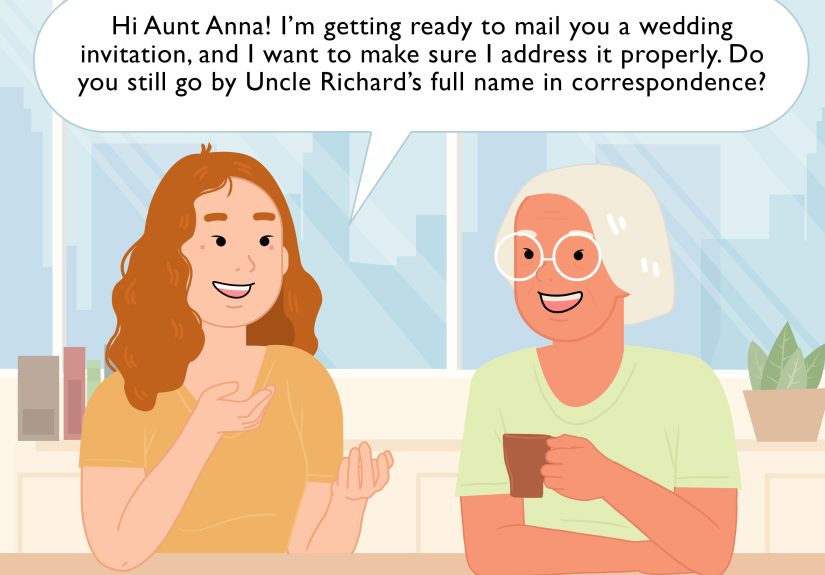
- Step 6) For invitations, decide whether you’re inviting just heror her household
- Step 7) For sympathy cards and condolence letters, warmth matters more than formality
- Step 8) When you truly don’t know, asksoftlyor choose the gentlest neutral option
- Quick Reference: Common Scenarios
- Common Mistakes (and easy fixes)
- Real-World Experiences: What People Learn After They’ve Actually Done This
- Conclusion
If you’ve ever stared at an envelope like it’s a bomb you can’t defusecongrats, you’ve met the “How do I address a widow?”
question. It feels small (it’s “just” a title), but it can land big because grief makes everything louder: what you say, what you don’t say,
and yes, what you write on the front of an envelope.
The good news: you don’t need a PhD in Etiquette Studies (minor in Calligraphy). You just need a thoughtful approach and a couple of reliable default
options. The best rule is also the simplest: address her the way she prefers. The second-best rule is a close runner-up:
when you don’t know, choose the option that’s respectful and least likely to feel like an assumption.
Below are eight practical stepsplus examplesso you can handle sympathy cards, wedding invitations, workplace emails, and introductions with tact,
warmth, and minimal second-guessing.
Step 1) Identify the setting (because “formal” and “kind” aren’t always the same thing)
Before you pick Ms., Mrs., or anything else, ask one question: What kind of communication is this?
The “right” form of address changes depending on whether you’re writing a condolence note, inviting someone to an event, or emailing a client.
Common settings and what they usually call for
- Close relationship (friend/family): A first name often feels most supportive: “Dear Linda,”
- Sympathy card to someone you know but not well: Title + last name on the envelope can feel respectful: “Ms. Rivera”
- Formal social invitation (wedding, gala): More traditional formatting is common, but still preference-driven.
- Professional/work context: Use her name and any professional title (Dr., Judge, Captain). Avoid “Mrs. Late Husband’s Name.”
This isn’t about being “extra.” It’s about matching tone. A condolence message is personal; a wedding invitation is ceremonial; a work email is
identity-and-role forward. Your address line should follow the same logic.
Step 2) Use her preferred name and title whenever you know it
The most respectful choice is always the one she already uses. If you’ve received mail from her, check the return address label. If you’re corresponding
by email, check her signature. If she’s in your contacts, see how she’s saved there (and maybe update your address book while you’re at it).
What “preference” might look like in real life
- Ms. Jane Smith (common modern default; doesn’t signal marital status)
- Mrs. Jane Smith (common, especially if she used Mrs. during marriage)
- Mrs. John Smith (traditional form some widows still prefer, especially in older generations or formal circles)
- Jane Smith (no titlecommon in casual contexts or when she explicitly prefers it)
- Dr. Jane Smith (professional title overrides courtesy titles in most formal/professional settings)
If you’re working from partial information, choose the option that aligns with what you know, not what you assume. Which brings us to the
safest default step.
Step 3) When you’re unsure, default to “Ms. + her name” (it’s the least assumptive)
If you don’t know whether she uses Mrs., kept her married name, returned to a prior name, or simply can’t stand old-school conventions, Ms.
is a widely accepted, respectful fallback. Think of it as the “I respect you as a person, not as a marital status” option.
Safe defaults you can use confidently
- Envelope: Ms. Jane Smith
- Salutation (formal): Dear Ms. Smith,
- Salutation (warm but not overly familiar): Dear Jane,
“Ms.” also avoids the subtle sting some people feel with “Mrs.” if it implies dependence on a spouse’s identity. When in doubt, choose dignity over tradition.
Step 4) Understand traditional widow addressingthen use it only when it fits
Traditional etiquette in the U.S. has long included addressing a widow as “Mrs. [Husband’s First Name] [Last Name]”for example,
“Mrs. Henry Jones.” You’ll still see it in formal invitation guidance and older correspondence conventions.
Here’s the key: traditional does not automatically mean preferred. Some widows genuinely like the continuity. Others find it outdated,
impersonal, or painfulespecially soon after the loss. Your job isn’t to “get the rule right.” Your job is to be respectful.
When the traditional form can be appropriate
- She used that form during marriage and continues to use it.
- You are writing in a highly formal social context where that convention is common.
- A family member confirms she prefers it.
When to avoid it
- Work or professional settings (it can feel inaccurate or out of place).
- You suspect she dislikes being identified through her late spouse.
- It’s soon after the death and you want to minimize anything that could feel sharp.
A modern compromise in formal mail is often “Mrs. Jane Smith” (if you’re confident she uses Mrs.) or “Ms. Jane Smith”
(if you’re not). Both read clean, respectful, and human.
Step 5) In professional or official contexts, lead with her identity and title
Workplace messages, client correspondence, and official letters should generally use the recipient’s name and professional title if applicable. If she’s a
doctor, judge, professor, clergy member, or military officer, that title typically takes priority over Mrs./Ms.
Professional examples
- Envelope: Dr. Jane Smith
- Email greeting: Hello Dr. Smith,
- Formal letter: Dear Judge Smith:
Also: skip any wording that points to widowhood in a professional address line. “Widow of…” isn’t an address. It’s a biographyand not one she asked you to write.
Step 6) For invitations, decide whether you’re inviting just heror her household
Invitations are where people panic the most because the envelope feels like it’s being graded by an invisible etiquette committee. Relax: your goal is clarity
and respect.
If you’re inviting only her
- Outer envelope: Ms. Jane Smith
- Inner envelope (optional): Ms. Smith
If you’re inviting her and a named partner
- Outer envelope: Ms. Jane Smith and Mr. Alex Brown
- Inner envelope: Ms. Smith and Mr. Brown
If you’re offering a plus-one but don’t know who
- Outer envelope: Ms. Jane Smith
- Inner envelope: Ms. Smith and Guest
One sensitivity note: if the loss is recent, consider whether “and Guest” could feel jarring. Some invitation guides suggest avoiding it soon after the death
and instead making any plus-one clarification privately and gently.
Step 7) For sympathy cards and condolence letters, warmth matters more than formality
A sympathy card isn’t a legal document. It’s a human moment. If you know her well, using her first name can be the most comforting approach.
If you don’t, use a respectful title and last name on the envelope and a simple greeting inside.
Examples for a sympathy card
- Envelope (close): Jane Smith
- Inside (close): Dear Jane,
- Envelope (formal): Ms. Jane Smith
- Inside (formal): Dear Ms. Smith,
If you’re sending something to the household (especially when multiple people are grieving), you can address the envelope to the family:
The Smith Family or Jane Smith and Family. That can reduce the pressure to “get the title perfect” while still being thoughtful.
A quick “don’t make it weird” checklist
- Don’t use “Mrs.” if you know she prefers “Ms.” (or vice versa).
- Don’t mention widowhood as a label (“Dear Widow…” is not a thingever).
- Don’t overthink the envelope so much that you never send the card.
The message inside matters most. A simple, sincere condolence with a specific memory or offer of support will outshine perfect stationery etiquette every time.
Step 8) When you truly don’t know, asksoftlyor choose the gentlest neutral option
If you’re close enough to ask without adding stress, a gentle question can be the most respectful move:
“I want to address this the way you preferdo you use Ms. or Mrs.?” Keep it short, casual, and non-dramatic.
If asking would burden her (especially soon after the loss), go with a neutral option:
Ms. + her full name for formality, or her first name if you’re close.
If you’re worried about mail delivery details
Use the name that matches the mailbox label when possible. If she’s temporarily staying with family and you’re addressing mail “in care of” someone else,
format it clearly (for example, “Jane Smith, c/o Robert Smith”) so it arrives without confusion.
Quick Reference: Common Scenarios
| Scenario | Envelope | Greeting Inside |
|---|---|---|
| Close friend, sympathy card | Jane Smith | Dear Jane, |
| Acquaintance, sympathy card | Ms. Jane Smith | Dear Ms. Smith, |
| Formal invitation, you’re unsure | Ms. Jane Smith | Ms. Smith |
| Formal tradition is expected and confirmed | Mrs. Henry Jones | Mrs. Jones |
| Work email | (No envelope) Hello Ms. Smith, | Hello Ms. Smith, |
| Professional title applies | Dr. Jane Smith | Dear Dr. Smith, |
| Inviting her and named partner | Ms. Jane Smith and Mr. Alex Brown | Ms. Smith and Mr. Brown |
| Inviting the household | The Smith Family | Dear Smith Family, |
Common Mistakes (and easy fixes)
Mistake: Assuming “Mrs.” is always correct
Some widows keep “Mrs.” and some don’t. If you’re not sure, “Ms.” is a safer courtesy titleor use her first name if you’re close.
Mistake: Using “Mrs. [Late Husband’s Name]” in professional life
In a workplace setting, it can feel outdated or inaccurate. Use her name and role instead (Ms./Dr./Judge + last name).
Mistake: Letting etiquette anxiety stop you from reaching out
The perfect address line is not the point. The point is kindness. A card addressed “Jane” that arrives with love beats a flawless envelope that never gets sent.
Real-World Experiences: What People Learn After They’ve Actually Done This
Let’s talk about the part no one admits: most people don’t mess this up because they’re careless. They mess it up because they’re trying so hard to be
respectful that they freezethen they default to whatever their grandmother’s etiquette book once shouted at them in all caps.
One common experience shows up in families after a death: someone starts managing mail, thank-you notes, and event invites, and suddenly the surviving spouse
receives letters addressed three different ways in the same week“Mrs. John Smith,” “Mrs. Mary Smith,” and “Ms. Mary Smith.” The widow usually isn’t keeping
score on who used which; she’s noticing who showed up with care. But people around her can be. Adult children, siblings, or close friends sometimes have strong
feelings about what “should” be used, and that can create awkward side conversations. The practical takeaway: if you’re part of a community circle, it helps to
quietly align on what she prefers so others can follow.
Another frequent situation: workplace condolences. Coworkers want to be kind, but they also don’t want to be overly personal. That’s where “Ms. + last name”
(or a professional title) shines. It communicates respect without implying intimacy. People also learn that the greeting inside the card can soften the formality:
“Dear Ms. Smith,” on a company card is fine, but “Thinking of you, Jane” at the end can add warmth if it matches your relationship.
Invitations are the third “experience hotspot,” especially weddings. Couples building guest lists often realize their spreadsheets weren’t designed for life’s
complicated chapters. A widow may be invited alone, with family, orsometimeswith a new partner. Many hosts learn a simple strategy: write the envelope in the
most respectful, accurate way you know (“Ms. Jane Smith”), and handle plus-one details with a private note or a quick call. That avoids broadcasting assumptions
(like “and Guest” when she’s not ready) while still making her feel welcome.
People also discover that timing changes everything. Right after a death, some widows prefer familiar addressing that feels groundingfirst name, warm tone,
“Dear Jane.” Others prefer formal distance because they’re exhausted and don’t want emotional intensity from everyone who writes. Months later, preferences can
shift again as life reorganizes. The lesson: don’t treat a title like a permanent label. Treat it like a courtesy you’re willing to adjust as she does.
Finally, a surprisingly common experience: the “mailbox reality check.” Even if etiquette guides suggest a traditional form, mail needs to arrive. If you know
the mailbox label says “Jane Smith,” using “Jane Smith” (or “Ms. Jane Smith”) is both considerate and practical. Etiquette is supposed to help people, not
turn the postal system into an obstacle course.
In real life, the best addressing choices share three traits: they’re accurate, kind, and low-drama.
If you can manage those, you’re doing this right.
Conclusion
Addressing a widow isn’t about memorizing a single “correct” formula. It’s about choosing language that respects her identity, fits the situation, and avoids
assumptions when you don’t have enough information. If you know her preference, use it. If you don’t, “Ms. + her name” is a safe, modern defaultwhile a first
name can be the warmest choice when you’re close.
When you lead with respect, you can’t really go wrong. And if you do stumble? A sincere message still lands. Etiquette is a toolnot a trap.