Table of Contents >> Show >> Hide
- What Interviewers Really Mean When They Ask This
- The Best Structure: STAR (With a Tiny Upgrade)
- Pick the Right “Challenge” Story (The Goldilocks Rule)
- How to Build Your Answer Step-by-Step
- What to Say (And Not Say) When You’re Put on the Spot
- 3 Sample Answers You Can Customize
- Common Mistakes (AKA: How Good Answers Go Off the Rails)
- A Quick Prep Checklist (So You Don’t Wing It)
- Conclusion: A Challenge Answer That Sounds Like You (But Better Organized)
- Additional Experience-Based Insights (500+ Words)
This interview question shows up like a pop quiz you didn’t study forexcept you did study, because you’re here.
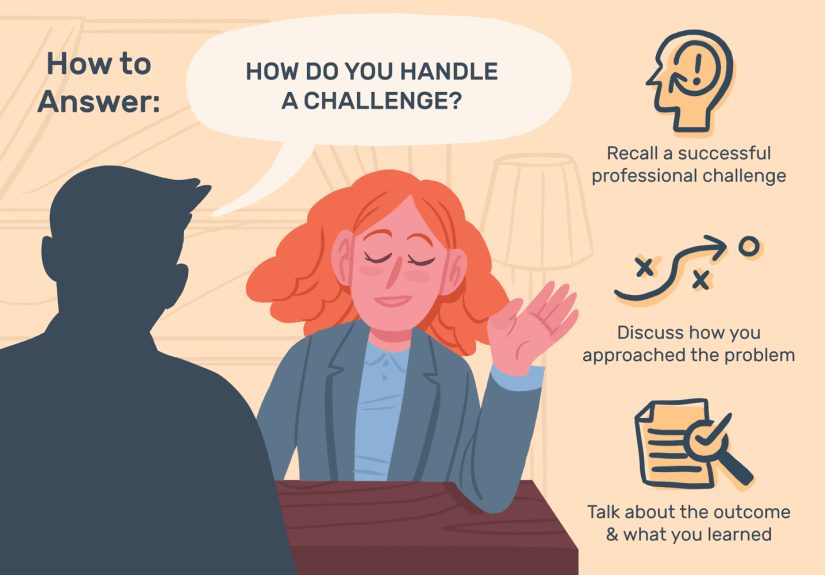
“How do you handle a challenge?” sounds simple, but it’s sneakily loaded. The interviewer isn’t collecting inspirational quotes.
They’re trying to predict how you’ll behave on a Tuesday at 4:47 p.m. when Slack is melting, the deadline is real, and someone
just wrote, “Quick question…” (famous last words).
The good news: there’s a reliable way to answer this without rambling, oversharing, or accidentally confessing to a workplace crime
(“So anyway, that’s why the printer is banned from the third floor…”). Below is a clear, human-sounding strategywith specific examples
so your answer feels confident, credible, and genuinely you.
What Interviewers Really Mean When They Ask This
“How do you handle a challenge?” is a behavioral interview question in disguise. It’s less about the challenge and more about your
problem-solving, resilience, communication, and judgment.
They’re listening for how you think, not just what happened.
They’re quietly scoring you on things like:
- Ownership: Do you take responsibility or point fingers?
- Process: Do you diagnose, prioritize, and actor panic and vibe?
- Collaboration: Do you ask for help appropriately and align stakeholders?
- Adaptability: Can you pivot when the plan gets tackled by reality?
- Results + learning: Did you improve something, or just survive it?
The Best Structure: STAR (With a Tiny Upgrade)
If your answer feels like a Netflix series that never gets to the point, use a structure. The most widely accepted is
STAR: Situation, Task, Action, Result.
Here’s the upgrade: add a quick “Lesson” at the end so you sound reflective, not robotic.
STAR-L (Situation, Task, Action, Result, Lesson)
- Situation: Set the scene in 1–2 sentences.
- Task: What was your responsibility or goal?
- Action: What you actually did (this should be the longest part).
- Result: What happened? Use numbers when possible.
- Lesson: What you learned and how you apply it now.
This structure helps you answer “How do you handle a challenge?” in a way that’s clear, concise, and memorablewithout sounding like
you copied a script off the internet.
Pick the Right “Challenge” Story (The Goldilocks Rule)
The wrong story can tank an otherwise strong interview. You want a challenge that’s real, relevant,
and solvablenot a soap opera and not a humblebrag.
Choose a challenge that is:
- Job-adjacent: It showcases skills the role actually needs (problem-solving, prioritization, stakeholder management, customer empathy).
- Meaty but not fatal: Hard enough to be impressive, not so catastrophic it raises red flags.
- Centered on your actions: You had meaningful influence on the outcome.
- Safe: Avoid confidential information, trash-talking, or “and then HR got involved.”
Great challenge categories (that interviewers love)
- Ambiguous project with unclear requirements
- Competing deadlines and limited resources
- A process breakdown you helped fix
- A difficult customer or stakeholder situation
- A mistake you owned and corrected (yes, this can be a win)
- Learning something fast to deliver on time
How to Build Your Answer Step-by-Step
Step 1: Start with a one-sentence “headline”
Give the interviewer a quick preview so they know where the story is going.
Example headline: “When a project scope changed two weeks before launch, I reset priorities, aligned the team, and still hit the deadline by simplifying the first release.”
Step 2: Keep the setup tight
Your Situation is not a memoir. Two sentences max.
Step 3: Make your actions specific (not inspirational)
Replace vague phrases like “I worked hard” with concrete behaviors: clarifying requirements, gathering data, escalating early,
communicating tradeoffs, creating a plan, testing assumptions, documenting decisions.
Step 4: Prove the outcome
Whenever possible, include measurable results:
time saved, revenue protected, customer satisfaction improved, errors reduced, cycle time shortened, stakeholder buy-in gained.
Step 5: Add the “Lesson”
End with what changed in your approach. This is the difference between “I survived a challenge” and “I grew into someone you want to hire.”
What to Say (And Not Say) When You’re Put on the Spot
Sometimes you blank. It happens. Your brain decides to reboot mid-interview like a laptop from 2009.
If that moment hits, you can buy time without looking unprepared.
Helpful stall lines that still sound professional
- “Good questionlet me think of a specific example that’s most relevant to this role.”
- “I have a couple examples; I’ll pick one that best shows how I handle ambiguity and deadlines.”
- “Before I answer, do you mean challenges with priorities, people, or technical issues?”
3 Sample Answers You Can Customize
Below are examples that work because they’re specific, balanced, and results-oriented. Don’t memorize themborrow the bones and
rebuild with your real details.
Example 1: Project ambiguity (general corporate role)
Situation: “In my last role, we were asked to launch a new onboarding flow, but requirements kept changing based on stakeholder feedback.”
Task: “I owned the project plan and needed to keep the team moving without building the wrong thing.”
Action: “I scheduled a short requirements workshop, documented decisions in a one-page brief, and set a weekly checkpoint for scope changes. I also created a ‘must-have vs. nice-to-have’ list so we could make tradeoffs quickly.”
Result: “We shipped the core flow on time, reduced last-minute change requests, and cut onboarding support tickets the next month.”
Lesson: “Now I handle uncertainty by aligning early, documenting assumptions, and creating a simple change-control process so momentum doesn’t turn into chaos.”
Example 2: Difficult customer (customer support / success)
Situation: “A customer escalated because a product bug blocked their workflow the week of their busiest season.”
Task: “I needed to de-escalate, restore trust, and coordinate a realistic path forward.”
Action: “I acknowledged the impact, asked targeted questions to reproduce the issue, and set expectations on timing. I looped in engineering with clear steps and business context, then gave the customer frequent updates and a temporary workaround.”
Result: “The customer stayed with us, the workaround kept their operations running, and engineering shipped a fix with better monitoring to prevent recurrence.”
Lesson: “When challenges get emotional, I stay calm, focus on facts, and communicate clearlypeople don’t need perfect news, they need reliable news.”
Example 3: Technical challenge (engineering / analytics)
Situation: “We discovered performance issues after a feature releasepage load time spiked and users dropped off.”
Task: “I was responsible for identifying the root cause and improving performance quickly.”
Action: “I reviewed logs, isolated the slow query, and introduced caching and indexing. I partnered with a teammate to run load tests and set thresholds so we’d catch regressions earlier.”
Result: “Load time improved significantly, the error rate dropped, and we added performance checks to the deployment process.”
Lesson: “Challenges are easier to handle when you build guardrailsmonitoring and testing turn ‘surprises’ into signals.”
Common Mistakes (AKA: How Good Answers Go Off the Rails)
- Being too vague: “I’m a hard worker” is not a strategy. Show behaviors.
- Blaming others: Even if someone else was the problem, keep your tone professional and focus on what you controlled.
- No result: If your story ends with “and then… it was fine,” you missed your chance to prove impact.
- Making yourself the hero of a disaster movie: “Only I could save the company” can read as dramatic or dismissive of teamwork.
- Choosing a challenge that reveals a dealbreaker: For example, “I hate feedback” or “I freeze under pressure.”
A Quick Prep Checklist (So You Don’t Wing It)
- Pick 3 challenge stories that show different strengths (deadlines, conflict, ambiguity, learning fast).
- Write each story in STAR-L format in bullet points.
- Add one metric to each story (time, cost, quality, satisfaction, speed).
- Practice out loud until it fits in 60–120 seconds.
- Prepare a one-sentence version in case the interview is rapid-fire.
Conclusion: A Challenge Answer That Sounds Like You (But Better Organized)
The best way to answer “How do you handle a challenge?” is to tell a short, specific story that shows your thinking under pressure.
Use STAR-L, keep the setup tight, make your actions concrete, and land the plane with results and a lesson learned. That’s how you turn
a generic interview question into proof that you can handle real workwithout needing a motivational poster or a dramatic soundtrack.
Additional Experience-Based Insights (500+ Words)
People often assume the “best” answer to a workplace challenge is the most impressive onethe biggest fire, the tightest deadline, the
most cinematic turnaround. In reality, the answers that land best tend to be the ones that sound believable. Not small. Not boring.
Just real. Hiring managers have an internal radar for stories that are inflated, overly polished, or suspiciously perfectlike a résumé
with “100% success rate” written all over it.
One pattern that shows up in interview debriefs (from both candidates and interviewers) is that the strongest answers usually include a
moment of decision. The challenge isn’t merely “a lot of work.” It’s a fork in the road: Do we delay launch or cut scope?
Do we escalate now or troubleshoot longer? Do we respond emotionally to a difficult stakeholder or ask better questions and reframe the problem?
That decision point is where your judgment shines. If you can name the tradeoff and explain why you chose your path, you sound like someone
who can be trusted with responsibility.
Another consistent insight: candidates often talk about “staying calm” as their main strategy. Calm is great. Calm is also invisible.
Interviewers can’t hire your inner vibe unless you translate it into actions. The most persuasive answers typically describe calm as a
sequence: “I paused, clarified the goal, gathered the facts, looped in the right people, and communicated next steps.” Calm becomes
credible when it leaves footprints.
There’s also a sweet spot in how much struggle you describe. If the story sounds effortless, it doesn’t prove resilience. If the story sounds
like a three-act tragedy, the interviewer may worry the same chaos will follow you into their organization (even if it wasn’t your fault).
The most effective “challenge” stories usually include frictionmisalignment, limited resources, a technical constraint, or a stakeholder conflict
and then show how you reduced that friction with structured thinking and communication.
A particularly useful experience-based tactic is to keep a “challenge library” of short stories that map to common themes: ambiguity, conflict,
learning fast, prioritization, and recovering from a mistake. Candidates who do this tend to feel less anxious because they’re not trying to invent
a story mid-interview. They’re selecting a story that fits. It also helps you adapt the same story to different question wordingbecause “challenge,”
“pressure,” “setback,” “obstacle,” and “difficult situation” are often asking for the same thing with different costumes.
Finally, if you want your answer to stand out, add a small “after” detail: what you changed so the challenge wouldn’t repeat. That might mean creating
a checklist, adding a monitoring dashboard, setting clearer expectations with stakeholders, updating documentation, or adjusting a process. This signals
maturity: you don’t just put out firesyou reduce the chance of future fires. And yes, it’s okay to be funny about it (“I learned to never schedule a
‘quick sync’ without an agendabecause that’s how meetings multiply.”). Humor, used lightly, can make you memorable. The key is that the substance remains
strong: clear actions, solid judgment, and a meaningful outcome.