Table of Contents >> Show >> Hide
- What Is a Function in Microsoft Visual Basic?
- The Basic Syntax for Calling a Function
- How To Create and Call a Simple Function
- Calling a Function Without Arguments
- Calling a Built-In Visual Basic Function
- Calling a Function in VBA
- Function vs. Sub: Which One Should You Call?
- Should You Use the Call Keyword?
- Passing Arguments to a Visual Basic Function
- ByVal and ByRef Explained
- Calling a Function With Optional Parameters
- Calling a Function With Named Arguments
- Calling Functions Inside Other Functions
- Common Mistakes When Calling a Function
- Best Practices for Calling Functions in Visual Basic
- Real-World Example: Calling a Function to Validate Input
- Experience Notes: Lessons From Calling Functions in Visual Basic
- Conclusion
Calling a function in Microsoft Visual Basic sounds like one of those tiny programming tasks that should take three seconds. Then you meet parentheses, return values, ByVal, ByRef, optional arguments, and the mysterious old-school Call keyword, and suddenly your code editor feels like it is asking riddles under a bridge.
The good news is that calling a function in Visual Basic is not difficult once you understand the basic pattern: write the function, pass any needed arguments, receive the return value, and use that value where it makes sense. Whether you are working in Visual Basic .NET, VBA for Excel, Access, or an older Visual Basic environment, the main idea remains friendly: a function does a job and gives something back.
In this guide, we will walk through how to call a function in Microsoft Visual Basic, how functions differ from sub procedures, how to pass arguments, how to use return values, and how to avoid common mistakes that make beginners question their life choices and the semicolon-free universe.
What Is a Function in Microsoft Visual Basic?
A function in Microsoft Visual Basic is a reusable block of code that performs a task and returns a value to the code that called it. That returned value is the key difference between a Function and a Sub. A Sub can do something, such as print text, update a worksheet, or save a file, but it does not return a value directly. A Function, on the other hand, can calculate, transform, validate, or retrieve something and hand the result back like a polite little code butler.
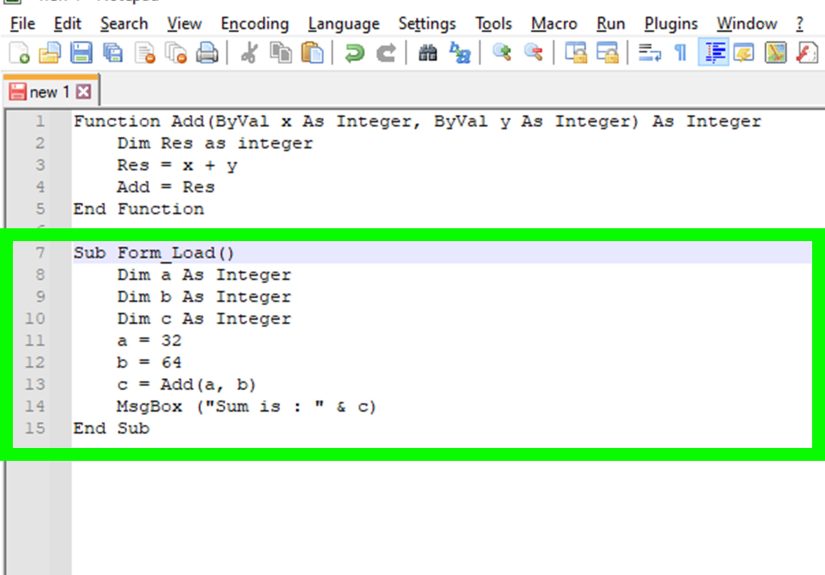
Here is a simple Visual Basic function:
This function accepts two integer arguments, adds them together, and returns the result as an integer. The function name is AddNumbers. The parameters are firstNumber and secondNumber. The return type is Integer.
To call this function, you use its name followed by parentheses containing the arguments:
After this code runs, total contains 12. No fireworks appear, but your program has successfully delegated work to a reusable function. That is programming happiness in sensible shoes.
The Basic Syntax for Calling a Function
The standard way to call a function in Microsoft Visual Basic is:
The function name tells Visual Basic which function to run. The arguments provide values the function needs. The result stores the value returned by the function. In many cases, you can also use the function call directly inside an expression:
Here, CalculatePrice(100D, 0.08D) runs first, returns a value, and then Visual Basic adds 5D to it. This is one reason functions are so useful: they can be used wherever a value of the correct type is expected.
How To Create and Call a Simple Function
Let us start with a clean beginner-friendly example. Imagine you want to calculate sales tax. Instead of writing the formula again and again, you can create a function once and call it whenever needed.
In this example, CalculateSalesTax is called from inside Main. The value 50D is passed as the price, and 0.07D is passed as the tax rate. The function returns 3.5, which is stored in the variable tax.
The letter D tells Visual Basic the number is a Decimal. That matters in money-related calculations because decimal values are often preferred for currency work. In other words, your code is not just calculating; it is wearing a tiny accountant hat.
Calling a Function Without Arguments
Some functions do not need input. They simply return something when called. For example:
Even though the function has no parameters, it is still best to include empty parentheses when calling it. This improves readability and makes it clear that GetWelcomeMessage is a function, not a variable wearing a fake mustache.
Calling a Built-In Visual Basic Function
Visual Basic also includes many built-in functions. For example, you can use Math.Sqrt to calculate a square root:
You can also call string-related functions and methods:
After this runs, formattedName contains "VISUAL BASIC". Built-in functions and methods follow the same overall idea: call the function or method, pass any required arguments, and use the result.
Calling a Function in VBA
If you are using VBA in Microsoft Excel, Access, Word, or another Office application, the structure is similar, though the environment is different. Here is a simple Excel VBA function:
Notice that this VBA function returns its value by assigning the result to the function name: DoubleValue = number * 2. That style is common in VBA. In Visual Basic .NET, Return is often clearer and more modern, though assigning to the function name is also part of Visual Basic tradition.
In Excel VBA, you may also call a custom function from a worksheet cell if the function is placed in a standard module. For example, after creating DoubleValue, you could type this into a worksheet cell:
Excel will display 50. At that moment, your spreadsheet has become slightly more powerful and approximately 17% smugger.
Function vs. Sub: Which One Should You Call?
Use a Function when you need a value back. Use a Sub when you want to perform an action without directly returning a value.
Use a Function When You Need a Result
This function returns True or False, so it fits naturally inside conditions:
Use a Sub When You Only Need an Action
The PrintGreeting procedure performs an action, but it does not return a value. Trying to store its result in a variable would not make sense because there is no result to store.
Should You Use the Call Keyword?
Visual Basic supports the Call keyword, but in most modern code, you do not need it. The simpler style is usually preferred:
Instead of:
When you use Call, arguments must be enclosed in parentheses. Also, if you use Call with a function that returns a value, the returned value is discarded. That can be useful in rare situations, but most of the time, calling a function and ignoring its return value is like ordering pizza and throwing away the pizza. Technically possible, emotionally suspicious.
For clear and maintainable code, call functions directly and store or use their return values.
Passing Arguments to a Visual Basic Function
Arguments are the values you send into a function. Parameters are the names used inside the function definition. Think of parameters as labeled parking spaces and arguments as the cars you park there. Ideally, nobody parks a string in an integer space.
Here, "Ava" is passed to firstName, and "Johnson" is passed to lastName. The function returns "Ava Johnson".
ByVal and ByRef Explained
Visual Basic lets you pass arguments by value or by reference. The two keywords are ByVal and ByRef.
Using ByVal
ByVal means the function receives a value. Changes inside the function do not replace the original variable in the calling code.
The output is still 10. The procedure changed its local copy, not the original variable.
Using ByRef
ByRef means the function or procedure can modify the original variable passed by the caller.
This time, the output is 99. Use ByRef carefully because it can make code harder to follow if values change unexpectedly. It is powerful, but so is a leaf blower indoors.
Calling a Function With Optional Parameters
Optional parameters let you call a function without providing every argument. Each optional parameter must have a default value.
The first call returns "Hello, Liam!". The second call returns "Hello, Liam.". Optional parameters are handy when most calls use the same default behavior, but you still want flexibility.
Calling a Function With Named Arguments
Named arguments let you specify which parameter receives which value. This can make code easier to read, especially when a function has several parameters.
Named arguments reduce confusion because the call clearly shows what each value means. This is much better than staring at FormatUser("Emma", "Brown", 30) six months later and wondering whether 30 is an age, a department number, or the number of coffees consumed during debugging.
Calling Functions Inside Other Functions
A function can call another function. This is one of the best ways to organize code into small, readable pieces.
Here, GetFinalTotal calls GetDiscount. Each function has one clear job. This keeps the code easier to test, reuse, and explain to another human without needing a flowchart the size of a garage door.
Common Mistakes When Calling a Function
Forgetting the Return Value
If a function returns a value, do something with that value. Store it, print it, use it in a condition, or pass it to another function.
This call may run, but the returned result is ignored. Better:
Passing Arguments in the Wrong Order
Argument order matters unless you use named arguments. If a function expects firstName and then lastName, reversing them can create awkward results.
This may return "Smith Olivia", which sounds less like a person and more like a law firm.
Using the Wrong Data Type
If a function expects an integer, do not pass text unless conversion is intentional and safe. Clear data types help Visual Basic catch errors early.
This is not a good plan. Use numeric values when numeric values are expected.
Making Functions Do Too Much
A function should usually do one clear thing. If your function calculates a total, sends an email, formats a report, updates a database, and makes coffee, it is no longer a function. It is a small software octopus.
Best Practices for Calling Functions in Visual Basic
Use descriptive function names. CalculateInvoiceTotal is clearer than DoThing. Return a specific type whenever possible. This makes your code safer and easier to understand. Prefer ByVal unless you truly need ByRef. Keep functions short enough that a future reader can understand them before their snack gets cold.
Also, avoid unnecessary use of the Call keyword in modern Visual Basic code. It is not wrong, but it often adds clutter. Write function calls in a way that makes the returned value obvious. When a function name reads like a question, such as IsValidEmail, return a Boolean. When it reads like a calculation, such as CalculateTotal, return a number.
Real-World Example: Calling a Function to Validate Input
Here is a practical example that checks whether a username is valid:
This pattern is common in real applications. The function performs the validation and returns True or False. The calling code decides what to do next. That separation keeps your program tidy and prevents your logic from turning into spaghetti with Wi-Fi.
Experience Notes: Lessons From Calling Functions in Visual Basic
When learning how to call a function in Microsoft Visual Basic, the biggest lesson is that small habits make a huge difference. The first habit is naming. A function name should explain the result it returns. When beginners write names like ProcessData, RunStuff, or FinalThing, the code technically works, but it also becomes a treasure map with half the landmarks missing. A name like CalculateMonthlyPayment or GetCustomerFullName immediately tells the reader what to expect.
The second lesson is to respect return values. Many new programmers call a function and forget to store the result. The function runs, but the useful answer disappears into the digital mist. A good habit is to ask, “What does this function give back, and where should that value go?” If the function returns a price, store it in a price variable. If it returns a Boolean, use it in an If statement. If it returns text, display it, save it, or pass it along.
The third lesson is to be careful with ByRef. It can be useful, especially when you intentionally need a procedure to update a variable from the calling code. But when overused, ByRef can create surprising changes. A value goes into a function as one thing and comes back as another, and then debugging becomes a detective show where every variable looks suspicious. Prefer ByVal unless there is a clear reason to allow the function or procedure to change the original variable.
The fourth lesson is to keep functions focused. In real projects, long functions are often the source of confusion. If a function takes many arguments, changes several values, performs unrelated tasks, and returns something vague, it becomes difficult to test. Smaller functions are easier to call correctly because their purpose is obvious. They also make error handling easier. Instead of asking, “Why did this 90-line function fail?” you can inspect a smaller piece of logic and find the problem faster.
The fifth lesson is that examples matter. Reading syntax is helpful, but writing actual function calls is where the concept becomes real. Start with tiny functions such as AddNumbers, FormatName, or IsValidInput. Then call those functions from a Sub, print the results, and experiment with changing the arguments. This practice builds confidence quickly because you see the connection between input, function logic, and returned output.
Finally, remember that calling functions is not just a Visual Basic skill. It is a programming habit that carries into many languages. Once you understand how to call a function, pass arguments, and use return values, you are thinking like a developer. Visual Basic simply gives you a readable, beginner-friendly place to practice. And unlike some languages, it usually does not make you count curly braces until your eyes file a complaint.
Conclusion
Calling a function in Microsoft Visual Basic is one of the most important skills you can learn because functions help you write cleaner, reusable, and more reliable code. The basic formula is simple: use the function name, provide any required arguments in parentheses, and use the returned value. From simple calculations to input validation and Excel VBA worksheet formulas, functions make your code more organized and easier to maintain.
As you practice, focus on clear names, correct data types, useful return values, and readable structure. Avoid making functions too large, use ByRef only when needed, and do not worry too much about the old Call keyword unless you are maintaining legacy code. Once you get comfortable calling functions, Visual Basic starts to feel less like a puzzle and more like a toolbox. And yes, the toolbox still has a few weird old wrenches in it, but now you know which ones to pick up.