Table of Contents >> Show >> Hide
- Quick Answer: Best Place to Find Iron Ore in Stardew Valley
- What Is Iron Ore Used For?
- Every Spot to Find Iron Ore in Stardew Valley
- 1. The Mines: Floors 41-79
- 2. Iron Nodes
- 3. The Quarry
- 4. The Quarry Mine
- 5. Hill-top Farm and Four Corners Farm Quarry Areas
- 6. Skull Cavern
- 7. Volcano Dungeon
- 8. Breakable Crates and Barrels in the Mines
- 9. Monster Drops
- 10. Geodes
- 11. Fishing Treasure Chests
- 12. Panning
- 13. The Blacksmith
- 14. Traveling Cart
- 15. Garbage Cans Outside the Blacksmith
- 16. Recycling Trash
- 17. Ice Pip Fish Pond
- 18. Desert Festival Shop
- Best Iron Farming Strategy for Early Game
- Best Iron Farming Strategy for Mid Game
- Best Iron Farming Strategy for Late Game
- Common Mistakes When Farming Iron Ore
- Personal Experience: What Actually Works When You Need a Lot of Iron
- Final Thoughts
If you have just reached the chilly blue levels of the Mines and suddenly need Iron Ore for everything, congratulations: you have entered the “my entire farm runs on metal now” phase of Stardew Valley. Iron is one of those resources that feels common until you need twenty bars for tool upgrades, Quality Sprinklers, Kegs, Bee Houses, bombs, and other little “just one more” projects that somehow empty your chests faster than Pierre empties your wallet.
This guide breaks down every reliable way to get Iron Ore in Stardew Valley, including the best mine floors, alternative locations, buying options, Fishing Treasure Chests, Geodes, Panning, Recycling, Fish Ponds, and late-game areas. Whether you are in Spring Year 1 with a rusty sword and questionable snack choices, or you are deep into late game turning your farm into an artisan empire, here is where to find Iron Ore and how to farm it efficiently.
Quick Answer: Best Place to Find Iron Ore in Stardew Valley
The best place to farm Iron Ore is the Mines, especially floors 41 through 79. This icy section has the highest concentration of Iron Nodes, with particularly good results on floors in the 70s. For most players, the simplest route is to use the elevator to floor 40, go down to floor 41, scan for Iron Nodes, mine what you see, then reset the floor by leaving and re-entering.
If you want the practical version: bring food, a decent weapon, a Copper Pickaxe or better, and enough patience to repeat the same floor like a farmer with a very specific rock-based grudge.
What Is Iron Ore Used For?
Iron Ore is a basic resource that can be smelted into Iron Bars. To make one Iron Bar, you need 5 Iron Ore and 1 Coal in a Furnace. Smelting takes two in-game hours, so it is smart to process ore while you farm, fish, organize chests, or stare at your crops like they owe you rent.
Iron Bars are used in many important upgrades and crafting recipes. You need them for tool upgrades, Sprinklers, Quality Sprinklers, Kegs, Bee Houses, Lightning Rods, and several machines that push your farm from “cute dirt rectangle” to “fully operational money factory.” Iron Ore is also used directly to craft Bombs once you reach Mining Level 6, which means iron helps you get even more ore later. Stardew logic: use rocks to explode rocks to get more rocks.
Every Spot to Find Iron Ore in Stardew Valley
1. The Mines: Floors 41-79
The Mines are the main and most dependable source of Iron Ore. Iron Nodes begin appearing in meaningful amounts once you reach the frozen section, especially from floor 41 onward. This area includes icy floors, Dust Sprites, Frost Jellies, and enough white-blue scenery to make you wonder whether your farmer should have packed a jacket.
For efficient farming, use the elevator. Every five floors you unlock becomes a checkpoint, which means you do not need to start from floor 1 every time. Once floor 40 is unlocked, take the elevator there, go down to floor 41, and look around. If you see Iron Nodes nearby, mine them. If the floor is empty, leave, reset, and try again.
Many players like floors 41, 45, 55, 61, 65, 71, and 75 because they are easy to reach from elevator stops and often provide good visibility. Floors 71-79 can be especially rewarding, though they may take longer depending on your gear and enemy comfort level. If a floor has several Iron Nodes grouped together, bombs can save time, but do not waste Bombs on one lonely node unless you enjoy dramatic overreactions.
2. Iron Nodes
Iron Nodes are the main rock type you are hunting. When broken with a Pickaxe, an Iron Node usually gives 1 to 3 Iron Ore. If you choose the Miner profession at Mining Level 5, you receive extra ore per vein, making mining sessions more productive. For anyone planning a big Sprinkler or Keg push, Miner is a very comfortable choice.
Iron Nodes are visually distinct from regular stones, so prioritize them instead of smashing every rock on the floor. Regular rocks can still hide ladders or give stone, coal, and occasional drops, but if your mission is iron, your eyes should be trained like a tiny industrial hawk.
3. The Quarry
The Quarry becomes available after completing the Crafts Room bundles in the Community Center or purchasing the Bridge repair from Joja. Once unlocked, it can spawn many types of ore and gem nodes, including Iron Nodes.
The Quarry is not usually faster than the Mines for targeted iron farming, but it is excellent as a passive bonus. Clear the Quarry regularly so new rocks and nodes can spawn. Think of it as a free outdoor snack tray for miners: sometimes it gives you exactly what you need, sometimes it gives you a bunch of plain rocks and the emotional texture of stale crackers.
4. The Quarry Mine
The Quarry Mine is the cave located at the Quarry. It contains Copper and Iron Nodes, along with monsters such as Haunted Skulls, Copper Slimes, and Iron Slimes. It is not the best place for bulk Iron Ore compared with the regular Mines, but it counts as another valid source.
Visit it when you have the Quarry unlocked and want to collect ore while exploring. Just be prepared for Haunted Skulls. They have the charming personality of a flying headache.
5. Hill-top Farm and Four Corners Farm Quarry Areas
If you chose the Hill-top Farm or Four Corners Farm map, your farm includes a small quarry area. After reaching Mining Level 4, Iron Nodes can appear there. This is not enough to replace the Mines, but it is a convenient source that requires no travel, no elevator, and no monster ambushes before breakfast.
Check your farm quarry every few days. Clear unwanted stones to make room for new nodes. If you are trying to build early Quality Sprinklers, this small home supply can be surprisingly helpful.
6. Skull Cavern
Skull Cavern in the Desert can contain Iron Ore at any floor. However, Skull Cavern is better known for Iridium Ore, rare items, and high-risk mining runs. If you are already going there for treasure, you will pick up iron along the way. If you only need iron, the regular Mines are usually safer and more efficient.
Bring Bombs, food, strong weapons, and a clear goal. Skull Cavern is not the place to wander in with three berries, a dream, and a weapon that looks like it came free with a cereal box.
7. Volcano Dungeon
The Volcano Dungeon on Ginger Island can also contain Iron Ore. Like Skull Cavern, this is more of a late-game bonus source than a beginner farming route. You will find many valuable materials there, and iron can appear while you are hunting other resources.
Once Ginger Island is part of your routine, treat iron from the Volcano Dungeon as extra income for your resource chest. It is not the first place to go for iron, but it is another reliable spot once your save file has advanced.
8. Breakable Crates and Barrels in the Mines
Crates and barrels inside the Mines can drop Iron Ore. When you are farming floors 41-79, break containers you pass naturally. Do not cross an entire floor just to smash one barrel unless you are also looking for ladders, geodes, or monster loot.
The best approach is simple: mine the Iron Nodes first, break containers nearby, and move on. Efficiency matters. Your farmer has a bedtime, even if they keep pretending 1:50 a.m. is “basically still early.”
9. Monster Drops
Certain monsters can drop Iron Ore. Stone Golems on floors 31-39, Metal Heads on floors 81-119, and Iron Slimes can provide ore drops. This is useful while progressing naturally through the Mines, but monster farming is usually not the fastest way to collect iron.
That said, enemies in the frozen section are worth fighting because Dust Sprites drop Coal, and Coal is the other ingredient you need for smelting. Iron without Coal is like coffee without a mug: technically promising, but not very useful yet.
10. Geodes
Iron Ore can appear inside Geodes. This includes regular Geodes, Frozen Geodes, Magma Geodes, and Omni Geodes. Take Geodes to Clint at the Blacksmith and crack them open for a fee, or use a Geode Crusher once you have access to one.
Geodes are not the most targeted iron method, but they are great supplemental sources. During mining trips, collect them anyway. Even when they do not give iron, they may provide minerals, artifacts, or other useful resources.
11. Fishing Treasure Chests
Fishing Treasure Chests can contain Iron Ore, sometimes in stacks. This is especially nice in early game if you enjoy fishing and want ore before you have fully explored the Mines. The catch is that treasure chest rewards are random, so do not rely on fishing alone if you need a large number of Iron Bars quickly.
Use bait, tackle, and higher Fishing skill to make treasure hunting smoother. If you get Iron Ore from fishing, consider it a pleasant bonus. If you get bait, stone, or something weird instead, welcome to Stardew’s tiny floating lottery.
12. Panning
After unlocking the Copper Pan, you can pan sparkling spots in rivers, lakes, and other water areas. Panning may produce Iron Ore, along with other ores and minerals. It is not the fastest method, but it can be useful when you are already walking around town or exploring Ginger Island.
The best way to think about panning is “free extra stuff.” Do not build your whole iron economy around it, but do not ignore sparkles if you are nearby. Every ore counts when your farm machinery list starts looking like a construction company invoice.
13. The Blacksmith
Clint sells Iron Ore at the Blacksmith. The price is 150g each in Year 1 and 250g each from Year 2 onward. Buying ore is expensive, but it can save a project when you are short by a few pieces and do not want to spend another day mining.
For example, if you need one more Iron Bar, buying five Iron Ore may be worth it. Buying hundreds of ore early on, however, can drain your gold fast. Clint is helpful, but he is not running a charity. He is running a business, and apparently the business model is “charge farmers for the rocks they failed to hit themselves.”
14. Traveling Cart
The Traveling Cart may occasionally sell Iron Ore for 100g to 1,000g each. The price range is chaotic, so check before buying. If it is cheap and you need iron, go for it. If it is 1,000g for one ore, politely close the shop menu and pretend you did not see that financial crime.
The Traveling Cart is best for rare items and bundle help, not regular ore supply. Still, it is worth checking on Fridays and Sundays because sometimes luck wears a purple cart and parks in Cindersap Forest.
15. Garbage Cans Outside the Blacksmith
You can sometimes find Iron Ore in Garbage Cans outside the Blacksmith. This is not glamorous, but Stardew farmers are practical people. They will dig in trash, fight slimes, and give mayonnaise to villagers if the profit margin looks right.
Be careful not to rummage through trash when villagers are nearby unless you enjoy the social consequences. It is a tiny thing, but every friendship point matters when you are trying to become the most beloved trash goblin in Pelican Town.
16. Recycling Trash
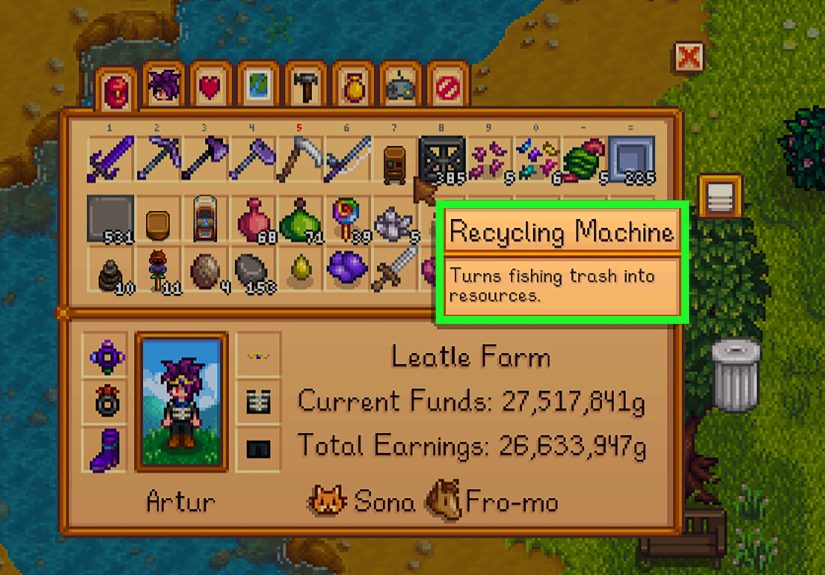
Trash can be recycled into Iron Ore with a chance of producing 1 to 3 ore. If you fish often and collect Trash, save it for the Recycling Machine. This turns a disappointing catch into useful metal, which is one of the most satisfying upgrades in the game.
Recycling is not a primary iron strategy, but it becomes excellent over time. Keep a chest near your fishing area or machines, toss in Trash, and process it in batches. Yesterday’s garbage can become tomorrow’s sprinkler. Inspirational? Maybe. Sanitary? Let’s not ask questions.
17. Ice Pip Fish Pond
An Ice Pip Fish Pond can produce 5 Iron Ore when the pond population reaches 3. This is a niche but real source, and it fits well into farms that already use Fish Ponds for resources. It is not as fast as mining, but it is passive, which means the fish do the work while you run around doing farmer chaos.
If you enjoy Fish Ponds, an Ice Pip pond can provide occasional iron while also adding variety to your farm. If you only care about raw speed, stick with the Mines.
18. Desert Festival Shop
During the Desert Festival, Iron Ore can be purchased from Clint’s festival shop for Calico Eggs. This is a version 1.6 option and gives players another seasonal way to stock up. It is not available all year, but it is worth remembering if you are attending the festival and have extra event currency.
Best Iron Farming Strategy for Early Game
For early game, your goal is to reach floor 40 as soon as reasonably possible. Do not try to reach it all in one day. Unlock elevator checkpoints every five floors, bring food, upgrade your Pickaxe when you can, and avoid fighting every monster unless necessary.
Once you unlock floor 40, start farming floor 41. Take the elevator to 40, climb down, scan for ore, mine what is visible, then leave and repeat. This method is simple, safe, and effective. If you have enough energy and health, continue deeper through floors 45, 50, 55, 60, 65, 70, and 75. The deeper frozen floors can reward you with more nodes, gems, and Coal from Dust Sprites.
Best Iron Farming Strategy for Mid Game
In mid game, you should have a better Pickaxe, stronger weapon, more food, and maybe Bombs. This is when Iron Ore farming becomes much faster. Instead of carefully tapping every rock, use Bombs on clusters of ore and stone. You will collect ore, reveal ladders, and save energy.
Farm floors 41-79 for Iron Ore and Coal at the same time. Coal is often the real bottleneck because every Iron Bar needs one Coal. Dust Sprite farming in the icy Mines is useful because it supports smelting while you collect iron. A chest near the Mines entrance can also help you store food, bombs, and extra supplies.
Best Iron Farming Strategy for Late Game
Late-game players can combine several sources. The Mines remain the best targeted iron location, but Skull Cavern, the Volcano Dungeon, the Quarry, Fish Ponds, Recycling Machines, and purchased ore can all contribute. If you have strong income from wine, truffles, ancient fruit, or other artisan goods, buying a small amount of Iron Ore may be more efficient than spending a whole day mining.
However, for massive projects such as Keg sheds, Bee House fields, or large sprinkler layouts, mining still wins. A focused day in the Mines can produce a large amount of ore, Coal, gems, and other useful materials. Add coffee or speed-boosting food, and your farmer becomes a tiny mining tornado with a backpack.
Common Mistakes When Farming Iron Ore
Mining the Wrong Floors
New players often search for Iron Ore too early in the Mines. Copper dominates the first section. If you are still on floors 1-39, iron will be rare or inconsistent. Push to the frozen levels first, then begin serious iron farming.
Ignoring Coal
Iron Ore is only half the equation. Without Coal, your Furnace sits there like a decorative metal oven. Kill Dust Sprites, break crates, use Charcoal Kilns if needed, and save Coal instead of spending all of it on random crafting projects.
Crafting Too Many Basic Sprinklers
Basic Sprinklers use Iron Bars, but many players prefer saving iron for Quality Sprinklers, which cover more tiles and are easier to organize. A few basic Sprinklers can help, but mass-crafting them may slow down better upgrades. Plan your iron spending before your farm turns into a sprinkler museum.
Forgetting to Reset Floors
If a mine floor has no Iron Nodes, leave and reset. Do not waste half the day smashing every plain rock unless you also need stone or ladders. Efficient iron farming is about checking high-value floors quickly and repeating the best ones.
Personal Experience: What Actually Works When You Need a Lot of Iron
In my experience, Iron Ore is the first resource in Stardew Valley that teaches you to plan ahead. Copper feels manageable because early upgrades come slowly, but iron arrives right when the farm starts asking for everything at once. You want better tools. You want Quality Sprinklers. You want Kegs. You want Bee Houses. You want Bombs. Suddenly, one innocent stack of Iron Ore disappears like snacks at a sleepover.
The most reliable routine is still the classic elevator method. I like to start at floor 40, drop to 41, and check the layout immediately. If there are Iron Nodes close to the entrance, I mine them. If not, I leave and reset. When I have more time and food, I run deeper into the 50s, 60s, and 70s. The 70s often feel especially generous, but they can also be more annoying depending on enemies and floor shape. When a floor is packed with stones and ore, that is when Bombs shine.
One underrated tip is to farm iron and Coal together instead of treating them as separate chores. The frozen Mines are great because Dust Sprites can drop Coal, and Coal is what turns your ore into bars. A player who brings home 80 Iron Ore but only 3 Coal is not done farming; they have merely collected shiny homework. Spend time fighting Dust Sprites as you move through the iron floors, and your Furnace schedule will feel much smoother.
I also recommend upgrading your Pickaxe before doing long iron sessions. You can technically mine iron with a basic Pickaxe, but it feels like stirring peanut butter with a toothpick. A Copper Pickaxe makes the process less painful, and better upgrades improve the rhythm even more. Bring food that restores both health and energy, because running out of either ends the trip early. Field Snacks, Salmonberries, Cave Carrots, cheese, or cooked meals all help depending on where you are in the game.
For casual players, the Quarry and farm quarry are great “check when passing by” sources. They will not replace the Mines, but they add up over a season. Recycling Trash is another habit worth building. At first, it seems small. Later, when machines are running and every bar matters, turning junk into ore feels like beating the game at its own cozy little economy.
The biggest lesson is simple: do not wait until you need Iron Bars to start collecting Iron Ore. Keep a dedicated ore chest, smelt bars in batches, and save Coal whenever possible. Stardew rewards preparation. Also, it rewards stubbornness, because sometimes the Mines give you five amazing floors in a row, and sometimes they give you rocks, bats, and a personal test of character.
Final Thoughts
The best way to get Iron in Stardew Valley is to farm the Mines from floors 41-79, with special attention to convenient elevator routes and ore-rich frozen floors. For most players, this is faster than buying ore, waiting on the Quarry, or hoping for Fishing Treasure Chests. Still, the smartest strategy uses every source: mine Iron Nodes, break crates, open Geodes, recycle Trash, check the Quarry, pan when convenient, and buy small amounts when time matters more than gold.
Iron Ore may not be the flashiest resource in the valley, but it quietly powers some of the best progress in the game. Once you build a steady supply, your farm opens up: better tools, better sprinklers, better machines, and fewer mornings spent watering crops until your farmer’s arms file a complaint.