Table of Contents >> Show >> Hide
- Why Sliding (Bypass) Closet Doors Are Worth It
- Before You Start: Choose the Right Sliding Closet Door Setup
- Tools and Materials Checklist
- Measure Like You Mean It: Sizing Sliding Closet Doors
- How to Install Sliding Closet Doors: 13 Steps
- Step 1: Clear the workspace (and your pride)
- Step 2: Remove old doors, track, and hardware
- Step 3: Inspect the opening for level and plumb
- Step 4: Add or confirm solid backing for the top track
- Step 5: Mark the track location and centerline
- Step 6: Cut the top track to length (if needed)
- Step 7: Install the top track level and secure
- Step 8: Attach rollers/hangers to the doors
- Step 9: Hang the rear door first
- Step 10: Hang the front door and install stops/bumpers
- Step 11: Install the bottom guide in the right spot
- Step 12: Adjust door height and alignment
- Step 13: Add pulls, trim, and do a final “glide test”
- Troubleshooting: When Your Doors Don’t Behave
- Maintenance: Keep Sliding Closet Doors Smooth
- DIY vs. Hiring a Pro: Quick Reality Check
- Extra : Real-World Experiences & Pro Tricks (So You Don’t Learn the Hard Way)
- Conclusion
Sliding closet doors (a.k.a. bypass doors) are the quiet heroes of tight spaces: they don’t swing into your room,
they don’t smack your laundry basket, and they don’t demand you rearrange furniture like a tiny, demanding interior designer.
Install them correctly, and you’ll get smooth gliding panels, a cleaner look, and a closet that finally behaves like it pays rent.
This guide walks you through how to install sliding closet doors in 13 steps, with the same priorities
a pro would use: accurate measurements, a level track, solid anchoring, and fine-tuning rollers so the doors don’t wobble,
scrape, or pop out at the worst possible moment (usually when guests are over).
Why Sliding (Bypass) Closet Doors Are Worth It
- Space-saving: No swing radius, so bedrooms and hallways stay usable.
- Cleaner sightlines: Panels overlap neatly, especially with mirrored or modern flat panels.
- DIY-friendly: Most kits are straightforward if you measure carefully and keep everything level.
- Upgradeable: You can swap panels later (mirrored, louvered, shaker-style) without reframing the opening.
Before You Start: Choose the Right Sliding Closet Door Setup
Top-hung vs. bottom-roll: what’s the difference?
Many closet systems are top-hung (rollers ride in the top track) with a small floor guide
to keep panels aligned. Some systems use a bottom track too. Top-hung setups tend to look cleaner and collect less debris,
while bottom-track systems can feel more “locked in” but need more cleaning (hello, pet hair).
Two-panel vs. three-panel bypass doors
Two-panel systems are most common: one door slides in front of the other. Three-panel systems are used for wider openings,
but hardware and sizing rules can change. Always match your hardware kit to your panel count and door weight.
Mirrored, wood, composite: pick your “door personality”
Mirrored panels brighten rooms and make closets feel bigger. Solid or composite panels hide clutter better. Louvered doors
add ventilation (nice for linen closets). The “best” choice is the one that fits your opening, matches your style, and doesn’t
weigh more than your track system was born to carry.
Tools and Materials Checklist
Most sliding closet door installation kits include track, hangers/rollers, guides, and stops. You’ll typically need:
- Measuring tape and pencil
- Level (2 ft is fine; longer is nicer)
- Drill/driver + bits (common: small pilot bit; some pulls use a 3/4-in bit or Forstner)
- Screwdrivers (Phillips and/or flat)
- Hacksaw + miter box (for cutting track cleanly)
- Stud finder (helpful) and appropriate anchors if you can’t hit framing
- Safety glasses (because eyeballs are not replaceable parts)
- Optional: shims, wood blocking/header board, silicone-based lubricant, vacuum
Measure Like You Mean It: Sizing Sliding Closet Doors
Measuring is where most sliding closet door “mysteries” are created. Measure the finished opening
(inside jamb to inside jamb, finished floor to header) and record it. Then measure again, because
the first time you were emotionally optimistic.
Measure width and height in multiple spots
Measure width across the top, middle, and bottom. Measure height on the left and right.
Use the smallest measurement as your “truth,” because doors don’t care about your best-case scenario.
Allow for overlap and track clearance
Bypass doors need a little extra width so they overlap when closed (to avoid a gap down the middle).
Many kits size each panel slightly wider than half the opening. Door height is often slightly shorter than
the opening to accommodate hangers/track and provide floor clearance. Follow your kit’s specifications for your system.
Example: For a 48-inch opening, many two-panel systems use doors around 24 1/2 inches wide each so the panels overlap.
For height, a common guideline is to size doors roughly 1 3/4 inches shorter than the finished opening (kit-dependent),
but confirm with your hardware instructions before you cut anything you can’t un-cut.
How to Install Sliding Closet Doors: 13 Steps
-
Step 1: Clear the workspace (and your pride)
Empty the closet enough to work comfortably. Lay down a drop cloth or cardboard to protect flooring.
If you’re installing mirrored doors, clear a safe leaning spot where they won’t tip or get bonked. -
Step 2: Remove old doors, track, and hardware
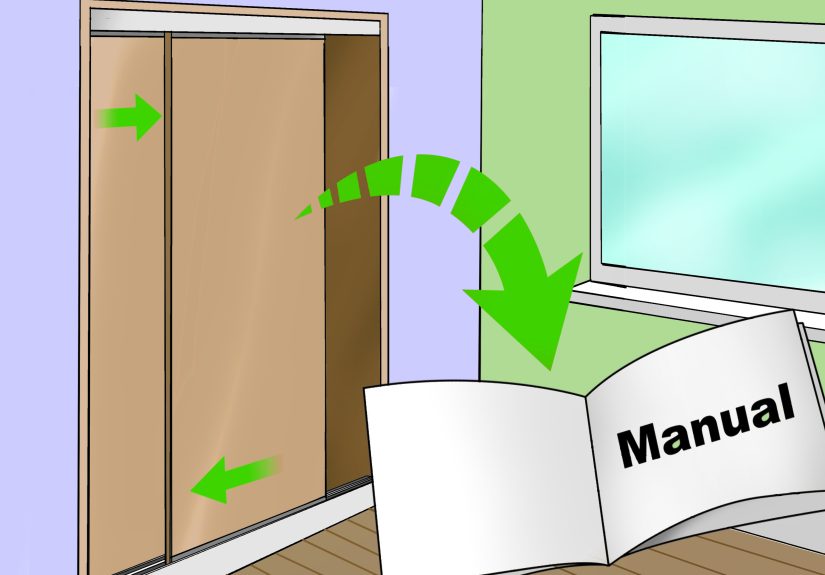
For most sliding systems, loosen bracket screws at the top, lift the door, and tilt the bottom out of the track.
Get helpdoors are awkward, not heavy until they’re suddenly heavy. Remove old tracks if they’re incompatible
or worn. Patch holes and remove protruding nails/screws so the new hardware sits flat. -
Step 3: Inspect the opening for level and plumb
Check the header and floor with a level. If the opening is out of level, the doors may “self-slide”
(dramatic on TikTok, annoying in real life). Minor issues can be handled with shims behind the track or guide.
Major issues may require correcting trim/jambs or adding a proper mounting surface. -
Step 4: Add or confirm solid backing for the top track
The top track must be fastened to something solid. Ideally, you’re screwing into framing (studs/header).
If your opening lacks good wood where the track mounts, install a straight, sturdy header board (backer)
anchored into studs, then mount the track to that. This is the difference between “smooth glide” and
“why is my track sagging like a tired hammock?” -
Step 5: Mark the track location and centerline
Dry-fit the track at the top of the opening, centered between jambs (or per your kit’s instructions).
Mark screw-hole locations using the track as a template. If the system uses two rails (front and rear),
confirm which side is front/back before drilling. -
Step 6: Cut the top track to length (if needed)
Many tracks need trimming. A common practice is to cut the track slightly shorter than the finished opening
so it fits cleanly. Use a hacksaw and keep the cut square with a miter box. Deburr sharp edges so rollers
don’t snag. -
Step 7: Install the top track level and secure
Drill pilot holes (where appropriate) and fasten the track using the provided track screws. Re-check level
as you go. If your ceiling/header is uneven, shim behind the track to keep it straight. A level track is the
“secret sauce” for quiet, effortless sliding. -
Step 8: Attach rollers/hangers to the doors
Place the doors on a protected surface. Install hangers/rollers on the top/back edge of each door,
typically about 1 to 1 1/2 inches from each side (follow your kit’s exact spacing). Use the hanger as a template
to mark holes and drill pilot holes before driving screwsthis prevents splitting and keeps hardware aligned.Pro note: Some systems include offset hangers depending on door thickness or whether the panel is front or rear.
Read the kit notes so the doors overlap correctly and don’t bump each other like shopping carts in a narrow aisle. -
Step 9: Hang the rear door first
This isn’t a traditionit’s physics. Tilt the top of the rear panel back slightly, engage the rollers in the rear rail,
then let the door hang. Slide it gently to confirm it rolls smoothly. If it binds, stop and check for burrs, crooked rollers,
or track misalignment. -
Step 10: Hang the front door and install stops/bumpers
Hang the front panel on the front rail the same way. Then install door stops or bumpers (if included) to prevent the doors
from slamming into jambs or overshooting. Adjust stop positions so the doors close neatly with a comfortable overlap. -
Step 11: Install the bottom guide in the right spot
The bottom guide keeps doors from swinging. Position it so it sits under the overlap area and the door edges ride in the guide
channels without rubbing. Many guides are adjustable for different door thicknesses. Fasten the guide to the floor with proper
screws and anchors (especially if you’re installing into concrete).If you have thick carpet, you may need a riser or spacer so the guide reaches the door properly without you having to carve a trench
into your carpet like you’re digging for treasure. -
Step 12: Adjust door height and alignment
Most bypass door hangers have an adjustment slot or cam. Support the door, loosen screws slightly, and adjust until the door is plumb
and gaps at the jambs look even. Then tighten screws firmly. Repeat for both doors. The goal: parallel doors, clean overlap, and no
scraping on the floor. -
Step 13: Add pulls, trim, and do a final “glide test”
Install finger pulls or handles at a comfortable height (many people like around 36–42 inches from the floor). Some recessed pulls require
drilling a shallow hole with a Forstner bit or large drill bitmeasure twice before drilling, because “oops” is not a style.If you’re using fascia or trim to hide the track, install it now for a finished look. Finally, slide doors open/closed repeatedly.
If anything rubs, rattles, or fights you, it’s telling you what needs adjusting. Listen to the door. It’s not being dramatic. You are.
Troubleshooting: When Your Doors Don’t Behave
-
Doors scrape the floor: Raise the rollers/hangers, confirm the bottom guide isn’t forcing the door out of plumb,
and check if carpet pile is pushing up into the door. - Doors won’t stay closed: Your track may be slightly out of level. Shim the track or adjust stops.
-
Doors rub each other: Confirm you used correct offsets (front vs rear hangers) and that the bottom guide sits under the overlap,
not pushing panels together. - Doors jump the track: Confirm rollers are seated fully, stops are installed, and the guide is tight. Some systems use anti-jump clipsinstall them.
- Rattling or rough sliding: Vacuum the track, check for metal burrs, and use a light silicone-based lubricant (sparingly).
Maintenance: Keep Sliding Closet Doors Smooth
- Vacuum dust and grit from tracks (especially if you have pets).
- Check screws and stops every few monthsdoors “walk” hardware loose over time.
- Use silicone-based lube lightly on track/rollers; avoid oily products that attract grime.
- Replace worn rollers and cracked guides before they ruin your track.
DIY vs. Hiring a Pro: Quick Reality Check
Installing sliding closet doors is a classic half-day DIY project for many homeowners, assuming the opening is reasonably square and the kit fits.
If you’re dealing with uneven floors, damaged framing, or heavy custom panels, a professional can save you time (and save your doors from becoming
“modern art” in the hallway).
As a ballpark, professional installation for sliding mirrored closet doors often falls in a few-hundred-dollar range depending on size, materials,
and local labor rates. DIY saves labor cost, but you’ll want the right tools and enough patience to adjust everything properly.
Extra : Real-World Experiences & Pro Tricks (So You Don’t Learn the Hard Way)
Here’s what actually happens in real homeswhere floors aren’t perfectly level, drywall isn’t perfectly flat, and the previous homeowner
treated “measure twice” like it was a suggestion from a fortune cookie.
Experience #1: The “My Doors Keep Rolling Open” Mystery.
This is almost always a level problem. Even a tiny slope in the top track can turn your closet doors into tiny runaway skateboards.
The fix usually isn’t ripping everything outit’s shimming. Loosen the track screws slightly, slip thin shims behind the low side, and
re-tighten while watching your level like it’s a lie detector test. Once the track is truly level, the doors stop “choosing” a side.
Experience #2: Carpet Is Not a Neutral Party.
Carpet loves to interfere. Thick pile can lift the bottom edge of the door just enough to cause scraping, or prevent the bottom guide from
grabbing the door correctly. If your guide feels too low or buried, add a riser/spacer (many systems have options for this) or mount the guide
on a thin block that matches your trim. The goal is simple: the guide should control the door, not wrestle it.
Experience #3: Rear Door First Is Not Optional.
Every DIYer tries it once: “I’ll hang the front door first. I’m built different.” Then the front door blocks the rear rail and you end up
doing a door-holding ballet while trying not to chip the corner. Hanging the rear panel first is the easiest way to keep your sanity (and your glass intact).
Experience #4: The Bottom Guide Placement Trick.
Put the guide under the overlap area where both doors pass, and align doors flush to the jamb edge before fastening. A guide that’s off-center
will force doors to angle, creating that annoying “one corner sticks out” look. Before you commit with screws, do a dry-fit: slide both doors
across the opening, watch how they track, and mark where the guide naturally wants to live.
Experience #5: Your Hardware Kit Is the Boss.
Online advice is helpful, but your specific kit dictates exact clearances, offsets, and screw types. Two kits can look similar and behave very
differently based on door thickness and roller design. A common mistake is mixing old track with new rollers (or vice versa). Sometimes it works.
Sometimes it sounds like a shopping cart that lost a wheel in 2009.
Experience #6: Micro-adjustments Make It Look Expensive.
The difference between “installed” and “installed well” is usually 10 minutes of adjustments:
tweak hanger height so gaps are even, set stops so doors close with a clean overlap, and square the panels so they don’t kiss the jamb at the top
and glare at it at the bottom. Take your time here. This is where your project goes from “DIY” to “did you hire someone?”
Experience #7: Clean Tracks = Quiet Life.
If you want buttery sliding, keep tracks clean. Vacuum first, then wipe. Use silicone-based lubricant lightly if needed. Avoid heavy grease,
because dust will move in and never leave. Think of grease like an open invitation to every crumb in your home.
Experience #8: Handles and Pulls Are a Comfort Upgrade.
Finger pulls look sleek, but choose placement thoughtfully. Too low and you’ll crouch every time. Too high and shorter family members will
treat the closet like a climbing wall. A good rule is “comfortable hand height,” then test it by pretending you’re holding laundry.
If it feels natural, it’s right.
Conclusion
Installing sliding closet doors isn’t complicated, but it is precise. Measure carefully, mount the top track level, hang the rear door first,
place the bottom guide correctly, and adjust the rollers until everything glides smoothly. Do those things, and your closet doors will stop being
a daily nuisance and start acting like the calm, functional upgrade you paid for.