Table of Contents >> Show >> Hide
- What a Lead Does (and Why You’ll Want One)
- Quick Answer: The Current Lead Recipe (Newest Versions)
- How to Get String Fast (Without Turning It Into a Whole Saga)
- Legacy Recipe: If Your Game Still Demands a Slimeball
- How to Use a Lead in Minecraft (Step-by-Step)
- Newer Lead Updates You Should Know (So Your Info Isn’t Stuck in 2022)
- Practical Examples: Using Leads Like a Pro
- Troubleshooting: Why Your Lead Keeps Breaking (and How to Stop It)
- FAQ: Lead Crafting and Usage
- Conclusion
- Player Experiences Related to “How to Make a Lead in Minecraft” (Extra)
If you’ve ever tried to move a cow across a river, through a forest, and into a carefully built pen, you already know the truth:
animals in Minecraft have the survival instincts of a shopping cart on an icy parking lot. That’s why the Lead
(also called a leash) is one of the most underrated quality-of-life items in the game.
In this guide, you’ll learn how to make a Lead in Minecraft using the latest recipe, how to use it on mobs,
how to tie animals to fences (so they stop “exploring” your crops), and how to avoid the classic “why did my Lead snap?” moment.
We’ll also cover what changed in newer versions so you’re not chasing a Slimeball for no reason.
What a Lead Does (and Why You’ll Want One)
A Lead lets you leash certain mobs so they follow you, then secure them by tying the Lead to a fence post
(or other leash-friendly anchors, depending on your version). It’s perfect for:
- Moving animals to a new barn, pen, or breeder setup
- Transporting horses, llamas, and other “I’m fast but I refuse to cooperate” companions
- Keeping mobs from wandering off while you build (or while you panic-craft a fence)
- Organizing farms, stables, and trading outposts so everything looks intentional
Think of it as the friendly handshake between you and Minecraft’s chaos. Not a magic remote controlmore like a polite “please come with me”
that still requires some planning.
Quick Answer: The Current Lead Recipe (Newest Versions)
In many newer versions of Minecraft, the Lead no longer requires a Slimeball. Instead, you craft it using 5 String
in a specific pattern on a Crafting Table. The recipe makes 2 Leads at a time.
Ingredients
- 5 String
- Crafting Table (3×3 grid)
Crafting Pattern (5 String)
Place the String in the Crafting Table like this:
Drag the output into your inventory and you’ll get 2 Leads. If your recipe book still shows a Slimeball requirement,
jump to the “Legacy Recipe” sectionyour world/version is using the older crafting rule.
How to Get String Fast (Without Turning It Into a Whole Saga)
String is one of those items you “always have” until you urgently need five of it. Here are reliable ways to gather it:
- Spiders: A classic sourceespecially at night or in caves.
- Cobwebs: Found in mineshafts and some structures; cut them efficiently and collect String.
- Chests/loot: You’ll often find a little String while looting early-game structures.
- Trading/other sources: Depending on your playstyle and game mode, String can show up in multiple progression paths.
Pro tip: If you’re short by one or two, check your “junk drawer” chests. String loves hiding between rotten flesh and that single beetroot seed
you swear you’ll plant someday.
Legacy Recipe: If Your Game Still Demands a Slimeball
Some versions (and many older guides) use the original Lead recipe: 4 String + 1 Slimeball. If that’s what your recipe book shows,
you’re not doing anything wrongyou’re just playing under the older rules.
Ingredients (Legacy)
- 4 String
- 1 Slimeball
Crafting Pattern (Legacy: Slimeball + String)
This pattern matches the newer one, except the center slot is a Slimeball instead of String:
If you do need Slimeballs, you can get them from slimes (often in swamps or certain underground areas depending on world conditions).
It’s a very “Minecraft” moment: you set out to craft a leash and end up tracking moon phases and swamp humidity like you’re doing field research.
How to Use a Lead in Minecraft (Step-by-Step)
Crafting the Lead is the easy part. Using it smoothly is where you go from “new rancher” to “efficient livestock logistics professional.”
1) Leash a Mob
- Put the Lead in your hand (hotbar).
- Walk up to a compatible mob.
- Use/interact on the mob to attach the Lead.
Once attached, the mob will follow you as you move. Try not to sprint around tight corners like you’re late for an appointmentyour cow is not built
for parkour.
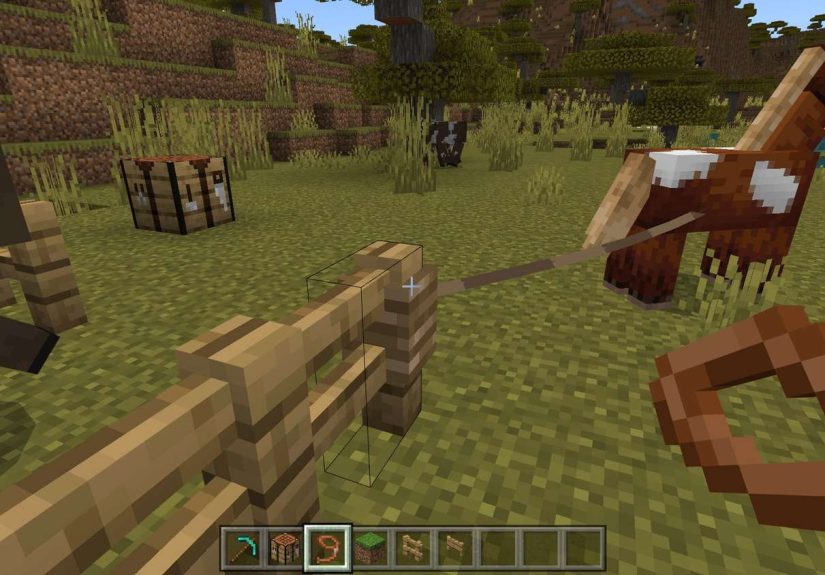
2) Tie the Lead to a Fence (So the Mob Stays Put)
- Leash the mob with the Lead.
- Walk to a fence post.
- Use/interact on the fence post to tie the Lead.
You can tie multiple mobs to the same fence post, which is perfect for temporary holding pens, building projects, or that moment you realize you brought
home three animals and built exactly zero fences.
3) Unleash the Mob
To remove a Lead, interact with the mob or the leash knot (the little hitch point). In newer versions, you may also be able to use Shears
to cut leashes cleanlyespecially useful when you’ve created a tangled web of animals that looks like a farm and a spaghetti factory collaborated.
Newer Lead Updates You Should Know (So Your Info Isn’t Stuck in 2022)
Minecraft has recently made leashing feel more modern and less like you’re operating a medieval pulley system. Depending on your edition/version,
you may notice improvements like:
- Longer leash snapping distance: Many cases now allow up to about 12 blocks before the leash breaks.
- Shears interactions: Shears can be used to snip or remove leashes more conveniently.
- Leashing boats: You can leash a boat to move it without constant pushing.
- Leashing mobs together: Some newer mechanics let you connect entities more flexibly (great for controlled movement).
- Multiplayer fairness: Many updates aim to prevent “stealing” someone else’s leashed mob.
Translation: Leads are still simple, but they’re a lot less fussy than they used to bekind of like upgrading from a flip phone to a smartphone,
but for animal wrangling.
Practical Examples: Using Leads Like a Pro
Example 1: Moving a Cow to a New Base
You found a perfect meadow near your new build sitegreat views, lots of grass, zero cows. Here’s a clean way to relocate one:
- Craft or obtain a Lead.
- Leash the cow and walk it toward your base.
- Pause at rivers or cliffs and choose safe crossings (bridges beat “please don’t fall” every time).
- At your base, tie the cow to a fence post while you finish the pen.
The fence-post step is the secret sauce. It prevents the cow from wandering off while you place the last few fence pieces and wonder why you didn’t
bring more wood.
Example 2: Temporary “Staging Area” for a Breeding Farm
When you’re building a breeder setup, Leads are excellent for staging animals before you move them into the final enclosure.
Tie them to fence posts in a small area, then release them one by one to avoid a stampede (or at least Minecraft’s version of a stampede).
Example 3: Llamas and Caravans
Llamas are famously cooperative once you start a caravan chain. A Lead helps you begin the process and keep everything organized while you move
supplies across long distancesespecially in early survival when your inventory space feels smaller than your ambitions.
Troubleshooting: Why Your Lead Keeps Breaking (and How to Stop It)
Problem: The Lead snaps when I walk away
The most common cause is distance. If you move too far from the mob (or the mob gets stuck behind blocks while you keep walking), the Lead can break.
Slow down, clear a path, and avoid sharp elevation changes.
Problem: The mob won’t leash at all
Not every mob can be leashed in every edition/version. If interaction does nothing, try a different mob or confirm the rules for your edition.
When in doubt, test on a common passive animal first.
Problem: I can’t tell which recipe my world uses
Use the in-game recipe book. If it shows 5 String, you’re on the updated recipe. If it shows Slimeball + String,
you’re on the legacy recipe. This one trick saves you from becoming a part-time swamp monster hunter.
FAQ: Lead Crafting and Usage
How many Leads do you get per craft?
Typically, crafting yields 2 Leads per recipe.
Can I get a Lead without crafting it?
Yes. One common way is interacting with wandering trader setups (they often involve llamas and Leads), or finding Leads through gameplay/loot paths.
It’s a good option if you’re missing ingredients early-game.
Can I tie multiple animals to one fence post?
In many versions, yesand it’s extremely handy for managing animals while you build or reorganize your base.
Conclusion
A Lead is one of those Minecraft tools that doesn’t look flashyuntil you use it once and realize it saves you from chasing animals like you’re
reenacting an old cartoon. Whether your version uses the updated 5 String recipe or the legacy Slimeball + String pattern,
the Lead makes transporting mobs, organizing farms, and building cleaner bases way easier.
Craft a couple, keep one in your “utility” hotbar slot, and future-you will be grateful the next time you find the perfect horse… three biomes away.
Player Experiences Related to “How to Make a Lead in Minecraft” (Extra)
Ask a group of Minecraft players about Leads and you’ll usually get the same kind of laugh: the “I learned this the hard way” laugh. A common first
experience is crafting your first Lead because you’re determined to bring a specific animal homemaybe a horse with perfect speed, or a cow you’re
weirdly attached to because it survived your first night. You craft the Lead, leash the mob, and immediately discover that “follow me” is not the
same as “follow me intelligently.” The animal stops for every shrub, bumps into blocks, and occasionally stares at you like you’re the one being weird.
Another classic moment happens when someone follows an older guide and sets off on a Slimeball questonly to open the recipe book and realize the game
now wants String instead. That realization is both hilarious and slightly tragic, like showing up to a party in a costume when nobody else got the memo.
On the bright side, the trip often ends with extra resources: you found a swamp, picked up slime for sticky pistons later, and now you’re the proud
owner of a small chest labeled “Stuff I didn’t need but will pretend I planned.”
Leads also create “farm management stories.” Players often describe building a pen, then realizing they forgot a gate, then tying animals to a fence
post while they fix their mistake. That temporary hitching post becomes a lifesaverespecially when you’re relocating multiple animals and you don’t want
them wandering into your crops or falling into a nearby ravine. There’s a strange satisfaction in seeing a neat row of animals calmly tied up while you
finish construction. It feels like you’re running a tiny, blocky ranch with a clipboard and a plan.
Once you get comfortable, Leads become part of your “travel kit.” Many players keep one on hand the same way they keep torches and food: you never know
when you’ll find something worth bringing home. This is especially true for explorers who like building satellite bases. You spot a great biome, decide
it needs a stable, and suddenly you’re escorting a horse across half the map like you’re on an epic journeyexcept the hero is you, and the sidekick is
an animal that keeps trying to walk into a cactus.
Finally, there’s the multiplayer experience: someone inevitably ties a bunch of mobs to one post “just for a second,” and now the area looks like a
petting zoo. It’s chaotic, but in a charming way. Leads are one of those items that quietly enable teamworkone player builds, one gathers animals,
one organizesand suddenly your base feels alive. In the end, that’s the real “Lead” magic: less chasing, more building, and a lot more laughing at the
tiny disasters that make Minecraft memorable.