Table of Contents >> Show >> Hide
- Before You Start: What Makes a Hotel Review “Helpful”?
- The 10-Step Hotel Review Method
- Step 1: Write it while the details are fresh
- Step 2: Add your trip context in one sentence
- Step 3: Start with a clear overall takeaway (your “headline”)
- Step 4: Describe the room like a traveler, not a brochure
- Step 5: Talk about cleanliness with specifics (and be fair)
- Step 6: Review the people part: service, check-in, and problem-solving
- Step 7: Cover the amenities you actually used (and what was actually open)
- Step 8: Explain location in real-life terms
- Step 9: Talk value without pretending everyone paid what you paid
- Step 10: Finish strong: tips, photos, and a quick integrity check
- A Short Example Hotel Review (Put-Together and Human)
- Common Mistakes That Make Hotel Reviews Less Useful
- A Simple Outline to Keep You Organized
- Conclusion: Write the Review You Wish You Could Read
- Extra: Real-World Experiences That Turn Into Great Reviews (500+ Words)
A hotel review is basically a tiny public service announcement with pillows. Done well, it helps travelers dodge the “mystery damp carpet” suite and find the place with the surprisingly glorious shower pressure. Done poorly, it’s “Nice.” (Thanks. Super helpful. We all feel enlightened.)
If you want your review to actually matteron Google, Yelp, TripAdvisor, Expedia, Booking platforms, and anywhere people compare prices like it’s an Olympic sportuse this 10-step method. It keeps you fair, specific, and readable, without turning your review into a novel called The Lobby Smelled Like Cinnamon.
Before You Start: What Makes a Hotel Review “Helpful”?
The best hotel reviews do three things at once: they describe what happened, explain why it mattered, and give future guests a quick way to decide if the hotel fits their trip. That means your review should be:
- Specific: “Thin walls” is helpful; “worst hotel ever” is a mood.
- Contextual: A hotel can be perfect for a conference and awful for a romantic weekend.
- Balanced: Mention both wins and misses, even if you’re annoyed.
- Actionable: Include details that change a booking decision (noise, cleanliness, safety, value).
- Trustworthy: No exaggeration, no personal attacks, and disclose incentives if you got any.
Think of it this way: you’re not writing a verdict for a courtroom. You’re writing a guide for a friend who texts, “Should I book this place?” while standing in an airport line with one bar of Wi-Fi and a dream.
The 10-Step Hotel Review Method
Follow these steps in order and you’ll cover what travelers actually care aboutwithout rambling, repeating yourself, or accidentally turning your review into a manifesto about the concept of towels.
-
Step 1: Write it while the details are fresh
The best time to write a hotel review is within a day or two of checkoutwhile you still remember whether the “ocean view” required binoculars and a strong imagination. If you can’t write immediately, jot quick notes: noise level, cleanliness, staff, and anything that made you go “wow” (good or bad).
Quick note trick: record a 30-second voice memo like, “Room 1207: quiet, amazing blackout curtains, shower pressure could power a small submarine.”
-
Step 2: Add your trip context in one sentence
Give readers the basics that shape your experience. For example: “Stayed two nights for a work conference,” or “Weekend trip as a couple,” or “Family stay with two kids under 10.” Context helps people calibrate your comments.
Also include details that meaningfully affect expectations: room type (standard vs. suite), season, and whether you booked through points, a package, or a discount.
-
Step 3: Start with a clear overall takeaway (your “headline”)
Before you dive into details, give a one- to two-sentence summary that matches your rating. Think of it like the first bite of a restaurant review: if it’s confusing, readers stop chewing.
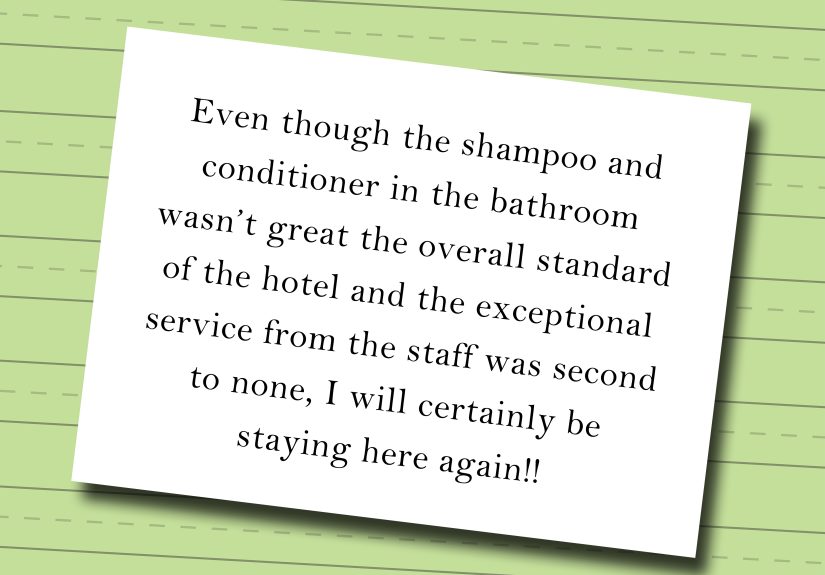
Example: “Comfortable, spotless, and walkable to everythinggreat value if you don’t need a big pool.”
Your goal is not to be dramatic. Your goal is to be useful. Drama is for prestige TV, not the business center.
-
Step 4: Describe the room like a traveler, not a brochure
Hotels list amenities; guests live with them. Cover the things that can make or break a stay:
- Bed & sleep: mattress comfort, pillow options, blackout curtains, temperature control
- Noise: hallway noise, street noise, thin walls, elevators, nightlife nearby
- Bathroom: cleanliness, water pressure, hot water consistency, ventilation, counter space
- Layout: usable workspace, outlets by the bed, lighting, storage, size vs. expectations
Keep it concrete. “The AC rattled every five minutes” tells future guests more than “bad room.”
-
Step 5: Talk about cleanliness with specifics (and be fair)
Cleanliness is one of the biggest booking factors, so be precise. Instead of “dirty,” write what you saw: “Dust on the headboard,” “stains on the carpet,” or “bathroom smelled like bleach (in a good way).”
If something went wrong, mention whether the hotel fixed it. A problem plus a fast, respectful solution is not the same as a problem plus a shrug.
-
Step 6: Review the people part: service, check-in, and problem-solving
Staff interactions can swing a rating fast. Focus on behaviors and outcomes rather than attacking individuals. Mention wait times, clarity, and follow-through:
- Was check-in smooth, or did it feel like waiting for concert tickets in 2009?
- Did someone explain fees, deposits, and policies clearly?
- If you requested something (extra towels, room change), how quickly did it happen?
Example: “Front desk offered a quieter room immediately when I mentioned street noise.” That tells readers this hotel handles issues proactively.
-
Step 7: Cover the amenities you actually used (and what was actually open)
Amenities matter, but only the real versionnot the marketing version. If you used the gym, say whether it had functional equipment and enough space. If you used the pool, mention temperature, crowding, towel availability, and hours.
Also call out closures or limitations that change expectations: “Rooftop bar was closed on weekdays,” “Breakfast was grab-and-go only,” or “Spa requires booking days ahead.”
If you didn’t use an amenity, don’t guess. “Didn’t try the restaurant, but it smelled amazing” is fine. “Restaurant is terrible” when you never ate there is… how rumors are born.
-
Step 8: Explain location in real-life terms
“Great location” is vague. Great for what? Add details travelers can picture:
- Walk time to major spots (or transit options)
- Neighborhood vibe (busy, quiet, nightlife, family-friendly)
- Safety impressions (well-lit streets, easy late-night access)
- Parking reality (cost, availability, garage height limits)
Example: “Ten-minute walk to the convention center, but the street gets loud after 11 p.m.” gives readers an actual tradeoff.
-
Step 9: Talk value without pretending everyone paid what you paid
Value is the sneakiest category because it depends on price, timing, and expectations. If you paid a premium, say what you got for it. If you scored a deal, admit it. Readers appreciate honesty more than mystery math.
Helpful value language sounds like: “At $180/night, this felt like a win,” or “At $420/night, the room size and service didn’t match the price.”
-
Step 10: Finish strong: tips, photos, and a quick integrity check
End with one or two practical tips and your final recommendation. This is where your review becomes bookmark-worthy.
- Add photos: show room lighting, view reality, bathroom condition, or noise sources.
- Include a tip: “Ask for a room away from the elevator,” or “Breakfast gets crowded after 8 a.m.”
- Be guideline-friendly: keep it about your stay, avoid hate speech, threats, doxxing, and personal attacks.
- Disclose incentives: if you got a discount, freebie, or perk in exchange for a review, say so plainly.
Quick integrity check: If the hotel replied and offered to fix things, would you still stand by every sentence you wrote? If not, revise. You can be honest without being reckless.
A Short Example Hotel Review (Put-Together and Human)
Here’s what “specific + balanced + readable” looks like. Notice how it includes context, details, and a tipwithout turning into a diary entry.
Stayed 3 nights for a work trip (solo) in a standard king room. Overall: clean, quiet, and genuinely convenient I’d stay again, but I’d skip the paid breakfast.
Check-in took under 5 minutes and the front desk explained the deposit and parking fee upfront (appreciated). The room was spotless, with strong Wi-Fi and plenty of outlets by the bed. Mattress was firm, and the blackout curtains actually did their job. The only downside: the AC cycled loudly about every 10 minutes.
Gym was small but usable (two treadmills, free weights up to 50 lbs). Location was the main win: 8–10 minutes walking to the convention center and plenty of quick food nearby. Tip: ask for a room away from the ice machine; I walked past it and it was louder than it needed to be.
Common Mistakes That Make Hotel Reviews Less Useful
- No context: “Horrible stay” doesn’t tell readers what kind of trip you were on.
- Vague extremes: “Perfect” or “disgusting” without examples reads like fiction.
- Reviewing what you didn’t experience: Don’t rate the spa if you never set foot in it.
- Personal attacks: Critique the service outcome, not someone’s appearance or identity.
- Missing the fix: If staff solved the issue, that’s major information.
- Ignoring fees: Resort fees, parking, and deposits can change “value” dramatically.
A Simple Outline to Keep You Organized
If you blank when you see the review text box (it happens), use this quick outline. It’s not a scriptjust a structure so your review reads cleanly:
- Context: who/why/how long/room type
- One-sentence verdict: would you return, and for what type of traveler?
- Room: sleep, noise, bathroom, layout, Wi-Fi
- Cleanliness: what you noticed + whether it was addressed
- Service: check-in, requests, issue resolution
- Amenities used: gym/pool/breakfast/parking
- Location: walkability, transit, neighborhood notes
- Value: price context + what felt worth it
- Tip: one practical suggestion for future guests
Conclusion: Write the Review You Wish You Could Read
Writing a great hotel review isn’t about being positive or negativeit’s about being clear. Describe what happened, show how it affected your stay, and offer a tip that helps the next traveler book smarter. Keep it respectful, honest, and grounded in your experience. Your future self (and everyone else trying to avoid the “surprise construction noise” special) will thank you.
Extra: Real-World Experiences That Turn Into Great Reviews (500+ Words)
To make this even easier, here are some common hotel moments travelers run intoand the kind of details that turn those moments into a strong, trustworthy review. These scenarios are based on patterns guests frequently describe, so you can borrow the approach without copying the story.
1) The “My Room Isn’t Ready” Check-In Spiral
You arrive after a long flight, mentally committed to a shower and silence, and the front desk says your room won’t be ready for two hours. A useful review doesn’t just complainit documents the process. Mention the time you arrived, whether early check-in was promised, and what the hotel did next: offered luggage storage, lounge access, a drink voucher, or a firm timeline. If they kept you updated and followed through, say so. If you had to ask three times and still got vague answers, say that too. Readers care about how a hotel handles stress, not just whether stress exists.
2) The Mystery Fees That Jump-Scare Your Receipt
Resort fees, parking fees, “destination” feesfees have hobbies now. When you write about value, include what the fees were and whether they were disclosed clearly. Did the hotel explain them at booking or check-in, or did they appear like an unwanted sequel at checkout? Also mention whether the fee included anything meaningful (water, gym, shuttle) or felt like paying admission to your own hotel room. This helps other travelers compare total cost, not just the nightly rate.
3) The Noise Problem That Ruins Sleep
Noise is a top complaint because it’s personalbut you can still write it objectively. Instead of “so loud,” describe the source and timing: street traffic all night, hallway doors slamming at 6 a.m., thin walls with TV noise, or a bar downstairs that turns into a bass concert after midnight. Add whether the hotel offered solutions (earplugs, room change, higher floor). A review that says “Room 512 faces the loading dock; trucks start around 5 a.m.” is gold for future guests who value sleep more than skyline views.
4) The “It Was Clean… Except” Moment
Many stays live in the gray area: mostly clean, but with one glaring issue. A strong review explains that balance. For example: “Bathroom was spotless and smelled fresh, but the carpet had visible stains near the bed,” or “Sheets were crisp, but there was dust on the lamp and the remote.” If housekeeping fixed it quickly, mention the response time. This kind of detail is both fair and practicalbecause travelers can decide what they can tolerate and what’s a dealbreaker.
5) The Great Staff Save (or the Customer Service Fumble)
Sometimes a hotel earns its rating not by being perfect, but by making things right. If a staff member solved a problemmoving you to a quiet room, finding a late checkout, handling a billing issuedescribe the outcome and how it was handled (respectful, fast, clear). If service was the weak point, focus on behaviors: long waits, unclear answers, promises not kept. Avoid personal attacks and stick to what happened. Readers trust reviews that critique the process, not the person, and hotels tend to learn more from that kind of feedback too.
If you’re ever unsure what to include, ask yourself: “What would I want to know before booking?” Then write that, with specifics. That’s the whole secret. The rest is just punctuation and the occasional well-earned side-eye.