Table of Contents >> Show >> Hide
- Jump to a Section
- What Hubble Actually Saw
- A Quick Image Tour (Text-Only Gallery)
- How a Supermassive Black Hole “Runs Away”
- Why Stars Might Form in a Black Hole’s Wake
- The Great Debate: Wake vs. Disguised Galaxy
- What Comes Next: Webb, Roman, and More Cosmic Weirdness
- FAQ
- Experiences (Extra ): What This Discovery Feels Like From the Outside
If you’ve ever stared at a photo and thought, “That’s definitely just a smudge,” congratulationsyour instincts match
a team of astronomers working with the Hubble Space Telescope. They saw a thin, almost too-straight-to-be-real streak
in a deep-space image and assumed it was a camera artifact. Then they checked. Then they checked again. And that’s when
the universe basically shrugged and said: “Nope. That line is mine.”
The leading idea? A runaway supermassive black holea cosmic heavyweight apparently kicked out of its home
galaxymay be plowing through tenuous gas and leaving behind a 200,000-light-year-long trail of newborn stars.
That’s a starry contrail roughly twice the diameter of the Milky Way. In other words: the universe may have invented
its own version of a road flare… except it’s made of hot blue stars and existential dread.
What Hubble Actually Saw
The headline-grabbing feature is deceptively simple: a long, narrow, nearly straight streak of light stretching away
from a distant galaxy in an archival Hubble image. Follow-up observations suggest the streak is made of
young, blue starsthe kind that burn hot and bright and don’t live long enough to ever learn to pay taxes.
The intriguing part is the geometry. The “line” appears to point back to a galaxy, and one end of the streak features
a compact, bright region where shocked gas (including ionized oxygen) shows up strongly. That bright “knot” is one reason
researchers suspect a compact powerhouselike an actively feeding black holecould be involved.
In the runaway-black-hole scenario, the black hole itself is not “seen” directly (black holes are famously committed to
the whole light-not-leaving lifestyle). Instead, astronomers infer it from the surrounding effects: ionized gas,
star formation, and the overall structure of the streak.
A Quick Image Tour (Text-Only Gallery)
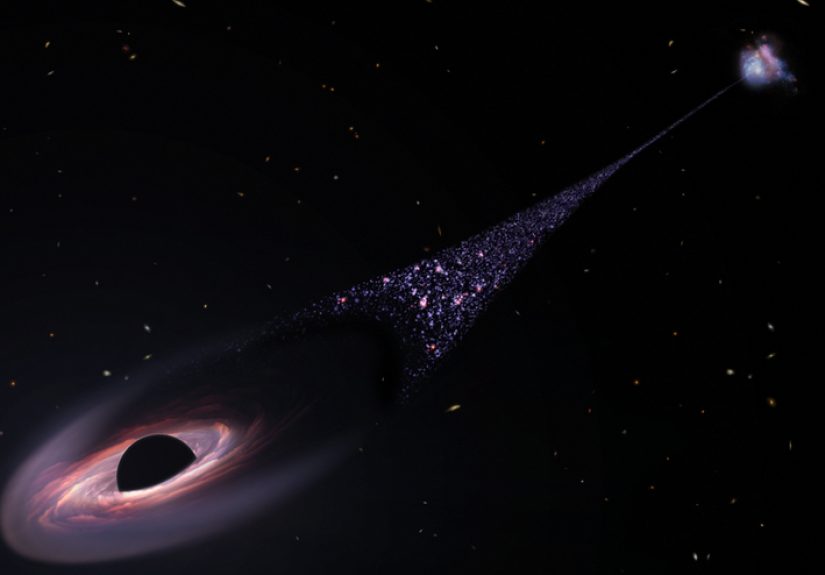
You’ll often see this story paired with two kinds of visuals: (1) the actual Hubble field image, and (2) an artist’s
impression that translates the science into something your brain can process without filing a formal complaint.
diagonal streak. In the zoomed inset, the streak becomes a chain of faint, bluish pointsconsistent with young stars
connecting back toward a galaxy.
is astonishingly long and narrow on a galactic scaleexactly the kind of thing that makes scientists say,
“Okay, but… what if it’s real?”
region at the front and a long “contrail” of star formation trailing behindlike a boat wake, except the boat is a
supermassive black hole and the lake is the cosmic web.
These visuals matter because the discovery began as a classic “blink and you’ll miss it” moment. The streak looked
like a detector artifact at first. The only reason it became a big deal is that someone took the time to rule out the
boring explanationscosmic rays, imaging glitches, and the universe’s habit of photobombing itself.
How a Supermassive Black Hole “Runs Away”
Supermassive black holes usually behave like the world’s most stubborn couch potatoes: they sit at the centers of galaxies
and refuse to move. So what could possibly eject one into intergalactic space?
Scenario 1: Three-body chaos (a.k.a. “Two’s company, three’s a crowd”)
One proposed origin story involves a galaxy merger. Two galaxies collide, their central black holes form a close binary,
and then a third galaxy arrives with its own central black hole. Three massive objects exchanging energy is a recipe for
instability. In many gravitational “scuffles,” one object gets flung out while the remaining two settle into a tighter
configuration. The ejected one becomes the runaway.
Scenario 2: A gravitational-wave recoil kick
There’s also a mind-bending possibility tied to Einstein’s universe: when two black holes merge, they radiate gravitational
waves. If that radiation is emitted asymmetrically, the newly merged black hole can recoilgetting a “kick” that sends it
racing away. This mechanism has been predicted for years, and it’s one reason astronomers keep an eye out for black holes
that aren’t where they “should” be.
Either way, the takeaway is the same: galaxy mergers are messy, and black holes don’t always stay put just because it’s
convenient for our textbooks.
Why Stars Might Form in a Black Hole’s Wake
The runaway-black-hole hypothesis isn’t just “black hole goes zoom.” It tries to explain a specific puzzle: why you’d get
a long, bright trail of newborn stars in a relatively empty region of space.
Compression: the simple (and surprisingly effective) idea
Even intergalactic space isn’t perfectly empty; it contains thin gas. If a massive object barrels through that gas at high
speed, it can compress and shock itlike a supersonic aircraft creating a shock front. Compressed gas can cool and collapse,
and collapsed gas can form stars. So the contrail becomes a kind of cosmic “pressure cooker” for star formation.
But shouldn’t a black hole just eat the gas?
Usually, yesblack holes grow by accreting material. But if the black hole is moving fast relative to the surrounding gas,
it may not efficiently capture that gas. In the runaway picture, the black hole is more of a bulldozer than a vacuum cleaner:
it stirs, shocks, and compresses instead of calmly dining.
The brightest knot of ionized gas near one tip of the feature is especially interesting because it hints at energetic
processesshock heating and/or radiation from an accretion diskthat could mark the black hole’s current position.
The Great Debate: Wake vs. Disguised Galaxy
Science rarely goes: “Wild claim → instant universal agreement → everybody high-fives.” It’s more like:
“Wild claim → other experts squint at the data → polite academic disagreement → more data → slightly less squinting.”
After the runaway-black-hole interpretation made headlines, other researchers argued the streak might be something far more
ordinary (and far more annoying): a bulgeless disk galaxy seen edge-on that just happens to line up in a way
that looks like a contrail. In that alternative view, the “line” could be the light of a thin galaxy rather than a wake of
star formation triggered by a fleeing black hole.
This debate matters because the two explanations make different predictions. A genuine wake should show signatures of
shocked gas and peculiar kinematics tied to a fast-moving compact object. An edge-on galaxy should behave like a rotating
disk, with velocity patterns and brightness profiles matching galaxy scaling relations.
The controversy isn’t a weaknessit’s the point. Extraordinary claims should get stress-tested. And in this case,
the “stress test” is exactly what astronomers began requesting: deeper imaging, more spectroscopy, and multiwavelength
observations to see whether the streak is truly a wake or simply a galaxy wearing the universe’s best disguise.
What Comes Next: Webb, Roman, and More Cosmic Weirdness
The original Hubble-based claim was described as a candidate discoverycompelling, weird, and in need of confirmation.
That’s why follow-up observations with other facilities were baked into the story from the start.
Why JWST is a big deal here
The James Webb Space Telescope (JWST) can examine faint structures and gas signatures that are hard to pin down otherwise.
Recent reporting describes JWST observations that strengthen the runaway-black-hole case by identifying a shock structure
consistent with a fast-moving object plowing through gasexactly the kind of “smoking gun” astronomers hoped for. Some
accounts describe this as the first strong confirmation of the phenomenon, while noting the work has been circulating as
a preprint and undergoing the usual scientific scrutiny.
Enter the Roman Space Telescope: the ultimate “weird stuff finder”
NASA’s Nancy Grace Roman Space Telescope is expected to combine wide-field surveys with sharp resolution, which makes it
ideal for hunting rare shapeslike long, thin star streaksacross huge swaths of sky. If runaway supermassive black holes
are real and not one-off cosmic pranks, Roman could help determine whether they’re uncommon curiosities or a regular (if
dramatic) chapter in galaxy evolution.
Why astronomers care so much
Runaway supermassive black holes touch multiple big questions at once: how galaxies merge, how black holes grow, how
gravitational-wave recoil behaves in nature, and how star formation can ignite in places that look too empty to bother.
It’s a rare story where a single “mysterious streak” can connect Hubble’s legacy, JWST’s new capabilities, and the next
generation of sky surveys.
FAQ
Is Hubble literally photographing a black hole?
Not directly. Hubble images the light from stars and gas. The “black hole” enters the story because the feature’s shape,
gas ionization, and inferred dynamics can be explained by a compact massive object influencing its environment.
How long is the trail, and why is that so shocking?
The feature is described as roughly 200,000 light-years longso large that it rivals (and exceeds) the scale
of major galaxies. If it’s truly a wake created in tens of millions of years, it implies a dramatic and efficient process
shaping gas and triggering star formation across an enormous distance.
What’s the biggest uncertainty?
Interpretation. A star-forming wake from a runaway black hole is a bold explanation, but thin edge-on galaxies exist, and
nature is perfectly capable of producing something ordinary that looks extraordinary from one particular angle. That’s why
follow-up data across multiple wavelengths is so important.
Could this happen in the Milky Way?
It’s not something we expect anytime soon. But in the deep past and the distant universe, galaxy mergers were more common.
Over cosmic time, interactions between galaxiesand their central black holescan produce dramatic outcomes, including
off-center or even ejected black holes.
Experiences (Extra ): What This Discovery Feels Like From the Outside
The funniest part of stories like this is how relatable they are. Not the “runaway black hole” partunless your commute is
unusually intensebut the human part. Someone is calmly doing one project (in this case, scanning Hubble data for something
completely different) and then suddenly the universe drops a bizarre doodle in the margin. If you’ve ever opened a folder
on your computer and found a file named “final_final_REAL_v7,” you already understand the vibe: confusion first, truth later.
For a lot of space fans, the experience starts with the images. You see the Hubble field and your eyes snap to the straight,
thin streak because our brains are wired to notice lines. Nature usually prefers swirls and blobsspiral galaxies, fuzzy
nebulae, soft gradients. A line looks like a mistake, like someone ran a piece of tape across the cosmos. Then you learn it
wasn’t a cosmic-ray hit. It wasn’t a sensor glitch. It’s something sitting out there at a time when the universe was about
half its current age, quietly being outrageous.
The next experience is scale shockmy favorite genre of shock. You read “200,000 light-years” and your brain tries to
translate it into something familiar, like “How many Costco parking lots is that?” (Answer: all of them, forever.) The trail
is so long that it doesn’t behave like a normal object in your imagination. It behaves like geography. You don’t “look at it,”
you “visit it,” mentally, as if it’s a cosmic highway you could drive on if you had a car powered by patience and physics.
Then comes the part that feels surprisingly personal: the argument. Some researchers say, “This is a runaway supermassive
black hole making stars in its wake,” and other researchers say, “Or… it’s an edge-on galaxy, and we’re all getting excited
about cosmic pareidolia.” If you’ve ever watched two smart people debate whether a weird noise in your car is “definitely the
transmission” or “probably a loose heat shield,” it’s the same energyexcept the car is a galaxy and the mechanic’s bill is
telescope time.
If you’re the kind of person who reads about space for fun, this is also where you get to enjoy the best feature of modern
astronomy: teamwork across instruments. Hubble gives you the “wait, what is that?” image. Ground-based observatories add
spectroscopy and kinematics. JWST can bring in sensitive infrared detail and gas diagnostics. Future survey missions can
search for more examples so we can stop treating every new oddball as a once-in-a-universe unicorn. The experience becomes a
rolling detective story, with each telescope playing a different character: Hubble is the sharp-eyed witness, Keck is the
interrogator, JWST is the forensic lab, and Roman will be the nosy neighbor with a panoramic security camera.
And finallythis is the sneaky emotional payoffrunaway black holes make you reconsider what “center” means. We talk about
galaxies like they’re neat systems with black holes sitting politely in the middle. But the universe is a place where
collisions happen, momentum gets exchanged, and even the most massive objects can be displaced. There’s something strangely
comforting about that. It’s messy, yesbut it’s also dynamic, creative, and full of surprises. Even a supermassive black hole
can get booted out and still leave something beautiful behind: a ribbon of brand-new stars, glowing like proof that chaos
sometimes comes with its own light show.