Table of Contents >> Show >> Hide
- What Risk Parity Is Actually Trying to Do
- Why Risk Parity Gets Attacked So Often
- The Strongest Argument in Favor of Risk Parity
- In Defense of Any Long-Term Strategy
- Where Critics Are Right
- A Better Way to Judge a Long-Term Strategy
- Experience: What Living With a Long-Term Strategy Really Feels Like
- Conclusion
Note: This article is for educational publishing purposes only and reflects general portfolio-construction principles, not personalized investment advice.
Risk parity has a public relations problem. It sounds mathematical, it often uses leverage, and after a rough stretch, critics tend to appear like clockwork and declare the whole thing dead, buried, and probably replaced by a spicy new acronym. But risk parity is not really the villain of modern portfolio construction. In many ways, it is simply an unusually honest strategy. It tells investors, right up front, that diversification should be measured by risk, not just by dollars, and that patience is the admission price.
That is also why defending risk parity becomes a defense of nearly every serious long-term strategy. Whether the framework is value investing, broad diversification, factor exposure, systematic rebalancing, or an all-weather approach, the pattern is familiar. It works over long horizons, disappoints over short ones, and gets mocked most aggressively right when investor discipline is running on fumes. In other words, it behaves exactly like a long-term strategy.
What Risk Parity Is Actually Trying to Do
At its core, risk parity is not an attempt to predict the future with wizard-like precision. It is an attempt to build a portfolio where each major asset group contributes a more balanced share of total risk. That sounds simple, but it is a direct challenge to the traditional “balanced” portfolio, especially the famous 60/40 mix. A 60/40 portfolio may be balanced by capital, but not by risk. Stocks are so much more volatile than bonds that equities usually dominate the portfolio’s risk budget.
Risk parity starts with a different question: instead of asking, “How many dollars do I put in each bucket?” it asks, “How much portfolio pain can each bucket cause?” That shift matters. It means lower-volatility assets often get larger capital allocations, while higher-volatility assets get smaller ones. Because safer assets usually come with lower expected returns, leverage is often used to bring the overall portfolio risk and return target up to a competitive level.
Why That Sounds Weird to Traditional Investors
For many investors, leverage is the word that makes the record scratch. The moment it appears, people imagine a portfolio wearing sunglasses indoors and making bad life choices. But leverage in risk parity is not there to turn a cautious mix into a casino chip. It is there because a portfolio that spreads risk more evenly often needs a modest boost to deliver return expectations comparable to a more equity-heavy allocation.
That does not make leverage harmless. It increases complexity, raises implementation risk, and can amplify losses when correlations move the wrong way. But complexity is not the same thing as stupidity. A chainsaw is dangerous too, yet nobody concludes that trees should remain undefeated forever. The real question is whether the tool is used thoughtfully inside a disciplined process.
Why Risk Parity Gets Attacked So Often
The answer is painfully human: long-term strategies are easiest to criticize during the exact periods they are hardest to hold. Risk parity enjoyed admiration after the global financial crisis because diversification looked brilliant when concentrated equity exposure looked reckless. Then came the 2010s, a decade in which traditional stock-heavy portfolios did exceptionally well. Suddenly, extra diversification felt unnecessary, even boring. Investors began asking the timeless question that has destroyed many good plans: “Why own the thing that is not winning right now?”
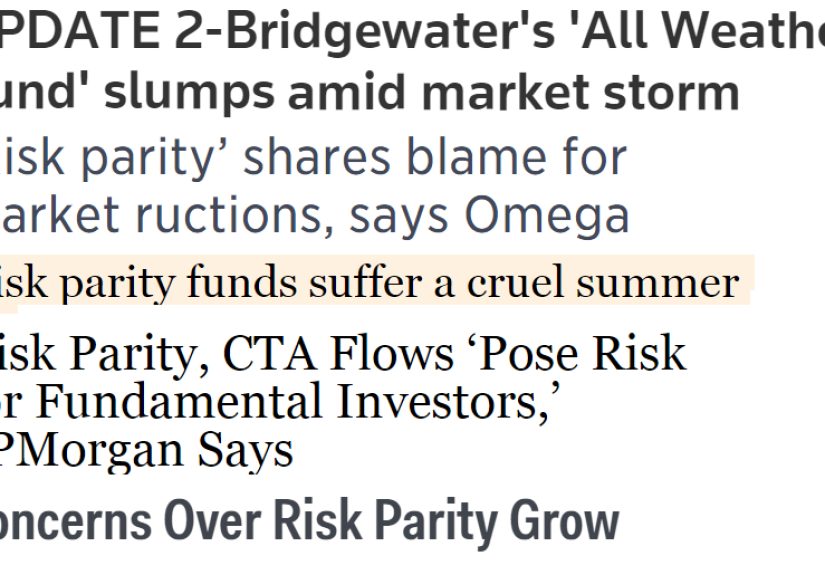
Then 2022 arrived and reminded everyone that regimes change. Inflation surged, rates jumped, and both stocks and bonds were hit hard at the same time. That was a brutal environment for many diversified portfolios, including some risk parity implementations. Critics treated this as the final verdict. But one ugly period, even a very ugly one, does not invalidate the logic of a long-term process. It may expose design flaws, excessive leverage, poor implementation, or weak inflation protection. It does not automatically prove that diversification itself was a bad idea.
The Short Version of 2022
Risk parity struggled in a world where traditional bond diversification did not behave the way investors had grown used to. Rising inflation changed the relationship between stocks and bonds, and that matters because many portfolio frameworks depend on imperfect but useful diversification across macro environments. When those relationships break down, pain follows. But that is not unique to risk parity. It is true of every strategic allocation model. A long-term framework is not a machine that avoids all disappointment; it is a system designed to survive disappointment without forcing you to start over every three years.
The Strongest Argument in Favor of Risk Parity
The best defense of risk parity is not that it always wins. It does not. The best defense is that it addresses a real problem: many supposedly diversified portfolios are still heavily dependent on one economic outcome. If growth is strong, inflation is contained, and equities are loved, those portfolios can look brilliant. If growth disappoints or inflation shocks the system, they can feel a lot less diversified than the marketing brochure suggested.
Risk parity tries to reduce that dependence by balancing exposure across assets tied to different macro forces. Growth-sensitive assets, nominal bonds, inflation-linked assets, and commodities can all play a role. The goal is not perfection. The goal is resilience. That is a meaningful distinction. Perfection is fantasy. Resilience is a portfolio objective.
There is also a philosophical strength here. Risk parity assumes humility. It does not say, “We know exactly which asset will dominate next.” It says, “We probably do not, so let’s avoid building a portfolio that only thrives in one season.” That is not flashy, but it is wise. Most catastrophic investor mistakes begin with excessive confidence dressed up as conviction.
In Defense of Any Long-Term Strategy
Once you zoom out, risk parity is just a special case of a much larger truth: a long-term strategy must look wrong often enough to tempt you into abandoning it. Otherwise, it would not earn a long-term premium. Value investing has endured long stretches of embarrassment. Trend following can look ridiculous in sideways markets. Broad diversification feels wasteful in runaway bull markets. Even simple rebalancing can feel like selling your winners for no good reason. Yet these approaches survive because they impose discipline when emotion wants a microphone.
That is the part investors routinely underestimate. The challenge of a long-term strategy is rarely intellectual. Most people understand diversification, rebalancing, and risk control just fine when the portfolio is behaving. The challenge is behavioral. Can you keep following the plan when your neighbor’s concentrated tech bet looks like genius? Can you rebalance after a drawdown instead of hiding under a blanket and refreshing your account every seven minutes? Can you distinguish between a strategy that is temporarily out of favor and one that truly no longer matches your goals?
Those questions matter more than whether a strategy had a rough three-year stretch. Investors often do more damage by switching frameworks repeatedly than by sticking with an imperfect but coherent plan. The graveyard of wealth is full of abandoned strategies that worked just fine over a full cycle but were fired halfway through the ugly part.
Staying the Course Does Not Mean Turning Off Your Brain
Defending long-term strategy does not mean blind loyalty. A disciplined investor should still ask hard questions. Is the strategy transparent? Are costs reasonable? Is the leverage controlled? Does the implementation match the theory? Are you judging it against the right benchmark? Is it still aligned with your actual risk tolerance and time horizon?
That last point matters more than enthusiasts sometimes admit. A brilliant strategy that you cannot emotionally hold through inevitable drawdowns is not brilliant for you. A portfolio only works in real life if it is investable not just mathematically, but psychologically. The best strategy on paper can become the worst strategy in practice if it asks more patience than the investor can realistically give.
Where Critics Are Right
Risk parity is not above criticism. Some versions are overly dependent on the stock-bond diversification regime that prevailed for long stretches of the last few decades. Some rely too heavily on leverage without enough attention to liquidity, financing costs, or macro regime shifts. Some investors buy the label without understanding the actual exposures underneath. And some managers sell “diversification” with all the charm of a used-car commercial and only half the disclosure.
Critics are also right that there is no universal portfolio. A young investor saving aggressively for retirement, a pension fund, and a near-retiree drawing income may all need different solutions. Risk parity is a framework, not a religion. It is one way to think seriously about balancing risk across assets. It is not a commandment carved into a stone tablet and delivered from a mountain of Bloomberg terminals.
A Better Way to Judge a Long-Term Strategy
If you want to evaluate risk parity fairly, or any long-term strategy fairly, start with a few simple standards.
1. Judge the logic before the recent returns
If a strategy only looks convincing after a hot streak, you are not evaluating it. You are admiring its recent outfit. Start with the mechanism. What problem does it solve? What risk does it accept? In what environments should it struggle? If you cannot answer those questions, you do not own a strategy. You own a hope.
2. Compare it to the right alternative
Risk parity is not supposed to look like 100% equities in a raging stock bull market. Rebalancing is not supposed to beat letting winners run forever during a mania. The relevant comparison is whether the strategy offers a more durable balance of return, drawdown control, and survivability over a full cycle.
3. Define your holding period honestly
If your emotional holding period is 18 months, please do not adopt a strategy that requires a decade of patience and then act shocked when the relationship fails. That is not strategy failure. That is expectation mismatch with a side of denial.
4. Respect rebalancing
Long-term strategy is not just about picking allocations. It is about maintaining them. Rebalancing is the quiet workhorse of disciplined investing. It trims what has become dominant, adds to what has lagged, and keeps the portfolio aligned with its original risk target. It is also wonderfully annoying, which is how you know it is probably doing something useful.
Experience: What Living With a Long-Term Strategy Really Feels Like
In practice, the experience of following a long-term strategy is far less glamorous than the diagrams in white papers suggest. It often begins with relief. The investor finally has a framework, a philosophy, a structure that makes sense. The portfolio is diversified. Expectations are written down. Rebalancing rules exist. There is a process. For a little while, this feels fantastic, like finally cleaning the messy garage of your financial life.
Then reality starts doing what reality does. One year, the strategy looks smart. Another year, it looks overly cautious. Then comes the season when a concentrated bet somewhere else is beating everything in sight, and the disciplined portfolio suddenly feels like the person at the party talking about sleep schedules while everyone else is doing karaoke on the furniture. That is usually when doubt enters.
Investors who stay with a long-term strategy often describe the same emotional cycle. First comes boredom, then envy, then irritation, then the urge to “just tweak a few things.” That phrase should come with a warning label. Most wealth-destroying decisions do not arrive wearing a villain cape. They arrive disguised as a reasonable little adjustment. A bit more equity here. A little less ballast there. Maybe skip the rebalance this time. Maybe switch after the next quarter. And just like that, the strategy is no longer the strategy.
Advisors and experienced allocators tend to learn a humbling lesson: the hardest part of a portfolio is not building it, but living with it when its purpose is not immediately rewarded. A resilient strategy can feel mediocre for surprisingly long stretches. Yet those same stretches are often what make the discipline valuable. The portfolio is not trying to win every month. It is trying to keep the investor from turning temporary discomfort into permanent damage.
That is why the most successful long-term investors are often not the ones with the most elegant spreadsheet. They are the ones who can tolerate looking a little wrong for a while without assuming they are permanently wrong. They understand that every serious strategy charges a behavioral fee. Sometimes that fee is boredom. Sometimes it is regret. Sometimes it is watching somebody else get rich faster for a while. None of that is fun. But compared with panic selling, performance chasing, or rebuilding a portfolio every time the macro backdrop changes, it is usually a much cheaper price to pay.
Conclusion
Risk parity deserves a defense not because it is flawless, but because it is built around a sound question: how do you avoid mistaking capital balance for risk balance? That question still matters. So does the broader lesson behind it. Long-term strategies are designed to survive many kinds of markets, not to flatter investors in every season. They can lag, frustrate, and occasionally look foolish. But that is not the same as being broken.
A good strategy is not one that never disappoints you. It is one that disappoints you in ways you understand, for reasons you accepted in advance, while still giving you a fighting chance to reach your goals over time. Risk parity, at its best, aims to do exactly that. And so does every long-term strategy worth defending.