Table of Contents >> Show >> Hide
- The Scene That Started a Thousand “Wait, Who Is That Guy?” Threads
- Meet Pedro Lopez, the Man Behind the Briefs
- Why the Dancing Guy Works: Comedy Mechanics in Motion
- The Dancing Guy’s “Move Secrets” You Can Actually Steal
- Why Public Access Was the Perfect Home for This Bit
- A 3-Minute “Dancing Guy” Practice (Safe for Non-Dancers)
- What This Moment Says About It’s Always Sunny as a Comedy Machine
- Real-Life “Dancing Guy” Experiences ( of Totally Relatable Chaos)
- Conclusion
Every long-running comedy has its legends: catchphrases, running gags, characters who show up for 40 seconds and somehow live rent-free in everyone’s brain for the next 20 years.
It’s Always Sunny in Philadelphia has all of the aboveand then it has Public Access Dancing Guy, the human embodiment of “you had to be there” who turned a blink-and-you-miss-it moment into a cult favorite.
He’s not the star of the episode. He’s not even a supporting character. He’s basically a vibe with cowboy boots.
And yet, fans remember him as clearly as they remember any of the Gang’s big schemesbecause his dancing isn’t just funny.
It’s committed, confident, and weirdly hypnotic in a way that feels like the purest form of low-budget television magic.
The Scene That Started a Thousand “Wait, Who Is That Guy?” Threads
The setup is classic Sunny: the Gang wants fame, shortcuts are taken, and dignity is treated like an optional subscription you can cancel anytime.
In the Season 3 episode “Frank Sets Sweet Dee on Fire”, Mac, Charlie, and Frank start sniffing around for “newsworthy” footage to air on public accessonly to discover that the public access channel is already serving something far more powerful than investigative journalism:
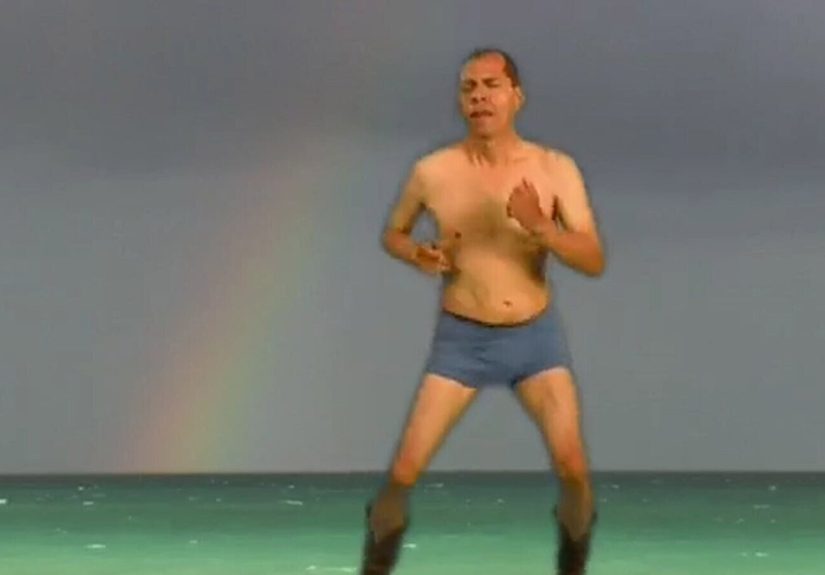
a man dancing in cowboy boots and blue boxer briefs in front of a green screen that keeps changing locations like it’s trying to win an award for “Most Frequent Background Swap Per Minute.”
The joke lands because it feels painfully believable. If you’ve ever clicked around at 2 a.m. and ended up watching something you can’t explain to your future self, you know the sensation.
The dancing isn’t polished. The production isn’t polished. The whole thing is held together by the kind of confidence that can’t be faked.
You don’t watch because it’s “good.” You watch because it’s undeniably happening.
Later, the episode doubles down on the absurdity by letting the dancing-guy energy leak into “real life,” as the Gang’s club aspirations collide with the same strange little micro-celebrity orbit.
It’s a reminder that Sunny’s universe has a special talent: it can take a tiny, throwaway bit and make it feel like a whole ecosystem.
Meet Pedro Lopez, the Man Behind the Briefs
Here’s the twist that makes the Dancing Guy even better: the performer behind him, Pedro Lopez, didn’t come into the role with a grand plan to become a cult icon.
According to an interview, he got into acting after retiring from teachingencouraged by his sonand then landed this gig in a way that sounds almost like an improv exercise:
he walked in, they basically said, “Are you ready?” and then, “Okay… start dancing.”
And he did. No overthinking. No negotiation. No “Do you have choreography?” Just movement.
That’s the first secret right there: momentum beats perfection.
Lopez has said the moves were his, made up in the moment, and that he’d taken beginner salsa classes in the pastnot exactly the résumé you’d expect for a scene that’s still getting replayed, clipped, and referenced years later.
The directing detail is also delightfully surprising: Fred Savage directed the Dancing Guy segments in that episode, which somehow makes the whole thing even more charming.
In other words: a retired teacher, a green screen, a pair of boots, and a director best known to many people from an entirely different TV era.
That is the exact recipe public access was built forSunny just bottled it and served it back with a wink.
Why the Dancing Guy Works: Comedy Mechanics in Motion
The Dancing Guy isn’t funny because he’s “bad.” He’s funny because he’s so earnestly in it.
Comedy loves contrast, and this is contrast in its purest form:
the Gang is trying to manufacture attention through schemes, while this man has attention simply by moving like he owns the air.
Secret #1: Total Commitment (No Apologies, No Winks)
The biggest mistake people make when they dance “as a joke” is that they keep one foot on the brakes.
They try to protect themselves with irony. The Dancing Guy doesn’t do that.
He’s not performing embarrassment. He’s performing confidence.
That’s why it’s mesmerizing: the body language says, “This is the show,” and the universe agrees.
Secret #2: Signature Moves Beat Fancy Choreography
If you freeze-frame the vibe (not the exact choreography), you’ll notice something important:
the energy comes from repeatable, recognizable patternssimple steps, upper-body accents, and a steady groove.
It’s the same reason a good chant beats a complicated speech: it sticks.
Fans can mimic “the spirit” of the Dancing Guy without needing dance training, because the formula is accessible:
pick a rhythm, repeat a motif, and commit like you’re headlining the channel.
Secret #3: Wardrobe Is Part of the Punchline
Cowboy boots plus boxer briefs is an instant character.
It tells you everything in one glance: fearless, a little ridiculous, fully unbothered.
Great comedy costuming works like a shortcutbefore the character moves, you already know what kind of world you’re in.
Secret #4: The Green Screen Makes Your Imagination Do the Work
The constantly changing backgrounds aren’t just random visualsthey create a low-budget “music video” feeling that invites your brain to fill in the gaps.
When production value is stripped down, your attention shifts to what can’t be outsourced:
timing, movement, presence.
The Dancing Guy’s “Move Secrets” You Can Actually Steal
You don’t need to recreate the exact look to learn from the performance.
Think of this as the Dancing Guy methodminus the cowboy boots (unless you’re ready to commit to the lifestyle).
1) Start Before You Feel Ready
Lopez’s audition story is basically a productivity tip disguised as a dance anecdote:
when the moment comes, you move. You don’t wait for a perfect plan.
In dance terms, that means giving yourself a simple starter motionstep-touch, bounce, shoulder rollso you’re never stuck at “zero.”
2) Choose One Tempo and Build
A common beginner trap is changing speeds constantly because nerves feel like they need variety.
A steadier approach reads as confident: lock into a beat, then layer small changes on top (bigger arms, sharper accents, a turn, a freeze).
3) Make Your Upper Body Tell a Story
Legs keep time. Upper body sells attitude.
Shoulder pops, chest hits, arm swings, finger pointsthese are the “highlighter markers” of dancing.
They make simple footwork look intentional, and they photograph well (which is the modern version of “public access visibility,” if we’re being honest).
4) Use Your Eyes Like a Spotlight
Dance performance advice often comes back to focus: where you look changes how confident you appear.
Pick a few “camera points” (even if there’s no camera) and let your gaze land deliberately.
This is the difference between “I’m flailing” and “I’m performing.”
5) Let Breathing Be Part of the Rhythm
One charming detail from the Dancing Guy story is that you can actually catch the human reality of effortfatigue, a breath, and then back to it.
That’s not a flaw. That’s proof it’s real.
If you get winded, don’t panicuse it as a beat reset and keep going.
Why Public Access Was the Perfect Home for This Bit
Public access TV has always been the wild frontier of local media: low-budget, community-driven, and often delightfully unfiltered.
It exists to give ordinary people a channelsometimes literallyto create programming without needing a network-sized gatekeeper.
That “anything could happen” energy is exactly why the Dancing Guy feels authentic instead of manufactured.
Sunny’s satire works best when it’s grounded in something recognizable.
The Gang thinks fame is something you seize through strategy. Public access laughs back and says,
“Actually, sometimes fame is just a guy dancing like he means it.”
A 3-Minute “Dancing Guy” Practice (Safe for Non-Dancers)
Want the vibe without overcomplicating it? Try this quick practice session in your room.
No special gear required. Optional: boots that make you feel invincible.
- 0:00–0:30 – Step-touch side to side. Keep your knees soft. Add a gentle bounce.
- 0:30–1:15 – Add shoulders: pop right-left-right-left on the beat.
- 1:15–2:00 – Add arms: swing low, then high. Pick one “signature” gesture and repeat it.
- 2:00–2:30 – Change direction: face one corner, then the other. Give your eyes a target.
- 2:30–3:00 – Finish with a freeze: hit a pose, hold for two beats, then walk away like it’s normal.
The goal isn’t to look like a professional dancer. The goal is to look like someone who chose a lane and drove confidently down it.
That’s the Dancing Guy’s true superpower.
What This Moment Says About It’s Always Sunny as a Comedy Machine
Sunny has lasted because it treats the world like a playground for tiny, perfectly observed absurdities.
The Dancing Guy is a perfect example of the show’s craft: a short gag that feels like a whole subculture.
The Gang doesn’t create the funniest thing in the scenethey discover it, react to it, and then (as they do) try to exploit it.
And because the Dancing Guy isn’t explained to death, he stays funny.
He remains a mystery with a beat. A human screensaver. A reminder that sometimes the strongest comedy is a confident left-field swing that doesn’t ask permission.
Real-Life “Dancing Guy” Experiences ( of Totally Relatable Chaos)
The funniest part about the Public Access Dancing Guy isn’t just that he existsit’s how easily he escapes the episode and shows up in everyday life.
Not literally (although imagine the joy of him wandering into your local community center like a friendly glitch in reality),
but as a social moment people keep recreating without even meaning to.
You know the scenario: someone’s phone is connected to a speaker, the playlist has drifted from “background music” to “main event,”
and there’s that one person who says, “Okay, I’m doing it,” with the confidence of a performer stepping onto a tiny stage that doesn’t technically exist.
They’re not trying to be the best dancer in the room. They’re trying to be the most committed dancer in the room.
That’s Dancing Guy energy.
At school events, it often looks like this: the crowd is hovering, half-dancing, half-standing around like they’re waiting for instructions.
Then one person breaks the stalemate with a simple groovetwo steps, shoulders, arms doing something intentional.
Suddenly, people laugh (in a good way), and the vibe shifts from “everyone is self-conscious” to “okay, we’re actually having fun.”
It’s not because the move was complicated; it’s because it was clear. Clear beats awkward every time.
At family gatherings, Dancing Guy shows up as a survival skill. Somebody’s aunt asks for “one dance,” a cousin tries to disappear into the snack table,
and you realize the only way out is through: you step into the open space and do the simplest thing possiblestep-touch, clap, a goofy pointand commit.
People cheer because you did them a favor: you made it okay to be silly for 30 seconds.
That’s basically what public access has always done, too: it gives permission to be unpolished and still be entertaining.
Even solo, the Dancing Guy method works. There’s a specific kind of confidence you get from dancing alone in your room when nobody’s watching.
It’s not performance confidence; it’s self-confidenceproof that you can be ridiculous without being embarrassed.
You try a move, you repeat it, you add something dumb, you laugh, you keep going.
That looptry, repeat, build, commitis the same loop that makes the Dancing Guy funny and weirdly inspiring.
And if you ever need a small mindset reset, think about the origin story: a person walks into an audition, is told to start dancing, and just… does.
No complicated identity crisis, no overthinking, no “What if they judge me?” (They’re judging everyone; it’s an audition.)
He moved first. He worried later. That’s the sneaky lesson inside the joke:
sometimes the best “move” is simply deciding you’re already allowed to take up space.
Conclusion
The Public Access Dancing Guy endures because he’s the opposite of the Gang’s desperate chasing: he’s effortless commitment in its purest form.
Pedro Lopez didn’t “solve” dancing with complicated choreographyhe solved it with confidence, repetition, and the courage to be fully, loudly present.
Whether you’re trying to dance better, perform with more swagger, or just stop apologizing for being a little weird in public,
the secret is the same: pick a beat, pick a move, and own it like the background just changed to a waterfall and you’re the reason the channel exists.