Table of Contents >> Show >> Hide
Every era has a “look.” The ’70s gave us shag carpet. The ’90s gave us oak cabinets and brass everything.
And the modern era? It’s giving us open shelves that collect grease like it’s their full-time job.
To be clear: if you love any of the trends below, you’re not “wrong.” Your home is not a museum exhibit that needs
internet approval. But when people complain about modern home trends, they usually aren’t whining about stylethey’re
reacting to daily life: cleaning, noise, privacy, maintenance, and the “why did I pay for this?” moment after the
honeymoon phase ends.
Why a Trend Becomes Annoying (Even If It Looks Amazing Online)
- It’s high-maintenance: The design demands constant cleaning, staging, or babying.
- It fights your habits: You cook a lot, but the trend assumes you never fry anything… ever.
- It sacrifices comfort: Good acoustics, warmth, storage, and privacy get traded for a “wow” photo.
- It’s expensive to undo: Trendy choices in floors, tile, and built-ins can be costly regrets.
- It dates fast: Some looks scream a specific year the way skinny jeans scream 2012.
40 Modern Home Trends People Love to Hate
Layout, Architecture, and “Why Is Sound Everywhere?”
-
Fully open-concept living (no separation anywhere).
Great for parties. Less great for cooking smells, Zoom calls, and hearing every spoon clink like it’s amplified. -
No entrywayjust the front door opening straight into the living room.
Mud, backpacks, shoes, deliveries… everything lands in the “nice” space immediately. -
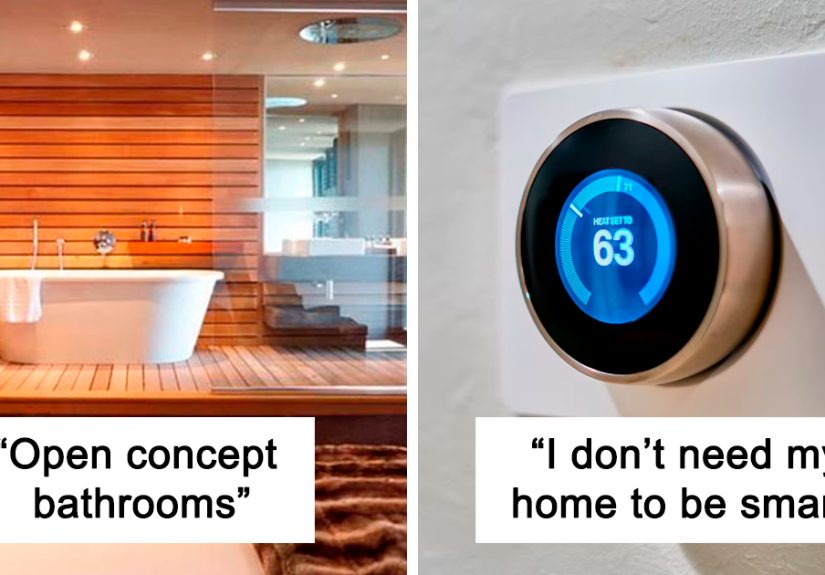
“Open concept” bathrooms.
If your toilet can make eye contact with your bed, we need to talk. -
Oversized “great rooms” with two-story ceilings.
They look dramatic, but they can feel echo-y, hard to heat/cool, and awkwardly empty without giant furniture. -
Floating stairs that feel like a trust fall.
Pretty? Yes. Friendly for kids, pets, guests, or anyone who enjoys not falling? Depends on the design. -
Interior windows and half-walls everywhere.
They promise “light” and “flow,” but can deliver a strange fishbowl vibe and fewer places to put furniture. -
Sliding barn doors for bathrooms.
The aesthetic is cozy-farmhouse; the soundproofing is… optimistic. -
TV above the fireplace as the default.
It can be too high for comfortable viewing, and the room layout becomes dictated by one wall. -
Giant picture windows with zero practical window treatments.
Natural light is wonderful until the afternoon sun turns your sofa into a toasted marshmallow. -
“Statement” front doors that sacrifice function.
Stunning oversized doors are cooluntil they’re drafty, heavy, or require specialized hardware to behave.
Kitchens: Where Trends Go to Meet Grease
-
Open shelving instead of upper cabinets.
Gorgeous in photos. In real life: dust, grease, and the pressure to keep every mug “aesthetic.” -
All-white kitchens with zero contrast.
Bright and cleanuntil it feels sterile, and every scuff becomes a headline. -
Waterfall-edge islands (especially when they kill storage).
Sleek, but if the island is basically a sculpture, it’s not helping you live. -
“A kitchen island big enough to host the Olympics.”
If you need hiking boots to get from the sink to the fridge, the layout might be doing too much. -
Overly trendy backsplashes.
Bold pattern can be fun, but ultra-specific looks can feel dated faster than you can say “remodel.” -
Matte black fixtures everywhere.
Chic, dramatic… and ready to showcase water spots like an art installation titled “Mineral Deposits.” -
Pot fillers that rarely get used.
A dreamy feature for some cooks, but often an expensive “nice to have” with extra plumbing risk. -
Minimal upper cabinets + “we’ll just add a pantry.”
It’s a great idea if you actually have pantry space. Otherwise, clutter migrates to counters instantly. -
Cheap “luxury look” materials (faux marble everywhere).
When the veining is louder than your personality, it’s hard for the room to feel timeless. -
Integrated appliances with complicated repairs.
Seamless design is lovely until the custom panel situation turns a simple fix into a saga.
Bathrooms: Spa Dreams, Real-Life Maintenance
-
Vessel sinks (the bowl-on-the-counter look).
They can be stylish, but cleaning around themand dealing with splashcan get old fast. -
Floating vanities with no practical storage.
They look airy, but if your toiletries end up in a basket tower, the “clean look” disappears. -
All-glass showers with lots of hardware.
The more metal and glass, the more surfaces to squeegee, polish, and keep spot-free. -
Wet rooms done without enough planning.
Beautiful when executed perfectly. Annoying when water escapes to places water should never be. -
Freestanding tubs that are rarely used.
They photograph like a luxury hotel. Many homeowners report they become expensive laundry-folding monuments. -
Toilets without privacy (bad partitions, awkward sightlines).
Some design choices forget that bathrooms are, in fact, for bathroom things. -
Trendy tile with too much grout.
Tiny tiles can be gorgeous, but grout lines are basically a part-time job if you’re not careful. -
Minimal lighting around mirrors.
If your bathroom lighting makes you look like a ghost, it’s not “moody,” it’s unhelpful.
Floors, Walls, and Finishes That Wear Out Their Welcome
-
Gray vinyl floors everywhere (“the greige era”).
People are tired of cool, flat grays that make homes feel a little… rental-grade. -
Overdone shiplap (especially when it appears in every room).
A little texture can be charming. Whole-house shiplap can feel like living inside a theme set. -
Ultra-gloss finishes on floors or cabinets.
Shine shows every footprint, smudge, and crumblike your home is keeping receipts. -
Faux-distressed “farmhouse” finishes on new items.
Some folks love rustic charm; others feel like they bought damage at full price. -
Overly stark minimalist interiors with no warmth.
Minimal can be calming. But when it gets too bare, it can feel cold, echo-y, and not very human. -
Accent walls that feel random.
Sometimes it’s a great focal point. Sometimes it’s one lonely wall screaming, “I was trendy in 2017!” -
Brushed gold everywhere (without balance).
It can be elegantuntil it’s on every handle, faucet, and light fixture like a shiny takeover. -
Overly bold “statement ceilings” done without a plan.
A ceiling can be amazing. But if it fights the rest of the room, you’ll feel it every time you look up.
Décor, Tech, and Lifestyle Trends That Can Backfire
-
Word-art signage in every room.
If your kitchen needs a sign that says “EAT,” your fridge and your stomach already had it covered. -
Overbuilt smart homes that require troubleshooting to turn on a lamp.
Smart is great. “Please update firmware” at 11 p.m. is not. -
Ultra-low furniture and “platform everything.”
It looks sleekuntil getting up feels like a core workout you didn’t consent to. -
Decor that’s chosen for the camera, not the couch.
Homes should feel good to live in, not just good to post. Comfort is not a filter.
How to Avoid Trend Regret Without Living in a Beige Box
You don’t have to reject every modern home trend to build a home you love. The trick is choosing trends
that match your lifestyleand keeping the most permanent parts of the home (floors, cabinets, tile, layout)
more timeless.
- Test-drive your idea: Try temporary versions first (open shelves in one section, peel-and-stick tile as a mock-up, etc.).
- Prioritize function in “daily-use” zones: Kitchens, bathrooms, and entryways should work hard, not just look pretty.
- Use trends in swappable layers: Paint, hardware, lighting, rugs, and art are easier to change than flooring and built-ins.
- Think about cleaning honestly: If you hate dusting, don’t choose designs that create more surfaces to dust.
- Design for your household: Pets, kids, roommates, work-from-home lifeyour home’s needs are real, and trends don’t pay your utility bill.
Real-Life Experiences: When the Trend Meets Tuesday (Extra 500+ Words)
Ask people what annoys them about modern home trends and you’ll hear the same pattern: the idea sounded great,
the photos looked perfect, and then real life moved in with a backpack, a frying pan, and a dog that sheds like
it’s being paid per hair.
Take open shelving. Many homeowners describe a “two-week glow” where everything looks curatedmatching mugs,
neatly stacked plates, maybe a tiny plant bravely trying to survive above the toaster. Then reality arrives.
Cooking creates grease. Dust exists. And suddenly every shelf becomes a stage where your mess performs nightly.
People who actually cook often end up rotating items constantly: the “pretty” dishes go up front, the practical
stuff hides in corners, and no one admits how often they wipe down the shelves because it ruins the fantasy.
Or consider the all-white kitchen. Some homeowners love the bright, airy lookuntil they realize white reflects
everything, including chaos. A single scuff on a cabinet becomes an unwanted focal point. Tomato sauce splatter
feels like a personal attack. And if you have kids (or clumsy adults, which is also a valid household category),
white finishes can become a daily reminder that life happens fast and stains happen faster.
Matte black fixtures have a similar arc. They look modern, crisp, and expensive. Then hard water shows up like,
“Hello, I live here now.” People report wiping spots more often than they expected, especially in showers and
around sinks. Some switch cleaners, some add water softeners, and some simply accept the new aesthetic:
“matte black with a hint of mineral speckle.”
Then there’s the smart home dream. In theory, voice-controlled lighting, app-based thermostats, and automated
routines make life easier. In practice, folks complain about juggling multiple apps, devices that don’t talk to
each other, and the occasional moment where turning on a ceiling fan becomes a technical support ticket. The most
common “win” stories are actually modest: a smart thermostat that saves energy, a video doorbell for deliveries,
and lighting schedules that help the house feel safe. The frustration tends to come from over-automationwhen
everything is smart except the system that keeps it simple.
Home office life also changed what annoys people. Open concept used to be a brag: “Look how big it feels!”
Now, people mention the sound bounce, the lack of doors, and the awkwardness of trying to take calls while someone
is blending a smoothie five feet away. Even families who still like openness often want “soft separation”a pocket
door, a partial wall, a nook, or a way to close off noise without building a whole maze of rooms.
The biggest takeaway from these experiences is surprisingly hopeful: most people aren’t anti-trend. They’re
anti-regret. They want homes that look good and function well. The best modern spaces usually borrow the
pretty parts of a trend while respecting everyday lifereal storage, real privacy, real durability, and materials
that don’t require you to live like a showroom model. In other words: design for the humans who live there, not
the algorithm that scrolls past.
Conclusion
Modern home design isn’t the enemymismatched expectations are. If a trend makes your life easier, makes your
home feel like you, and doesn’t demand constant upkeep, it’s probably a keeper. But if it looks amazing online
and feels annoying in real life, you’re allowed to pass. Your home’s job is to support your days, not audition for
strangers.