Table of Contents >> Show >> Hide
- The Forgotten Sega Machine That Said “AI” Before It Was Cool
- What Was the Sega AI Computer?
- How “Artificial Intelligence” Worked in 1986
- Why Sega’s AI Computer Was Ahead of Its Time
- Why Did the Sega AI Computer Stay So Obscure?
- Preservation Brought Sega’s AI Dream Back to Life
- Sega AI Computer vs. Today’s AI Revolution
- What Sega’s AI Computer Teaches Modern Tech Companies
- Experience Notes: Meeting the Sega AI Computer From the Future
- Conclusion
- SEO Tags
Before AI could write emails, generate images, or explain your dishwasher manual like a tiny digital professor, Sega tried to bring artificial intelligence into homes and classrooms with a mysterious 1986 machine called the Sega AI Computer.
The Forgotten Sega Machine That Said “AI” Before It Was Cool
When most people hear “Sega,” they think of Sonic sprinting through Green Hill Zone, the Genesis yelling “blast processing,” or arcade cabinets that swallowed quarters faster than a raccoon in a snack aisle. But buried deep in Sega history is a strange, ambitious, and surprisingly forward-looking device: the Sega AI Computer.
Released in Japan in the mid-1980s, the Sega AI Computer was not a mainstream console, not a typical home computer, and definitely not a chatbot in a plastic shell. It was an educational computer aimed largely at young children and schools. Its pitch was bold for the time: artificial intelligence could help make learning more personal, conversational, and adaptive.
That idea sounds very 2026. Personalized learning? Natural language interaction? A machine that responds to a child’s answers and adjusts difficulty? Today, those are buzzwords in every AI education startup deck. Sega was exploring them when floppy disks were still considered glamorous office accessories.
What Was the Sega AI Computer?
The Sega AI Computer was a rare educational system built around the idea that computers should not simply wait for rigid commands. Instead, it attempted to understand structured user input, respond with speech, and guide children through lessons, stories, music, writing, and language activities.
Unlike many home computers of the era, it was not centered on typing lines of BASIC. Its identity came from Sega Prolog, a logic-programming environment connected to artificial intelligence research of the 1970s and 1980s. Prolog was especially associated with symbolic reasoning, natural language processing, and rule-based systems. In plain English, it was a language for telling a computer facts and rules, then letting it reason through them.
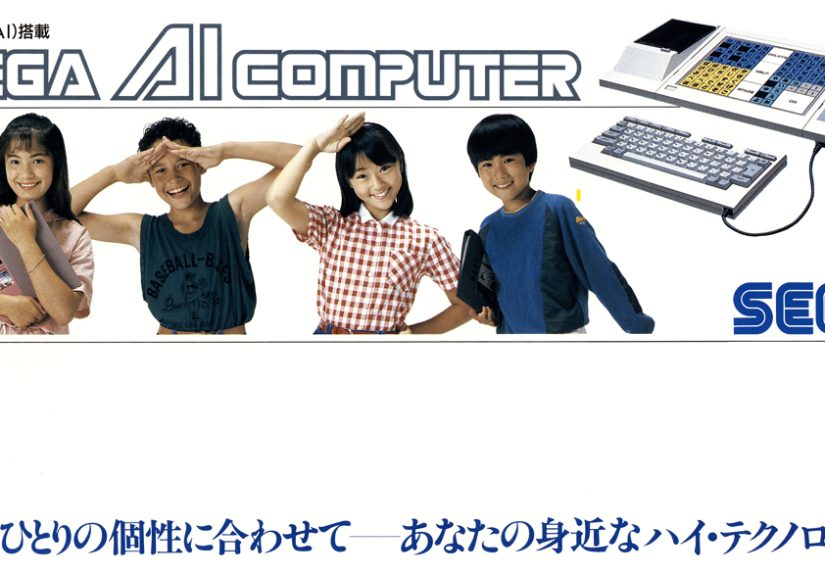
The machine included a large touch surface that could use custom overlays. Imagine a tablet before tablets, except thicker, rarer, and much more likely to make collectors gasp dramatically. Different software titles shipped with different overlay sheets, allowing the touchpad to become a Japanese syllabary board, drawing surface, music interface, or educational control panel.
Key Hardware Features
Under the hood, the Sega AI Computer was more capable than its obscure reputation suggests. It used a 16-bit NEC V20 processor running at 5 MHz, 128 KB of RAM, and a total ROM setup that included system software, character data, and speech data. It also featured Yamaha video hardware, PSG sound, microphone input, cassette support, Sega My Card software, and optional peripherals such as a keyboard and a Sound Box with FM audio.
For a children’s educational computer, that was not shabby. It was not a supercomputer, but it also was not a toy pretending to be smart by blinking aggressively. Sega was clearly trying to create a dedicated learning platform with multimedia features: speech, music, touch interaction, storage cards, and cassette-based content.
How “Artificial Intelligence” Worked in 1986
Today, AI often means neural networks trained on enormous datasets. In the 1980s, AI usually meant symbolic systems: expert systems, logic programming, rule-based reasoning, and programs that appeared intelligent because they could parse inputs and make decisions based on stored rules.
The Sega AI Computer fit that older definition. Its “AI” was not going to paint a cyberpunk hedgehog, summarize your tax documents, or politely hallucinate a recipe for lasagna smoothies. Instead, it used Sega Prolog to power educational activities that could respond to children in a more flexible way than standard software.
One famous example is the diary application. The child could answer prompts about the day, and the program would generate a grammatically correct diary entry from those answers. That may sound simple now, but in the context of 1986 educational software, it was a meaningful step toward human-computer interaction that felt less mechanical.
The system also aimed to evaluate a learner’s ability and move to suitable material rather than merely advancing one level at a time. In modern terms, we might call that adaptive learning. In 1986 terms, it was closer to “the computer is trying to act like a patient teacher instead of a vending machine with homework.”
Why Sega’s AI Computer Was Ahead of Its Time
The most fascinating thing about the Sega AI Computer is not that it predicted ChatGPT. It did not. The real point is that Sega recognized several ideas that still drive the artificial intelligence revolution today.
1. AI Should Feel Interactive
Modern AI succeeds partly because users can talk to it naturally. The Sega AI Computer was also built around interaction. Its touch overlays, speech functions, and prompt-based lessons tried to reduce the distance between child and machine. Instead of forcing children into command-line logic, it invited them to touch, listen, respond, and explore.
2. Education Was a Natural AI Use Case
From the beginning, Sega’s machine was tied to learning. Its software focused on language, music, stories, writing, numbers, and child-friendly lessons. That was smart. Education is one of the clearest places where AI can help, because every learner moves differently. Some children need repetition. Some need challenge. Some need encouragement. Some need a snack and a nap, but unfortunately even modern AI has not solved that one.
3. Hardware and Software Needed to Work Together
The Sega AI Computer was not just software running on a generic box. Its hardware design supported its educational mission. The overlays changed the meaning of the touch surface. The speech ROM supported spoken feedback. The cassette and card systems delivered different kinds of content. This tight connection between interface and learning experience remains important today.
4. AI Needed Trust
Even in its simple form, Sega’s AI promise depended on trust. Parents and schools had to believe the machine could help children learn. Modern AI faces the same challenge, only at a much larger scale. Today’s AI systems must be reliable, transparent, safe, and accountable. If an AI tutor gives bad advice, invents facts, or quietly trains a child to write like a corporate memo, the magic disappears fast.
Why Did the Sega AI Computer Stay So Obscure?
The Sega AI Computer was ambitious, but ambition does not guarantee market success. It appears to have been sold mostly in Japan, with strong ties to educational settings. Its software library was specialized, text-heavy, and aimed at young learners. Planned broader releases, including possible international versions, never turned it into a familiar household name.
There were practical obstacles. The hardware was specialized. The educational software market was smaller than the game console market. AI was a difficult concept to explain to consumers. And Sega, like many technology companies of the 1980s, was experimenting in a world where standards were still forming.
There is also a branding issue. Sega later became famous for speed, attitude, arcades, and console battles. The quiet educational computer that helped children write diary entries did not fit neatly into the mythology of “Sega does what Nintendon’t.” It was more like “Sega helps your child practice language skills through a Prolog-based interface,” which is accurate but less likely to sell T-shirts.
Preservation Brought Sega’s AI Dream Back to Life
For decades, the Sega AI Computer was nearly mythical. Collectors knew bits and pieces. A few scans and advertisements surfaced. But the machine remained one of Sega’s rarest and least understood systems.
That changed when preservation efforts made system ROMs, software dumps, scans, photographs, and technical details more widely available. MAME support also helped transform the Sega AI Computer from a museum whisper into something researchers and enthusiasts could examine more concretely.
This matters because video game and computer history is fragile. Old educational systems are especially vulnerable because they were often used by children, schools, and institutions rather than preserved by collectors from day one. Software can disappear. Manuals can be thrown out. Cassettes degrade. A rare machine can become a rumor with a power cable.
Preserving the Sega AI Computer does more than rescue an odd Sega artifact. It helps us understand how companies imagined artificial intelligence before the internet, before cloud computing, and before GPUs became the precious gemstones of Silicon Valley.
Sega AI Computer vs. Today’s AI Revolution
The modern artificial intelligence revolution is much larger than anything Sega could have built in 1986. Today’s AI systems can generate essays, code, music, images, game assets, customer-service responses, and research summaries. AI adoption has moved quickly across consumer tools, business workflows, software development, education, entertainment, and design.
Yet the Sega AI Computer still feels relevant because it represents an earlier version of the same dream: make machines more helpful by making them more responsive to human language, context, and ability.
Symbolic AI vs. Generative AI
The Sega AI Computer belonged to the symbolic AI tradition. It worked through rules, logic, and structured interpretation. Modern generative AI relies heavily on machine learning models trained on huge collections of data. The difference is enormous. Symbolic AI is like a rulebook. Generative AI is like a probability engine with a library card, a caffeine problem, and confidence it may or may not deserve.
But symbolic AI had strengths that remain valuable. Rules can be inspected. Logic can be explained. Educational paths can be designed deliberately. As modern AI systems become more powerful, many researchers and developers are returning to hybrid approaches that combine generative flexibility with structured guardrails.
The User Experience Lesson
Sega understood that intelligence is not only about raw computation. It is also about interface. Children did not need to know what Prolog was. They needed a friendly system that could ask questions, speak, show visuals, and react to their input.
Modern AI companies should remember that. The best AI tools are not always the ones with the biggest models. They are the ones that fit naturally into human workflows. A helpful AI tutor, writing assistant, game design partner, or accessibility tool must feel understandable, controllable, and useful.
What Sega’s AI Computer Teaches Modern Tech Companies
The Sega AI Computer is a charming piece of retro technology, but it also carries serious lessons for the current AI market.
Lesson One: AI Needs a Clear Job
Sega’s machine was not a general-purpose AI miracle. It had a focused mission: children’s education. That focus made its features understandable. Modern AI products often fail when they promise everything to everyone. The best tools solve specific problems: help a student practice reading, help a developer debug code, help a doctor organize notes, or help a designer explore concepts.
Lesson Two: Intelligence Is Not Enough
A system can be clever and still fail commercially. The Sega AI Computer had novel ideas, but it needed the right price, distribution, software ecosystem, and audience. Today’s AI startups face the same reality. A dazzling demo is not a business model. A model that performs well in a lab still needs usability, trust, support, and measurable value.
Lesson Three: Educational AI Must Respect Learners
AI in education should not simply automate worksheets. It should support curiosity, confidence, creativity, and human teaching. The Sega AI Computer’s child-centered design is worth noticing. Its interface was playful. Its software used stories, music, drawing, and writing. It treated learning as interaction, not just instruction.
Lesson Four: Preservation Is Part of Innovation
Technology culture loves the future, but the future has a terrible memory. Looking back at machines like the Sega AI Computer helps us avoid repeating old mistakes. It reminds us that AI hype is not new, educational technology has always needed careful design, and the most interesting inventions are not always the most famous ones.
Experience Notes: Meeting the Sega AI Computer From the Future
Exploring the Sega AI Computer today feels like opening a time capsule from an alternate version of the tech industry. In that timeline, maybe Sega did not become known mainly for console wars and blue hedgehogs. Maybe it became the company that put conversational learning machines into classrooms. Maybe children grew up with Sega-branded AI tutors before they ever touched a Genesis controller.
The first experience is surprise. The phrase “Sega AI Computer” sounds like a modern product name generated by a marketing department trapped in a lightning storm. But then the details appear: Prolog, touch overlays, speech synthesis, educational courseware, natural language prompts. Suddenly it becomes clear that this was not just a gimmick. It was a serious attempt to make computing feel more personal for children.
The second experience is affection. Retro technology often has a physical honesty that modern devices lack. The Sega AI Computer had cards, cassettes, overlays, buttons, optional hardware, and a visible relationship between object and activity. When a child placed an overlay on the touch surface, the interface changed in a way they could see and understand. Modern AI often hides its complexity behind a blank text box. Sega’s machine made learning tactile.
The third experience is humility. Today, we talk about AI as if we invented ambition last Tuesday. But the Sega AI Computer proves that people were already asking big questions decades ago. Can a machine understand a child’s words? Can software adapt to ability? Can a computer help write, speak, learn, and play? The answers were limited by 1980s hardware, but the questions were remarkably modern.
The fourth experience is caution. AI hype has always had a shiny jacket. In 1986, artificial intelligence sounded futuristic enough to sell a specialized learning computer. Today, it sells software subscriptions, enterprise platforms, productivity suites, and occasionally refrigerators that claim to know your lifestyle better than you do. The lesson is not that hype is bad. Hype can attract attention and funding. The lesson is that useful AI must eventually prove itself in ordinary life.
Finally, the Sega AI Computer creates a feeling of continuity. It connects the old dream of intelligent machines with the new reality of generative tools. Its diary program was a tiny ancestor of today’s writing assistants. Its adaptive lessons foreshadowed AI tutors. Its speech and touch features anticipated more natural interfaces. It did not change the world, but it pointed in a direction the world eventually followed.
That is why Sega’s forgotten AI machine deserves attention now. It is not merely a collector’s curiosity. It is a reminder that revolutions rarely appear from nowhere. They are built from experiments, false starts, strange devices, schoolroom prototypes, preserved ROMs, and ideas that were too early to become ordinary. The Sega AI Computer embraced the artificial intelligence revolution before the revolution had enough memory, speed, or market timing to embrace it back.
Conclusion
The Sega AI Computer is one of the most fascinating artifacts in Sega’s history because it reveals a side of the company that was experimental, educational, and quietly futuristic. Long before modern generative AI became a daily tool, Sega explored how artificial intelligence could support children through language, music, writing, speech, and adaptive lessons.
It was not the same kind of AI we use today, but it was built on a powerful idea: computers should respond to people more naturally. That idea still drives the AI revolution. The difference is scale. Sega had Prolog, touch overlays, and cassettes. Today we have large language models, cloud infrastructure, and AI tools used by millions. But the human question remains the same: can technology help us learn, create, and think better?
The Sega AI Computer may be rare, but its lesson is not. The future often arrives first as a weird machine nobody knows how to market.