Table of Contents >> Show >> Hide
- What Does “Sorry for Your Loss” Mean?
- Why This Phrase Works (Even If It Feels Scripted)
- When to Say “Sorry for Your Loss” (And When to Upgrade It)
- How to Say It Better: Small Tweaks That Make It Feel Real
- Alternatives to “Sorry for Your Loss” (By Situation)
- What Not to Say (Even If You Mean Well)
- How to Respond When Someone Says “Sorry for Your Loss”
- Common Scenarios: What to Say (With Specific Examples)
- Quick FAQ
- Conclusion
- Real-Life Experiences: What Helped (and What Didn’t)
Few phrases are as commonand as awkwardas “sorry for your loss.” It shows up in sympathy cards, texts, office emails,
and those hallway moments when your brain suddenly forgets every word you’ve ever learned. People say it because they care,
because they’re trying to honor someone’s grief, and because English sometimes hands us one “standard line” and says,
“Good luck out there.”
The good news: “sorry for your loss” is usually appropriate, usually kind, and usually enough. The better news:
you can also make it warmer, more personal, and easier for the grieving person to receivewithout accidentally turning your condolence
into a TED Talk or a mystery novel.
What Does “Sorry for Your Loss” Mean?
“Sorry for your loss” is a condolencean expression of sympathy and support after someone experiences a death or another meaningful loss.
In everyday American English, it means:
- I acknowledge what happened. I’m not pretending it’s normal or fine.
- I recognize your pain. Even if I can’t fix it, I see it.
- I care about you. I’m offering respect, compassion, and (sometimes) presence.
It’s not an apology for causing the loss. It’s “I’m sorry this happened” rather than “I’m sorry I did this.” In other words:
you’re showing empathy, not taking blame.
Why This Phrase Works (Even If It Feels Scripted)
When someone is grieving, mental energy can be limited. Long messages can unintentionally create “reply homework.”
A short condolenceespecially one that doesn’t demand a responsecan be a relief. That’s why a simple phrase often lands better than
a complicated speech.
Still, people sometimes worry the phrase sounds automatic. The fix is easy: add one small, sincere detaillike the person’s name,
a specific memory, or an offer of practical help. Think of “sorry for your loss” as a solid base layer. You can wear it as-is,
or dress it up.
When to Say “Sorry for Your Loss” (And When to Upgrade It)
1) In person
In face-to-face settingsfunerals, visitations, religious services, or a quiet moment“I’m so sorry for your loss” is perfectly appropriate.
Keep your tone gentle. Keep your volume low. And keep your body language calm (a soft handshake, a brief hug if it’s welcome, or simply being present).
Helpful add-on: Use the deceased person’s name if you’re sure you have it right:
“I’m so sorry for your loss. I’ll always remember how kind Jordan was.”
2) Over text or direct message
Text condolences can feel weird, but they’re often the quickest way to show you care. Short is good. Clear is good. No pressure is best.
- “I’m so sorry for your loss. Thinking of you.”
- “I just heard about your dad. I’m truly sorry. I’m here if you want to talk.”
- “I don’t have the perfect words. I just want you to know I care.”
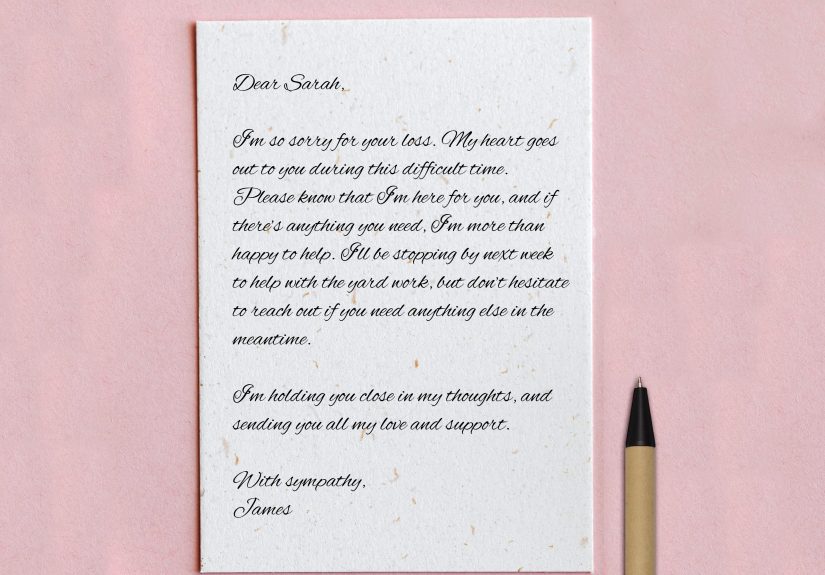
3) In a sympathy card
Cards are ideal for a slightly more personal message. A simple structure works:
- Acknowledge the loss (“I’m so sorry for your loss.”)
- Name the person (“I’ll be thinking of you as you remember Maria.”)
- Share a specific positive detail (“She always made people feel welcome.”)
- Offer support (“If you’d like a meal dropped off, I’m happy to help.”)
4) At work (coworkers, clients, professional relationships)
Workplace condolences should be respectful, brief, and low-pressure. You can absolutely say “sorry for your loss” professionally.
Keep it clean and supportive:
- “I’m very sorry for your loss. Please take the time you need. We’re thinking of you.”
- “Please accept my condolences. If it’s helpful, we can adjust deadlines and coverage.”
5) For non-death losses
People sometimes use “sorry for your loss” for other significant griefmiscarriage, infertility news, divorce, a serious diagnosis, or even a pet loss.
In those cases, the phrase can be okay, but it depends on the person and the context. When in doubt, use something more specific:
“I’m so sorry you’re going through this.”
How to Say It Better: Small Tweaks That Make It Feel Real
If you want to keep the phrase but make it warmer, try one of these upgrades:
- Name the person: “I’m so sorry for your loss. I was saddened to hear about Ms. Lee.”
- Acknowledge the relationship: “I know how close you were. I’m really sorry.”
- Offer presence: “I’m here with youtoday and in the weeks ahead.”
- Offer practical help: “Can I drop off dinner Thursday, or would next week be better?”
- Share a brief memory: “I’ll never forget how he made everyone laugh at the cookout.”
Notice what’s missing: advice, silver linings, and explanations. In grief, “presence” tends to beat “solutions.”
Alternatives to “Sorry for Your Loss” (By Situation)
Sometimes you want a different phrasebecause “sorry for your loss” feels too generic, or because you know the person prefers plain language.
Here are options that still sound natural in standard American English.
Simple, universally safe alternatives
- “I’m so sorry.”
- “My condolences.”
- “I’m thinking of you.”
- “I’m here for you.”
- “This is heartbreaking. I care about you.”
When you knew the person who died
- “I’m going to miss them. They mattered to me.”
- “They were wonderful to be around. I’m so sorry.”
- “I feel lucky I got to know them.”
When you don’t know what to say
- “I don’t have the right words, but I’m here.”
- “I’m so sorry. I’m holding you in my thoughts.”
- “I wish I could make this easier. I care about you.”
When you want to offer specific help
- “I can bring dinner this weekwould Tuesday or Friday be better?”
- “If you want, I can handle school pickup/errands on Saturday.”
- “If you need someone to sit with you, I can be there.”
When the loss is a pet
- “I’m so sorry. I know how much you loved them.”
- “They were family. I’m thinking of you.”
- “I’m glad they had you.”
What Not to Say (Even If You Mean Well)
Many common phrases are meant as comfort but can sound dismissive or pressure-filled. A good rule: avoid statements that explain the loss,
assign meaning, or rush the grieving person’s timeline. Examples that often backfire:
- “Everything happens for a reason.”
- “They’re in a better place.” (Unless you know the person shares that belief and has used that language.)
- “At least they lived a long life.”
- “Be strong.”
- “I know exactly how you feel.”
- “Let me know if you need anything.” (Not wrong, but vaguespecific offers are easier to accept.)
If you’ve already said something awkward, don’t panic. A simple repair works:
“I’m sorrythat came out wrong. I just care about you and I’m here.”
How to Respond When Someone Says “Sorry for Your Loss”
If you’re the one grieving, you don’t owe anyone the “perfect” reply. You can respond in a way that matches your energy, your privacy,
and your relationship with the person speaking.
Short, easy responses (in person or by text)
- “Thank you.”
- “I appreciate it.”
- “Thanks for reaching out.”
- “That means a lot.”
When you want to keep it brief and private
- “Thank you. I’m taking it one day at a time.”
- “I appreciate your kindness. I’m not up for talking much right now.”
- “Thanks. I’m keeping things quiet, but I’m grateful you reached out.”
When you want to share a little
- “Thank you. It’s been really hard, but we’re getting through.”
- “Thanks. I’m going to miss them a lot.”
- “I appreciate it. They meant so much to me.”
When you’d like support (and want to make it easy for others)
- “Thank you. I could really use company this weekend if you’re free.”
- “I appreciate it. If you could help with groceries this week, that would be amazing.”
- “Thankscould you check in next week? The quiet after everything settles is tough.”
When someone’s message is well-meant but clumsy
You can keep it simple, or not respond at all. If you do respond:
- “Thank you for thinking of me.”
- “I appreciate your message.”
Common Scenarios: What to Say (With Specific Examples)
If you just found out (you’re the first to respond)
Text: “I’m so sorry for your loss. I’m here with you. Do you want to talk now, or would you rather I check in later?”
If it’s a coworker you’re not close with
Email: “Hi [Name], I was sorry to hear about your loss. Please accept my condolences. If there’s anything you need at work as you return, I’m happy to help.”
If you’re attending a service and speaking briefly
In person: “I’m so sorry for your loss. [Name] was truly special. I’m thinking of you.”
If you’re responding to an announcement on social media
Keep it respectful and private when possible. A public comment can be simple:
“I’m so sorry for your loss. Sending love to you and your family.”
If you know the person well, a direct message may be more supportive than a comment thread.
Quick FAQ
Is “sorry for your loss” too generic?
Not inherently. It’s a widely recognized condolence in American English. If you want it to feel more personal, add one sentence:
a memory, the person’s name, or a specific offer of support.
Should I say “my condolences” instead?
“My condolences” is slightly more formal but equally appropriate, especially in professional or acquaintance settings.
“I’m sorry for your loss” often feels warmer and more conversational.
Do I have to respond when someone offers condolences?
No. A response is polite, but grief isn’t a customer service desk. If you can, “Thank you” is enough.
If you can’t, silence is also okay.
What matters more than the exact words?
Sincerity and follow-through. One kind check-in later (“Thinking of you today”) can mean more than the perfect phrase said once.
Conclusion
“Sorry for your loss” is popular because it does something important: it names grief without trying to control it. If you’re offering condolences,
keep it simple, respectful, and humanthen, when appropriate, add a small personal detail or a specific offer of help.
If you’re receiving condolences, you’re allowed to answer in the shortest way possible (or not at all).
In the end, people don’t remember your exact wording as much as they remember whether you showed up with care. In grief, that’s the real language.
Real-Life Experiences: What Helped (and What Didn’t)
If you’ve ever left a condolence conversation thinking, “Well, that was… a sentence I said out loud,” welcome to the human club.
Here are realistic, everyday experiences (the kind people quietly swap later) that show how “sorry for your loss” can landand how to make it kinder
without making it complicated.
1) The hallway moment at school or work. Someone returns after time away, and the room gets weirdly quiet, like grief is a surprise pop quiz.
The best responses are short and private: a gentle “I’m so sorry for your loss” after the meeting, not shouted across the room like a morning announcement.
What helps most isn’t the line itselfit’s the calm tone and the fact that you didn’t make them perform emotions in public.
2) The “I didn’t know what to say, so I said nothing” regret. Plenty of people freeze because they’re afraid of saying the wrong thing.
But many grieving people remember silence as absence. A simple message“I’m so sorry for your loss. I’m thinking of you.”often feels better than
perfectly composed nothing. Even if it’s not poetic, it’s present.
3) The sympathy text that accidentally becomes homework. A long paragraph full of questions (“How are you holding up?” “Are you okay?”
“Tell me everything.”) can be exhausting. The texts that help usually remove pressure:
“No need to replyI just wanted you to know I care.” That one sentence gives the grieving person control, which is a quiet gift when everything feels out of control.
4) The “at least…” comment that stings. People often reach for optimism: “At least they lived a long life,” or “At least you have your siblings.”
The problem is that “at least” can sound like a debate team trying to win against sadness. In real life, grief doesn’t want an opponent; it wants a witness.
“I’m so sorry for your loss” works better because it doesn’t argue with reality.
5) The unexpectedly meaningful follow-up. Many people show up at first, then disappear once the casseroles stop arriving.
The most memorable support is often later: a message two weeks or two months after the service“Thinking of you today. No reply needed.”
That kind of steady grief support feels like someone remembered the loss didn’t end when the calendar turned the page.
6) The practical offer that actually gets accepted. “Let me know if you need anything” is kind, but vague.
“I can bring dinner Thursdaywould you prefer pasta or soup?” is specific enough to be usable.
In many real situations, the “best” condolence isn’t a phrase at allit’s lowered effort: rides, meals, errands, coverage, or simply sitting quietly together.
The takeaway from these experiences is simple: “sorry for your loss” is a strong starting point. If you add softness (tone),
specificity (a name or a memory), or support (a concrete offer), you turn a standard condolence into something that feels like a hand on the shouldersteady,
respectful, and real.