Table of Contents >> Show >> Hide
- Why Humans Are Obsessed with Circles
- Circles in Religion and Spirituality
- Circles in Architecture: From Domes to Labyrinths
- Circles in Art, Design, and Everyday Life
- How to Notice (and Use) Circle Symbolism in Your Own Life
- Lived Experiences: Feeling the Power of the Circle
- Conclusion: The Circle Keeps Turning
If you had to pick one shape to represent “everything,” the circle is a surprisingly strong candidate. It’s in halos and wedding rings, rose windows and city roundabouts, prayer beads and perfectly plated cappuccinos. The circle shows up when we talk about eternity, community, perfection, and even our messy psychological inner lives.
In this deep dive, we’ll explore the symbolism of the circle in religion, sacred architecture, psychology, and everyday design. Along the way we’ll see why people keep turning (pun fully intended) to this simple shape when they want to point at something bigger than words: the divine, the self, and the cycles that structure our lives.
Why Humans Are Obsessed with Circles
Before we jump into stained glass and temples, it helps to ask a basic question: why are humans so drawn to circles in the first place?
Part of the answer is that we’re surrounded by them. The sun, the moon, tree rings, ripples on a pond, the iris of the eye, the horizon curving away from us on a clear day—nature loves round shapes. When our ancestors looked up or out or into a pool of water, they saw circles. It’s not surprising that those shapes became visual shortcuts for cosmic power, time, and life itself.
Psychology also plays a role. Curved forms tend to feel softer and safer than sharp angles. A circle has no “attack point.” Every point on its edge is equal, and its center anchors everything. That makes it a powerful symbol for unity, balance, and inclusion—exactly the themes religions, architects, and artists love to work with.
Circles in Religion and Spirituality
Across cultures and belief systems, circles tend to carry a few consistent meanings: eternity, wholeness, and the presence of the sacred. How those ideas are pictured or ritualized, though, varies in fascinating ways.
The Circle as Eternity and the Divine
Start with the obvious: a circle has no beginning and no end. If you’re looking for a visual way to talk about eternal life, infinite love, or the unbroken presence of God, this is your shape.
That’s why so many traditions use circles or circular objects in rites of commitment or covenant. The wedding ring is the classic example. The ring is small and practical, but symbolically it’s saying: “This promise is continuous. There’s no break in the line.” In Christian thought and in broader spiritual writing, the circle often stands for the perfection and unity of the divine—a reminder that the sacred is complete in itself, not pieced together from parts.
Christianity: Halos, Hosts, and Heavenly Windows
If you flip through Christian art, circles are everywhere once you know to look for them. Halos frame the heads of saints and angels, creating a glowing ring that separates holy figures from ordinary space. The halo is like a mini-sun, marking the person as radiant with divine light and eternal life.
In church architecture, circular forms do a lot of quiet theology. The round communion host, for example, hints at wholeness and unity as believers gather around one table. Circular crowns and wreaths in art reinforce the idea of the “crown of life” and victory over death. Even baptismal fonts are sometimes circular, echoing rebirth into an unending life with God.
Zoom out to the building itself, and you’ll find circular motifs in domes, oculi (round roof openings), and rose windows—each one a carefully crafted intersection of geometry and faith.
Hinduism, Buddhism, and Walking in Sacred Circles
In Hinduism, Buddhism, Jainism, and Sikhism, circles show up not just as pictures but as movement. One of the most striking examples is the practice of circumambulation: walking around a temple, stupa, or sacred object in a clockwise circle.
This ritual, often called pradakshina in Sanskrit, mirrors the way planets orbit the sun. By circling the holy center, worshippers literally “align” themselves with cosmic order. The divine remains at the center; the person moves around it, acknowledging dependence, reverence, and the cyclical nature of birth, death, and rebirth.
Then there are mandalas: intricate circular diagrams used in Hindu and Buddhist traditions as tools for meditation and visualization. A mandala often starts with a central point, then expands outward in ordered layers. Meditating on a mandala is like traveling from the chaos of everyday thoughts toward greater inner stillness and unity with the sacred.
Indigenous and Earth-Based Traditions: The Sacred Circle
Many Indigenous traditions in North America and elsewhere treat the circle as a core symbol of the universe. Sacred circles appear in medicine wheels, community councils, dance rings, and the arrangement of lodges.
In a talking circle, for example, people sit in a ring so that no one is “at the head of the table.” Everyone faces the center, and everyone is equally visible. The shape itself is part of the teaching: each voice matters, each direction has wisdom, and the community is healthiest when it functions as a balanced whole.
Medicine wheels and circular ceremonial grounds map out the four directions, seasons, life stages, or elements. Walking or praying around these circles reinforces the idea that life is cyclical and that harmony comes from respecting all parts of that cycle, not racing through it in a straight line.
The Ouroboros: Circles of Time and Transformation
One of the most dramatic circle symbols is the ouroboros: a serpent or dragon biting its own tail. You’ll find it in ancient Egyptian funerary texts, Greek magical writings, Gnostic and Hermetic traditions, and later in alchemical diagrams.
The ouroboros is a circle with personality. It represents cycles of time, the death-and-rebirth pattern of the universe, and the idea that everything is constantly transforming into something else. In some alchemical imagery, the ouroboros encloses the words “the all is one,” suggesting that even apparent opposites are united within the same cosmic loop.
Psychologically, it can point to the way we “digest” our own experiences, constantly reworking and renewing ourselves. The circle here is not just peaceful and serene; it’s dynamic, sometimes even unsettling, reminding us that endings are usually disguised beginnings.
Circles in Architecture: From Domes to Labyrinths
Religions don’t just talk about circles; they build them into actual stone, glass, and brick. Sacred architecture uses round forms to shape how people feel and move in a space, guiding them toward awe, focus, or inner reflection.
Domes: The Sky, Brought Indoors
Walk into a great domed building and most people do the same thing: they tilt their head back and stare up. That reaction is intentional. Domes turn architecture into a physical version of the heavens, translating the infinite arc of the sky into a contained, human-scale circle.
From Roman and Byzantine domes to Islamic mosques and Renaissance cathedrals, the round vault overhead suggests that the sacred realm is both beyond us and, mysteriously, right above our heads. The dome gathers the community into a shared circle beneath an encompassing “firmament.”
In some domes, a central oculus (a round opening) lets in a shaft of light. It’s a dramatic, architectural halo: a circular beam that seems to connect the earthly interior with the sky outside. Even in modern civic buildings, domes say “this is important” and “this space belongs to everyone,” leaning on the circle’s association with unity.
Rose Windows and Stained-Glass Circles
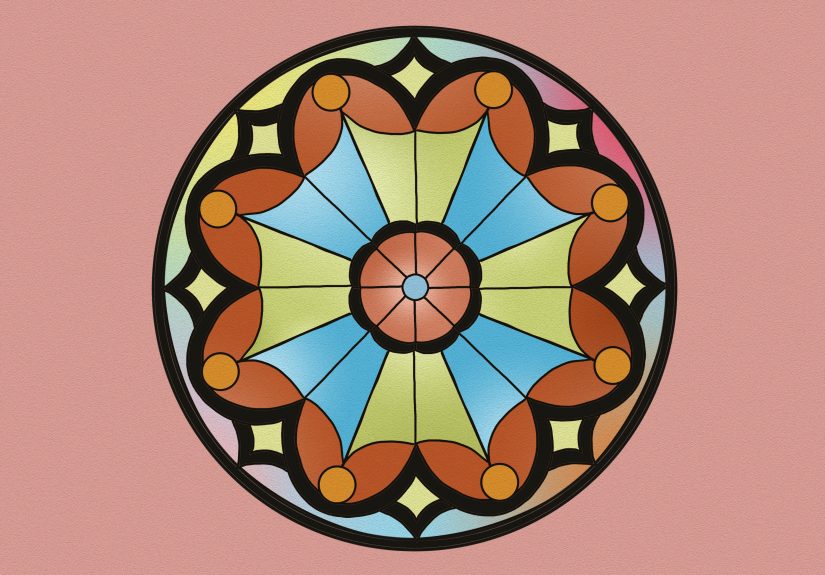
Gothic cathedrals pushed circular symbolism into technicolor with rose windows: huge round stained-glass compositions over entrances or transepts. These windows often consist of concentric rings of smaller circles and shapes arranged around a central motif.
The geometry is more than decorative. The orderly radiating pattern suggests a cosmos held together by a divine center. Light passes through biblical scenes, saints, and symbolic colors, transforming raw sunlight into a story-soaked glow. Worshippers looking up didn’t just see a pretty wheel; they saw a visual sermon about heavenly order, community, and the light of God pouring into the world.
Smaller circular medallions in stained glass serve similar purposes: framing key symbols like the cross, the Eucharist, or the Lamb of God inside luminous rings that hint at eternity and perfection.
Labyrinths, Plazas, and Everyday Urban Circles
Some sacred spaces use circles not above you but under your feet. Medieval floor labyrinths, often set into the stone of cathedral naves, are typically circular. Pilgrims could walk the winding path as a symbolic journey to Jerusalem, to God, or to the center of their own soul.
These labyrinths are not mazes; there are no dead ends. Like spiritual life at its best, you may feel lost at times, looping back on yourself, but if you stay with the path, you reach the center. Once again, the circle becomes an image of faithfulness over time, not instant arrival.
Outside of explicitly religious buildings, we still use circles to create shared, almost ritual spaces. Think of circular plazas, amphitheaters, and roundabouts. When people gather around a fountain or stage in a ring, the shape invites equality and shared attention. We naturally treat the center as special, whether the “sacred object” is a statue, a musician, or a very enthusiastic street performer.
Circles in Art, Design, and Everyday Life
Even if you never set foot in a temple or cathedral, you’re still surrounded by circle symbolism in art and design. Most of the time it works on you without your noticing.
Logos, Rings, and Brand Identity
Designers love circles for the same reasons spiritual traditions do: they feel complete, balanced, and welcoming. Circular logos suggest reliability and wholeness. Think of brands that use rings, orbs, or circular badges to signal unity and global reach.
In jewelry, rings and circular pendants are go-to choices for marking commitment, remembrance, or identity. Stackable rings show layered relationships and life stages; signet rings and family crests compress heritage and belonging into a tiny circle you carry everywhere.
Mandalas, Therapy, and the Inner Self
In modern psychology, especially in Jungian-inspired work and art therapy, the circle becomes a kind of mirror for the inner self. Mandalas—circular drawings, paintings, or sand designs—are used as tools for self-exploration. People create them spontaneously or color pre-drawn mandalas as a calming practice.
The process is simple but deceptively powerful. You pick a center, choose patterns, and build outward. Over time, your choices reveal emotional themes: where you feel stable, where you feel chaotic, which colors you gravitate toward when you’re tired or hopeful.
Therapists sometimes interpret these images as expressions of the “Self”: the deeper, more integrated identity beneath our everyday roles. The circle holds everything—light and dark, order and confusion—without collapsing. That’s exactly the kind of inner container many people are subconsciously searching for.
How to Notice (and Use) Circle Symbolism in Your Own Life
Once you start looking, circles are everywhere. Noticing them can be a surprisingly grounding practice, and intentionally using them can add meaning and harmony to your spaces and routines.
- At home: Round tables encourage conversation because no one is stuck at the “end.” A circular rug can visually anchor a living room or meditation corner, turning that spot into a mini “sacred circle.”
- In ritual and celebration: Birthday cakes, wreaths, and rings all lean on circle symbolism. If you’re planning a ceremony (from weddings to baby showers), think about how round objects might highlight themes of continuity and community.
- In personal reflection: Try drawing a simple mandala when you feel scattered. Start with a circle, add a dot or shape at the center, and then build out patterns. Don’t worry about making it pretty; think of it as giving your thoughts a safe container.
- In movement: Walking loops around a park, pacing a circular path, or even slowly circling in your living room can become a mindful practice. With each lap, you’re embodying the idea of returning again and again to what matters most.
Lived Experiences: Feeling the Power of the Circle
It’s one thing to analyze circle symbolism; it’s another to feel it in your bones. To see how circles work on us at a gut level, imagine a few scenes.
First, picture yourself standing under a great dome. Maybe it’s an old cathedral, maybe it’s a state capitol. You walk into the central hall, your footsteps echo, and instinctively you drift toward the middle. When you look up, the circular vault gathers your attention like a giant hand. Your everyday worries suddenly feel smaller, not because anyone lectured you about perspective, but because the space itself is literally scaled to a different vision of reality. The circle overhead says, “There is something larger holding all of this together.”
Now jump to a very different space: a community support group meeting in a plain room with folding chairs. Instead of rows facing a podium, the chairs are set in a circle. People filter in, sit down, and glance around the ring. The arrangement quietly changes the power dynamics. There’s no “front.” When someone speaks, they address everyone; when someone cries, the circle holds that emotion. Over time, people start associating that simple shape with honesty, safety, and being seen.
Or imagine walking a circular labyrinth. Maybe it’s laid out in stones in a garden, or painted on canvas for a temporary retreat. You start at the outer edge, following a winding path that seems to head toward the center, then away again, looping and turning until you lose your sense of distance. There’s no puzzle to solve; the path is already set. Your only job is to keep going. When you finally arrive at the center, you pause. The world is still messy and complicated, but for a moment you feel strangely gathered. The circle under your feet has done its quiet work.
Think about everyday circles, too. The ring someone nervously turns on their finger before they propose. The wheel of a car you grip on your first solo road trip. The perfect round orange you peel on a break, tiny suns in your hands. None of these objects have religious labels attached, but they still carry hints of completion, continuity, and connection. They’re personal mandalas: small, holdable symbols of a much larger story.
Even technology keeps pulling us back into circular metaphors. Video call interfaces arrange faces in grids, but group icons and avatars are often cropped into circles, as if to say, “Here is a whole person.” Smartwatches and circular progress indicators reassure us that time, habits, and goals are part of repeating cycles, not one-shot performances. Missed a day? The circle starts again tomorrow.
When you begin to notice these experiences, the world feels a little more intentional. The circle stops being just a geometry-class diagram and starts to feel like a friendly reminder built into your environment: life moves in cycles; wholeness is possible; you belong in the larger pattern. You don’t have to believe anything in particular to feel that. You just have to be willing to see the shapes that have been quietly preaching that message for thousands of years.
Conclusion: The Circle Keeps Turning
From halos to mandalas, domes to labyrinths, support groups to city plazas, the circle keeps showing up wherever humans try to express eternity, unity, and transformation. It’s simple enough for a child to draw and deep enough to hold entire religious systems and psychological theories.
Pay attention to the circles in your own life—the rituals you repeat, the people you gather around, the spaces that make you feel held instead of cornered. Chances are, those patterns aren’t accidental. They’re part of an ancient visual language that whispers the same message in a thousand accents: everything is connected, everything moves in cycles, and you are not outside the circle.