Table of Contents >> Show >> Hide
- 1) A Bubble Is Nature’s “Least-Effort” Geometry Machine
- 2) Soap Films Can Solve Shape Problems Faster Than Your Laptop
- 3) Bubble Colors Are a Built-In Thickness Scanner
- 4) In Space, Boiling Bubbles Behave Like They Forgot Gravity Exists
- 5) Tiny Bubbles Help Clean WaterAnd Save Serious Energy
- 6) Dissolved Air Flotation Uses Bubbles to Lift Gunk Out of Water
- 7) Medical Microbubbles Turn Ultrasound into a Better Detective
- 8) Microbubbles Can Help Open the Brain’s Security Gate
- 9) Wrong Pressure + Human Body = Dangerous Bubble Physics
- 10) Bubble Physics Helps Keep Fragile Newborn Lungs Open
- Conclusion: Bubbles Are Small, But Their Job Description Is Huge
- 500-Word Experience Collection: What Bubble Science Looks Like in Real Life
Bubbles look like pure nonsense: shiny, wobbly, dramatic, and emotionally unprepared for sharp objects.
But in science, bubbles are little overachievers. They help doctors see blood flow, help engineers clean
wastewater, help neonatal teams support fragile lungs, and help physicists understand everything from surface
tension to heat transfer in space.
If you’ve ever thought bubbles were just bath-time confetti, welcome to your plot twist. The same physics that
makes a soap bubble iridescent also powers medical imaging and influences industrial efficiency. The same
“tiny gas pocket” idea can save a preterm infant in a NICUor make a diver dangerously sick if pressure changes
too quickly.
In this guide, we’ll break down ten weirdly useful scientific facts about bubbles in plain English, with real
examples and practical takeaways. You’ll get bubble science without the textbook headache: clear explanations,
helpful analogies, and just enough humor to keep your neurons hydrated. Let’s pop into it.
1) A Bubble Is Nature’s “Least-Effort” Geometry Machine
Why it’s weird
A free bubble tends to become a sphere because surface tension pulls the liquid film into the smallest possible
surface area for a given volume. In short: bubbles are lazy in the most efficient way possible.
Why it’s useful
This “minimum area” behavior is a physical shortcut for optimization problems. Scientists and engineers study
soap films to understand how systems can settle into efficient structures.
Real-world example
Think about packaging, membranes, and lightweight structures: when designers want high efficiency with minimal
material, bubble-like geometry often shows up in the final concept.
2) Soap Films Can Solve Shape Problems Faster Than Your Laptop
Why it’s weird
Dip a wire frame in soap solution and the film stretches into minimal surfaces automatically. No keyboard,
no solver, no “loading…”. Just physics doing computation in real time.
Why it’s useful
These experiments help explain optimization principles in architecture, materials science, and engineering
education. Bubble films become visual models for how tension distributes across complex boundaries.
Pro takeaway
For teaching STEM, bubbles are elite. They turn abstract math into “oh wow, I can see it” science in seconds.
3) Bubble Colors Are a Built-In Thickness Scanner
Why it’s weird
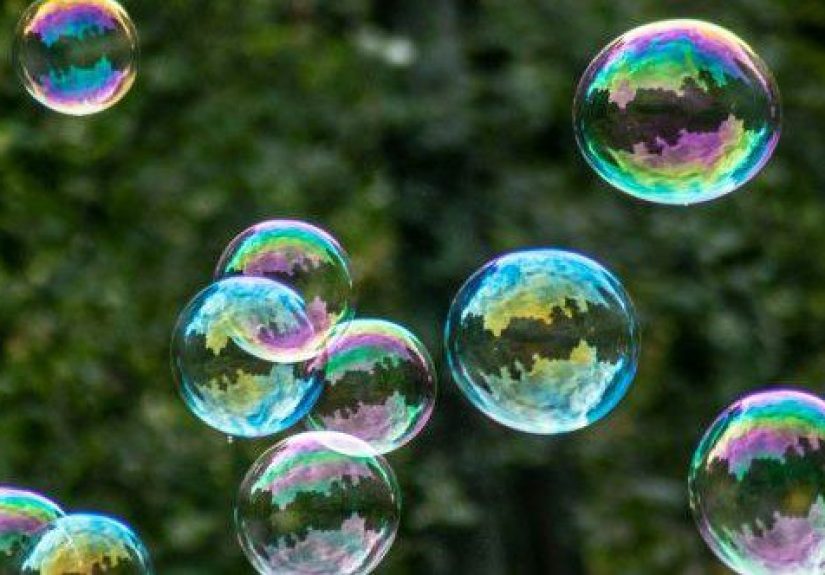
Soap bubbles aren’t “dyed rainbow.” Their colors come from thin-film interference: light reflects off the
outer and inner film surfaces, and some wavelengths reinforce while others cancel out.
Why it’s useful
Those changing color bands reveal film thickness changes in real time. When regions become extremely thin,
bubbles can look dark right before popping. That’s not dramait’s optics.
Real-world example
Thin-film interference principles are used in anti-reflective coatings, optical design, and quality checks for
ultra-thin layers in research and industry.
4) In Space, Boiling Bubbles Behave Like They Forgot Gravity Exists
Why it’s weird
On Earth, bubbles in boiling liquids detach and rise because buoyancy helps pull them away from a hot surface.
Under microgravity, that process changes dramatically: bubbles can grow larger, linger longer, and alter heat
transfer behavior.
Why it’s useful
Spacecraft thermal systems rely on accurate boiling and cooling behavior. Understanding bubble dynamics in low
gravity helps engineers design safer, more efficient systems for long missions.
Practical angle
If your cooling model is Earth-only, it can fail in orbit. Bubble physics is mission-critical, not decorative.
5) Tiny Bubbles Help Clean WaterAnd Save Serious Energy
Why it’s weird
Wastewater treatment uses aeration to feed oxygen to microbes that break down pollutants. Fine bubbles transfer
oxygen effectively because they create lots of gas-liquid interface area.
Why it’s useful
Aeration is one of the biggest energy costs in treatment plants. Improving bubble-based oxygen transfer can
reduce operating costs and support better process control.
Real-world impact
In municipal systems, better aeration strategy can mean lower utility costs, improved treatment performance,
and a smaller environmental footprint.
6) Dissolved Air Flotation Uses Bubbles to Lift Gunk Out of Water
Why it’s weird
In dissolved air flotation (DAF), tiny pressurized air bubbles attach to suspended particles and help float
them to the surface for removal. Basically: bubbles act like tiny elevator balloons for contaminants.
Why it’s useful
DAF is especially effective for certain low-density particles, oils, and algae-rich waters where settling alone
may be less effective.
Where you’ll see it
Industrial and municipal treatment lines use DAF as a practical clarification step before downstream treatment.
7) Medical Microbubbles Turn Ultrasound into a Better Detective
Why it’s weird
Contrast-enhanced ultrasound uses gas-filled microbubbles (roughly red-blood-cell scale) injected into blood.
These bubbles scatter ultrasound waves strongly, making blood flow and tissue perfusion easier to see.
Why it’s useful
Clinicians can evaluate organs and blood vessels with improved clarity, often without ionizing radiation.
That makes bubble-based contrast a valuable tool in real-world diagnosis.
Why patients care
Better visualization can support faster and more confident decisions in abdominal and cardiovascular imaging.
8) Microbubbles Can Help Open the Brain’s Security Gate
Why it’s weird
The blood-brain barrier is notoriously selective. With focused ultrasound and circulating microbubbles,
researchers have shown a way to temporarily increase permeability in targeted regions.
Why it’s useful
This approach may help deliver therapies that normally struggle to reach brain tissue. It’s still an active
research area, but the concept is powerful: bubbles can act as mechanical assistants for precision medicine.
Big picture
Future neuro-oncology and neurology treatments may depend on this kind of targeted transport strategy.
9) Wrong Pressure + Human Body = Dangerous Bubble Physics
Why it’s weird
Under high pressure, inert gases dissolve into tissues. If pressure drops too quickly (for divers or compressed-air
workers), bubbles can form in blood and tissues. That’s decompression sicknessthe bends.
Why it’s useful
Understanding bubble formation in physiology led to decompression tables and chamber protocols that prevent
severe injuries.
Safety takeaway
Bubble science here is not theoretical. It’s an occupational and diving safety lifesaver.
10) Bubble Physics Helps Keep Fragile Newborn Lungs Open
Why it’s weird
In neonatology, bubble CPAP uses pressure oscillations and continuous airway pressure to support breathing in
preterm infants with respiratory distress.
Why it’s useful
Clinical evidence shows CPAP can reduce respiratory failure and need for invasive ventilation in appropriate
settings. Add surfactant sciencereducing harmful lung surface tensionand outcomes for premature infants
have improved dramatically over decades.
Real-world meaning
This is bubble science at its most human: tiny physical principles supporting tiny lives.
Conclusion: Bubbles Are Small, But Their Job Description Is Huge
So yes, bubbles are fun. But they’re also practical tools for medicine, environmental engineering, thermal
systems, safety protocols, and applied physics. They optimize shape, reveal film thickness, move oxygen, lift
contaminants, sharpen ultrasound, and support preterm lungs. Not bad for something that usually dies in
under ten seconds.
If you’re creating educational content, product content, or science communication, bubble science is a rare
gift: visual, intuitive, and surprisingly deep. It can hook curious readers fast, then deliver serious insight
without feeling heavy.
Next time a bubble pops, don’t think “gone.” Think “physics demo completed.”
500-Word Experience Collection: What Bubble Science Looks Like in Real Life
Below is a composite, reality-based narrative drawn from common scenarios where bubble science shows up in
daily life and professional settings.
In a middle-school science classroom, a teacher stretches soap film across a wire cube. Students expect a flat
sheet; instead they get curved films that reorganize when one edge moves. The room goes from “science is boring”
to “wait, it’s solving itself?” in about eight seconds. The teacher doesn’t start with equationsshe starts with
a bubble wand. By the end of class, words like surface tension and interference are no longer abstract.
They’re visible. A student who usually avoids participation points at a dark patch near the top of a bubble and
says, “That means it’s super thin, right?” Exactly right.
Across town, a wastewater operator watches dissolved oxygen trends on a control panel. Nothing glamorous, no
cinematic soundtrack, just process stability and careful aeration control. But those tiny bubbles being pushed
through diffusers are doing expensive, essential work. Too little oxygen and biology underperforms. Too much and
the electric bill throws a tantrum. Fine-tuning bubble behavior becomes an operations superpower: better treatment,
steadier compliance, and lower energy waste.
On a hospital imaging floor, a patient gets contrast-enhanced ultrasound. The idea sounds futuristicgas-filled
microbubbles circulating through blood vesselsbut the clinical goal is straightforward: clearer information,
sooner. Better visualization can reduce ambiguity and help clinicians decide what to do next without unnecessary
delay. In that moment, bubble physics is not a trivia fact; it’s part of medical clarity.
In neonatal care settings, bubble CPAP equipment hums quietly while teams monitor tiny chest movements and oxygen
trends. Here, “bubble” is not playful language. It’s a practical respiratory support strategy used to avoid more
invasive ventilation when possible. Pair that with surfactant-based understanding of lung surface tension, and
you can see how deep physics and compassionate care intersect.
Meanwhile, in a dive training briefing, decompression rules are explained with blunt honesty: your body can
absorb gas under pressure, and ascent discipline matters because bubbles can form if pressure drops too fast.
Dive computers, staged ascents, and decompression protocols are basically bubble-management tools with high
stakes. The science feels instantly personal when safety depends on it.
Even coastal communities experience bubble consequences. Breaking waves entrain air; bursting bubbles launch sea
spray particles into the atmosphere. That connects ocean processes to air chemistry, cloud behavior, and in some
locations even pollution transport. The shoreline is not just sceneryit’s an active bubble-to-aerosol laboratory.
The pattern across all these settings is the same: bubbles are tiny interfaces where forces, chemistry, and
biology negotiate outcomes. In classrooms they teach. In plants they clean. In hospitals they assist diagnosis
and breathing support. In oceans they influence the atmosphere. In diving they define safety margins. The next
time you see foam in a sink or fizz in a glass, you’re looking at more than decorationyou’re watching one of
science’s most useful recurring characters do its job.