Table of Contents >> Show >> Hide
- Why So Many People Regret Their Wall Art Choices
- Step 1: Read the Room Before You Read the Artwork
- Step 2: Get the Scale Right Before You Fall in Love
- Step 3: Buy for the Long Haul, Not the Quick Thrill
- A Quick Example of the 3-Step Method in Action
- Common Wall Art Mistakes This Method Helps You Avoid
- Final Thoughts
- Additional Experience-Based Insights: What People Often Learn After Living with Their Wall Art
- SEO Tags
Choosing wall art sounds easy until you’re standing in front of a blank wall, holding your phone like a tiny interior designer with no signal. Suddenly every option feels risky. Too trendy. Too beige. Too giant. Too tiny. Too “I bought this because it matched the throw pillows and now I need to rethink my life.”
The good news is that choosing wall art does not have to feel like an expensive personality test. The best pieces are not always the priciest, the boldest, or the most “designer approved.” They are the ones that make sense for your space, feel true to your taste, and still look right six months later when the dopamine from online checkout has worn off.
If you want wall art you will never regret, stop shopping by impulse and start choosing by method. A simple, practical three-step approach can save you from the classic mistakes: art that is too small, colors that fight the room, pieces that feel random, and gallery walls that look like they were hung during a minor earthquake.
This guide breaks the process into three clear steps: read the room, match the scale, and test the long-term feeling. Follow them, and your art will look intentional, personal, and far less likely to become “that thing I should probably move to the hallway.”
Why So Many People Regret Their Wall Art Choices
Most regret does not come from buying “bad” art. It comes from buying the right piece for the wrong wall, the wrong size for the furniture, or the wrong mood for the way the room actually functions. A beautiful abstract can still look awkward if it hovers too high above a sofa. A sweet little print can disappear on a large wall like a shy guest at a loud party. Even a meaningful piece can feel off if the frame, color palette, or orientation clashes with the room around it.
That is why designers repeatedly return to the same ideas: proportion, placement, cohesion, and emotion. The art should connect to the room, not just exist in it. Think of it less as “filling blank space” and more as setting the tone for how the room feels when someone walks in.
Step 1: Read the Room Before You Read the Artwork
The first step is not shopping. It is paying attention. Before you buy anything, study the room where the art will live. What is the room used for? How much natural light does it get? What mood do you want the space to create? Calm? Energetic? Cozy? Sophisticated? Playful? Wall art works best when it supports the life of the room instead of competing with it.
Ask What the Room Needs Emotionally
A bedroom usually wants softer, more personal art. A home office may benefit from pieces that feel clean, focused, or energizing. A living room can handle stronger conversation pieces because it is often where people gather, talk, and spend time looking around. If the room already has loud patterns, dramatic furniture, or bold paint, the wall art may need to bring balance. If the room is neutral and quiet, art can be the spark that wakes everything up.
This is where many people go wrong. They buy wall art because it is pretty in isolation, not because it fits the emotional job of the room. A hyperactive neon print in a restful bedroom may look cool for three days and mildly annoying for three years. On the other hand, a layered landscape, textured piece, or soft-toned abstract might feel calming every single time you walk in.
Look at What the Room Is Already Saying
Study the colors, materials, and shapes you already have. Is the room full of curved furniture, warm woods, and linen textures? Or is it sleek, dark, and modern? Your wall art does not need to match everything exactly, but it should feel like it belongs in the same conversation. A room can handle contrast, but it still needs chemistry.
One reliable trick is to pull one or two colors from the room and look for art that repeats, softens, or balances them. If your sofa, rug, or curtains already bring plenty of color, artwork can echo those tones in a subtler way. If the room is mostly neutral, the art can become the main color event. Either way, you are making the art relate to the room rather than float making the art relate to the room rather than float above it like a confused tourist.
Notice the Light and the Wall Conditions
Light matters more than people think. A wall flooded with direct sun can make certain pieces fade faster over time, especially more delicate works. Heat sources matter too. Hanging art over a fireplace may look dramatic, but it can expose the piece to heat, soot, and grime. In humid spaces, precious works may not be your smartest choice either. In other words, choose with real-life conditions in mind, not just the fantasy version of your home that exists for seven minutes after cleaning.
At the end of Step 1, you should be able to answer this question clearly: What should this art do for this room? If your answer is something specific like “add warmth,” “create a focal point,” “make the room feel taller,” or “bring in personality without overwhelming the space,” you are ready for Step 2.
Step 2: Get the Scale Right Before You Fall in Love
This step saves people from the most common wall art mistake of all: choosing a piece that is the wrong size. Bad scale can make great art look accidental. Good scale makes even affordable art look polished.
Start with the Wall and the Furniture
If you are hanging art above a sofa, bed, sideboard, or desk, the piece should visually connect to that furniture. A useful rule of thumb is to choose art that spans roughly two-thirds to three-fourths of the furniture’s width. That proportion helps the piece feel anchored rather than lost. Too small, and it looks timid. Too big, and it starts bossing the room around.
Placement matters too. Art hung over furniture usually looks best when the bottom of the frame sits about 8 to 10 inches above the furniture. That keeps the art connected to what is below it. If it floats much higher, the whole arrangement can feel disjointed, like the wall and the sofa are no longer speaking.
Use the Eye-Level Rule, Then Adjust Like a Human
For a single piece on an open wall, many designers use the classic eye-level guideline: the center of the artwork lands around 57 to 60 inches from the floor. That is a strong starting point, not a law passed by the Department of Picture Placement. If the room has tall ceilings, if people are mostly standing, or if the piece is part of a larger grouping, you can adjust. The point is balance, not obedience.
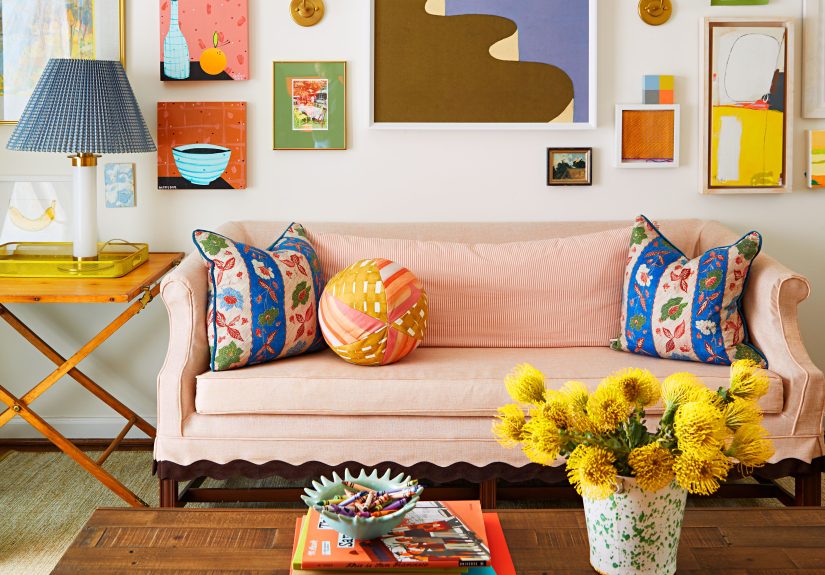
Gallery walls work a little differently. Instead of treating every frame as its own island, think of the full arrangement as one large visual unit. The center of the grouping should feel balanced in the room, and the spacing between pieces should look intentional. A few inches between frames usually works well. Too tight feels cramped. Too wide feels like a group project where nobody coordinated.
Choose Orientation with Purpose
Horizontal art often works beautifully above sofas, beds, and long consoles because it mirrors the shape of the furniture. Vertical art can help emphasize height, especially on narrower walls or in entryways. A grid of smaller pieces can feel classic and orderly. An asymmetrical gallery wall feels more collected and relaxed. Neither is better. The best choice depends on the architecture of the wall and the personality of the room.
Mock It Up Before You Commit
This is the least glamorous step and maybe the most important. Use painter’s tape, paper templates, or floor layouts to test size and arrangement before you hang anything. Designers do this for a reason. It gives you a preview of proportion, spacing, and rhythm. It also prevents the dreaded “Swiss cheese wall” effect, where too many holes tell the story of every decision you made and then immediately unmade.
If you are choosing among several options online, measure the art dimensions on the wall with tape. Seriously. A 24-by-36-inch piece can seem huge on a product page and weirdly modest in a room with high ceilings. Real measurements beat hopeful imagination every time.
Step 3: Buy for the Long Haul, Not the Quick Thrill
Now that the room and the scale are right, you get to the most personal step: choosing art you will still want to live with later. This is where regret gets filtered out.
Look for a Piece That Holds Your Attention
Good wall art does not have to shout, but it should have staying power. When you look at it, do you keep coming back for another glance? Does it make you feel something beyond “well, that matches”? The pieces people regret least are often the ones that feel personal, memorable, or emotionally grounded. Maybe it reminds you of a place, a season of life, a color palette you always love, or a mood you want more of at home.
This does not mean every piece needs a dramatic backstory. It just means your choice should have a reason beyond filling empty space. Trend-driven décor can be fun, but if a piece only feels exciting because it is currently everywhere, that is a warning sign. Choose what still makes sense when trend cycles move on to the next obsession.
Balance Personality with Cohesion
The safest way to avoid regret is not to choose bland art. It is to choose art with personality that still feels coherent in your home. If you love quirky vintage prints, great. If moody abstracts are your thing, also great. If you want a gallery wall with photography, sketches, textile art, and one odd little antique bird painting that makes your friends ask questions, honestly, delightful. The key is some thread that ties it together: color, framing, subject matter, mood, or scale.
Frames matter here more than people expect. The right frame can make mixed pieces feel cohesive. Black, wood, gold, and white are often reliable unifiers. Consistent matting can calm down a busy arrangement. On the flip side, a heavy, ornate frame on a delicate modern print can feel like dressing a minimalist in a chandelier.
Use the “Would I Rebuy This?” Test
Before you commit, ask yourself one brutally helpful question: If this disappeared tomorrow, would I buy it again for this exact room? If the answer is immediate yes, you are onto something. If the answer is “maybe, but mostly because I already spent 40 minutes looking,” step away. That is not love. That is shopping fatigue wearing a fake mustache.
You can also try the 48-hour rule for bigger purchases. Save the piece, leave it, and come back later. If you still like it just as much after the initial excitement fades, it is more likely to become a lasting favorite.
A Quick Example of the 3-Step Method in Action
Let’s say you are choosing wall art for above a camel-colored sofa in a bright living room with warm wood, cream curtains, and a black floor lamp.
Step 1: You decide the room needs warmth and personality, not more visual noise. Because the room gets plenty of light, you want something with depth and contrast, but not harsh neon color.
Step 2: Your sofa is 84 inches wide, so you aim for art or a grouping that lands around 56 to 63 inches across. You test a horizontal piece first, then a pair of stacked vertical works, and realize the single horizontal piece gives the room more calm.
Step 3: You compare a trendy graphic print with a textured landscape in earthy greens, rust, and charcoal. The print is fun, but the landscape keeps pulling you back. It echoes the room’s palette, feels timeless, and still has enough character to avoid looking generic. That is your winner.
Notice what happened there: the decision was not random. It was guided by mood, scale, and staying power. That is exactly how you avoid regret.
Common Wall Art Mistakes This Method Helps You Avoid
- Buying art that is too small for the wall or furniture beneath it.
- Choosing a piece because it is trendy, not because it fits your taste.
- Ignoring how the room is actually used.
- Hanging art too high and disconnecting it from the space.
- Mixing styles without any unifying thread.
- Skipping a mockup and hoping for the best.
- Putting delicate or valuable art in direct sun, heat, or humidity.
Final Thoughts
The best wall art does not just decorate a room. It helps define it. And the pieces you love longest are usually not chosen in a rush. They are chosen with attention. First, you read the room and decide what the art needs to do. Then, you match the scale so it looks like it truly belongs. Finally, you choose for long-term connection, not short-term excitement.
That is the three-step method for choosing wall art you will never regret: function first, proportion second, lasting feeling third. It is simple, repeatable, and surprisingly good at saving you from expensive mistakes. It also makes the process more fun, because instead of wondering whether you are “good at decorating,” you are just making smart, thoughtful choices one wall at a time.
And that blank wall you have been ignoring? It may be only three steps away from becoming your favorite part of the room.
Additional Experience-Based Insights: What People Often Learn After Living with Their Wall Art
One of the most interesting things about wall art is that your opinion of it changes once you actually live with it. In the store, you notice color first. In a staged photo, you notice style. But at home, over weeks and months, you notice something else: whether the piece still feels good in everyday life. That lived-in response is what separates art you enjoy from art you quietly resent.
A common experience is realizing that scale matters more than price. Someone may buy a modest print from a local artist, frame it well, hang it at the proper height, and love it for years because it fits the room beautifully. Someone else may splurge on a more expensive piece, hang it too high over a sofa, and spend the next year thinking something feels off without understanding why. The lesson is simple but powerful: placement often determines satisfaction more than prestige.
Another frequent experience is that meaningful art ages better than purely trendy art. A print connected to a favorite city, a landscape that reminds you of family trips, black-and-white photos you actually care about, or a painting whose colors echo your home in a natural way tends to last emotionally. These pieces become part of the rhythm of the room. Trendy pieces can still be fun, of course, but they often burn bright and fade fast. They impress on day one and feel oddly disposable by month six.
People also learn that wall art affects the mood of a room more quietly than furniture does, but sometimes more deeply. A bedroom with rushed, random art can feel unsettled even when everything else is beautiful. A hallway with a thoughtful series of prints can suddenly feel curated rather than forgotten. A dining room can shift from functional to memorable just by adding one strong piece that anchors the wall and gives the eye somewhere to land.
Many homeowners discover that gallery walls get easier when they stop trying to make them perfect and start trying to make them coherent. The most successful arrangements usually have some kind of backbone: similar frames, a repeating color palette, a shared subject, or a clear shape to the grouping. Once that structure is in place, there is more freedom to mix styles and sizes. Without that structure, even lovely pieces can feel visually noisy.
There is also a practical lesson people learn the hard way: lighting changes everything. Art that looked soft and balanced in an online photo may feel washed out on a bright wall, while a darker piece can suddenly become rich and dramatic in the same spot. That is why mockups, samples, and return windows matter. Living with a piece for even a short time often reveals whether it truly works in your environment.
Finally, many people realize their favorite wall art choices were the ones they made a little more slowly. Not timidly. Just thoughtfully. They measured the wall. They sat on the idea. They imagined the piece in morning light and evening light. They asked whether it suited the room and whether they would still want it a year later. That extra care does not drain the joy out of decorating. It protects the joy. It turns a purchase into something more lasting: a part of home that continues to feel right long after the box is gone and the credit card statement has stopped being dramatic.