Table of Contents >> Show >> Hide
- What Is the 4100 Math Challenge?
- The Viral Addition Problem
- The Correct Answer Is 4,100
- Why So Many People Say 5,000
- No, This Is Not a PEMDAS Problem
- How to Beat the 4100 Math Challenge Every Time
- What the 4100 Challenge Actually Teaches
- Why This Puzzle Went So Viral on TikTok
- Common Myths About the 4100 TikTok Puzzle
- Experiences People Relate to the 4100 Math Challenge
- Final Answer
Every few months, the internet rediscovers a simple math problem and acts like it has uncovered a secret portal to chaos. This time, the star of the show is the 4100 Math Challenge on TikTok, a viral addition puzzle that looks so easy it practically begs you to answer too quickly. And that is exactly how it gets people.
The challenge usually goes like this: someone reads out a running total, one number at a time, while another person tries to keep up in their head. Confidence rises. Eyebrows lift. A final answer is shouted. Then, suddenly, the room splits into two camps: the people who say 5,000 and the people who say, with the quiet satisfaction of someone who has seen the trap coming, 4,100.
So what is the real answer? Why does this addition problem fool so many smart people? And why has a grade-school-style arithmetic question become perfect TikTok bait? Let’s break it down without making your brain file a formal complaint.
What Is the 4100 Math Challenge?
The 4100 Math Challenge is a viral addition puzzle shared across TikTok, short-form video posts, reaction clips, and reposted articles. The setup is simple on purpose. There are no fractions, no algebra, no parentheses, and no dramatic PEMDAS showdown. It is just straightforward addition presented in a fast, rhythmic sequence.
That simplicity is what makes it so sneaky. People hear a series of large round numbers mixed with smaller tens, do the math mentally at speed, and often blurt out the wrong answer. The puzzle spread because it creates the perfect social media moment: a quick challenge, a confident mistake, and an instant reveal that makes everyone either laugh, argue, or demand a rematch.
In other words, it is not really a hard math problem. It is a human attention problem wearing a math costume.
The Viral Addition Problem
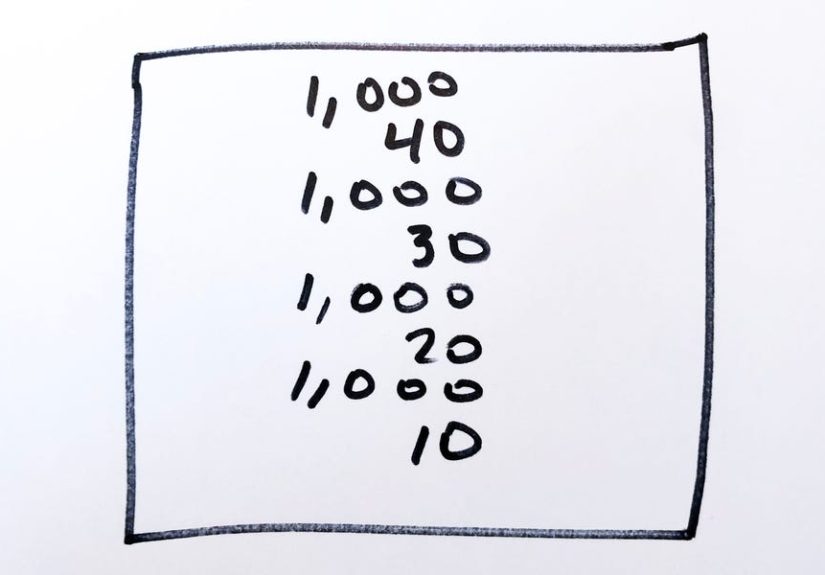
Here is the challenge in its common form:
1,000
+ 40
+ 1,000
+ 30
+ 1,000
+ 20
+ 1,000
+ 10
A lot of people answer 5,000. It sounds clean, satisfying, and beautifully wrong.
The Correct Answer Is 4,100
Step-by-step solution
Let’s do the arithmetic slowly, like adults who have learned not to trust a smug-looking internet puzzle:
- 1,000 + 40 = 1,040
- 1,040 + 1,000 = 2,040
- 2,040 + 30 = 2,070
- 2,070 + 1,000 = 3,070
- 3,070 + 20 = 3,090
- 3,090 + 1,000 = 4,090
- 4,090 + 10 = 4,100
That means the final answer is 4,100.
An even faster way to solve it
If you want the neat shortcut, group the numbers by size:
- 1,000 + 1,000 + 1,000 + 1,000 = 4,000
- 40 + 30 + 20 + 10 = 100
- 4,000 + 100 = 4,100
Same answer, less drama, fewer bruised egos.
Why So Many People Say 5,000
This is where the puzzle gets interesting. The wrong answer is not random. Most people do not guess 4,700 or 8,212 or “banana.” They tend to land on 5,000 because the brain loves patterns, shortcuts, and tidy-looking numbers.
Your brain wants a “friendly” number
When people hear repeated thousands in quick succession, the mind starts predicting the shape of the answer before the calculation is finished. It senses the pattern of big jumps and starts leaning toward the next dramatic round number. By the time the total reaches 4,090, some people mentally leap to 5,000 instead of correctly adding just 10.
That is the whole trap. The puzzle does not defeat math skills. It exploits fast-thinking habits.
It messes with place value
The challenge also plays with place value, which is the basic idea that digits mean different things depending on where they sit. In a base-ten number system, the difference between 10, 100, and 1,000 is not a cute technicality. It is everything.
People who rush the problem are not usually forgetting how to add. They are briefly losing track of the fact that the final number is 10, not 100 or 1,000. The eye and ear notice the repeated thousands, while the tiny final ten gets treated like an unimportant side character. Unfortunately, that side character is holding the plot twist.
Mental math is effortful, not magical
There is also a simple cognitive reason this happens: mental arithmetic takes attention. When people are trying to calculate quickly, especially while being watched or recorded, they are more likely to rely on intuition instead of careful checking. TikTok makes this even funnier because the format encourages speed, reaction, and performance. That is not exactly the natural habitat of cautious arithmetic.
Put plainly, the challenge is a perfect storm of quick pacing, repeated number patterns, and just enough confidence to make people answer before their slower, more accurate thinking catches up.
No, This Is Not a PEMDAS Problem
Let’s clear up a common misunderstanding. The 4100 TikTok math challenge is not an order-of-operations puzzle. There are no parentheses, exponents, multiplication, or division. PEMDAS can stay home and enjoy a quiet evening.
This is plain addition. The only real issue is whether you keep track of the running total correctly and respect place value all the way to the finish line.
That is actually part of why the challenge works so well online. Many viral math posts rely on ambiguity or badly written notation. This one does not. It is fair. It is simple. It still gets people anyway. That makes it oddly beautiful, in a “the banana peel was clearly visible and I still slipped on it” kind of way.
How to Beat the 4100 Math Challenge Every Time
1. Group similar numbers together
When you see repeated large values, collect them first. Four 1,000s give you 4,000. Then add the tens separately. This reduces the amount of mental juggling your brain has to do.
2. Track the subtotal, not just the pattern
Do not let the repeated 1,000s hypnotize you. After each step, lock in the actual subtotal. Once you know you are at 4,090, it becomes much harder to pretend that adding 10 gives you 5,000.
3. Watch out for “round-number gravity”
Round numbers like 1,000 and 5,000 feel attractive because they are mentally tidy. That does not make them right. In lots of viral math puzzles, the most tempting answer is the exact one you should verify twice.
4. Slow down by one beat
The difference between a wrong answer and a correct one is often about half a second. Give yourself that half second. Social media challenges love speed. Math usually prefers accuracy. Let them fight it out. Accuracy wins.
What the 4100 Challenge Actually Teaches
For a problem built from four thousands and a few tens, this puzzle teaches a surprisingly useful lesson. It reminds people that number sense matters as much as memorized rules. Good arithmetic is not just about getting answers fast. It is about understanding what numbers are doing.
That is why the puzzle feels more educational than it first appears. It exposes the gap between thinking you know and carefully knowing. It shows how easy it is to let pattern recognition override place-value awareness. And it proves that even adults who are perfectly capable of doing the math can get nudged into an error when the problem is framed like a performance.
In that sense, the viral addition problem is less about humiliation and more about humility. Math has a polite way of saying, “Maybe double-check that, champ.”
Why This Puzzle Went So Viral on TikTok
The 4100 math challenge on TikTok has all the ingredients of a viral format:
- It is short and easy to explain.
- Anyone can try it instantly.
- It produces a dramatic split between right and wrong answers.
- It makes viewers want to test friends, parents, teachers, coworkers, and unsuspecting cousins.
- It creates comments full of certainty, confusion, and occasional chaos.
That is social media gold. You do not need background knowledge. You do not need a tutorial. You just need a number, a reaction, and the confidence to be loudly incorrect in public. The internet has never been shy about volunteering for that role.
There is also a deeper reason these puzzles travel so far: they are interactive. A person watching is not passive. They are already solving. That tiny burst of participation makes the content sticky. By the time the reveal happens, viewers feel personally invested. If they got it right, they feel clever. If they got it wrong, they immediately want revenge and send it to someone else.
Common Myths About the 4100 TikTok Puzzle
“It’s a trick question.”
Not really. It is a straightforward addition problem with a psychological trap.
“Only people who are bad at math get it wrong.”
Absolutely not. Fast-thinking errors happen to all kinds of people. In fact, confident people are sometimes easier to fool because they answer before checking.
“You need a calculator to prove it.”
No calculator needed. A clean place-value breakdown solves it immediately.
“The answer depends on order of operations.”
Nope. This is just addition. The answer is still 4,100.
Experiences People Relate to the 4100 Math Challenge
One reason this puzzle keeps resurfacing is that people recognize themselves in it. Not necessarily in a flattering, Nobel-worthy way, but definitely in a very human one.
Think about the classic kitchen-table version of the challenge. Someone reads the numbers aloud while everyone else tries to keep up. One person says 5,000 immediately, like they are announcing the winning lottery number. Another person squints and says, “Wait, that can’t be right.” Then the group does the math again, slower this time, and the energy in the room shifts from confidence to suspicious silence. Suddenly, the wrong answer feels less like a math mistake and more like a personality test.
Then there is the office version. Someone drops the puzzle into a team chat with a message like, “Easy one.” Within minutes, the thread becomes a tiny digital courtroom. One coworker is posting 5,000 with full certainty. Another is typing 4,100 in the calm tone of someone who has already accepted that the world is too chaotic for optimism. A third person is arguing that the challenge is badly written, which is often what people say when arithmetic has offended them personally.
Teachers and parents know this feeling too. A problem like this is great because it creates a teachable moment without requiring a lecture. Kids can see, in real time, that adults are not immune to silly mistakes. That is actually useful. It takes the fear out of being wrong and replaces it with something better: curiosity. Why did so many people jump to 5,000? What did they miss? How can you check your thinking? Those are the kinds of questions that build real math confidence.
There is also the solo experience, which may be the funniest one of all. You see the puzzle, say 5,000 in your head, scroll down, and discover the answer is 4,100. So you go back and do it again. Slowly. Then again, because your pride needs closure. By the third pass, you are no longer solving a math problem. You are negotiating with your own brain like a customer service manager trying to de-escalate a complaint.
What makes the experience so memorable is that the mistake feels weirdly personal. People are not used to missing a basic addition problem. If the puzzle were calculus, nobody would care. But because it is built from numbers that look friendly, the wrong answer lands with extra sting. It creates that rare combination of surprise, embarrassment, and amusement that social media absolutely loves.
And then comes the final stage of the experience: passing it on. Once people understand why the answer is 4,100, they almost always want to test someone else. Not out of cruelty, mostly. Out of fascination. It is one of those little internet moments that makes you realize how the mind works under pressure. The challenge becomes less about showing off and more about watching the same pattern unfold again and again in new people.
That shared experience is a huge part of why the 4100 challenge stays alive. It is not just a puzzle. It is a social ritual: ask, answer, react, laugh, explain, repeat.
Final Answer
So, let’s put the mystery to bed.
The correct answer to the 4100 Math Challenge on TikTok is 4,100.
The cleanest explanation is this:
- Four 1,000s = 4,000
- 40 + 30 + 20 + 10 = 100
- 4,000 + 100 = 4,100
That is the whole story. No trick math. No secret rule. Just a viral reminder that the brain loves shortcuts, and math does not always forgive them.
If you got 5,000 the first time, congratulations: you are extremely normal. If you got 4,100 right away, congratulations: you now have permission to be a little smug, but only a little. Either way, the puzzle wins because it got you to pay attention to numbers again. For a tiny addition problem on TikTok, that is not bad at all.