Table of Contents >> Show >> Hide
- Why Dual-Band Matters (Even If You’re Not Chasing Speed)
- Meet the ESP32-C5: What It Is (and What It Isn’t)
- What’s New Under the Hood
- The Wi-Fi Details That Actually Affect Your Project
- Hardware Reality Check: Antennas, Range, and the Laws of Physics
- Dev Boards and Tooling: Getting From “Cool Chip” to “Working Prototype”
- Where the ESP32-C5 Fits in the ESP32 Family
- Real-World Examples: Where Dual-Band Changes the Outcome
- Should You Use the ESP32-C5 Yet?
- Conclusion: Dual-Band ESP32 Feels Like the Future Showing Up on Time (For Once)
- Bonus Field Notes: The First Weekend You Put an ESP32 on 5 GHz (About )
For years, “ESP32 + Wi-Fi” has basically meant “2.4 GHz, take it or leave it.” And honestly? Most of us took it.
IoT sensors, smart switches, wearables, little dashboards that show the weather and (somehow) also your existential dread
2.4 GHz got the job done.
But the world didn’t stay still. Apartments became RF soup. Offices added “guest Wi-Fi” networks like they were collecting Pokémon.
Coffee shops started broadcasting three SSIDs per espresso machine. Meanwhile, the 5 GHz band sat there like an empty movie theater on a Tuesday afternoon:
more channels, less interference, fewer “why is my packet loss doing parkour?” moments.
That’s why the ESP32-C5 is a big deal. It’s Espressif’s long-awaited move into dual-band Wi-Fi2.4 and 5 GHzpaired with Wi-Fi 6 efficiency,
Bluetooth LE, and 802.15.4 (Thread/Zigbee) on the same chip. It’s like the ESP32 family finally got a second lane on the highway… and also added a bike path.
Why Dual-Band Matters (Even If You’re Not Chasing Speed)
Let’s get one thing straight: most microcontroller projects aren’t streaming 4K video. Your smart thermostat doesn’t need to buffer.
So why do we care about 5 GHz?
1) Congestion is the real enemy
2.4 GHz travels farther and penetrates walls betterbut that’s also why everything uses it: routers, cameras, baby monitors,
cheap wireless audio, some microwaves that choose chaos, and a parade of IoT devices that chat constantly and politely refuse to take turns.
5 GHz, on the other hand, gives you more room to breathe. More non-overlapping channels means your device can often find cleaner spectrum,
which can translate into fewer retries, lower latency, and more predictable performanceespecially in dense environments.
2) Reliability beats raw throughput for IoT
If your device sends small bursts (sensor updates, control commands, MQTT messages), the “feel” of the network matters more than the theoretical top speed.
Less interference can mean faster association, fewer dropped packets, and less time spent with the radio yelling, “HELLO? DID YOU GET THAT?”
3) Better options for hubs and gateways
Dual-band becomes especially valuable when your ESP device is the “middleman”:
a smart home hub, a bridge, or a gateway that handles multiple clients and protocols.
Keeping the backhaul on 5 GHz while local device traffic lives elsewhere can be a practical way to reduce collisions and keep things smooth.
Meet the ESP32-C5: What It Is (and What It Isn’t)
The ESP32-C5 is positioned as a high-efficiency wireless MCU: dual-band Wi-Fi 6, Bluetooth 5 (LE), and IEEE 802.15.4 for Thread/Zigbee-class networks.
It’s built around a 32-bit RISC-V core with a low-power companion core for sleep/housekeeping tasks in supported designs and SDK patterns.
Translation: it’s modern ESP32 DNA, but with more radios and more band choices.
Dual-band doesn’t mean “simultaneous dual-band”
Here’s the “read this before tweeting” part: dual-band support typically means the chip can operate on either 2.4 GHz or 5 GHz,
not necessarily both at the same time. In Espressif’s tooling, you’ll see an “auto” band mode that can select between bands based on the AP and configuration.
That’s still extremely useful, but it’s not the same as a phone that can roam aggressively or run concurrent connections on separate bands.
Wi-Fi 6: more “crowd management” than “rocket ship”
Wi-Fi 6 (802.11ax) is often marketed like it’s a speed potion. In practice, for many IoT projects, the bigger win is efficiency in busy environments:
smarter scheduling, better handling of many devices, and less time wasted on retransmissions.
Even when the payload is tiny, the network can feel less “stuttery.”
What’s New Under the Hood
RISC-V processing and memory choices
ESP32-C5 continues Espressif’s RISC-V direction for the “C” line, targeting cost-effective, efficient connectivity.
The chip family is designed to pair on-chip resources with external flash/PSRAM options depending on the module you choose.
That matters because the difference between “works fine” and “mysteriously resets when TLS wakes up” is often just memory headroom.
Multi-protocol radios (and why that’s not just a buzzword)
A single chip that can handle Wi-Fi, Bluetooth LE, and 802.15.4 is attractive for smart home products because real homes are messy.
You might want Wi-Fi for cloud connectivity, BLE for onboarding, and Thread/Zigbee for local meshwithout turning your PCB into a radio zoo.
The practical value shows up in product design:
fewer BOM line items, fewer antennas competing for space, and a tighter software stack storyespecially if you’re building a gateway or a hub.
The Wi-Fi Details That Actually Affect Your Project
Spec sheets are fun, but the day-to-day experience is shaped by small decisions:
band selection policy, protocol compatibility, bandwidth settings, and regulatory channel rules.
Band selection: don’t let 2.4 GHz “win by default”
In many environments, 2.4 GHz appears stronger (higher RSSI) because it penetrates walls better.
If your router broadcasts the same SSID on both bands, an automatic selection strategy may lean 2.4 GHz unless you nudge it.
Espressif’s SDK supports a band “preference” style adjustment so you can bias toward 5 GHz when signals are close enough to be useful.
Protocol flexibility across bands
One underrated detail: the protocol mix differs by band.
2.4 GHz typically covers the classic b/g/n family (and ax), while 5 GHz leans into a/n/ac/ax.
Being able to configure protocol sets per band can help you avoid “legacy drag” on 2.4 while keeping a fast, clean configuration on 5.
Bandwidth: bigger isn’t always better
Wider channels can increase throughput, but they also increase the chance of overlapping interference.
For IoT devices sending small amounts of data, a stable 20 MHz channel often beats a flaky wider channel that keeps stepping on neighbors.
The ESP32-C5 toolchain supports configuring bandwidth behavior with awareness of band and protocol combinations.
DFS channels: more room, more rules
If you’ve ever wondered why some 5 GHz channels feel like “VIP sections,” it’s often because they overlap with radar requirements.
DFS (Dynamic Frequency Selection) can open more channels, but it also means radar detection rules apply, and behavior may vary by region.
For many maker projects, the simplest path is to start with non-DFS channels and treat DFS as a “later, when the rest works” optimization.
Hardware Reality Check: Antennas, Range, and the Laws of Physics
5 GHz range is shorterplan for it
The 5 GHz band generally doesn’t penetrate obstacles as well as 2.4 GHz.
In a small home office, 5 GHz can be fantastic. Across multiple walls and floors, you may see it fall off faster.
Dual-band gives you options: use 5 GHz when it’s strong, fall back to 2.4 GHz when you need reach.
Module selection: built-in antenna vs external antenna connector
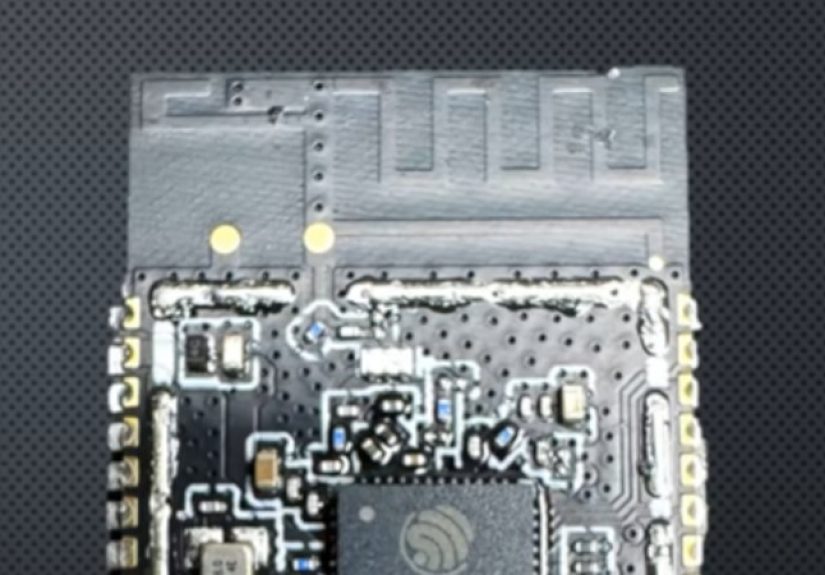
Espressif’s module ecosystem matters here. Some variants use on-board PCB antennas (convenient, compact),
while “U” variants typically expose an external antenna connector (better for enclosures, awkward placements, or “my device lives in a metal box” situations).
If your product sits behind drywall or inside a cabinet, external antenna options can be the difference between “rock solid” and “why does it only work when the door is open?”
Power budget: Wi-Fi is still the hungriest roommate
Wi-Fi (especially higher throughput modes) draws more power than BLE or 802.15.4 in many typical use cases.
The good news is Wi-Fi 6 is designed with efficiency tools (like scheduling and wake-time strategies) in mind.
The less-good news is your coin cell still has feelings, and those feelings are “please stop transmitting.”
Treat dual-band as a performance tool you use intentionally, not an always-on flex.
Dev Boards and Tooling: Getting From “Cool Chip” to “Working Prototype”
The ESP32-C5 story is not just the siliconit’s the ecosystem. Dev boards show up, toolchains catch up, and
suddenly your weekend project becomes “this could actually ship.”
The official DevKit: a practical baseline
Espressif’s ESP32-C5-DevKitC-1 is designed to be a straightforward entry point:
module-on-board, headers for GPIO, and modern USB-C connectivity.
It’s the kind of board that says, “Yes, you can breadboard this,” without laughing at you.
USB and debugging: small conveniences that save big time
If you’ve been spoiled by newer ESP boards, you’ll appreciate the direction here:
native USB capabilities for flashing/communication and a USB-to-UART bridge option depending on the board design.
This can simplify programming, improve workflow, and reduce the pile of mystery dongles on your desk.
ESP-IDF first, then everything else
As with many new Espressif chips, ESP-IDF tends to be the “first-class citizen.”
Arduino and third-party environments generally follow once the lower layers stabilize.
If you’re building something seriousor you need the newest Wi-Fi featuresyou’ll likely get the smoothest experience by starting with ESP-IDF.
Where the ESP32-C5 Fits in the ESP32 Family
Think of the ESP32 lineup like a toolbox where every tool is slightly different, but somehow they all look like pliers.
The C5 sits at an interesting intersection:
it’s “C-series” (cost/efficiency, RISC-V), but it brings “big connectivity energy” with dual-band Wi-Fi 6 plus BLE and 802.15.4.
- Compared to classic 2.4 GHz ESP32 boards: the C5 adds 5 GHz options and Wi-Fi 6 efficiency.
- Compared to single-band Wi-Fi 6 parts: dual-band gives you flexibility in crowded environments.
- Compared to “Wi-Fi only” approaches: integrated 802.15.4 and BLE reduce radio sprawl for smart home/gateway designs.
If you’re building a device that must survive in real, noisy networksand you want modern smart home protocol options without juggling chips
the ESP32-C5 is a compelling “one-chip connectivity” candidate.
Real-World Examples: Where Dual-Band Changes the Outcome
Example 1: An apartment-friendly Home Assistant bridge
Imagine a small gateway device that talks Thread/Zigbee locally (mesh), but uses Wi-Fi to reach your server.
In a high-rise building, 2.4 GHz Wi-Fi can be saturated. If your gateway can live on 5 GHz for backhaul,
you reduce the chance it gets stuck in the 2.4 GHz traffic jam while still supporting local mesh radios.
Example 2: A “fast update” dashboard that doesn’t stutter
For dashboards that refresh frequently (sensor panels, status displays, alert devices), consistency matters.
A clean 5 GHz connection can reduce jitter and retries. The user experience becomes “snappy,” not “eventually… updated.”
Example 3: A responsible Wi-Fi environment monitor for your own network
Makers love Wi-Fi analyzers because they’re useful: choose better channels, spot interference, and understand why the guest Wi-Fi is slower than a sleepy turtle.
If you build anything like this, keep it ethical: scan and analyze your own environment for optimization and troubleshooting,
not for snooping. (Yes, this is the part where the fun police show upbut they’re right.)
Should You Use the ESP32-C5 Yet?
If you’re prototyping today, the answer is often “yes, if your project benefits from 5 GHz or multi-protocol connectivity.”
Dual-band plus Wi-Fi 6 is meaningful in dense RF environments, and integrated 802.15.4 can simplify smart home designs.
The bigger question is your toolchain comfort:
if you want the newest features, start with ESP-IDF. If you need Arduino today, check that your specific board and core version support C5 cleanly.
The ecosystem is moving fast, but early adopters should expect occasional sharp edgeslike any exciting new hardware platform.
Conclusion: Dual-Band ESP32 Feels Like the Future Showing Up on Time (For Once)
The ESP32-C5 isn’t just “another ESP32.” It’s a strategic upgrade: dual-band Wi-Fi 6 for modern RF environments,
plus BLE and 802.15.4 for the increasingly multi-protocol reality of IoT.
It gives makers and product teams more control over interference, more options for architecture, and a smoother path toward hub/gateway designs.
If your devices live in busy airspaceapartments, offices, schools, maker spacesdual-band is more than a checkbox. It’s a quality-of-life upgrade.
And if you’re building the next generation of smart home gear, the “Wi-Fi + Thread/Zigbee + BLE” combo in one chip can simplify both hardware and onboarding.
In short: the ESP32-C5 is Espressif finally bringing the ESP32 family into the dual-band era. And honestly? About time.
Bonus Field Notes: The First Weekend You Put an ESP32 on 5 GHz (About )
Nobody needs 5 GHz Wi-Fi to blink an LED. That’s true. But the first time you move a familiar ESP-style project onto a 5 GHz network,
you understand why people have been asking for this chip like it’s a concert ticket drop.
The “weekend experience” usually starts with a simple goal: connect to the same SSID your phone uses, but prefer 5 GHz.
In a typical home router setup, you’ve got one network name that serves both bands. On older ESP boards, you either connected (2.4 GHz) or you didn’t.
With the C5, you can finally think in terms of choiceand that’s the difference between “it connects” and “it connects well.”
Then comes the first surprise: 5 GHz is pickier about placement. Move the board behind a monitor, under a desk, or inside a half-finished 3D-printed enclosure
and the signal might drop faster than you expected. This isn’t the chip misbehavingit’s physics doing physics things.
The practical takeaway is that dual-band is not “5 GHz forever,” it’s “5 GHz when it’s smart, 2.4 GHz when it’s necessary.”
That mindset makes designs better. It pushes you to think about antennas, enclosure materials, and where the device will actually live.
The second surprise is how much nicer crowded environments can feel. When 2.4 GHz is saturated, your project doesn’t fail dramaticallyit fails politely.
It reconnects. It retries. It stalls for half a second and then acts like nothing happened. That’s the worst kind of failure because it’s hard to diagnose.
With a cleaner 5 GHz channel, the same firmware suddenly feels “professional.” Status updates land consistently. Latency spikes calm down.
Your logs stop looking like a suspense novel.
If you build a simple network monitor (again: for your own network), dual-band is where the fun really shows up.
You can compare 2.4 vs 5 GHz conditions in the same room and watch how interference changes by location.
You learn quickly that “strong RSSI” doesn’t always mean “better experience,” and that a slightly weaker 5 GHz signal can still outperform a “loud” 2.4 GHz signal
that’s fighting every neighbor’s router.
Finally, you hit the “ecosystem reality” stage: selecting the right board, making sure your toolchain is current, and discovering that new chips
sometimes require new habits. That’s not a downsideit’s the price of being early. And with the ESP32-C5, being early gets you something tangible:
the ability to build ESP-style projects that behave like they belong in 2026’s Wi-Fi landscape, not 2016’s.
The end-of-weekend verdict most builders arrive at is simple: dual-band doesn’t make your project magically coolerbut it makes it more dependable.
And in IoT, dependable is cool.