Table of Contents >> Show >> Hide
- What Is a Triple Monitor Luggable PC?
- Why the DIY Perks Build Became So Popular
- The Real Power of Three Screens
- Desktop-Class Hardware in a Portable Body
- Cooling: The Hidden Hero of the Build
- Power Delivery: Why This Is Not Your Average Laptop
- Design Details That Make It Practical
- Triple Monitor Luggable PC vs. Laptop
- Triple Monitor Luggable PC vs. Traditional Desktop
- Who Should Build or Buy Something Like This?
- Challenges of a Triple Monitor Luggable PC
- The Future of Portable Multi-Screen Workstations
- Experience Section: Living With the Idea of a Triple Monitor Luggable PC
- Conclusion
A triple monitor luggable PC sounds like something a mad scientist would roll into a LAN party while whispering, “Behold, productivity with handles.” Yet this wonderfully excessive idea is more than a flashy computer mod. It is a serious answer to a question many power users have quietly asked for years: what if a desktop workstation, a multi-monitor command center, a gaming rig, and a portable all-in-one PC could somehow become the same machine?
That is the magic behind the triple monitor luggable PC concept. It is not a laptop in the traditional sense, and it is definitely not something you casually open on an airplane tray table unless you enjoy making nearby passengers nervous. Instead, it sits in the proud tradition of “luggable” computers: machines designed to be moved, not necessarily carried gracefully. Think less featherweight ultrabook and more desktop muscle with a travel handle.
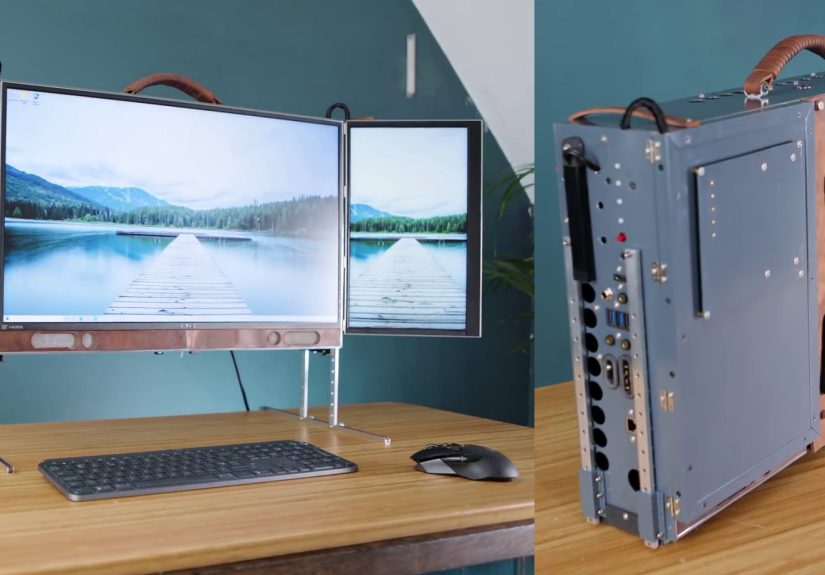
The project made famous by DIY Perks showed exactly why the idea caught the internet’s attention. It combined a large central display with two fold-out side screens, powerful desktop hardware, liquid cooling, huge SSD storage, premium audio, and a custom enclosure that looked part briefcase, part cyberpunk workstation, and part “yes, I built this because I could.” The result was an all-in-one powerhouse that made normal laptops look like they had skipped leg day.
What Is a Triple Monitor Luggable PC?
A triple monitor luggable PC is a portable desktop-style computer with three integrated displays. Unlike a normal desktop setup, the screens, computer components, speakers, cooling system, power delivery, and storage are built into one transportable unit. Unlike a laptop, it uses desktop-class parts and often needs more desk space, more power, and a stronger sense of commitment.
The most eye-catching feature is the triple-screen layout. Typically, the main display sits in the center, while two smaller panels fold out from the left and right sides. This creates a wraparound workspace for gaming, editing, coding, monitoring dashboards, managing chat windows, or pretending you are piloting a spaceship while answering emails.
The “luggable” part matters. The first generation of portable computers in the early 1980s, including machines like the Osborne 1, were not light by modern standards. They were portable because they could be moved from one place to another, not because they were comfortable to balance on your knees. Today’s triple monitor luggable PC revives that idea with modern displays, high-performance processors, powerful GPUs, SSDs, and clean custom fabrication.
Why the DIY Perks Build Became So Popular
The DIY Perks triple monitor luggable PC went viral because it did not feel like a gimmick. Many experimental computer builds look fantastic for three minutes and then collapse under practical questions such as heat, power, cable routing, and “where does the keyboard go?” This build answered those questions with surprising elegance.
The machine used a powerful AMD Ryzen 9 5950X processor, an NVIDIA RTX 3080 graphics card, 64GB of memory, and two 8TB SSDs. That is not “portable compromise” hardware. That is the kind of configuration you would expect in a serious gaming desktop, editing workstation, or 3D rendering machine. In other words, the build did not simply attach extra screens to a weak computer and call it innovation. It put real horsepower behind the display circus.
The three displays also supported high refresh rates, making the design more appealing to gamers and creators. High refresh displays are valuable for smooth gameplay, responsive editing timelines, and fluid day-to-day desktop movement. Once you have experienced a fast display, going back to a sluggish panel feels like trying to stir peanut butter with a toothpick.
Another reason the build stood out was the craftsmanship. The components were mounted behind the main display using a custom aluminum backplate, 3D-printed brackets, threaded inserts, and careful cable management. The fold-out screens protected the main display during transport, while a back compartment stored a full-size keyboard and mouse. It was not just powerful; it was thought through.
The Real Power of Three Screens
The main keyword here is “triple monitor luggable PC,” but the real value is not only in having three displays. It is in having three usable zones. One screen can hold the primary task, another can handle reference material, and the third can manage communication, system monitoring, media controls, or notes.
For Gamers
A triple monitor gaming PC can transform how players manage modern games. The main screen can run the game, while side displays show Discord, maps, walkthroughs, livestream controls, hardware temperatures, or music. For simulation games, racing titles, flight sims, and open-world adventures, the wraparound effect can also increase immersion.
Of course, not every game plays nicely across three displays. Some titles support wide multi-monitor output beautifully; others behave as if the second monitor personally insulted them. Still, even when the game stays on the center screen, the extra displays make multitasking far easier.
For Creators
Video editors, designers, musicians, and streamers may benefit even more than gamers. A video editor could keep the timeline on the main display, preview footage on one side, and folders, notes, or audio controls on the other. A streamer could run gameplay, OBS, chat, alerts, and browser dashboards without constantly alt-tabbing like a caffeinated squirrel.
For writers and researchers, one display can hold the draft, another can show sources or outlines, and the third can run communication tools. This is where a portable multi-monitor workstation stops being a novelty and starts looking like a productivity weapon.
For Developers and Engineers
Developers often live in a world of code editors, terminals, documentation, browsers, build tools, logs, and issue trackers. A triple screen setup lets each category breathe. The center display can hold the codebase, one side can show documentation, and the other can show terminal output, tests, or live previews.
Anyone who has tried debugging on a single laptop screen knows the pain: window stacking, tab hunting, and the slow psychological collapse known as “where did I put that console?” Three screens reduce that friction dramatically.
Desktop-Class Hardware in a Portable Body
The phrase “all in one powerhouse” only works if the hardware deserves it. In the famous luggable build, the AMD Ryzen 9 5950X brought 16 cores and 32 threads to the table, making it suitable for demanding multitasking, rendering, compiling, and content creation. Paired with an RTX 3080 GPU, the machine had enough graphics power for high-end gaming, GPU acceleration, video work, and 3D applications.
Storage was another highlight. Two 8TB SSDs gave the system enormous local capacity. That matters for creators who move large project files, raw footage, game libraries, virtual machines, and backups. In a conventional laptop, high-capacity internal storage can be expensive, limited, or difficult to upgrade. In a custom luggable PC, there is more room to choose desktop-style solutions.
Memory also matters. With 64GB of RAM, a system like this can handle heavy creative workflows, large browser sessions, multitasking, and memory-hungry applications far better than the average laptop. The design philosophy is simple: do not bring a knife to a gunfight, and do not bring 8GB of RAM to a 4K video editing session.
Cooling: The Hidden Hero of the Build
Powerful hardware creates heat, and heat is the sworn enemy of compact computers. A triple monitor luggable PC has to solve a tricky equation: desktop performance plus integrated screens plus limited space plus transportability. That is why cooling becomes one of the most important parts of the entire design.
The DIY Perks build used a custom water-cooling loop for the CPU and GPU. Liquid cooling helped move heat away from the hottest components and distribute it through radiators and fans. This was not just for bragging rights. Without serious cooling, desktop-class parts in a slim enclosure could throttle performance, become uncomfortably loud, or turn the entire machine into a stylish panini press.
Good cooling also affects reliability. Components that run cooler and more consistently tend to behave better over long sessions. For gamers, that means stable frame rates. For creators, it means fewer interruptions during exports and renders. For everyone, it means the computer is less likely to sound like a leaf blower trying to achieve consciousness.
Power Delivery: Why This Is Not Your Average Laptop
A normal laptop is designed around battery efficiency. A luggable workstation is designed around performance first. The triple monitor luggable PC build reportedly drew around 600 watts under heavy load, including its displays and internal hardware. That is a completely different world from thin-and-light laptops.
Instead of a standard desktop power supply, the design used AC-to-DC conversion and a central DC-DC power distribution system. This reduced internal bulk and helped route power cleanly to the different components. It also allowed the system to run from wall power or a compatible external DC source, depending on the setup.
This is one of the clearest examples of why “luggable” is the correct word. Yes, the machine can move. No, it is not pretending to be a coffee-shop laptop. It is more like a mobile workstation for studios, events, LAN parties, field demonstrations, temporary offices, and creators who need real performance away from a fixed desk.
Design Details That Make It Practical
The best part of the build was not only the specification sheet. It was the practicality hidden in the design details. The side displays folded in for transport. The keyboard and mouse had dedicated storage. Adjustable legs helped position the computer comfortably. The enclosure protected the expensive internals. The audio system was integrated so the user did not need to carry external speakers.
That combination matters because portable computers fail when they create more problems than they solve. If a “portable” setup requires three separate monitor bags, six cables, a loose keyboard, a USB hub, a speaker, a power brick, a monitor arm, and a prayer, it is not portable. It is a desk explosion with travel anxiety.
A well-designed luggable PC reduces setup time. Open it, deploy the screens, connect power, place the keyboard, and get to work. That simplicity is exactly why the concept feels so appealing. It brings the permanence of a desktop setup into a form that can be packed, moved, and redeployed.
Triple Monitor Luggable PC vs. Laptop
A laptop wins on weight, battery life, convenience, and everyday portability. You can use it on a couch, in a classroom, at an airport, or in a tiny cafe where the tables appear to have been designed by someone who hates elbows.
A triple monitor luggable PC wins on screen space, cooling potential, repairability, component choice, storage options, audio capacity, and raw performance. It is not trying to replace every laptop. It is trying to replace the desktop setup you wish you could move without hiring a small moving crew.
For students, office workers, and travelers who mostly browse, write, and attend video calls, a normal laptop is the sensible choice. For video editors, developers, streamers, event technicians, traveling gamers, researchers, and hardware enthusiasts, the luggable approach can make sense.
Triple Monitor Luggable PC vs. Traditional Desktop
A traditional desktop is easier to upgrade, easier to cool, and usually cheaper to build for the same performance. It also supports larger monitors and more flexible desk ergonomics. If your computer never needs to move, a normal desktop still makes excellent sense.
The luggable PC wins when mobility matters. It turns a desktop workstation into a single transportable unit. Instead of unplugging monitors, carrying a tower, packing peripherals, and rebuilding the setup somewhere else, you move one integrated machine.
This is especially useful for live production, trade shows, gaming events, engineering demos, pop-up studios, classrooms, and temporary workspaces. Anywhere you need performance and display area but cannot rely on the destination having a perfect desk setup, a triple monitor luggable PC becomes surprisingly logical.
Who Should Build or Buy Something Like This?
This type of computer is not for everyone, and that is perfectly fine. A triple monitor luggable PC is best for people who need more than portability. They need portable performance, portable screen space, and portable workflow consistency.
Best Use Cases
- Gaming events and LAN parties
- Video editing and mobile production
- Software development and testing
- Streaming and content creation
- Field engineering and technical demonstrations
- Security monitoring and network administration
- Research, trading, and data analysis workflows
It is also ideal for enthusiasts who simply love building unusual machines. Not every project needs to be practical in the boring sense. Some projects exist because they push ideas forward, teach new skills, and make the rest of us stare at our laptops with mild disappointment.
Challenges of a Triple Monitor Luggable PC
As exciting as the concept is, there are trade-offs. Weight is the obvious one. Even with aluminum, compact components, and careful design, a luggable PC with three screens and desktop hardware will not be featherlight.
Power is another issue. High-performance CPUs and GPUs need serious wattage, especially when paired with multiple displays. Battery operation is possible in theory, but it requires large external battery systems and realistic expectations. You are not getting all-day unplugged performance from a machine built like a portable thunderstorm.
Durability also matters. Screens, hinges, water-cooling components, connectors, and storage compartments all need to survive transport. A commercial version would require extensive testing for vibration, drops, heat, cable strain, and repeated folding. DIY builders can accept some rough edges; mass-market customers usually cannot.
Finally, cost can climb quickly. High-end desktop components, multiple displays, custom metalwork, cooling hardware, power electronics, speakers, and storage all add up. This is why the concept remains more common among skilled makers and boutique builders than mainstream PC brands.
The Future of Portable Multi-Screen Workstations
The triple monitor luggable PC is part of a larger trend: people want more screen space without being chained to one desk. Portable monitors, laptop screen extenders, modular laptops, compact mini PCs, USB-C docks, and suitcase-style mobile workstations all point in the same direction.
As displays become thinner, GPUs become more efficient, batteries improve, and USB-C style connectivity becomes more capable, portable multi-screen setups will become more practical. Future versions could be thinner, lighter, quieter, and easier to manufacture. They may also use modular parts so users can replace screens, upgrade compute modules, or swap batteries without rebuilding the entire system.
The biggest opportunity is not necessarily a mass-market gaming machine. It may be professional mobile workstations for creators, engineers, developers, emergency response teams, educators, and live production crews. These users already carry equipment. A well-built luggable PC could reduce clutter while increasing capability.
Experience Section: Living With the Idea of a Triple Monitor Luggable PC
Using a triple monitor luggable PC, even in concept, changes how you think about computing. Most people divide computers into two simple categories: desktops are powerful but stuck in one place, while laptops are portable but limited. A luggable PC sits in the entertaining middle ground, grinning like it knows a secret. It says, “Why not take the desktop with you?” Then it politely asks for a sturdy table.
The first experience you imagine is setup. Instead of arriving somewhere and building a workstation from scattered parts, you open one machine and unfold your environment. The main screen becomes your focus zone. The left screen can hold chat, notes, documentation, or a browser. The right screen can show system stats, media controls, file folders, or a preview window. Within minutes, the workspace feels familiar. That consistency is powerful, especially for people who move between studios, offices, classrooms, and events.
The second experience is mental breathing room. A single laptop screen can make complex work feel cramped. You are constantly switching windows, forgetting where things are, and interrupting your own concentration. With three displays, information stays visible. A developer can keep logs open while coding. A video editor can watch footage while trimming a timeline. A streamer can monitor chat without hiding the game. This does not magically make someone more talented, but it removes small annoyances that quietly drain attention.
The third experience is performance confidence. A true luggable PC with desktop-class parts does not feel like a travel backup machine. It feels like the main machine. That changes behavior. You are more willing to edit large projects, run demanding software, play modern games, or present complex demos because the hardware is not apologizing before it starts. There is a certain joy in moving a serious workstation from room to room without sacrificing the tools you rely on.
There is also the social experience, which is impossible to ignore. A triple monitor luggable PC is not subtle. Opening one in public would attract attention faster than a dog wearing sunglasses. Some people would ask whether it is for gaming. Others would ask if it is legal. A few would simply stare, trying to decide whether they are looking at a computer, a control panel, or a briefcase from a spy movie. For makers and tech enthusiasts, that reaction is part of the fun.
The practical experience includes some reality checks. You would need to plan for power. You would need a strong bag or case. You would need to protect the displays and avoid careless handling. You would not want to set it up on a wobbly cafe table next to a large iced coffee and a person gesturing dramatically with both hands. Portability does not erase responsibility.
Still, the appeal remains strong. A triple monitor luggable PC offers a rare blend of spectacle and usefulness. It is excessive, yes, but not pointless. It solves real workflow problems while satisfying the maker instinct to build something bold. It reminds us that computers do not all have to look the same. Sometimes the best machine is not the thinnest, quietest, or most ordinary. Sometimes it is the one that unfolds like a command center and says, “Let’s get serious.”
Conclusion
The triple monitor luggable PC is an all-in-one powerhouse because it refuses to accept the usual compromise between performance and portability. It brings desktop-class hardware, multi-screen productivity, integrated audio, thoughtful storage, and a custom transportable design into one unforgettable machine.
It is not the perfect computer for everyone. It is heavy, power-hungry, complex, and expensive compared with normal laptops. But for the right user, that is not a deal breaker. It is the price of carrying a full workstation experience wherever the work, game, demo, or creative session happens next.
More importantly, it proves that the luggable PC idea still has life. Decades after early portable computers introduced the dream of taking computing power on the road, modern builders are reinventing that dream with better screens, faster chips, smarter cooling, and far more personality. The result is practical, ridiculous, impressive, and deeply lovable all at once. In other words, exactly the kind of computer the world needs more of.