Table of Contents >> Show >> Hide
- Why Voice and Choice Matter in Early Childhood
- What “Voice” and “Choice” Actually Look Like in Pre-K
- How Project-Based Learning Fits Pre-K So Well
- Examples of Voice and Choice in Pre-K Projects
- The Teacher’s Role: More Guide, Less Puppet Master
- How to Build Voice and Choice Without Losing the Plot
- Inclusion, Equity, and Family Partnerships
- Common Mistakes to Avoid
- Real-World Experiences With Voice and Choice in Pre-K Project-Based Learning
- Conclusion
- SEO Tags
Walk into a great Pre-K classroom during project time and you will not see tiny employees filling out identical worksheets like they are late for a quarterly meeting. You will see children wondering, building, talking, testing, drawing, revising, and proudly announcing discoveries with the confidence of people who have just solved the mystery of the universe with tape, cardboard, and glitter. That is the magic of voice and choice in Pre-K project-based learning.
In simple terms, “voice” means children get to express what they think, notice, wonder, and care about. “Choice” means they get meaningful chances to decide how they explore, create, and contribute. In a high-quality Pre-K project-based learning environment, these two ideas are not extras sprinkled on top like decorative confetti. They are central to how young children learn best.
When teachers build projects around children’s interests and pair that freedom with thoughtful structure, Pre-K students develop much more than content knowledge. They practice language, problem-solving, collaboration, self-direction, persistence, and confidence. They also learn a big lesson early: my ideas matter here. That belief can change everything.
Why Voice and Choice Matter in Early Childhood
Young children are naturally curious. They ask questions with the stamina of investigative journalists and the timing of tiny comedians. Why is the worm wet? Who lives under the playground? Can books have homes too? Those questions are not distractions from learning. They are the doorway into learning.
Giving children voice and choice supports motivation because they are more engaged when the topic feels connected to their lives. It also supports deeper learning. When a child helps shape the direction of a project, that child is not just completing a task. They are investing in it. Ownership turns participation into purpose.
This matters especially in Pre-K because school readiness is not only about letters, numbers, and knowing how to sit on a carpet square without rolling away. It also includes approaches to learning, social and emotional development, language growth, and the ability to stay engaged with a challenge. Project-based learning can support all of those areas at once when it is designed well.
What “Voice” and “Choice” Actually Look Like in Pre-K
Some adults hear “choice” and imagine total classroom chaos, as if giving a four-year-old a decision means the day will immediately become a pirate parade with glue on the ceiling. But meaningful choice in Pre-K is not the absence of structure. It is carefully planned freedom inside a supportive environment.
Voice in a Pre-K PBL classroom may include:
- children sharing what they already know about a topic
- children asking questions that help shape the project
- children telling stories, dictating observations, or explaining ideas
- children reflecting on what is working, what is confusing, and what they want to try next
Choice in a Pre-K PBL classroom may include:
- choosing which subtopic to explore
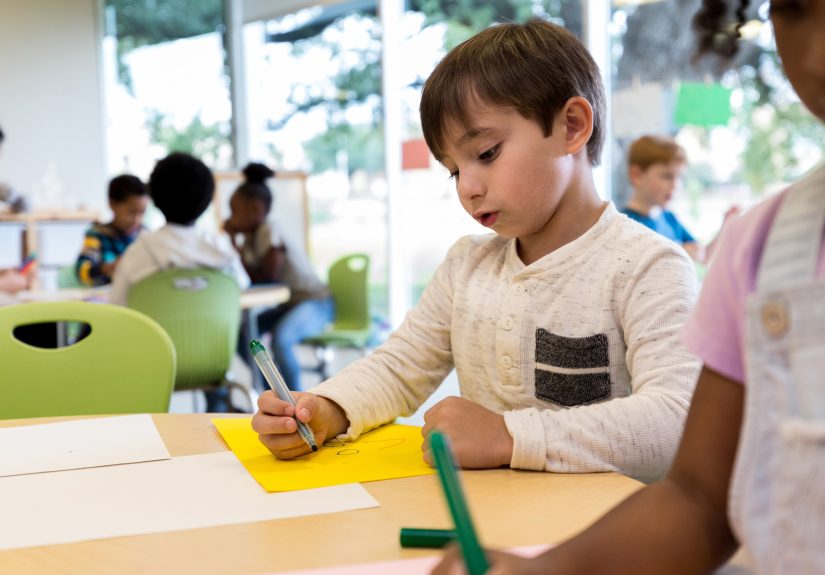
- selecting materials for building, drawing, or documenting
- deciding whether to work alone, with a partner, or in a small group
- choosing a role in the project, such as interviewer, builder, artist, book sorter, or map maker
- helping decide how the final work will be shared with families or the school community
The key is that the choices are real, developmentally appropriate, and connected to learning goals. Offering “choice” between two identical worksheets is not exactly a thrilling celebration of student agency. Offering a choice between making a class map, constructing a model, or creating labeled drawings to show understanding is much closer to the mark.
How Project-Based Learning Fits Pre-K So Well
Project-based learning works beautifully in early childhood because it matches the way young children naturally learn: through play, exploration, conversation, movement, repetition, and authentic experiences. A good Pre-K project starts with a meaningful question or problem and grows over time through investigation.
For example, a class might wonder, “How can we make our classroom library easier for everyone to use?” That one question can open the door to literacy, sorting, labeling, counting, sign-making, oral language, turn-taking, design thinking, and community responsibility. Suddenly, a project is not “extra.” It becomes the curriculum vehicle.
Strong Pre-K projects usually have a clear structure. Teachers help children build background knowledge, gather questions, investigate with hands-on experiences, talk to experts or community members, document learning, revise ideas, and create some kind of public product. That product does not need to be fancy. It can be a display, class book, school map, museum corner, garden tour, or child-led presentation. If it is meaningful to children and visible to others, it counts.
Examples of Voice and Choice in Pre-K Projects
1. A School Map Project
After noticing that new students sometimes looked confused in the hallway, a teacher might launch a project around the question, “How can we help visitors get around our school?” Children can walk the building, take notes through drawings, decide which places matter most, and choose how to represent them. Some may build landmarks with blocks, others may create signs, and others may dictate directions. Voice appears in the questions they raise. Choice appears in the way they investigate and communicate answers.
2. A Classroom Library Project
If children start pretending to run a library during play, that interest can become a full project. Students can decide what kinds of books belong in the space, how to organize them, what signs are needed, and how borrowing should work. Suddenly, kids are doing authentic literacy work because the task is real. They are not learning labels because a worksheet says so. They are learning labels because nobody wants the dinosaur books living in the poetry basket.
3. A Garden or Nature Project
A class noticing bugs, plants, or muddy patches on the playground can begin asking surprisingly rich questions. What helps plants grow? Which insects visit flowers? How can we make a place where living things thrive? Children can choose which plants to observe, what tools to use, and how to document change over time. Families and community partners can contribute seeds, stories, or expertise.
The Teacher’s Role: More Guide, Less Puppet Master
Voice and choice do not mean adults disappear into the background while the children reinvent city planning. Teachers are essential in Pre-K PBL. Their role is to listen carefully, design rich environments, scaffold thinking, protect the learning goals, and know when to step in or step back.
That balance matters. Too much adult control can flatten a project into a cute craft with predetermined outcomes. Too little support can leave children overwhelmed or stuck. The sweet spot is shared power: the teacher holds the framework, and children help shape the path inside it.
Teachers support voice and choice by:
- observing children’s interests before launching a project
- asking open-ended questions instead of racing to the answer
- offering open-ended materials rather than single-use materials
- documenting children’s thinking through photos, notes, transcripts, and work samples
- building routines that make independence possible
- scaffolding language for children who need help expressing ideas
In other words, the teacher is not giving up leadership. The teacher is using leadership to create a room where children can think, decide, and contribute in real ways.
How to Build Voice and Choice Without Losing the Plot
One of the smartest ways to protect both freedom and learning is to plan for choice at multiple stages of a project.
During project launch:
- invite children to share what they know and what they wonder
- vote, sort, or discuss which questions deserve more investigation
- use stories, photos, objects, or walks to spark curiosity
During investigation:
- let children choose tools, materials, or research stations
- allow different forms of documentation, such as drawings, dictation, charts, or models
- offer flexible grouping based on interests and strengths
During creation and sharing:
- let children help decide what the final product should be
- invite them to rehearse how they want to present their work
- include authentic audiences such as families, older students, librarians, or school visitors
Choice does not need to be huge to be meaningful. For a four-year-old, deciding whether to represent an idea with clay, blocks, paint, or a dictated story can be a serious act of ownership.
Inclusion, Equity, and Family Partnerships
High-quality early childhood education is not one-size-fits-all, and neither is project-based learning. Voice and choice become especially powerful when teachers make sure every child can access the project, including multilingual learners, children with disabilities, and children who may communicate in different ways.
That means providing visual supports, flexible materials, movement-friendly options, accessible spaces, and multiple ways to participate. A child might show understanding by talking, pointing, drawing, building, sorting, acting, or dictating. That variety is not lowering expectations. It is widening the doorway.
Family partnership also matters. In Pre-K, families are not side characters. They are central to the learning ecosystem. Teachers can invite caregivers to share stories, photos, home languages, cultural knowledge, tools, or expertise connected to the project. This strengthens authenticity and helps children see that learning lives beyond the classroom walls.
Common Mistakes to Avoid
- Too much fake choice: If every option leads to the same predetermined result, children notice.
- Too little structure: Choice works best when routines, expectations, and materials are thoughtfully organized.
- Projects that ignore children’s interests: A beautiful plan on paper can flop if the children are not invested.
- Overhelping: Adults can rush in so quickly that children never get to struggle, solve, or revise.
- Focusing only on the final product: In Pre-K, the investigation process is where the richest learning often happens.
Real-World Experiences With Voice and Choice in Pre-K Project-Based Learning
In many Pre-K classrooms, the most memorable projects begin with something small. A child finds a snail on the playground. Another notices that the block tower keeps falling. Someone asks why the class plants lean toward the window like they are chasing sunlight. These moments may seem ordinary, but they often become the spark for extraordinary learning when teachers pause long enough to listen.
One common experience teachers describe is how much more language children use when the project belongs to them. A child who says very little during a whole-group lesson may suddenly have a lot to say when explaining how the worm habitat should work. Another child who struggles to sit still during direct instruction may stay deeply engaged for twenty minutes while helping measure a garden bed or organize books for a class library. When the work is meaningful, children often reveal strengths adults did not fully see before.
Teachers also notice that voice and choice do not make classrooms less intentional. They make intentional teaching more visible. In a school map project, for example, one child may become fascinated by doors and hallways, another by room labels, and another by who works in each space. The teacher can still target vocabulary, early writing, spatial awareness, and collaborative problem-solving, but the path feels alive because children are helping shape it. Instead of dragging students through a lesson, the teacher is steering a boat that the children are actually excited to be on.
Families often become more engaged during projects too. When a project grows from genuine student curiosity, children want to talk about it at home. Caregivers may send in photos, books, recyclable materials, or stories connected to the topic. A family member who works in construction might visit during a building project. A grandparent who loves gardening might explain seeds. A librarian might help children think about organizing books. These experiences make learning feel authentic and communal rather than sealed inside the classroom like a secret recipe.
Another repeated classroom experience is that children learn to negotiate in surprisingly sophisticated ways. During a shared project, someone wants the sign blue, someone else insists on green, and a third child would honestly prefer glitter on everything forever. Those moments can be inconvenient, yes, but they are also golden opportunities. Children practice listening, taking turns, explaining ideas, compromising, and revising plans. Social learning is not interrupting the academic learning. It is the academic learning.
Of course, voice and choice in Pre-K are not always neat. Projects can look messy. Timelines can wobble. Children can change their minds halfway through. Materials can migrate to mysterious locations. But experienced educators often say that the mess is productive when the environment is well prepared and the teacher is paying close attention. The goal is not a Pinterest-perfect display created mostly by adults. The goal is a classroom full of children who feel capable, curious, and genuinely involved in their own learning.
Over time, these experiences build something bigger than one successful project. They build identity. Children begin to see themselves as question askers, idea sharers, builders, readers, artists, researchers, and problem-solvers. And once a child starts believing, “My thinking has value here,” that belief tends to stick. For Pre-K learners, that may be one of the most important outcomes of all.
Conclusion
Voice and choice in Pre-K project-based learning are not trendy buzzwords dressed up for a conference handout. They are practical, developmentally appropriate ways to help young children learn with purpose. When children can ask questions, make decisions, explore authentic problems, and share their ideas, they become more engaged and more capable. They build knowledge, yes, but they also build agency.
The best Pre-K projects do not hand children total control, and they do not lock them into adult-made plans either. They create a thoughtful middle ground where curiosity meets structure. In that space, children learn how to think, how to collaborate, how to persist, and how to trust their own voices. That is a powerful beginning for school and for life.