Table of Contents >> Show >> Hide
- What Is Vonage?
- Vonage Pricing in 2025: What You Should Expect
- The Good: Where Vonage Performs Well
- The Bad: Where Vonage Can Frustrate Buyers
- Vonage vs. Other VoIP Providers
- Who Should Use Vonage in 2025?
- Real-World Experience Notes: What Using Vonage Can Feel Like
- Final Verdict: Is Vonage Worth It in 2025?
Choosing a business phone system in 2025 feels a little like ordering coffee from a menu written by engineers: VoIP, UCaaS, CCaaS, APIs, SMS registration, call routing, AI voice, omnichannel messaging, and a few fees hiding in the foam. Somewhere in that busy marketplace sits Vonage, one of the oldest names in internet calling and still a serious player for small businesses, sales teams, support teams, developers, and companies that want voice, messaging, video, and contact center tools under one roof.
This Vonage review looks at the good and bad in plain English. No confetti cannon. No dramatic “this will change your life” nonsense. Vonage is not perfect, but it is not a relic either. In 2025, Vonage Business Communications remains a practical cloud phone system with mobile and desktop apps, unlimited domestic calling, SMS/MMS, voicemail, video meetings on higher plans, team messaging, integrations, and advanced call features. It also has Communications APIs and Contact Center products for companies that need more than a basic business phone line.
The short version: Vonage is best for businesses that want a flexible VoIP phone system with room to grow. It is less ideal for teams that want every advanced feature included cheaply from day one, or for buyers who hate add-ons, contract details, and “plus taxes and fees” language with the heat of a thousand missed calls.
What Is Vonage?
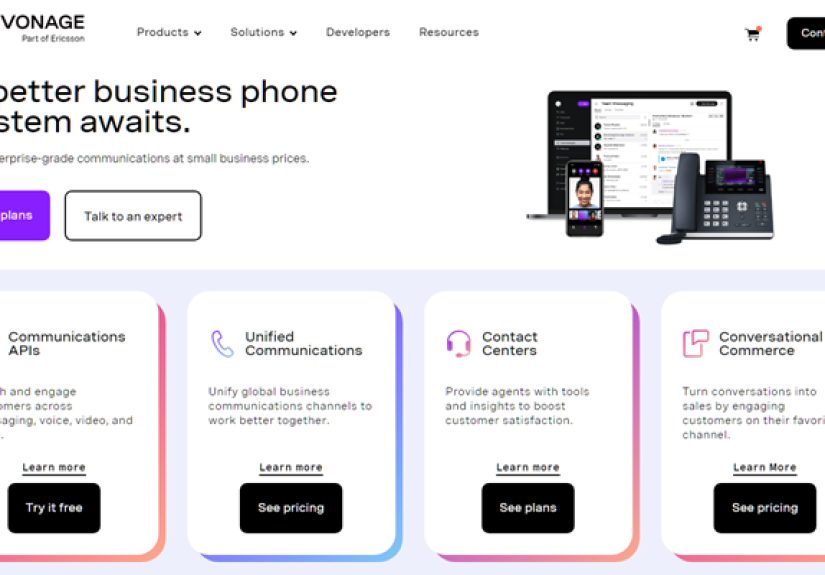
Vonage is a cloud communications company offering business phone service, unified communications, contact center software, and programmable communications APIs. Its best-known small business product is Vonage Business Communications, often shortened to VBC. This is the cloud phone platform most buyers mean when they search for a Vonage review, Vonage pricing, or Vonage VoIP.
At its core, VBC lets employees make and receive business calls through desktop apps, mobile apps, and supported desk phones. Depending on the plan, teams can also use SMS/MMS, voicemail, virtual receptionist, team messaging, video meetings, single sign-on, call groups, visual voicemail, call recording, and integrations with tools such as Microsoft Teams, Salesforce, Google, and other business apps.
Vonage also has a bigger enterprise story. Its Communications APIs let developers build messaging, voice, video, verification, and customer engagement workflows into their own applications. Its Contact Center products support sales and support organizations that need advanced routing, analytics, CRM integrations, AI-powered workflows, and omnichannel customer conversations. In other words, Vonage is not just “an app that rings.” It is more like a communications toolbox, and the wrench you need depends on your business size.
Vonage Pricing in 2025: What You Should Expect
Vonage Business Communications typically has three main plan levels: Mobile, Premium, and Advanced. Pricing can vary based on promotions, number of users, contract terms, location, taxes, fees, and add-ons, so businesses should always confirm the final quote before signing. That said, the usual public pricing structure gives buyers a helpful starting point.
Mobile Plan
The Mobile plan is the entry-level option. It is designed for teams that mainly need calling through desktop and mobile apps. It usually includes unlimited domestic calling, SMS/MMS, voicemail, the Vonage desktop app, the Vonage mobile app, and basic phone system tools. This plan can work well for solo operators, remote workers, consultants, and small teams that do not need desk phones or video meetings inside the same package.
Premium Plan
The Premium plan is the sweet spot for many businesses because it adds features that feel more like a complete unified communications system. It generally includes everything in Mobile plus support for VoIP desk phones, unlimited video meetings with up to 200 participants, team messaging, the VBC App Center, third-party integrations, and single sign-on. If your team lives in a mix of phones, meetings, CRMs, and internal chat, Premium is usually the first plan worth serious consideration.
Advanced Plan
The Advanced plan adds more call management power. It typically includes everything in Premium plus on-demand call recording, visual voicemail with transcription, and call groups. This plan is better for teams that need more supervision, record keeping, routing, or customer-facing workflows. Sales teams, support desks, recruiters, medical offices, legal intake teams, and multi-location service businesses may find these features more valuable than a bare-bones phone line.
The Pricing Catch
The advertised monthly price is not always the final monthly bill. Taxes and fees are extra. Some promotional prices require an annual contract. SMS may require business registration and campaign-related fees. Certain useful features may be add-ons rather than standard inclusions. Hardware, advanced reporting, toll-free usage, call recording expansion, receptionist tools, and contact center capabilities can increase the total cost. This is not unique to Vonage, but buyers should still treat the checkout page like airport food pricing: read carefully before you agree.
The Good: Where Vonage Performs Well
1. Strong Business Calling Features
Vonage covers the essentials that most small and midsize businesses expect from a modern VoIP phone system. Users can make calls from desktop or mobile apps, keep a business number separate from a personal number, route calls, use voicemail, set up a virtual receptionist, and manage users through an admin portal. For remote and hybrid teams, this is a big improvement over passing around personal cell numbers like business cards from 2008.
The calling experience is one of Vonage’s biggest strengths. Many users like that they can work from a laptop, mobile phone, or desk phone without losing the company identity. A sales rep can call from home, a manager can check voicemail from the road, and a receptionist can route calls without being chained to one physical office. That flexibility is exactly why cloud phone systems became popular in the first place.
2. Easy-to-Use Apps
Vonage’s desktop and mobile apps are generally straightforward. The interface is clean enough for non-technical users, and basic calling, voicemail, contacts, and messaging functions are not buried under seventeen layers of mystery buttons. That matters because a business phone system is not supposed to become a second job. Your team should be able to answer calls, check messages, and move on with their day.
For small businesses, ease of use can be more important than having the flashiest feature list. A phone system that employees actually use beats a “powerful” system that requires three meetings, four PDFs, and one emotionally damaged office manager to configure.
3. Good Fit for Remote and Hybrid Teams
Vonage is especially useful for teams that do not work in one central office. Employees can use the mobile app to maintain one business identity while calling or texting from different locations. This is helpful for consultants, real estate teams, field service businesses, distributed sales teams, recruiters, and support teams with flexible schedules.
The ability to work across devices also reduces hardware dependence. Some teams may never need desk phones at all. Others may want desk phones for reception, management, or high-volume calling roles while allowing mobile and remote staff to use the app. Vonage supports both styles, which gives businesses room to design their phone setup around real workflows instead of forcing everyone into the same mold.
4. Useful Integrations
Vonage becomes more valuable when it connects with the tools a business already uses. Its integrations with platforms such as Microsoft Teams, Salesforce, Google, and other productivity or CRM systems can reduce app-switching and help teams keep customer data closer to their conversations.
For example, a sales team using a CRM may want call activity logged automatically. A support team may want customer details visible before answering. A company already invested in Microsoft Teams may want stronger external calling without abandoning its internal collaboration hub. These integrations are not just “nice to have.” For busy teams, they can mean fewer missed details and fewer awkward moments that begin with, “Sorry, who are you again?”
5. Scalable Product Family
One underrated advantage of Vonage is that it can serve different levels of communication needs. A small business might start with Vonage Business Communications. A growing support operation might later evaluate Vonage Contact Center. A software company might use Vonage Communications APIs to build SMS alerts, voice workflows, verification tools, or messaging features into its own app.
This does not mean every business should buy the whole Vonage ecosystem. Many should not. But for companies that expect to grow from “we need a phone system” to “we need customer engagement workflows across channels,” Vonage offers more runway than some basic VoIP providers.
The Bad: Where Vonage Can Frustrate Buyers
1. Add-Ons Can Make the Bill Less Friendly
Vonage’s starting prices can look attractive, especially with promotional discounts. The trouble is that real businesses often need more than the starter bundle. Call recording, advanced routing, extra analytics, receptionist tools, toll-free usage, SMS compliance fees, hardware, and contact center features can raise the total monthly cost.
This does not automatically make Vonage overpriced. It means buyers need to compare total cost, not headline price. A plan that looks cheaper at first can become more expensive once the features you actually need are included. Before signing, list your must-have features and ask for a complete quote. Do not shop by the biggest discount badge alone. Discount badges are charming little creatures, but they do not pay your phone bill.
2. The Entry-Level Plan May Be Too Basic
The Mobile plan is useful, but it may feel limited for teams that want a full unified communications experience. Video meetings, team messaging, desk phone support, app integrations, and single sign-on are generally associated with the Premium plan. If your business needs these features, the entry-level price is not the price you should use for budgeting.
This is a common pattern in VoIP pricing. Providers use a low starter plan to attract small businesses, then reserve the most business-critical features for higher tiers. Vonage is no exception. The Mobile plan is best for simpler use cases. For many active businesses, Premium or Advanced will be the more realistic choice.
3. SMS Can Be More Complicated Than Expected
Business texting is no longer as simple as “type message, press send, feel productive.” In the United States, application-to-person messaging rules, carrier filtering, and business registration requirements have made SMS more regulated. Vonage notes that reasonable and acceptable usage applies, and campaign registration fees may apply for SMS.
For businesses that rely heavily on texting customers, this matters. Recruiters, appointment-based service providers, clinics, salons, real estate agents, and local service companies should ask detailed questions about SMS registration, throughput, message limits, delivery reliability, opt-in rules, and what happens if a texting campaign is delayed or rejected. SMS is powerful, but it now comes with paperwork wearing a tiny compliance hat.
4. Customer Support Reviews Are Mixed
User feedback on Vonage support is mixed. Some customers praise the support experience and say the system works reliably once configured. Others complain about slow resolutions, billing confusion, call connectivity issues, texting problems, or difficulty canceling. This split is important because phone systems are mission-critical. When calls fail, customers do not care that your vendor has a nice dashboard.
The practical lesson is simple: test support before committing. Ask sales how onboarding works. Confirm support hours. Find out whether you get phone support, chat support, ticket support, or a dedicated contact. If your business depends on inbound calls for revenue, support quality is not a side dish. It is the meal.
5. Contracts and Cancellation Terms Require Attention
Vonage may offer monthly and annual options, and promotional discounts are often tied to annual commitments. Annual contracts can reduce monthly rates, but canceling during the contract term may trigger early termination fees. Monthly plans may avoid early termination fees, but they may not receive the same discount.
This is not unusual in business software, but it is easy to overlook when everyone is excited about saving 30 percent. Before agreeing, ask what happens if you downsize, cancel, change plans, remove users, port numbers away, or stop using SMS. Boring questions now can prevent spicy billing conversations later.
Vonage vs. Other VoIP Providers
Vonage competes with providers such as RingCentral, Nextiva, 8×8, Ooma Office, Zoom Phone, Dialpad, GoTo Connect, and other business VoIP platforms. The best choice depends on what your company values most.
Choose Vonage if you want a recognizable VoIP brand, flexible calling apps, strong mobile use, Microsoft Teams or CRM integrations, scalable communications APIs, or a path toward contact center tools. Choose another provider if you want more included features at a lower tier, simpler pricing, stronger built-in analytics, or a support reputation that better matches your expectations.
Vonage is not always the cheapest or the most polished option. But it remains competitive because it offers a broad communications stack. That breadth is useful for businesses that want phone service today and may need deeper customer communication tools tomorrow.
Who Should Use Vonage in 2025?
Vonage Is a Good Fit For:
- Small businesses that want cloud calling without maintaining traditional phone hardware.
- Remote and hybrid teams that need business calling on mobile and desktop apps.
- Sales, recruiting, and service teams that make frequent outbound calls.
- Companies already using Microsoft Teams, Salesforce, or similar business apps.
- Growing businesses that may later need contact center software or communication APIs.
- Teams that value flexibility and are willing to review plan details carefully.
Vonage May Not Be Ideal For:
- Businesses that want the lowest possible all-in cost.
- Teams that need advanced features included in the cheapest plan.
- Companies heavily dependent on SMS but unwilling to manage registration and compliance details.
- Buyers who dislike add-ons, promotional contract terms, or variable fees.
- Organizations that need consistently white-glove support from day one.
Real-World Experience Notes: What Using Vonage Can Feel Like
In day-to-day business use, Vonage tends to feel strongest when the company has a simple but active communication workflow. Imagine a small insurance agency with six employees. The owner wants every producer to call from the business number, not from personal phones. The office manager needs voicemail, call routing, and a way to handle calls when someone is out. A few employees work from home twice a week. In that situation, Vonage can feel refreshingly practical. The team installs the app, ports a number, sets up extensions, records greetings, and suddenly the phone system no longer depends on one dusty device sitting next to a printer that jams every Thursday.
For mobile workers, the experience can be even better. A field service manager can return customer calls from the road while still showing the company caller ID. A consultant can check voicemail after a meeting. A recruiter can call candidates from a laptop, switch to mobile when leaving the desk, and keep work communication separate from personal life. That separation is not glamorous, but it is valuable. Nobody wants a client texting their personal number during dinner unless the client is also bringing tacos.
The experience becomes more mixed when businesses need deeper customization. For example, a growing support team may start asking for call queues, advanced reporting, automatic call recording, detailed analytics, CRM screen pops, and strict supervisor workflows. Some of these needs may push the company into higher Vonage plans, paid add-ons, or even the Contact Center product. That can be the right move, but it changes the buying conversation from “cheap business phone” to “communications platform investment.” Businesses should recognize that shift early.
Texting is another area where expectations need management. A local clinic, salon, real estate office, or staffing agency may assume SMS will work exactly like personal texting. In reality, business SMS in 2025 involves registration, acceptable use policies, opt-in practices, carrier rules, and potential delivery limitations. Vonage can support business messaging, but teams should treat SMS setup as a real project. Write compliant templates, confirm customer consent, test delivery, and create a backup channel for urgent messages. Texting is convenient until a delayed message costs an appointment, a lead, or a very confused customer waiting in the wrong parking lot.
Onboarding also depends heavily on how prepared the buyer is. A business with a clean list of users, numbers, call flows, greetings, office hours, and device needs will usually have a smoother rollout. A business that starts with “we just need phones, probably, maybe, ask Diane” may run into delays. Vonage gives you tools, but it does not magically design your communication process. Before implementation, map who answers calls, where calls go after hours, who needs voicemail transcription, who needs recording, who needs texting, and who needs admin access. Future you will be grateful. Future Diane will also be grateful, and Diane has been through enough.
Overall, the real-world Vonage experience is best when expectations match the product. It is a flexible, mature cloud communications system with useful apps and scalable options. It is not a magically simple, all-inclusive, zero-fee phone paradise. Treat it like a business platform, ask careful pricing questions, test the features that matter most, and it can serve well. Treat it like a $13.99 miracle and you may be surprised when real-world needs cost more.
Final Verdict: Is Vonage Worth It in 2025?
Vonage is worth considering in 2025 if your business wants a reliable cloud phone system with strong mobile access, useful integrations, and room to grow into more advanced communications tools. Its biggest strengths are flexibility, app-based calling, unified communications features, Microsoft Teams and CRM integration options, and the broader ecosystem of APIs and contact center products.
The downsides are equally real. Pricing can become more complicated once fees, contracts, add-ons, SMS registration, hardware, and advanced features enter the picture. The starter plan may be too limited for many teams. Customer support feedback is not universally glowing. Businesses that rely heavily on texting or inbound calls should test carefully before making Vonage their main communication lifeline.
The best advice is to evaluate Vonage based on your actual workflow, not the prettiest price on the page. List your required features, request the full monthly cost, confirm contract terms, test call quality, verify SMS requirements, and compare the final package against competitors. If Vonage matches your needs, it can be a strong business VoIP choice. If it does not, the market has plenty of alternatives waving politely from the next browser tab.
Bottom line: Vonage is good, sometimes very good, but not automatically the best fit for everyone. It is a flexible communications platform with a few pricing and support wrinkles. For the right business, those wrinkles are manageable. For the wrong one, they may feel like wearing a dress shirt straight from the dryer.
Note: Pricing, promotions, taxes, fees, SMS registration rules, and plan features can change. Businesses should confirm current Vonage terms directly before purchasing or publishing final buying advice.