Table of Contents >> Show >> Hide
- First, a quick translation: “Conjunction” in astrology vs. astronomy
- What is a conjunction aspect in astrology?
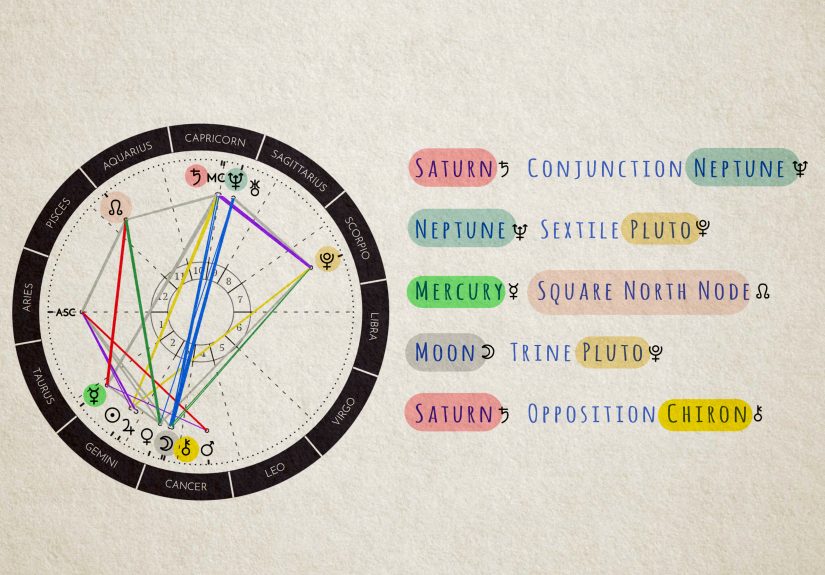
- How to spot conjunctions in your birth chart
- How to interpret a conjunction (without spiraling)
- Common conjunction examples (and what they can look like)
- Conjunctions in transits: when the sky “presses the button”
- Conjunctions in relationships (synastry): sparks, glue, and learning curves
- Common mistakes with conjunctions (aka how to avoid astrology faceplants)
- Mini cheat sheet: how conjunctions tend to feel
- Frequently asked questions
- Conclusion: Conjunctions are the chart’s power blend
- Experiences & real-life “conjunction moments” (stories, patterns, and what people tend to notice)
In astrology, some chart symbols whisper. Others kick the door open, drag in a karaoke machine, and demand we all sing along.
Conjunctions are the karaoke machine.
A planet conjunction (also called a conjunction aspect) happens when two chart points sit very close together in the zodiac.
Astrologers read this as a “blending” of energieslike mixing two paint colors. Sometimes you get a gorgeous new shade.
Sometimes you get… suspicious brown. Either way, it’s intense, memorable, and hard to ignore.
First, a quick translation: “Conjunction” in astrology vs. astronomy
You may hear “conjunction” on space news, tooand that’s not astrology trying to sneak into NASA’s group chat.
In astronomy, a conjunction is when objects appear close together in the sky from Earth.
In astrology, a conjunction is a chart aspect: an angular relationship measured along the zodiac.
Same word, different jobs.
- Astronomy conjunction: “They look close in the sky.”
- Astrology conjunction: “They’re close in zodiac degrees, so their symbolism blends.”
What is a conjunction aspect in astrology?
In a birth chart (or a transit chart), a conjunction is the 0° aspect. In plain English:
two planets (or a planet and a point, like the Ascendant) are positioned in nearly the same spot in the zodiac.
Astrologers consider conjunctions among the most powerful aspects because the two influences act togethersometimes smoothly,
sometimes like two roommates fighting over the thermostat.
The “orb”: how close is close?
Here’s where astrology gets politely opinionated. A conjunction is exact at 0° separation, but most astrologers use an
orb (a cushion of degrees) to decide whether the conjunction “counts.”
Many modern interpretations use something like up to about 8–10 degrees for conjunctions, often allowing wider orbs for
the Sun and Moon and tighter ones for slower-moving planets.
Translation: if your chart shows Venus at 12° Leo and Mars at 15° Leo, many astrologers would call that a conjunction.
If they’re at 12° Leo and 28° Leo, that’s not a conjunctionunless you’re using “orb math” from a parallel universe.
How to spot conjunctions in your birth chart
If you’ve ever looked at a chart wheel and thought, “This is a pie chart made by wizards,” you’re not alone.
Here’s the simplest way to find conjunctions without earning a degree in Mystical Geometry:
-
Look for planets clustered together in the same zodiac sign on the chart wheel.
When symbols bunch up, conjunctions are likely nearby. -
Check the degrees. If two planets are within your chosen orb (for example, within 8°),
you can treat them as conjunct for interpretation. - Use the aspect grid (most chart calculators include one). Conjunctions are usually marked with a “Con” label or a symbol.
- Note the house. Conjunctions don’t just describe what energies blend; the house describes where it plays out.
How to interpret a conjunction (without spiraling)
A conjunction is not automatically “good” or “bad.” Think of it as concentrated.
It’s a spotlight, not a moral judgment. To interpret it, astrologers typically layer four questions:
1) What are the planets trying to do?
Planets represent drives and functions. When they’re conjunct, those functions operate as a package deal:
you don’t get one without the other.
- Sun = identity, vitality, purpose
- Moon = emotional needs, instincts, comfort
- Mercury = communication, learning, decisions
- Venus = connection, pleasure, values
- Mars = motivation, action, assertion
- Jupiter = growth, meaning, opportunity
- Saturn = responsibility, boundaries, time
- Uranus = change, freedom, surprises
- Neptune = imagination, ideals, fog
- Pluto = intensity, transformation, power dynamics
2) What sign are they in?
The sign describes style. A Mars–Venus conjunction in Aries is spicy and direct.
The same conjunction in Libra may be charming, relational, and allergic to open conflict (until it isn’t).
3) What house are they in?
Houses answer the “life department” question. A conjunction in:
- 1st house: personality, self-presentation, first impressions
- 4th house: home, family, roots, private life
- 7th house: relationships, partnerships, close agreements
- 10th house: career, reputation, long-term goals
Same planets, totally different storyline depending on the house. Astrology loves context more than your group chat loves screenshots.
4) How exact is it (and is it applying or separating)?
In many traditions, the tighter the orb, the louder the aspect. Some astrologers also note whether the conjunction is
applying (moving toward exact) or separating (moving away from exact) in predictive work.
Applying aspects can feel like they’re building; separating aspects can feel like you’re integrating what just happened.
You may also hear the term partile, meaning “in the same degree” (very tight). In practice, partile conjunctions are often read as
especially potentlike espresso instead of iced coffee.
Common conjunction examples (and what they can look like)
Below are examples astrologers often discuss. These aren’t fate stamps; they’re themes that show up differently based on sign, house,
other aspects, and real-life choices.
Sun conjunct Mercury
A mind–identity merge. People with this conjunction are often strongly identified with their thoughts, opinions, or voice.
It can show quick thinking and strong opinions. The growth edge: learning when to let the mind rest so the self can breathe.
Venus conjunct Mars
Desire meets desirejust with different fonts. Venus seeks harmony and enjoyment; Mars seeks action and pursuit.
Together, this can look like charisma, creative drive, and magnetic relationship energy. The growth edge: not confusing chemistry
with compatibility, and not treating every crush like a season finale.
Moon conjunct Saturn
Feelings meet structure. This can show emotional maturity, self-control, and loyaltyplus a tendency to take responsibility early in life.
The growth edge: making room for softness, asking for support, and remembering that “being strong” doesn’t mean “never needing anything.”
Jupiter conjunct Saturn
Expansion meets restraint. This conjunction often gets interpreted as “realistic optimism”the ability to build something meaningful
without relying on wishful thinking. It can also feel like stop-and-go growth: progress, pause, progress, pause.
The growth edge: trusting timing, and setting goals that are both inspiring and doable.
Mars conjunct Neptune
Action meets fog (or inspiration). At its best, it can be artistic drive, compassionate action, or intuitive motivation.
At its messiest, it can be low energy, confusing desires, or chasing a mirage. The growth edge: clear boundaries, clear goals,
and checking whether your “dream” comes with a practical plan.
Conjunctions in transits: when the sky “presses the button”
A transit conjunction happens when a current-moving planet lines up with a natal planet or point.
Many astrologers treat conjunction transits as activations: the transiting planet brings events, opportunities, lessons,
or inner shifts that highlight the natal planet’s themes.
For example:
- Transit Jupiter conjunct natal Venus: often read as a season of growth in relationships, creativity, or financesplus a risk of overdoing it.
- Transit Saturn conjunct natal Moon: often read as emotional reality-checks, maturing needs, and learning sustainable self-care.
- Transit Mercury conjunct natal Sun: often read as busy days, conversations, decisions, and “wait, why did I schedule three things at the same time?” moments.
Conjunctions also matter in broader timing cycles. Many astrologers talk about planetary cycles beginning at conjunctions
(for example, a repeating cycle between two planets can be tracked from one conjunction to the next).
Conjunctions in relationships (synastry): sparks, glue, and learning curves
In synastry (comparing two people’s charts), conjunctions are often read as strong ties.
One person’s planet “lights up” the other person’s planet. This can feel familiar, exciting, or unavoidable.
- Venus–Mars conjunction between charts can feel highly magnetic.
- Sun–Moon conjunction can feel like “I get you,” emotionally and energetically.
- Saturn conjunctions can feel bindingsupportive and committed, or heavy if the relationship lacks warmth and flexibility.
A helpful rule: in synastry, conjunctions amplify whatever is already there. If two people communicate well, a Mercury conjunction can feel amazing.
If they don’t, it can feel like talking over each other with matching megaphones.
Common mistakes with conjunctions (aka how to avoid astrology faceplants)
Mistake #1: Treating every conjunction like “good luck”
Conjunctions are powerful, but not automatically lucky. They intensify. A Venus–Jupiter conjunction can feel sweet and abundant.
A Mars–Saturn conjunction can feel like driving with the parking brake on. Different lesson, same volume.
Mistake #2: Using orbs so wide they cover an entire zodiac sign
A huge orb can turn your chart into a spaghetti bowl of “everything aspects everything,” which is… less helpful.
Pick an orb system and stay consistent. If you’re learning, tighter orbs can make patterns easier to see.
Mistake #3: Ignoring sign and house
“Venus conjunct Mars” is not the whole story. Venus conjunct Mars in Capricorn is different from Venus conjunct Mars in Gemini.
And where it lands (house) changes how it shows up day-to-day.
Mistake #4: Forgetting the rest of the chart exists
A conjunction is one ingredient. The whole chart is the meal. You still need the bigger pattern:
repeated elements, chart ruler themes, and major configurations.
Mini cheat sheet: how conjunctions tend to feel
- Keywords: fusion, intensity, concentration, “two-for-one deal,” spotlight
- Strength: often strongest when tight (small orb), angular (near Asc/MC), or involving Sun/Moon
- Can be: harmonious, challenging, or bothdepending on planets, sign, house, and context
- Best use: focus and mastery (because conjunctions love specialization)
- Watch-outs: over-identifying with the conjunction (“This is my whole personality now”), extremes, blind spots
Frequently asked questions
Is a conjunction always in the same sign?
Many modern approaches describe conjunctions as planets in the same sign and close in degree.
Some astrologers also discuss “out-of-sign” conjunctions when planets are near the sign boundary (for example, 29° Aries and 1° Taurus),
depending on their technique. If you’re a beginner, start with same-sign conjunctionsyou’ll get clean, clear results.
What’s the difference between a conjunction and a stellium?
A stellium is a cluster of three or more planets in one sign or house (definition varies by astrologer).
A stellium often contains multiple conjunctions inside it, like a little neighborhood where everyone shares a wall.
What if I have “too many” conjunctions?
Then your chart is basically a themed playlistand that’s not a bad thing.
Conjunction-heavy charts often point to focus: fewer scattered interests, more concentrated drives.
The trick is giving those drives a healthy outlet.
Conclusion: Conjunctions are the chart’s power blend
A planet conjunction in astrology is the 0° aspect: two energies occupying nearly the same zodiac space,
operating together as a fused signal. Interpreting a conjunction becomes much easier when you:
(1) identify the planets, (2) read the sign style, (3) locate the house arena, and (4) consider orb and exactness.
Use conjunctions as a self-awareness tool, not a sentence. The goal isn’t to predict every plot twistit’s to understand the themes
you keep returning to, the strengths you can develop, and the habits you can upgrade. (Yes, astrology can be a software update.
No, you do not need to restart your life to install it.)
Experiences & real-life “conjunction moments” (stories, patterns, and what people tend to notice)
If conjunctions are the karaoke machine, then real life is the moment you realize you grabbed the micwhether you meant to or not.
People who track astrology often describe conjunction periods as times when a theme becomes unavoidably noticeable.
Not because the sky forces a single outcome, but because attention clusters around the symbolismlike a spotlight landing on one part
of the stage and staying there for a while.
One common experience is the “double-duty day”: you plan for one thing, but the conjunction insists on doing two at once.
For example, imagine someone with a natal Sun–Mercury conjunction. During a busy week, they might notice they can’t separate
who they are from what they think. A simple disagreement feels personal. A casual comment becomes a full TED Talk in their head.
The helpful shift (and yes, people report this kind of shift) is learning to pause before respondingcreating a tiny gap between identity and opinion.
That gap can turn “I am right” into “I have a perspective,” which is a glow-up in any era.
Another classic: the “chemistry vs. compatibility” lesson that often comes up in conjunction-heavy relationship signatures,
especially with Venus–Mars contacts. People sometimes describe meeting someone and feeling the connection instantlyfun,
energizing, and a little distracting. In healthy situations, that energy fuels creativity, play, and a stronger bond.
In messy situations, it can fuel impulsive choices or mixed signals. A practical way many people work with this is a simple check-in:
“Is this energizing me in a stable way, or is it just loud?” Conjunctions love volume, so learning to measure quality matters.
Conjunction experiences aren’t always sparkly. Consider a Moon–Saturn theme. People with this signature often describe being the
“responsible one,” sometimes from an early age. During emotionally intense periods, they may default to handling everything alone.
The conjunction’s gift shows up when they realize structure can support feelings rather than smother them. That might look like building a
reliable routinesleep, meals, downtimeso emotions have a safe container. It might also look like learning to ask for help before
the internal pressure hits “overflow.” In other words: the conjunction becomes a skill, not a burden.
Transits bring their own “conjunction moments.” When people track transit Jupiter conjunctions, they often describe a season of
opportunity: saying yes more often, taking a chance, meeting helpful mentors, or finally feeling momentum.
The funny part is that Jupiter’s “more” can also mean too much: overscheduling, overspending, overpromising.
A grounded Jupiter conjunction story is someone who gets a big opportunityand then realizes the real win is choosing the right one,
not chasing all of them. The conjunction highlights what you want to grow, and your choices decide the shape of that growth.
People also describe conjunctions as identity chapters, especially when the Sun or Ascendant is involved in synastry or transits.
It’s not uncommon for someone to say, “That year changed how I saw myself,” and then notice a conjunction was active in their chart.
Again, it’s not proof of a cosmic puppet showit’s a useful lens. If a conjunction points to a theme like confidence, boundaries, creativity,
or responsibility, you can work with it intentionally: journal about it, talk it out, set goals that match it, and watch what patterns repeat.
The most practical takeaway from these experiences is simple: conjunctions respond well to focus.
If your chart (or current transits) is shouting one message, you don’t have to panicyou can prioritize.
Pick one habit to strengthen, one project to push forward, one conversation to have clearly.
When you give conjunction energy a constructive channel, it often feels less like chaos and more like momentum.
And if it still feels chaotic sometimes? Congratulations: you’re human, not a perfectly labeled diagram in a textbook.