Table of Contents >> Show >> Hide
- 1) The Dutch Shipwreck That Pinged Back
- 2) The Colombian Weasel (Yes, On a Toilet)
- 3) The “Ghost Plane” Floating in Google Earth
- 4) The Biggest Underwater Eruption, Finally Drawn in Color
- 5) A Star Battle: R Aquarii Caught Mid-Drama
- 6) First Drone Glimpses of a Hidden Amazon Community
- 7) The Albino Panda: A White Shadow in the Bamboo
- 8) The First Constructed Image of a Terrestrial Gamma-Ray Flash
- 9) Supersonic Shock WavesFinally Photographed in the Wild
- 10) The Roosevelt Objects: When “Radar Glitch” Became a Safety Problem
- What These First Images Have in Common
- Experiences: The Joy (and Weirdness) of Chasing “First Images”
- Conclusion
- SEO Tags
The modern world is basically a nonstop photo dump. Your brunch gets a portrait session. Your dog has a brand. Even your houseplants are expected to “pose.”
So it’s easy to forget how wild it is that some things were never seenuntil one day, a sensor, a camera trap, a satellite pass, or a very confused
scientist finally captured the first clear “receipt.”
This Listverse-inspired collection isn’t about perfect photography. It’s about first evidence imagesthe moment something rare, debated,
hard-to-reach, or blinking-fast moved from rumor to record. Some are stunning. Some are creepy. One involves a weasel using a toilet like it pays rent.
All of them remind us that “seeing is believing”… and also that humans will point a lens at literally anything.
1) The Dutch Shipwreck That Pinged Back
Imagine you’re searching the seafloor for lost shipping containershigh-tech hide-and-seek with very expensive consequences. Then your sonar shows a weird
anomaly near the Dutch island of Terschelling. You send down equipment expecting metal… and you pull up wooden ship timbers and a haul of
copper sheets that scream, “I am absolutely not a modern container.”
That first sonar image mattered because it wasn’t just a blurry underwater “something.” It was the opening scene of a bigger story: a vessel roughly
five centuries old, carrying tons of copper that likely fed early coin-making and trade routes. Even better (for history nerds), the construction hints at
a pivotal transition in shipbuildinghow builders moved from older methods to stronger hull designs that helped European trade explode.
Why the first look mattered
Shipwrecks can be time capsules, but only if you can find them without turning the ocean into a demolition site. Sonar gives archaeology a superpower:
it “sees” through darkness and silt, mapping shapes long before divers ever touch a plank. That first image wasn’t just discoveryit was triage, allowing
experts to plan careful documentation instead of chaotic salvage.
2) The Colombian Weasel (Yes, On a Toilet)
Wildlife photography often looks glamorous. This one looked like a homeowner’s horror story: a small, rare carnivore perched on a bathroom toilet.
The Colombian weasel is famously elusiveso elusive that it had effectively become a scientific ghost story, known from only a handful of specimens and
basically never photographed alive.
Then an architect and nature enthusiast snapped photos, shared them through a citizen-science platform, and the internet did what it does best:
it collectively yelled, “WAIT… THAT’S REAL?” Experts confirmed the ID, turning an accidental bathroom encounter into a major data point for a species
that many people had never even heard of.
Why the first look mattered
The big win here wasn’t artistic lightingit was verification. The first clear photos helped confirm survival and location, and they also proved that
everyday observers (armed with a phone camera and curiosity) can contribute to biodiversity records. Sometimes science advances not with a grant proposal,
but with someone walking into the bathroom at the wrong time.
3) The “Ghost Plane” Floating in Google Earth
If you’ve ever zoomed around Google Earth at 2 a.m. like a digital raccoon, you know the thrill: the world is right there, and you can poke it with your
cursor. So when someone spotted what looked like an airliner underwater near Edinburgh, it felt like the opening act of an aviation conspiracy thriller.
The twist is nerdier (and honestly more comforting): it was a compositing artifact. Mapping platforms stitch together multiple images to
make the surface look continuous and sharp. If a plane shows up in one source image at the wrong moment, the “blend” can smear it into a spooky,
semi-transparent outlinelike a ghost that haunts cartography instead of castles.
Why the first look mattered
This “first image” is less about a rare object and more about a rare glitch that teaches media literacy. The internet doesn’t just need cameras;
it needs context. Seeing something isn’t always the same as understanding itespecially when algorithms are building the picture you think you’re seeing.
4) The Biggest Underwater Eruption, Finally Drawn in Color
Underwater eruptions are the ultimate “you can’t film this” event. They happen in darkness, under pressure, and often far from witnesses. But seismic
signals near Mayotte raised alarmsand eventually, surveys revealed something jaw-dropping: a new volcanic feature on the seafloor that hadn’t been there
months earlier, mapped with sonar into a vivid, topographic image.
That first clear sonar visualization did more than satisfy curiosity. It helped connect global rumblings to a real structurean evolving underwater
volcanosupporting hazard understanding for an inhabited region experiencing ongoing disturbances.
Why the first look mattered
In geology, “first images” can be safety tools. Mapping new seafloor features helps scientists track growth, locate activity, and evaluate risks. It also
shows how modern Earth science relies on indirect visionturning sound waves and measurements into maps we can interpret like photographs.
5) A Star Battle: R Aquarii Caught Mid-Drama
Space “first images” are often about distance and patience. R Aquarii is a binary system: a red giant and a white dwarf locked in a messy relationship
where one star pulls material from the other. That transfer can trigger outburstscosmic tantrums powered by physics, not feelings (though it sure looks
personal).
Modern imaging captured the system in striking detail, revealing surrounding structures and the chaotic aftermath of stellar interaction. It’s the kind of
image that makes you realize the universe is not a calm, silent placeit’s a constant, energetic negotiation.
Why the first look mattered
Images like this turn abstract astrophysics into something you can grasp. “Accretion” stops being a vocabulary word and becomes a visible story of matter
moving, heating, and reacting. For researchers, the details help test models of how binary systems evolve and how outbursts shape surrounding material.
6) First Drone Glimpses of a Hidden Amazon Community
Some of the most consequential “first images” come with an ethical warning label. A drone captured photographs of an isolated Amazonian communityimages
that offered rare confirmation and a distant look at people who have chosen (or been forced) to avoid contact with the outside world.
These pictures can support protection efforts by documenting existence and location without immediate ground contact. But they also raise hard questions:
who benefits from exposure, and who could be harmed by attention, intrusion, or disease transmission? With isolated groups, “curiosity” has a history, and
it’s not a cute one.
Why the first look mattered
The value of such images isn’t entertainmentit’s evidence that can strengthen land protections and enforcement. Done responsibly, distant documentation can
support a “leave them alone” approach while still proving they’re there and need safeguarding. Done irresponsibly, it becomes a digital violation.
7) The Albino Panda: A White Shadow in the Bamboo
Pandas already feel like mythical creatures that wandered out of a children’s book and into a bamboo forest. Then researchers reviewing a camera trap in
China saw something even rarer: a panda with no black bandsan all-white individual with the telltale signs of albinism.
The first confirmed image of a wild albino panda wasn’t just a “wow” moment. It was a reminder that genetic variation shows up in the wild in surprising
waysand that camera traps quietly collect stories that humans would almost never witness directly.
Why the first look mattered
For conservation and research, rare traits can be clues about genetics, population structure, and survival. A single image won’t answer everything, but it
confirms a phenomenon and invites careful questions: How common are such mutations? Does it affect health or visibility to predators? How does it influence
behavior? Wildlife science often starts with one undeniable frame.
8) The First Constructed Image of a Terrestrial Gamma-Ray Flash
Gamma rays sound like a “space-only” problemsupernovas, black holes, dramatic sci-fi things. But Earth’s thunderstorms can produce intense, extremely
brief gamma-ray bursts called terrestrial gamma-ray flashes. For years, scientists detected them, but turning that detection into a
constructed imagea visual map of where the burst came fromwas a major milestone.
The first image of a terrestrial gamma-ray flash was built from space-based measurements, tied to a thunderstorm over Borneo. It’s not a traditional photo
(no one snapped a gamma-ray selfie), but it’s still an image in the most important sense: it shows structure, location, and intensity in a way humans can
interpret.
Why the first look mattered
This is what modern imaging looks like at the edge of physics: translating invisible energy into a picture. A constructed image helps scientists link
gamma-ray flashes to storm processes, refine models of how they form, and connect them with lightning and atmospheric dynamics. It’s like finally seeing
the outline of a creature you’ve only heard moving in the dark.
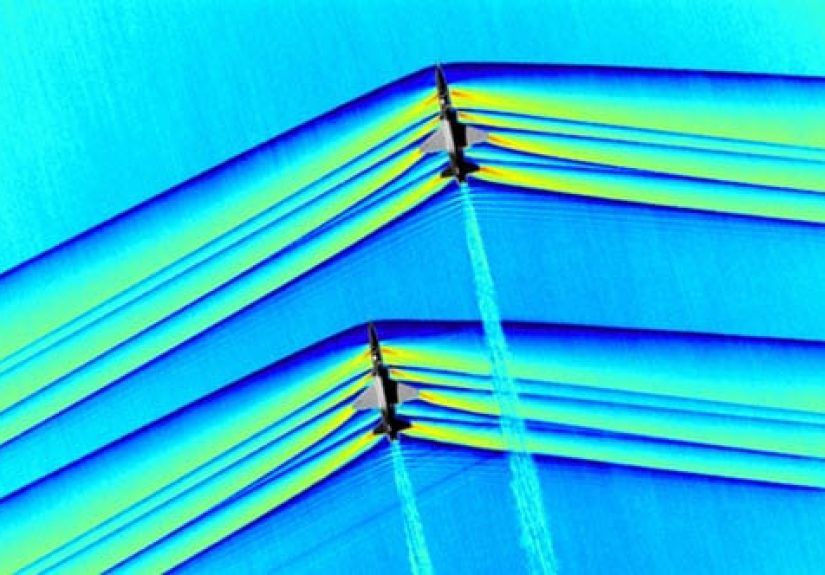
9) Supersonic Shock WavesFinally Photographed in the Wild
Sonic booms are loud, dramatic, and famously invisible. When aircraft exceed the speed of sound, they create shock wavespressure boundaries that move like
fast, sharp ripples through the air. Scientists have studied them for ages, but capturing clear, air-to-air images of shockwave interaction between two
aircraft in supersonic formation was a genuine “first.”
Using specialized schlieren imaging methods, researchers visualized shock waves streaming from two jets flying close together at supersonic speeds. The
result looked like a secret diagram the sky usually refuses to show.
Why the first look mattered
This isn’t just aviation eye candy. Seeing shock interactions helps engineers understand how to reduce or reshape the sonic boom footprintone of the
biggest barriers to future quiet supersonic travel over land. In other words: these images are part of the long game to make “faster” and “less obnoxious”
coexist in the same sentence.
10) The Roosevelt Objects: When “Radar Glitch” Became a Safety Problem
Some first images aren’t prettythey’re unsettling. Navy pilots operating from the USS Theodore Roosevelt described recurring unidentified objects detected
during training, initially dismissed as sensor issues until patterns persisted and, in some accounts, at least one object was visually observed at close
range. The famous descriptionsomething like a “cube inside a sphere”became part of the public conversation because it sounded both specific and bizarre.
Here’s the responsible takeaway: official sources have repeatedly emphasized that “unidentified” does not mean “aliens.” It means the data is incomplete,
the object isn’t confidently explained, and more rigorous collection is needed. The bigger point is aviation safety and national security: anything operating
in restricted airspace without identification is a problem, regardless of its origin.
Why the first look mattered
These reports pushed the topic out of the conspiracy corner and into formal processesstandardized reporting, government assessments, and scientific calls
for better data. In a world drowning in opinions, a documented “first” (even an imperfect one) can change what institutions take seriously enough to study.
What These First Images Have in Common
If there’s a theme here, it’s that imaging is expanding human senses. Sonar turns sound into sight. Camera traps turn patience into
proof. Satellites stitch time into maps. Gamma-ray instruments turn invisible radiation into a readable picture. And sometimes, the first “image” isn’t a
photo at allit’s a dataset rendered into something our brains can understand.
Another shared ingredient is humility. First images are often messy: a blurred outline, a noisy map, a weird composite artifact, a grainy sensor capture.
But they’re still powerful because they mark the moment a mystery becomes testable. Once you can see iteven imperfectlyyou can argue about it with
evidence instead of vibes.
Experiences: The Joy (and Weirdness) of Chasing “First Images”
You don’t need a space station badge or a deep-sea sub to feel the thrill of a “first image.” Most people experience it in smaller, surprisingly relatable
wayslike stumbling across an archival scan at midnight and suddenly realizing you’re looking at the earliest documented version of something that shaped
the world. It’s a unique kind of goosebumps: not fear, not nostalgia, but the feeling that human curiosity left footprints in the dark and you just found
one.
1) The museum moment: seeing history as evidence, not legend
If you’ve ever stood in a museum and stared at an early artifact photo, you know the sensation: the glass case isn’t the pointthe proof is.
“First images” hit differently because they’re not trying to be inspirational posters. They’re closer to a lab notebook. A sonar printout of a shipwreck
or a camera-trap frame of a rare animal feels like a detective’s clue board you’re allowed to peek at. And the best part is realizing that these discoveries
weren’t inevitable. Someone had to look in the right place, at the right time, with the right tool, and then have the patience to double-check what they
found instead of shouting “WORLD’S BIGGEST THING” and immediately posting it with fifteen fire emojis.
2) Falling down the public-archive rabbit hole (and loving it)
A lot of modern wonder lives in publicly accessible archivesspace image libraries, museum collections, research summaries, and citizen-science platforms.
The experience is half treasure hunt, half self-control test. You click to learn one fact and three hours later you’re comparing instrument readouts,
reading about how imaging techniques work, and pretending you aren’t. The more you browse, the more you realize that “first images” are often born from
teamwork: researchers, technicians, archivists, and sometimes ordinary people who happened to be curious enough to document something odd instead of
walking away.
3) Citizen science: the thrill of “wait, this matters?”
The Colombian weasel story is the perfect example of the most relatable scientific adrenaline rush: you record something because it looks unusual, and then
a community helps you understand it. That feeling“I thought this was just a weird moment, but it might actually be important”is what keeps citizen
science alive. It’s also a healthy reminder to document responsibly: note the location carefully when safe, share through reputable channels, and accept
corrections with grace. The goal isn’t internet fame; it’s turning a moment into usable knowledge.
4) Learning to “read” unfamiliar images
One underrated joy is learning how to interpret images that aren’t traditional photos. Sonar maps look like abstract art until someone explains how depth
and reflection translate into shape. Schlieren shockwave images can look like heat haze until you understand the physics of density gradients. Gamma-ray
flash renderings aren’t “pretty pictures” so much as visualized measurements. Once you learn the language, the images become more satisfying, not lesslike
finally understanding a joke that’s been told in a different dialect.
5) The ethics of looking
Not every “first image” should be treated like content. Images of isolated communities should spark responsibility before curiositybecause attention can be
harmful, and history is full of outsiders turning real people into spectacles. A good rule of thumb is to ask: does this image protect, inform, or
endanger? The most meaningful “first images” aren’t the ones that go viral; they’re the ones that lead to better decisionssafer flight reporting, better
conservation practices, stronger protections, and deeper scientific understanding.
Ultimately, chasing “first images” is a way of practicing awe without losing your skepticism. It’s letting yourself be amazed while still asking,
“How do we know? What does this actually show? What’s missing?” And if you can do thatcongratulations. You’re enjoying the internet like it was meant to
be used: not just to scroll, but to discover.
Conclusion
First images are milestones, not finish lines. A sonar outline becomes a shipwreck investigation. A bathroom photo becomes a biodiversity confirmation.
A strange Google Earth “plane” becomes a lesson in how images are made. A shockwave photo becomes a stepping stone toward quieter supersonic flight. And
a mysterious radar track becomes a call for better data and safer skies.
The best part is that we’re still living in the era of first images. New sensors and smarter tools keep revealing rare and unique phenomenasome beautiful,
some unsettling, all unforgettable. The universe is big, weird, and occasionally caught on camera… finally.