Table of Contents >> Show >> Hide
- 10 Non-Dinosaur Nightmares That Weren’t Dinosaurs
- 1. Megalodon – The Shark That Made Great Whites Look Tiny
- 2. Titanoboa – The Snake That Turned the Tropics into a Horror Movie
- 3. Mosasaurus – The “Meuse Lizard” That Ruled the Cretaceous Seas
- 4. Dunkleosteus – Armored Fish with a Built-In Can Opener
- 5. Jaekelopterus – The Giant “Sea Scorpion”
- 6. Arthropleura – The Car-Sized Millipede from Your Worst Basement Nightmare
- 7. Deinosuchus – The Crocodile That Snacked on Dinosaurs
- 8. Terror Birds – Phorusrhacidae, the Apex Birds of South America
- 9. Smilodon – The Saber-Toothed Cat That Wasn’t a Tiger
- 10. Megatherium – The Giant Ground Sloth That Could Ruin Your Day
- What These Non-Dinosaur Monsters Tell Us About Prehistoric Life
- Imagined Encounters: “Living” With 10 Non-Dinosaur Terrors
- Conclusion
When people picture prehistoric monsters, they usually default to the same A-list:
T. rex, Velociraptor, and whatever Jurassic Park told us to be afraid of. But long
before (and long after) many dinosaurs ruled the land, other creatures were busy
turning Earth into a full-time nightmare. From car-sized millipedes to birds that
hunted like hatchet-wielding emus, these non-dinosaur terrors prove that evolution
doesn’t need a T. rex to keep you up at night.
This countdown explores 10 terrifying prehistoric animals that were not
dinosaurs: sharks, snakes, sea scorpions, giant mammals, and more. Think of it as a
reminder that if you ever do get access to a time machine, “random spin on the
geologic timeline” is a terrible vacation plan.
10 Non-Dinosaur Nightmares That Weren’t Dinosaurs
1. Megalodon – The Shark That Made Great Whites Look Tiny
Let’s start with the headliner. Megalodon wasn’t just a big shark;
it was the shark equivalent of a freight train with teeth. This extinct giant mackerel
shark lived roughly 23 to 3.6 million years ago and is widely considered one of the
largest and most powerful predators to have ever existed. Based on its teeth and
vertebrae, most modern estimates put its maximum size in the ballpark of
60–70 feet long and around 50–70 tons. That’s about
three times the length of a big great white and many times the mass.
Megalodon’s jaw may have had a bite diameter approaching 3 meters,
big enough to chomp an orca like a chew toy. Fossil teeth show extremely fine
serrations, ideal for carving through blubber and bone. Paleontologists think this
shark preferred warm, coastal waters packed with whales, seals, and large fishbasically
the all-you-can-eat buffet of the Miocene and Pliocene. The only comforting thing about
Megalodon is that it’s gone… probably. (No, that blurry YouTube video is not proof.)
2. Titanoboa – The Snake That Turned the Tropics into a Horror Movie
After the non-avian dinosaurs died out, the reptiles didn’t clock out and go home.
About 60 million years ago, in the steamy Paleocene coal swamps of what is now
Colombia, a snake called Titanoboa cerrejonensis slithered onto the
scene. This giant boa could reach an estimated 42–47 feet in length
and weigh over a metric toneasily dwarfing modern anacondas and reticulated pythons.
Titanoboa likely lived a semi-aquatic lifestyle, patrolling warm, crocodile-filled
rivers. Its size is tied to the climate: warmer tropical temperatures allowed cold-blooded
reptiles to grow to extreme proportions. Instead of specializing in mammal-crunching,
Titanoboa probably hunted large fish and croc-like reptiles, coiling around them in
murky water and squeezing until the struggling stopped. Imagine wading into a swamp
where the “harmless log” next to you is a snake heavier than your car. Hard pass.
3. Mosasaurus – The “Meuse Lizard” That Ruled the Cretaceous Seas
If you’ve seen a certain blockbuster movie franchise, you’ve already met
Mosasaurusthough Hollywood cranked the drama up a few notches. In
real life, Mosasaurus was still plenty terrifying. This group of marine lizards ruled
the oceans in the Late Cretaceous, roughly 82–66 million years ago.
The largest species, Mosasaurus hoffmannii, may have stretched more than
50+ feet (15–17+ meters) from blunt snout to tail fluke. Its body was
long and torpedo-shaped, with paddle-like limbs and a powerful tail built for fast
swimming. Fossil evidence suggests a diet of sharks, large fish, other marine reptiles,
and pretty much anything unlucky enough to be in its path. As if that wasn’t enough,
Mosasaurus had a second row of teeth on the roof of its mouth to help drag prey down
the hatch. Dinosaurs on land, mosasaurs at seathere was literally no safe vacation
package in the Cretaceous.
4. Dunkleosteus – Armored Fish with a Built-In Can Opener
Long before sharks dominated the oceans, armored fish were doing the terrorizing.
Enter Dunkleosteus, a giant placoderm from the Late Devonian
(about 360 million years ago). Unlike modern fish, Dunkleosteus didn’t have typical
teeth. Instead, its skull featured sharp, bony plates that formed a natural
shear, like two meat cleavers meeting in the middle.
Estimates of its full body length varysome reconstructions suggest around
13–20 feet (4–6 meters) for the largest individualsbut everyone agrees
it had a monstrous bite. Biomechanical studies indicate that Dunkleosteus could
generate bite forces powerful enough to crush armored prey like other placoderms and
shelled invertebrates. In other words, it was a heavily armored missile with a skull
designed to open anything that looked remotely edible. If you were a Devonian fish,
Dunkleosteus was the last face you wanted to see.
5. Jaekelopterus – The Giant “Sea Scorpion”
The phrase “giant sea scorpion” already feels unfair, but the Devonian arthropod
Jaekelopterus rhenaniae took it to another level. Belonging to the
eurypterids, an extinct group of aquatic arthropods, Jaekelopterus is estimated to have
reached around 2.3–2.6 meters (7.5–8.5 feet) in length based on a
massive fossil claw.
This animal wasn’t a true scorpion, but it was close enough in spirit: it had large,
serrated claws, a broad body, and a flattened tail that likely worked like a rudder in
the water. Fossils suggest it lived in brackish or freshwater environments and likely
acted as an apex predator, preying on early fish and other arthropods. Imagine snorkeling
in a river and watching an 8-foot arthropod with giant claws maneuver toward you.
There is not enough therapy in the world.
6. Arthropleura – The Car-Sized Millipede from Your Worst Basement Nightmare
If centipedes already stress you out, you may want to skip this one. During the
Carboniferous and early Permian periods, around 344–292 million years ago,
the forests of what is now Europe and North America were home to
Arthropleura, a colossal millipede-like myriapod. Some specimens and
trackways indicate lengths of at least 2–2.6 meters (up to about 8.5 feet),
making it the largest known land arthropod in Earth’s history.
The good news: scientists think Arthropleura was probably herbivorous or at most an
opportunistic omnivore, feeding on decaying plant material and maybe small invertebrates.
The bad news: it was basically a living coffee table with legs, scuttling across the
forest floor. Its huge size was possible thanks to high atmospheric oxygen levels during
the Carboniferous, which allowed arthropods to grow larger than they can today. So yes,
the air itself once conspired to create nightmare bugs.
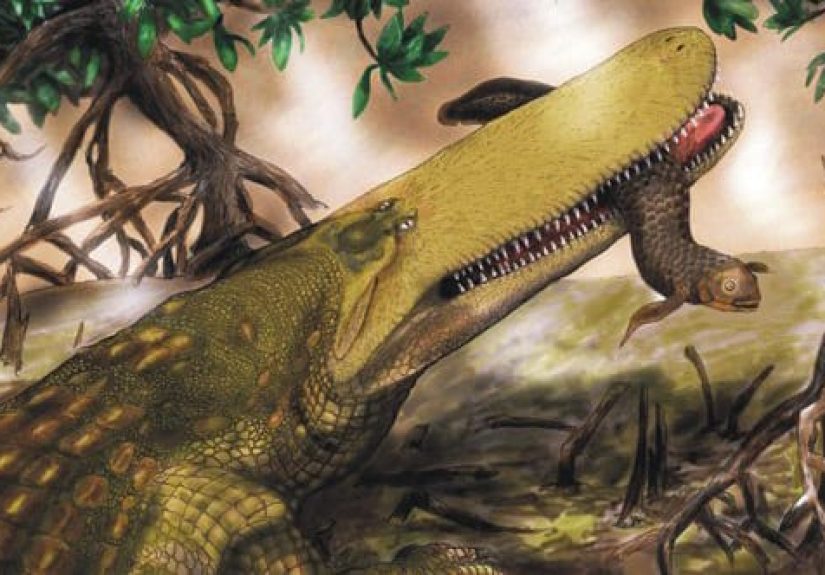
7. Deinosuchus – The Crocodile That Snacked on Dinosaurs
While technically not a dinosaur, Deinosuchuswhose name means
“terrible crocodile”earned a starring role in the Late Cretaceous horror reel.
This giant crocodilian lived roughly 75–82 million years ago in what
is now North America. The largest adults could exceed 35 feet
(10+ meters) in length and weigh over five tons, making them
bigger than almost any crocodile or alligator alive today.
Bite marks on dinosaur bones strongly suggest Deinosuchus attacked large herbivores that
came too close to the water’s edge. Picture a hadrosaur lumbering down to drink, only
to be ambushed, rolled, and dragged under by a reptile the size of a bus. Deinosuchus
likely also ate turtles, fish, and anything else it could surprise. In many coastal
environments along the Western Interior Seaway, dinosaurs ruled the shore, but the
“terrible crocodile” ruled the waterline.
8. Terror Birds – Phorusrhacidae, the Apex Birds of South America
For millions of years during the Cenozoic era, parts of South America were essentially
governed by a family of big, flightless, carnivorous birds known as
Phorusrhacidaebetter known as terror birds. These predators
ranged from about 3 feet tall in smaller species to nearly
10 feet (around 3 meters) in the giants, with estimates suggesting the
largest forms weighed up to 200–350 kilograms.
Terror birds had long, powerful legs built for running, reinforced skulls, and massive,
hooked beaks perfect for hammering and slicing. Biomechanical studies of their neck and
head suggest they could deliver rapid, downward strikesbasically weaponized head-butts
followed by precision dismemberment. Fossils show they dominated open habitats in
South America as top predators before large mammalian carnivores arrived via the Great
American Biotic Interchange. If you’re imagining a giant angry secretary bird with fewer
boundaries and more murder, you’re not far off.
9. Smilodon – The Saber-Toothed Cat That Wasn’t a Tiger
One of the most famous prehistoric mammals, Smilodon, is often called
the “saber-toothed tiger,” but it wasn’t closely related to modern tigers at all. This
robust big cat lived in the Americas during the Pleistocene, roughy
2.5 million to about 10,000 years ago. Several species are known,
including Smilodon fatalis in North America and the even larger
Smilodon populator in South America.
Smilodon was stocky and powerfully built, with muscular forelimbs and a relatively
short tail. Its iconic upper canines could reach lengths of about
7 inches (around 17–20 cm) in the largest species, with delicate
serrations that suggest they were used for precise killing bites rather than bone-crushing.
Studies of its skeleton indicate that Smilodon was likely an ambush predator, relying on
stealth and strength to wrestle large preysuch as bison, camels, or young mammothsto
the ground before delivering fatal bites to soft tissues. Basically, it was a big cat
designed to end fights quickly and messily.
10. Megatherium – The Giant Ground Sloth That Could Ruin Your Day
Sloths today are slow, tree-hugging ambassadors of chill. Their giant relatives?
Not so much. Megatherium, a South American ground sloth from the
Pleistocene, could reach around 5–6 meters (16–20+ feet) in length
and weigh several tonsrivaling modern elephants in mass.
Megatherium typically walked on all fours, but skeletal studies show it could rear up
on its hind legs, using its massive tail as a tripod support while it stretched upwards
to feed on high vegetation. Its forelimbs ended in large, curved claws that were likely
used to pull branches closer and possibly for defense. While it was primarily herbivorous,
you still wouldn’t want to annoy a multi-ton sloth with bear-like claws. Even large
predators, including saber-toothed cats, had to think twice before picking a fight with
this walking tank of fur and muscle.
What These Non-Dinosaur Monsters Tell Us About Prehistoric Life
Taken together, these 10 creatures show that “scary” is a recurring theme in Earth’s
evolutionary history. Terrifying size evolved in multiple lineages and environments:
sharks, snakes, crocodilians, marine reptiles, arthropods, birds, and mammals all took
turns at being the top terror of their time. Many of them got huge thanks to abundant
prey, warm climates, and ecological niches with little competition.
They also remind us that the end of one ruling group (like the non-avian dinosaurs)
often opens the door for new nightmares. After the dinosaurs’ extinction, Titanoboa,
terror birds, and giant mammals stepped into vacant predator roles. In oceans, shifts
in climate and ecosystems eventually spelled doom for megalodons and mosasaurs, making
room for the marine life we recognize today. The world kept turning, just with different
monsters on the menu.
Imagined Encounters: “Living” With 10 Non-Dinosaur Terrors
To really appreciate how unsettling these animals were, it helps to imagine what life
would feel like if you were actually sharing their world. Forget tidy museum displays;
picture yourself as an ordinary human dropped into their habitats with nothing but a
decent pair of shoes and a very healthy fear response.
On a Late Miocene beach, you might see nothing more alarming than calm blue water and a
few whales breaching in the distance. Then, far offshore, the surface suddenly heaves
a dark mass rolling just beneath the waves. That’s Megalodon cruising by. You wouldn’t
see the whole animal; you’d just catch a huge dorsal shadow and realize that if it
decided to close the distance, your entire coastline might as well be a snack bar.
Travel back further to a Paleocene swamp and you’d quickly learn new rules about where
to stand. At first, Titanoboa might be invisible, partially submerged among fallen logs
and murky water. The forest would be thick, hot, and loud with insect calls. Maybe you’d
notice a subtle ripple or the slow shift of what you thought was a floating tree trunk.
Then, as a giant fish glides past, the “log” coils, the water explodes, and a snake longer
than a bus wraps around its prey. You would instinctively step backward and trip over a
root, suddenly very aware that this predator doesn’t have to chase youjust wait where
you eventually have to drink.
In a Carboniferous forest with Arthropleura and early giant bugs, the fear is subtler but
constant. Imagine walking a spongy, fern-covered forest floor, hearing the crackle of
dried plant matter as something big moves just out of sight. When the enormous millipede
finally emergesa segmented, many-legged carpet as long as a compact caryour rational
brain might say, “It’s probably just an herbivore.” Your emotional brain would be too busy
planning a new life in some other geologic period.
Meanwhile, in Cretaceous coastal wetlands, Deinosuchus would teach you to respect the
shore. You might watch duck-billed dinosaurs milling near the water and think they’re the
stars of the show. But the real danger lurks where the murk meets the mud. Every quiet
surface could hide a crocodilian big enough to swallow you whole without changing its
afternoon plans. You’d learn to avoid overhanging banks, still pools, and basically
anything that looks like “prime ambush real estate.”
Fast-forward to Cenozoic South America, and terror birds change the rules again. Now the
danger is not hiding in the water; it’s sprinting toward you across open plains on two
powerful legs. A 9-foot Phorusrhacid with a hatchet-shaped beak could probably outrun
you, outstare you, andif you were prey-sizedtake you apart with a few well-placed
strikes. If you’ve ever been chased by an angry goose, congratulations: you’ve already
experienced the budget version of this nightmare.
Time-jump to an Ice Age steppe and things feel more familiaruntil they don’t.
Smilodon might remind you of a lion at first glance, but its build is bulkier, its fangs
longer, and its strategy more dramatic. You could imagine watching from a rocky outcrop
as a group of these saber-toothed cats circles a bison herd, focusing on the old or
injured. The takedown would be explosive: powerful forelimbs dragging prey down, jaws
opening impossibly wide to drive those long canines into vulnerable spots. You’d keep
your distance and silently thank modern evolution for inventing fences.
And then there’s Megatherium, the giant ground sloth, lumbering across the landscape like
a slow-motion bulldozer. From afar, it might look almost peaceful, browsing on high
branches. But the moment it rears up to its full height, balancing on massive hind legs
and tail, you’d understand why predators gave it space. Those claws aren’t for hugs.
One swipe from a multi-ton herbivore with attitude could turn even a saber-toothed cat
into a cautionary tale.
Thinking through these imaginary encounters makes one thing crystal clear: dinosaurs were
only one chapter in Earth’s horror anthology. Before them, alongside them, and long after
they vanished, other creatures carried the torch of terror. From oceans to forests to
windswept plains, the planet has rarely been a calm place to be small, squishy, and
edible. Compared to that lineup, modern humans have it pretty goodWi-Fi, groceries, and
the comforting knowledge that the worst thing lurking at the beach is usually just sunburn.
Conclusion
The phrase “age of dinosaurs” is catchy, but it barely scratches the surface. Megalodon,
Titanoboa, Mosasaurus, Dunkleosteus, Jaekelopterus, Arthropleura, Deinosuchus, terror
birds, Smilodon, and Megatherium prove that Earth has been running a rotating cast of
apex nightmares for hundreds of millions of years. Each of them evolved to dominate
specific ecosystems, taking advantage of climate, geography, and opportunity.
For modern readers, these non-dinosaur terrors are a reminder of three big truths:
evolution is endlessly experimental, extinction is inevitable, and survival often
depends less on being the scariest thing around and more on being adaptable when the
world changes. Dinosaurs may get the spotlight, but as this list shows, they definitely
didn’t have a monopoly on terror.