Table of Contents >> Show >> Hide
- What Makes a Tiny Paris Kitchen Different?
- 10 Tiny Paris Kitchens, 10 Smart Ideas
- 1. The Pink-and-Charcoal Corner Kitchen
- 2. The Galley Kitchen Behind Sliding Doors
- 3. The Two-in-One Pass-Through Kitchen
- 4. The Rustic-Blue Beam Kitchen
- 5. The Sloped-Ceiling Atelier Kitchen
- 6. The Terracotta-and-Checkered Backsplash Kitchen
- 7. The Mini Kitchen with a Wall-Mounted Table
- 8. The Graphic Open-Shelf Kitchen
- 9. The Almost-Invisible Kitchen Wall
- 10. The Color-Blocked Studio Kitchen
- Key Principles of Marianne Evennou’s Tiny Kitchen Style
- How to Bring Tiny Paris Kitchen Style Home
- Real-Life Lessons: of Tiny Paris Kitchen Wisdom
If you think your kitchen is small, wait until you see what Paris is working with. We’re talking spaces that could be mistaken for walk-in closets, hallways, or very ambitious pantries. Yet somehow, interior designer Marianne Evennou turns these compact corners into charming, hardworking kitchens that feel like the heart of the home rather than an afterthought.
Evennou is known for her poetic, ultra-functional designs in petite Paris apartments. Her projects often measure just a few square meters, but they’re packed with character: graphic tile, clever storage, joyful color, and an almost magical sense of order. Inspired by features showcased in outlets like Remodelista, House & Garden, Homes & Gardens, and other design publications, this guide breaks down what makes her 10 tiny Paris kitchens so specialand how you can steal the look at home, no French address required.
What Makes a Tiny Paris Kitchen Different?
Paris kitchens aren’t big, but they are bold. In historical Haussmann apartments and compact rentals alike, the kitchen is often squeezed into leftover pockets of space: under sloped ceilings, at the end of long corridors, or in what used to be maid’s rooms. Instead of fighting that, Evennou leans in and designs around the quirks.
- Every centimeter counts: Layout is obsessively planned so nothing is wastedeven corners and awkward niches get a job.
- Color is a major tool: Soft pinks, misty blues, charcoal, and clay tones define zones and hide awkward architecture.
- Interior windows and glass partitions: These bring in borrowed light from living rooms or courtyards while keeping cooking smells contained.
- Furniture-style details: Freestanding tables, café-style chairs, and open shelves keep kitchens from feeling like sterile fitted boxes.
The result: spaces that are modest in size but huge on personality.
10 Tiny Paris Kitchens, 10 Smart Ideas
1. The Pink-and-Charcoal Corner Kitchen
One of Evennou’s most iconic compact kitchens combines blush-pink walls with charcoal cabinets and a marble countertop. A tiny round table and two lightweight chairs tuck into the corner, proving that even a kitchenette can fit a place to sit down and savor a café au lait.
Steal this idea: Use contrast. Dark base cabinets ground the space while pale walls bounce light around. Add a petite café table instead of a bulky islandyour floor will feel bigger instantly.
2. The Galley Kitchen Behind Sliding Doors
In another project, the “kitchen” is basically a slim galley behind paneled sliding doors. Open, and you get a fully functional cook space with shelves, a cooktop, and sink. Close, and it melts into the living room wall like a chic built-in wardrobe.
Steal this idea: If your kitchen is part of a studio, consider pocket doors, sliding panels, or curtains in a beautiful fabric. You can hide the mess in seconds without sacrificing functionality.
3. The Two-in-One Pass-Through Kitchen
Evennou often plays with interior windows. In one tiny apartment, the kitchen is split by a partial wall with open shelving on both sides. A counter cutout doubles as a breakfast bar toward the living space and a prep zone toward the kitchen.
Steal this idea: Turn half-walls into multipurpose surfaces. A pass-through opening or interior window can share light between rooms while creating space for stools, serving, or display.
4. The Rustic-Blue Beam Kitchen
A quiet Paris cul-de-sac apartment features blue tongue-and-groove cabinetry paired with exposed wooden beams and a vintage-style fridge. Open shelves hold pottery, glass bottles, and everyday dishes, making the kitchen feel cozy rather than cramped.
Steal this idea: Choose one strong cabinet color and repeat it consistently. Then, add warmth with natural textureswood stools, woven pendants, or basketsthat keep the space from feeling cold.
5. The Sloped-Ceiling Atelier Kitchen
One of the trickiest kitchens sits under a dramatically sloped roof, almost like a painter’s studio. Evennou keeps upper cabinetry low and minimal, focusing storage below the counter and on a few strategic shelves. A long, slim table doubles as prep space and dining.
Steal this idea: In rooms with odd ceilings, keep tall units to the lowest side of the ceiling and use the rest for open shelves or art. You don’t have to cover each wall with cabinets to get good storage.
6. The Terracotta-and-Checkered Backsplash Kitchen
Some of her smaller spaces use warm terracotta or cinnamon walls paired with patterned backsplash tile and skirted lower cabinets. It’s part country house, part city apartmentand it works because everything is kept to a tight, harmonious palette.
Steal this idea: Choose one statement detail (like a checkered backsplash or patterned floor) and let everything else stay simple. When the colors play nicely together, pattern doesn’t feel overwhelming, even in a tiny space.
7. The Mini Kitchen with a Wall-Mounted Table
Paris designers love a wall-mounted table. Evennou uses narrow ledges and fold-down surfaces as breakfast bars or laptop spots, especially in corridor kitchens where a traditional table would block circulation.
Steal this idea: Install a narrow wall-mounted shelf or fold-down table. Pair it with a couple of stools and a sconce overhead. You’ve just created a micro dining nook that barely touches your floor plan.
8. The Graphic Open-Shelf Kitchen
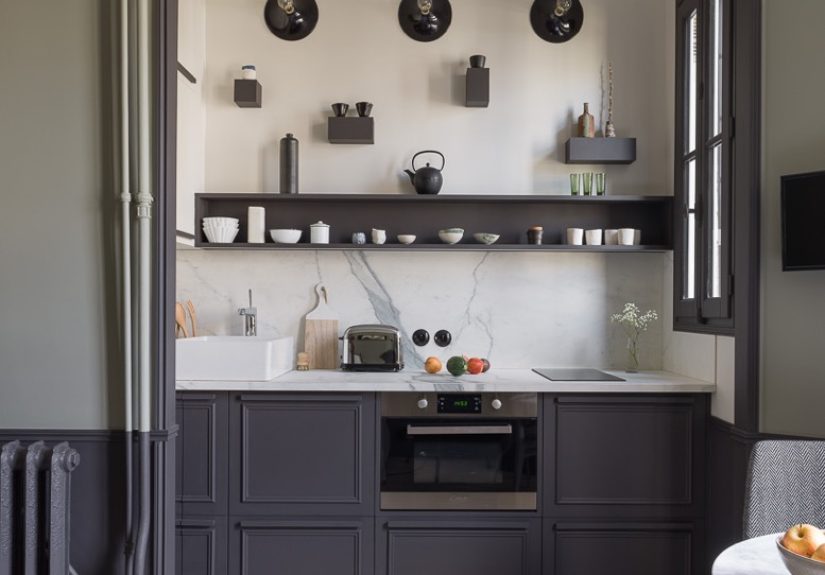
In some projects, floor-to-ceiling shelving frames a compact counter run. White dishes, glass jars, and a few colorful ceramics turn storage into display. Instead of hiding everything behind doors, Evennou styles it like a shopfront.
Steal this idea: If you don’t have room for a pantry, go vertical. Use deep shelves for everyday items and shallower shelves for pretty things. Keep the palette cohesivethink white dishes, clear jars, and one or two accent colorsso it feels curated, not cluttered.
9. The Almost-Invisible Kitchen Wall
One tiny kitchen appears to vanish into the wall thanks to flush-front cabinets painted the same color as the surrounding paneling. Hardware is simple and discreet; the only “decor” comes from a single pendant and a small framed print.
Steal this idea: Paint your cabinets and walls the same color, including trim and even the range hood. This monochrome approach visually enlarges the room and shifts attention to artwork, lights, and what’s happening at the table.
10. The Color-Blocked Studio Kitchen
In an 11–square-meter studio, the kitchen is treated like a color-blocked installation: one wall of deep blue cabinets, one band of pale tile, one small strip of wood counter. A vivid rug and a playful light fixture make the space feel like part of the living area, not a separate “work zone.”
Steal this idea: Use color blocking to define your kitchen in an open-plan room. Paint a single wall, use a distinctive rug underfoot, or choose a boldly colored cabinet run that says, “This is the kitchen,” even if it’s only six feet long.
Key Principles of Marianne Evennou’s Tiny Kitchen Style
1. Design from the Plan, Not the Products
Evennou starts with flow: Where do you move? Where does light enter? How wide is the passage? Only after the layout feels right does she choose finishes, appliances, and hardware. This is the opposite of buying cabinets first and forcing them to fit.
2. Mix Modest and Luxurious Materials
You’ll often see simple cabinets paired with marble counters, terrazzo floors, or handmade tile. This high-low mix appears in many small-kitchen projects by other designers too, proving that you don’t need a 20-foot island to justify a beautiful stone slab.
3. Prioritize Storagebut Make It Beautiful
Open shelves, plate racks, peg rails, and baskets are all part of the storage plan. Nothing is purely decorative; everything has a job. But the way items are displayedthe color of dishes, the shape of jars, the texture of linensmakes the storage itself part of the visual story.
4. Embrace Color with Intention
Instead of defaulting to all-white, many Paris kitchens combine soft neutrals with blues, greens, terracottas, or graphite grays. Carefully chosen hues make the room feel personal and cozy, not generic. Walls, cabinets, and ceilings are often painted the same shade to erase visual breaks and make the space feel bigger.
5. Treat the Kitchen as a Room, Not a Utility Zone
Artwork, rugs, vintage chairs, sculptural lightingthese are all fair game in Evennou’s tiny kitchens. The message is clear: your kitchen should reflect your personality, no matter how small it is. Practicality matters, but atmosphere matters too.
How to Bring Tiny Paris Kitchen Style Home
1. Start with a Smart Layout
Even in a rental kitchen, you can rearrange zones a bit. Group sink, dishwasher, and trash together; keep the cooktop and oven nearby; and carve out at least a small uninterrupted counter run for prep. If possible, avoid placing the fridge in the middle of the roomtuck it at one end or integrate it behind cabinet panels.
2. Light It Like a Living Room
Layered lighting is essential. Combine under-cabinet lighting for tasks, a pendant or two for mood, and a sconce over any dining ledge or table. Use warm bulbs so your tiny kitchen feels like a café, not a convenience store.
3. Curate, Don’t Hoard
Tiny kitchens force you to be brutally honest about what you actually use. Keep one good set of pots, a sharp knife or two, and dishes you truly enjoy seeing every day. Donate the rest. When open shelves hold only what you love, the whole room feels calmer.
4. Use Color and Texture to Fake Volume
Soft neutrals with warm undertones make small rooms feel airy, while a darker cabinet color below the counter can “ground” the space. Add texture with woven baskets, linen curtains, matte tile, or wood accessoriesthese keep an all-neutral palette from feeling flat.
5. Make Space for Sitting Down
One of the most Parisian details is the presence of a table, no matter how small. Even a narrow bistro table, wall-mounted slab, or overhanging counter can signal that this is a place to linger, not just a pit stop between the fridge and the door.
Real-Life Lessons: of Tiny Paris Kitchen Wisdom
So what do these 10 tiny Paris kitchens actually teach us when you zoom out from the pretty photos and think about everyday life? A lot. Here are some grounded, real-world lessons inspired by Marianne Evennou’s approachand from countless small-kitchen stories shared in design publications and homeowner experiences.
1. Your First Move Is Editing, Not Shopping
Before you paint a wall or order new cabinets, take a hard look at what’s living in your kitchen. Most people could free up 30–40% of their cabinet space just by letting go of duplicates and “someday” gadgets. Paris designers don’t fit more stuff into small spaces; they get ruthless about what earns the right to stay.
Try this: empty one cabinet at a time. Anything you haven’t used in a year goes into a donation box. Once you’ve edited, you’ll see where your true storage needs aremaybe you need more vertical space for dry goods, or better drawer organization instead of another shelf.
2. Small Kitchens Work Best When They Have a Rhythm
Evennou’s kitchens feel calm because they have a visual rhythm: repeating colors, repeating materials, repeating shapes. That might be a trio of woven pendants, a band of tile running across the backsplash, or a line of hooks holding wooden spoons and aprons.
In your kitchen, pick two or three details and repeat them. For example, black cabinet knobs, a black-framed print, and a black pendant light instantly connect different parts of the room. Or repeat a soft green on the cabinets, the dish towels, and a stripe in your rug. When the eye flows smoothly, the room feels larger.
3. Tiny Upgrades Can Have Big Daily Impact
Not every change has to be a renovation. Many of the most charming Paris kitchens rely on simple moves:
- Swapping a bulky table for a slim wall-mounted ledge.
- Replacing mismatched containers with clear jars and simple labels.
- Hanging a small piece of art above the sink so washing dishes feels less like a chore.
- Adding a runner rug to visually stretch the floor in a narrow galley.
Each tweak is easy and relatively affordable, but together they turn a cramped space into one you actually enjoy being in.
4. Embrace Imperfection
One of the most liberating aspects of Paris kitchen style is that nothing looks overly staged. Tiles might not align with mathematical precision; a curtain may hide the under-sink area instead of a custom cabinet door; a table might be slightly too big, but beloved.
Instead of chasing a showroom-perfect kitchen, aim for a space that feels lived-in and loved. Mix old and new chairs. Use hooks for mugs when you run out of cabinet space. Let a bit of patina show on your wood cutting board or copper pot.
5. Think of Your Kitchen as an Everyday Café
In Evennou’s designs, even the smallest kitchens feel like places to pause and enjoy the moment. That mindset is something you can adopt for free. Light a candle at breakfast. Put flowers or a bowl of lemons on the table. Play music while you cook. When you treat your kitchen as a destination instead of a hallway, you’ll naturally make better design choices for it.
Ultimately, these 10 tiny Paris kitchens aren’t about perfection or sizethey’re about intention. Thoughtful planning, edited belongings, considered color, and a dash of charm can turn even the smallest cook space into something deeply satisfying. Your kitchen may never overlook a Paris courtyard, but with a few smart moves, it can feel every bit as special as Marianne Evennou’s pocket-size masterpieces.