Table of Contents >> Show >> Hide
- 1. Cats Are Basically Sweet-Blind
- 2. Your Cat Probably Meows at Humans More Than at Other Cats
- 3. Purring Is Not Just the Sound of Happiness
- 4. Whiskers Are Not Just Fancy Face Decorations
- 5. That Weird Open-Mouth “Stink Face” Is Actually a Smell Superpower
- 6. Cats Do Not Always Land on Their Feet
- 7. A Cat’s Nose Print May Be As Unique As a Fingerprint
- 8. Cats Have a Nearly Floating Collarbone Situation
- 9. Cat Tongues Are Covered in Tiny Spines
- 10. The Slow Blink Is Real, and It Is Kind of a Big Deal
- Why These Weird Cat Facts Matter
- Real-Life Cat Experiences That Make These Facts Feel Even Weirder
- Conclusion
- SEO Tags
Note: Source links are intentionally omitted for clean web publishing.
Cats have mastered a very specific kind of chaos. They can nap like tiny furry philosophers for half the day, sprint through your hallway at 2 a.m. like they just remembered an unpaid bill, and stare at a blank wall as if they can see into another dimension. Naturally, this raises an important question: are cats adorable little weirdos by accident, or are they biologically engineered to keep humans confused forever?
The answer is, delightfully, a bit of both. Modern cat science has revealed that many of the strange things cats do are not random at all. They are built into feline anatomy, behavior, and communication. Behind every dramatic slow blink, mysterious open-mouth face, and judgmental meow is a surprisingly clever system at work. In other words, your cat is not being odd just to be odd. Your cat is being professionally feline.
Below are 10 weird facts about cats that are funny, fascinating, and backed by real science. If you have ever wondered why your cat sniffs a cupcake and walks away, why they chirp at birds like a malfunctioning laser printer, or why they purr when they are stressed, you are in the right place.
1. Cats Are Basically Sweet-Blind
Most humans see dessert and think, “Excellent. I will now make questionable life choices.” Cats? Not so much. One of the weirdest facts about cats is that they do not seem to detect sweetness the way we do.
That is because domestic cats lack a functioning sweet taste receptor. In plain English, their taste system is missing a key piece that most mammals use to detect sweet flavors. This helps explain why many cats are unimpressed by cookies, cake, or fruit. While they may sniff sugary foods out of curiosity, they are far more interested in meat-based aromas and protein-rich meals.
It makes perfect evolutionary sense. Cats are obligate carnivores, which means their bodies are designed to get nutrients from animal tissue, not from a trip through the bakery aisle. So when your cat ignores your ice cream but becomes spiritually awakened by a piece of roasted chicken, that is not rudeness. That is biology.
2. Your Cat Probably Meows at Humans More Than at Other Cats
Here is a weird little ego boost: your cat’s meow may be more for you than for fellow cats.
Adult cats do communicate with one another, but much of that communication is nonverbal. They rely heavily on scent, posture, facial expression, tail movement, and territory marking. Meowing, especially the dramatic housecat version of it, is often directed at humans. Over thousands of years of living with people, cats seem to have learned that we are remarkably easy to train with sound.
And let’s be honest, they are right. One tiny “mrrp?” and half the planet responds with, “Oh no, are you hungry? Bored? Sad? Writing a memoir?” Cats have become extremely good at using vocalizations to get food, attention, access to doors, or an audience for their emotional monologue.
So yes, your cat may be talking to you on purpose. Not because you are special, exactly. More because you are useful.
3. Purring Is Not Just the Sound of Happiness
Many people assume purring means one thing: bliss. Cat on lap, motor running, human heart melted. Fair enough. But purring is much stranger than that.
Cats may purr when they are relaxed and content, but they can also purr when they are frightened, injured, giving birth, or in pain. That makes purring less like a simple “I’m happy” signal and more like a multifunctional sound with several possible meanings.
Even weirder, experts have noted that some purrs seem designed to get human attention. The so-called “solicitation purr” blends the soothing quality of a normal purr with a more urgent sound, making it especially hard for humans to ignore. In other words, some cats may be using purring as a manipulative masterpiece. Respectfully, that is iconic behavior.
There is also ongoing discussion about whether low-frequency purr vibrations may play a role in comfort or recovery, though that idea should be treated carefully and not as magic healing proof. Still, the fact remains: purring is more complex, and much weirder, than a simple sign of contentment.
4. Whiskers Are Not Just Fancy Face Decorations
Whiskers may look like stylish accessories, but they are serious equipment. These specialized hairs, called vibrissae, are packed with sensory power.
Unlike ordinary fur, whiskers connect to follicles rich in nerves and blood vessels. That means they are extremely sensitive to touch, vibration, and subtle air movement. Cats use them to help navigate tight spaces, detect nearby objects, and move confidently in low light.
This is why whiskers should never be trimmed. To a cat, that would be like someone quietly removing part of your spatial awareness and then expecting you to walk through a cluttered room without stepping on a Lego. Cruel. Unnecessary. Unforgivable.
Whiskers can also hint at mood. Forward whiskers can signal curiosity, hunting focus, or excitement. Pulled-back whiskers may suggest fear, stress, or irritation. So yes, the face fluff is cute. It is also a highly advanced mood board.
5. That Weird Open-Mouth “Stink Face” Is Actually a Smell Superpower
Have you ever seen a cat sniff something, pause, open its mouth slightly, curl its lip, and look like it just heard offensive gossip? Congratulations. You have witnessed feline chemical analysis in progress.
Cats have an extra scent-detecting structure called the Jacobson’s organ, also known as the vomeronasal organ. It sits above the mouth and helps process certain chemical signals, including pheromones. When a cat makes that odd grimacing face, called the Flehmen response, it is drawing scent molecules toward this organ for closer inspection.
Basically, your cat is not being dramatic. Your cat is running a lab test with its face.
This helps cats gather social and environmental information that humans cannot easily detect. Who has been here? Is another animal nearby? Is this smell important? Is it gross? Is it romantically relevant? Cats are constantly collecting data, and sometimes the result is a hilarious expression worthy of a meme.
6. Cats Do Not Always Land on Their Feet
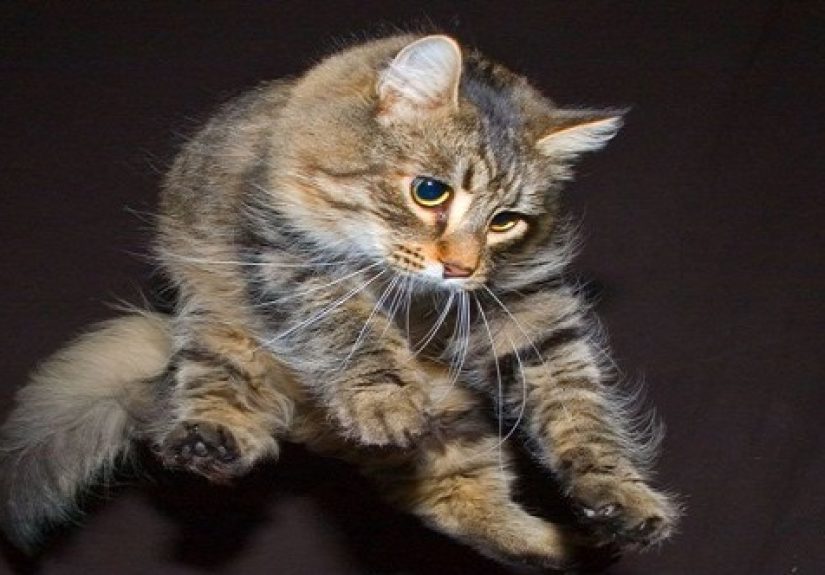
This classic saying needs a correction. Cats do have a righting reflex, which allows them to twist their bodies during a fall and often land feet-first. Kittens typically develop this ability very young. But the phrase “cats always land on their feet” is more myth than guarantee.
Landing safely depends on several factors, including the height of the fall, the cat’s body condition, speed of rotation, and overall health. In some cases, a fall from a short distance may not give a cat enough time to reposition properly. In others, obesity, age, or illness can reduce agility.
So yes, cats are astonishingly flexible and athletic. No, they are not fluffy superheroes with unlimited warranty coverage. Window screens, balconies, and high ledges are still real hazards. The righting reflex is impressive, but it is not a permission slip for gravity.
7. A Cat’s Nose Print May Be As Unique As a Fingerprint
Human fingerprints get all the publicity, but cat noses deserve a little attention too. The lines, ridges, and shape around a cat’s nose can be unique, much like the patterns seen in human fingerprints.
Now, to keep this honest and science-friendly: research on cat nose prints is more limited than on dogs. Still, veterinary sources commonly note that feline nose patterns are distinctive enough to be considered individual identifiers. So if your cat acts like a celebrity, there is apparently some biometric evidence to support the vibe.
It is one more reason cats feel like tiny mysteries in fur coats. Even their noses are custom designs.
8. Cats Have a Nearly Floating Collarbone Situation
One reason cats are so bizarrely good at squeezing through small spaces is their anatomy. A cat’s clavicle, or collarbone, is much reduced and does not connect to other bones the way a human collarbone does.
This contributes to their flexibility and agility. It also helps explain why a cat can stare at a gap that looks absolutely impossible, then slide through it like liquid with whiskers. If the head fits and the body condition allows, the rest of the cat often follows with deeply unsettling efficiency.
This same physical design supports their quick pounces, twisting jumps, and acrobatic midair adjustments. Cats are not just graceful by personality. They are built like tiny, silent gymnasts with excellent balance and strong opinions.
9. Cat Tongues Are Covered in Tiny Spines
If you have ever been licked by a cat and thought, “That feels like affectionate sandpaper,” you were not imagining things.
Cat tongues are covered with tiny backward-facing spines called papillae. These structures help pull saliva deep into the fur during grooming, which makes self-cleaning more efficient. That saliva can also help with cooling as it evaporates.
In short, your cat carries a built-in hairbrush on its face. A weird, spiky, highly engineered hairbrush.
This tongue design also helps with feeding and fur maintenance, which explains why cats spend so much time grooming. They are not merely being vain, though let us not rule that out. They are maintaining coat condition, redistributing oils, removing loose hair, and staying comfortable. They are basically running a full-service spa with zero customer service hours.
10. The Slow Blink Is Real, and It Is Kind of a Big Deal
If a cat slowly narrows its eyes at you and then blinks like it is in a romantic indie film, that is often a positive sign. Researchers have found evidence that slow blinking may function as a form of friendly emotional communication between cats and humans.
Even better, cats may respond to a human slow blink by relaxing and approaching more readily. So yes, the “cat smile” idea is not just internet fluff. It has actual behavioral support behind it.
This is wonderfully weird because it means one of the best ways to bond with a cat is not loud baby talk or chaotic enthusiasm. It is calm eye narrowing. Cats, once again, are telling us they prefer subtlety, respect, and low-drama energy. Honestly? Fair.
Why These Weird Cat Facts Matter
Weird facts about cats are fun, but they also make cat care better. When you understand that whiskers are sensory tools, purring is not always a sign of happiness, and a twitching tail may mean “please stop immediately,” you become much better at reading your cat’s world.
Cats are often labeled mysterious because they communicate more quietly than dogs. But once you know what to look for, they are not impossible to understand. They are just subtle. And a little theatrical. And deeply committed to making humans earn every scrap of affection.
That is part of their charm. Cats are soft, strange, clever creatures with biology that feels half science and half magic trick. The more you learn, the weirder they get. And somehow, the more lovable they become.
Real-Life Cat Experiences That Make These Facts Feel Even Weirder
Spend enough time around cats, and these facts stop being trivia and start becoming daily evidence. For example, one of the fastest ways to discover that cats are not interested in sweets is to set down a plate of birthday cake near a housecat and watch the absolute indifference. A dog might consider that cake a spiritual calling. A cat will often sniff once, look mildly offended, and wander away in search of tuna, as if to say, “I do not know what this frosted nonsense is, but it is not dinner.”
Then there is the meow phenomenon, which feels very personal when you live with a cat. Many owners notice their cats use different meows for different situations. There is the polite meow, the impatient meow, the dramatic hallway meow, and the “I can see one molecule of the bowl bottom” meow. The weird part is how often these sounds are aimed only at people. Put that same cat in a room with another cat, and suddenly the communication style changes. Much more staring. Much more body language. Much less customer service language.
The slow blink also becomes extremely convincing in real life. Plenty of cat people have had the experience of making eye contact with a nervous or newly adopted cat, blinking slowly, and seeing the cat soften just a little. It is not an instant Disney friendship montage every time, but it can feel like watching a tiny door unlock. The cat is not exactly throwing a parade in your honor. It is more like granting you a limited emotional permit. In cat terms, that is huge.
Whiskers become impossible to ignore once you know what they do. Watch a cat approach a cardboard box, a chair leg, or the narrow space between a sofa and a wall. The whiskers move first, like tiny antennae taking measurements. Then the cat decides whether to proceed. Sometimes the decision is sensible. Other times the cat goes for it anyway, because confidence has always been one of the species’ most overdeveloped muscles.
And of course, there is the famous Flehmen face. Every cat owner who has seen it remembers the first time. The cat sniffs a shoe, blanket, or mysterious patch of floor, opens its mouth a little, freezes, and looks like it just tasted a shocking rumor. If you do not know what the Jacobson’s organ is, this expression can be deeply confusing. Once you do know, it somehow becomes even funnier. Your cat is not broken. Your cat is sampling the air like a tiny detective in a fur trench coat.
Purring, too, becomes more layered with experience. People often imagine it as a cozy lap soundtrack, but many owners have heard purring in stressful moments too: at the vet, after a scare, during recovery, or when a cat is trying very hard to self-soothe. That does not make purring less lovely. It makes it more emotionally complex. It is one of those reminders that cats are not aloof robots in velvet pajamas. They are sensitive animals with rich inner states, even if they express them with the face of a retired mob boss.
One especially memorable cat experience is being licked for the first time by a trusting cat and realizing that affection can, in fact, feel like being exfoliated by a very small cheese grater. It is sweet. It is alarming. It is deeply on-brand. The same goes for watching a cat slide through a tiny opening that seems physically impossible, proving that the reduced-clavicle situation is not just textbook anatomy. It is a lifestyle.
All of these experiences add up to the same conclusion: cats are weird in ways that are real, functional, and endlessly entertaining. They are not just internet icons or aloof pets. They are biologically fascinating little roommates who can communicate with a blink, groom with built-in spikes, and ignore cheesecake with absolute conviction. Honestly, that is a pretty impressive résumé.
Conclusion
Cats have earned their reputation as strange little legends. They cannot properly taste sweet foods, they often meow mainly for humans, they process scent with a weird open-mouth face, and they communicate affection with something as subtle as a slow blink. Add in their sensory whiskers, spiky tongues, unusual skeleton design, and famously misunderstood purrs, and it becomes clear that cats are walking collections of fascinating contradictions.
They are elegant but chaotic, independent but manipulative, mysterious but surprisingly expressive once you learn their signals. That balance is exactly why people remain obsessed with them. The next time your cat stares at you, chirps at a bird, or squeezes through a gap that should require legal documentation, you will know there is real science behind the weirdness.