Table of Contents >> Show >> Hide
- What Is the Poseidon Apocalypse Torpedo?
- Why Russia Is Building Special Submarines for Poseidon
- What Russia Says Poseidon Can Do
- The Strategic Logic: Second-Strike Deterrence Underwater
- Does Poseidon Actually Change the Nuclear Balance?
- Why Khabarovsk Matters More Than the Hype
- Poseidon and the Problem of Arms Control
- Military Risks Beyond the Warhead
- Could the U.S. and NATO Counter Poseidon?
- The Propaganda Value of a Doomsday Weapon
- What This Means for Coastal Cities
- Experiences and Lessons From Following the Poseidon Story
- Conclusion: Poseidon Is a Weapon, a Signal, and a Warning
Russia’s newest undersea weapons program sounds like something a Hollywood villain would pitch while standing beside a glowing aquarium: nuclear-powered submarines built to carry nuclear-powered, nuclear-capable underwater drones nicknamed “apocalypse torpedoes.” Unfortunately, this is not a movie trailer. It is a real strategic weapons project centered on Poseidon, also known by its earlier name Status-6 and by NATO as Kanyon.
The headline-grabbing part is obvious: Poseidon is described as a massive autonomous underwater vehicle designed to travel across oceans and threaten coastal targets. The equally important part is less cinematic but more strategic: Russia is building special-purpose submarines such as Belgorod and Khabarovsk to carry and launch it. In nuclear strategy, the delivery platform often matters as much as the weapon itself. A torpedo without a carrier is a museum exhibit. A torpedo paired with a stealthy nuclear submarine becomes a political message with propellers.
This article explains what Russia is building, why Poseidon matters, what is known from public sources, what remains uncertain, and why the weapon’s biggest effect may be psychological as much as military.
What Is the Poseidon Apocalypse Torpedo?
Poseidon is widely described as a nuclear-powered, nuclear-capable unmanned underwater vehicle. It is often called a torpedo, but that word undersells its unusual scale. Traditional torpedoes are weapons launched from ships, submarines, or aircraft and used against naval targets. Poseidon is closer to a strategic underwater drone: large, long-range, powered by a compact nuclear reactor, and designed to travel far beyond normal torpedo ranges.
Public estimates vary, but many reports describe Poseidon as roughly 20 meters long, with a diameter close to two meters. It has been portrayed as capable of traveling thousands of miles, operating at great depth, and carrying a powerful nuclear warhead. Russian leaders have claimed it is exceptionally fast and difficult to intercept. Western analysts generally treat those claims with caution, because military marketing is not famous for humility. Still, even conservative assessments agree that Poseidon is not just another naval gadget.
Why the “Apocalypse” Label Stuck
The nickname “apocalypse torpedo” comes from the weapon’s alleged mission: threatening coastal cities, naval bases, ports, and critical infrastructure with nuclear devastation and radioactive contamination. Russian media and officials have at times leaned into dramatic language about radioactive ocean swells or tsunamis. Experts debate how realistic the most extreme tsunami claims are, but the psychological effect is obvious. The phrase “radioactive tsunami” does not need a public relations department. It does its own advertising.
That fear factor is part of the weapon’s value. Nuclear weapons are not only about battlefield use; they are about signaling, deterrence, coercion, and creating uncertainty in an adversary’s planning. Poseidon fits neatly into that tradition, with an undersea twist.
Why Russia Is Building Special Submarines for Poseidon
Poseidon is too large and specialized to be treated like a normal torpedo. That is why Russia has developed or modified submarines specifically associated with the system. The two best-known platforms are Belgorod and Khabarovsk.
Belgorod: The First Known Poseidon Carrier
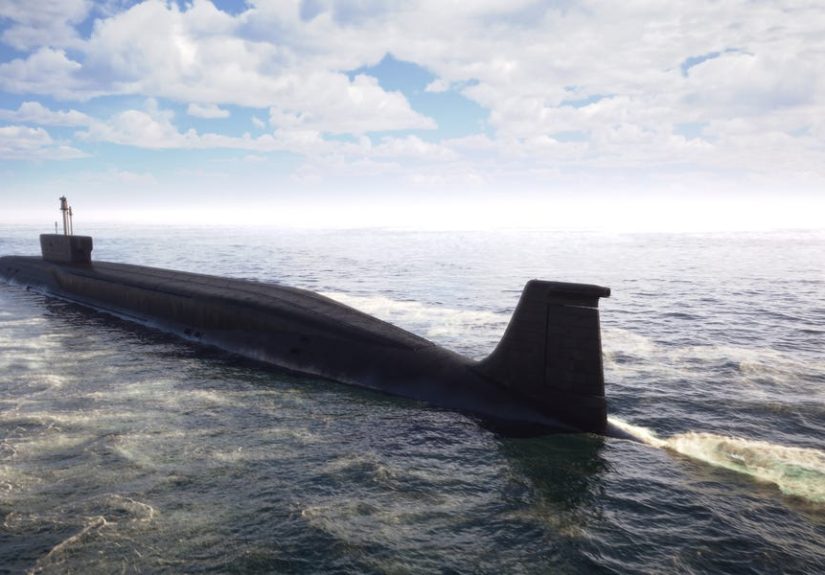
Belgorod, officially known as K-329, is a huge special-purpose nuclear submarine based on the Oscar-class design. It was launched in 2019 and has been widely identified as the first platform capable of carrying Poseidon underwater vehicles. Public analysis suggests it may be able to carry several Poseidon drones, though exact numbers remain uncertain.
Belgorod is not a standard attack submarine. It is a special-mission vessel, associated not only with Poseidon but also with deep-sea operations, seabed infrastructure activity, and undersea intelligence roles. In plain English, it is the kind of submarine that makes naval planners drink stronger coffee.
Khabarovsk: Built From the Start for the Poseidon Mission
Khabarovsk is even more important because it appears to have been designed from the beginning around the Poseidon mission. Russia launched the Project 09851 Khabarovsk submarine in November 2025 at the Sevmash shipyard in Severodvinsk. Unlike Belgorod, which was modified from an existing design lineage, Khabarovsk is commonly described as a dedicated Poseidon carrier.
That distinction matters. A modified submarine can prove a concept. A dedicated class suggests a longer-term force structure. If Russia builds multiple Khabarovsk-type submarines, Poseidon shifts from exotic prototype to an operational component of Russian nuclear strategy. That does not mean the system is simple, reliable, or immune to countermeasures. It does mean Moscow is spending serious money and shipyard time on it.
What Russia Says Poseidon Can Do
Russian President Vladimir Putin has repeatedly presented Poseidon as part of a group of advanced strategic weapons unveiled in 2018, alongside systems such as the Burevestnik nuclear-powered cruise missile, Avangard hypersonic glide vehicle, Sarmat heavy intercontinental ballistic missile, Kinzhal, and Zircon. The message is clear: Russia wants the United States and NATO to believe it can bypass missile defenses and guarantee retaliation under almost any circumstances.
In October 2025, Putin said Russia had successfully tested Poseidon, including launch from a carrier submarine and activation of its nuclear power unit. He described it as unmatched and difficult or impossible to intercept. As with all official claims from any military power, the smart approach is to separate what is confirmed, what is plausible, and what is theater.
Confirmed and Plausible Points
- Poseidon is a real program that has received significant Russian investment.
- Russia has built or launched submarines associated with carrying the weapon.
- The system is intended to strengthen Russia’s second-strike nuclear deterrent.
- Its nuclear propulsion concept is meant to provide very long range.
- Its size and mission make it unlike traditional torpedoes.
Uncertain or Disputed Claims
- The exact speed, range, depth, and warhead yield remain uncertain.
- Claims that Poseidon can create city-destroying tsunamis are debated by experts.
- Its real-world reliability, guidance, communication, and command-control arrangements are unclear.
- Whether it changes the nuclear balance is disputed, because Russia already has many ways to strike coastal targets with nuclear weapons.
The Strategic Logic: Second-Strike Deterrence Underwater
To understand Poseidon, forget the movie-monster nickname for a moment and think like a nuclear strategist. Nuclear deterrence depends on the ability to retaliate after being attacked. This is called second-strike capability. If one country believes it can destroy another country’s nuclear forces before they can respond, crisis stability becomes fragile. If both sides know retaliation is guaranteed, neither has an incentive to start Armageddon. Grim? Absolutely. But nuclear strategy has never been a cheerful picnic.
Russia presents Poseidon as a way to ensure retaliation even if missile defenses improve. Because Poseidon travels underwater rather than through the air or space, it is not affected by traditional ballistic missile defense systems. Its purpose is to complicate an adversary’s calculations. Instead of only tracking missiles, bombers, and ballistic missile submarines, planners would also have to consider autonomous nuclear systems moving through the ocean.
That is the strategic appeal. Poseidon widens the problem set. It says: even if you build better missile defenses, Russia can still threaten unacceptable damage from a different domain.
Does Poseidon Actually Change the Nuclear Balance?
Many analysts argue that Poseidon does not fundamentally change the nuclear balance between Russia and the United States. The reason is simple: Russia already has a large nuclear arsenal capable of striking U.S. cities, military bases, and infrastructure using intercontinental ballistic missiles, submarine-launched ballistic missiles, and long-range bombers. From that perspective, Poseidon is another terrifying delivery method, not a brand-new category of vulnerability.
However, “not changing the balance” does not mean “not important.” Poseidon may still matter because it creates new arms-control challenges, new detection problems, new escalation questions, and new political messaging opportunities. It is a weapon that seems designed to make adversaries ask uncomfortable questions. How many exist? Where are the carriers? Can they be tracked? Are they armed? Are they deployed? Are they under reliable human control? Every unanswered question adds friction to crisis management.
Why Khabarovsk Matters More Than the Hype
The Khabarovsk submarine is the serious part of the story. Weapons programs can generate wild claims for years without producing deployable systems. Submarines are harder to fake. They require steel, reactors, trained crews, docking facilities, command systems, maintenance, and money. When a country builds a dedicated submarine for a specialized weapon, it signals commitment.
Khabarovsk also suggests Russia wants Poseidon to be more than a one-off demonstration. If Belgorod is the experimental giant, Khabarovsk may be the first step toward a more repeatable Poseidon force. That would fit with earlier public reports that Russia planned multiple carriers and dozens of Poseidon systems, although those numbers remain unconfirmed and should be treated carefully.
Poseidon and the Problem of Arms Control
One of the biggest issues with Poseidon is that it does not fit neatly into older arms-control categories. Treaties such as New START were built around familiar strategic systems: intercontinental ballistic missiles, submarine-launched ballistic missiles, and heavy bombers. Poseidon is different. It is strategic in effect but underwater, unmanned, and nuclear-powered.
This creates a legal and diplomatic headache. If a weapon can travel intercontinental distances and carry a nuclear warhead, should it count under strategic arms limits? Many arms-control experts say yes. The problem is that counting, verifying, and limiting a system like Poseidon would require new rules. Inspecting a missile silo is one thing. Monitoring a secretive undersea drone program is another. Arms-control negotiators already have difficult jobs; Poseidon politely throws a wrench into their briefcases.
Military Risks Beyond the Warhead
The nuclear warhead is the most dramatic danger, but it is not the only concern. A nuclear-powered underwater drone raises questions about accidents, reactor safety, recovery, command reliability, and escalation. What happens if a test vehicle fails? What happens if communication is lost? What happens if an adversary detects a carrier submarine and misinterprets its mission during a crisis?
These questions matter because nuclear weapons are not only dangerous when intentionally used. They are also dangerous when systems behave unpredictably, when leaders misread signals, or when military exercises occur during political tension. Poseidon adds another complex machine to an already tense environment.
Could the U.S. and NATO Counter Poseidon?
Publicly, there is no simple “Poseidon shield.” Undersea warfare is difficult, slow, and expensive. Detecting submarines already requires networks of sensors, patrol aircraft, ships, submarines, satellites, and intelligence. Detecting a large autonomous underwater vehicle at great depth could be even more complicated, depending on how noisy it is, where it travels, and how it is deployed.
Still, no weapon is magic. High speed underwater can generate noise. Large systems require maintenance and logistics. Carrier submarines must leave port, transit patrol areas, communicate, and eventually return. NATO’s anti-submarine warfare forces would likely focus not only on the drone itself but also on the submarines and infrastructure that support it.
The practical contest may therefore be less about chasing Poseidon like a movie torpedo and more about monitoring Russian submarine bases, shipyards, test ranges, naval movements, and undersea routes. In real life, national security rarely resembles a clean action scene. It is more often a thousand analysts staring at satellite images and acoustic data while the coffee machine begs for mercy.
The Propaganda Value of a Doomsday Weapon
Poseidon is also a media weapon. Russia benefits when the world talks about a terrifying “doomsday torpedo.” The phrase reinforces Moscow’s image as a power that cannot be ignored. It also supports domestic messaging: Russia is surrounded, Russia is technologically advanced, Russia can answer Western pressure, and Russia remains a nuclear superpower.
That does not mean Poseidon is fake. A system can be real and still be used for propaganda. In fact, the most effective strategic messaging often combines real hardware with dramatic claims. The submarine is real. The test claims are politically useful. The most extreme tsunami language may be exaggerated. Together, they create the intended effect: uncertainty, concern, and attention.
What This Means for Coastal Cities
Headlines often focus on coastal cities because Poseidon is described as a weapon that could attack ports, naval bases, and coastal infrastructure. The United States, United Kingdom, and many NATO countries have major population centers and military facilities near the ocean. That geography makes the psychological threat easy to understand.
However, it is important not to treat every dramatic claim as a settled technical fact. A nuclear detonation near a coast would be catastrophic, but the exact effects would depend on yield, depth, distance from shore, seabed shape, weather, water movement, and many other variables. The “giant radioactive tsunami” image is powerful, but experts continue to debate how much of that scenario is physics and how much is theater.
The sober conclusion is still grim enough: Poseidon is designed to threaten coastal targets with nuclear devastation and long-term contamination. It does not need comic-book tsunami claims to be dangerous.
Experiences and Lessons From Following the Poseidon Story
For readers, journalists, analysts, and national security observers, the experience of tracking Russia’s Poseidon program is a lesson in how modern military stories unfold. It begins with a strange leak, grows through official speeches, gains momentum through animated videos, and then becomes real enough to appear in shipyard ceremonies and submarine launch reports. By the time the public sees a submarine like Khabarovsk, the story has already traveled through years of rumor, intelligence assessments, expert skepticism, and state-controlled messaging.
One useful experience is learning to treat superweapon claims with two hands: one hand holding caution, the other holding seriousness. Caution is necessary because governments exaggerate. Russia has strong reasons to make Poseidon sound unstoppable. The word “unstoppable” is a favorite in military speeches because “expensive, complicated, and possibly vulnerable under some conditions” does not look as good on television. Seriousness is also necessary because dismissing the program entirely would be foolish. Russia has built submarines, invested in nuclear-powered systems, and publicly tied Poseidon to its strategic deterrent. That is not vaporware. That is a program with steel behind it.
Another lesson is that nuclear strategy is often less about immediate battlefield use and more about shaping decisions before a conflict begins. Poseidon’s value may lie in forcing adversaries to spend money, attention, and planning capacity on a new undersea threat. It can influence arms-control talks, defense budgets, anti-submarine warfare investments, and public debate. A weapon can matter even if it is never used. In nuclear strategy, the shadow can be almost as influential as the object casting it.
There is also an experience of language. “Apocalypse torpedo,” “doomsday drone,” and “radioactive tsunami” are catchy phrases, but they can blur the line between analysis and panic. Good security writing should neither sanitize the danger nor inflate it into fantasy. Poseidon is frightening because it combines nuclear weapons, autonomy, undersea stealth, and strategic signaling. That is enough. It does not need cartoon lightning bolts.
Finally, the Poseidon story reminds us that oceans remain central to global security. Submarines are quiet instruments of national power. Cables, ports, naval bases, and maritime routes are all part of the modern strategic map. Russia’s work on Belgorod and Khabarovsk shows that the undersea domain is not a side stage; it is one of the main theaters of twenty-first-century deterrence. The world may look upward when missiles are discussed, but Poseidon tells everyone to look down, into the deep water, where the next arms-control challenge may already be moving.
Conclusion: Poseidon Is a Weapon, a Signal, and a Warning
Russia’s effort to build submarines capable of launching Poseidon apocalypse torpedoes is not just a naval modernization story. It is a nuclear strategy story, an arms-control story, and a psychological warfare story rolled into one very large underwater package. Belgorod showed that Russia could modify a massive submarine for the mission. Khabarovsk suggests Moscow wants a dedicated carrier designed around the weapon from the start.
Whether Poseidon becomes a reliable deployed system at scale remains uncertain. What is already clear is that it complicates deterrence, challenges existing treaty categories, and gives Russia another tool for nuclear signaling. The most extreme claims about radioactive tsunamis deserve skepticism, but the broader danger is real: a nuclear-powered underwater weapon built to threaten coastal targets and bypass traditional missile defenses.
The sensible response is neither panic nor dismissal. It is careful analysis, stronger crisis communication, improved undersea awareness, and renewed arms-control thinking that includes novel systems. Poseidon may be marketed as an apocalypse torpedo, but the real goal should be making sure it remains only a terrifying headline, not a chapter in history.