Table of Contents >> Show >> Hide
- Why Silverware and Utensil Storage Matters More Than You Think
- 15 Smart and Stylish Storage Ideas
- 1. Start With an Expandable Silverware Tray
- 2. Use a Two-Tier Organizer in a Deep Drawer
- 3. Try an Angled Organizer for Narrow Drawers
- 4. Create a Peg Drawer for Flexible Storage
- 5. Divide One Drawer by Function, Not Just by Size
- 6. Add an In-Drawer Knife Block
- 7. Install a Slim Pullout Near the Stove
- 8. Use Cabinet Doors for Hidden Storage
- 9. Keep Everyday Tools in Countertop Crocks
- 10. Hang Utensils Under Cabinets
- 11. Mount a Wall Rail or Pegboard
- 12. Use Labeled Bins for Serving Utensils and Special Sets
- 13. Repurpose a Rolling Cart for Overflow Storage
- 14. Dedicate a Drawer Just to Cooking Utensils
- 15. Build a Hybrid System for Daily Use and Back Stock
- How to Choose the Best Silverware Storage Solution
- Common Mistakes to Avoid
- Final Thoughts
- Real-Life Experience: What Actually Happens When You Reorganize Silverware and Utensils
- SEO Tags
If your kitchen drawers sound like a tiny metal avalanche every time you need a fork, you are not alone. Silverware and utensils have a special talent for multiplying, tangling, and turning one innocent drawer into a stainless-steel jungle. The good news is that smart kitchen storage does not require a full remodel, a celebrity organizer, or a dramatic soundtrack. Sometimes all it takes is the right drawer insert, a better zone, or the courage to admit you do not need six broken spatulas and twelve mystery spoons.
Whether you are working with a compact apartment kitchen or a busy family cooking zone, the best silverware storage ideas do two things well: they make everyday tools easy to grab, and they keep clutter from sneaking back in. Below are 15 clever storage ideas for silverware and utensils that can help you save space, simplify cooking, and make your kitchen feel calmer, cleaner, and far more functional.
Why Silverware and Utensil Storage Matters More Than You Think
Good kitchen organization is not just about making a drawer look pretty for five glorious minutes. It affects speed, workflow, and sanity. When forks, serving spoons, whisks, peelers, tongs, and measuring spoons all live in random places, cooking becomes a scavenger hunt. A smart storage system creates clear categories, reduces duplicate purchases, protects tools from damage, and helps everyone in the house know where things belong. In other words, it turns the kitchen from “Where is the can opener?” into “Dinner is almost ready.” That is progress.
15 Smart and Stylish Storage Ideas
1. Start With an Expandable Silverware Tray
An expandable drawer tray is one of the easiest upgrades you can make. It adjusts to fit the width of your drawer, which means you do not have to play an exciting game called “Will this organizer almost fit?” These trays are great for separating forks, knives, spoons, and smaller tools like seafood picks or baby spoons. If your cutlery collection changes over time, the flexible layout makes it easier to adapt without buying a new insert every year.
2. Use a Two-Tier Organizer in a Deep Drawer
Deep drawers are wonderful until silverware disappears into the abyss. A two-tier organizer solves that problem by giving you an upper layer for daily flatware and a lower layer for extras or special-occasion pieces. This is especially useful in households that keep backup silverware, steak knives, or holiday serving sets. Instead of wasting vertical space, you make the drawer work harder. Honestly, if your drawer has depth, it should be paying rent.
3. Try an Angled Organizer for Narrow Drawers
Not every kitchen was blessed with wide, spacious drawers. Some were apparently designed for exactly three forks and one emotional support spoon. In narrow spaces, an angled silverware organizer can be a lifesaver. Because utensils overlap slightly, the design stores more pieces in less width. It is a smart option for galley kitchens, apartments, and compact layouts where every inch matters.
4. Create a Peg Drawer for Flexible Storage
Peg drawers are not just for plates and Pinterest-perfect kitchens. They can also be used for awkward utensils and serving tools that never fit neatly in standard compartments. By repositioning the pegs, you can create custom zones for ladles, salad servers, mashers, whisks, and oversized spoons. This is one of the best utensil storage ideas if your tools vary in shape and size and refuse to cooperate with a standard tray.
5. Divide One Drawer by Function, Not Just by Size
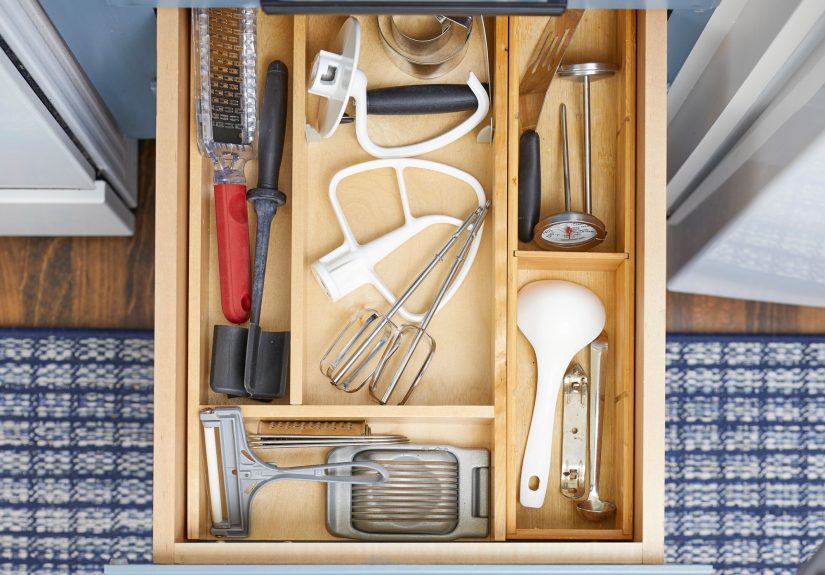
Most people organize utensils by what physically fits, but a better strategy is to organize by how you use them. Keep prep tools together, baking tools together, everyday cooking utensils together, and serving utensils together. You can do this with bamboo dividers, acrylic bins, or modular inserts. The result is a drawer that reflects your routine. When you are making pasta, you know where the tongs are. When you are baking, the measuring spoons are not hiding under a random bottle opener.
6. Add an In-Drawer Knife Block
If your countertop knife block is taking up prime real estate, consider moving those knives into a dedicated in-drawer block. This frees up counter space while keeping blades protected and safely separated. It also makes the silverware and utensil area more intentional. Just make sure the drawer is dry and the insert is designed for your knife sizes. A loose chef’s knife in a drawer is not “rustic.” It is a terrible surprise.
7. Install a Slim Pullout Near the Stove
A narrow pullout cabinet next to the range is a brilliant place to store cooking utensils, oils, and frequently used tools. It keeps essentials close to the action without crowding the counter. If you cook often, this setup improves workflow immediately. Think spatulas, wooden spoons, tongs, and thermometers within arm’s reach. It feels a little like upgrading your kitchen to first class, except with fewer peanuts and more sautéing.
8. Use Cabinet Doors for Hidden Storage
The inside of a cabinet door is often wasted space. Add shallow racks, small hooks, or mounted bins and you have an instant home for measuring spoons, small utensils, or specialty flatware. This works especially well for lightweight tools that tend to drift around drawers. It is one of the simplest kitchen organization ideas because it adds storage without taking up any new footprint.
9. Keep Everyday Tools in Countertop Crocks
Not every utensil belongs in a drawer. If you cook every day, a countertop crock near the stove can hold your most-used tools: spatulas, wooden spoons, whisks, and tongs. The trick is to be selective. A crock should store the all-stars, not the entire bench. Choose a sturdy container with enough height and weight to keep tools upright, then group similar tools together so it looks intentional instead of “I gave up halfway through organizing.”
10. Hang Utensils Under Cabinets
Under-cabinet hooks or a slim hanging rail can turn dead space into storage that is both practical and easy to reach. This is especially useful in small kitchens where drawers are overloaded. Hang lightweight tools, mini strainers, measuring cups, or frequently used gadgets. Bonus: it keeps bulkier utensils out of the main drawer, so your silverware has room to breathe and your spatulas stop behaving like commuters at rush hour.
11. Mount a Wall Rail or Pegboard
If you like visible storage, a wall-mounted rail or pegboard can be stylish as well as functional. This solution works beautifully for larger utensils that never sit neatly inside drawers. Ladles, tongs, strainers, and serving pieces can hang where you can see them, which is great for busy cooks and smaller kitchens. Choose a clean, organized arrangement so it reads as deliberate storage, not “kitchen tools gone rogue.”
12. Use Labeled Bins for Serving Utensils and Special Sets
Daily silverware should be easy to grab, but special pieces do not need front-row seats. Store holiday flatware, cake servers, seafood tools, and oversized serving utensils in labeled bins or handled trays inside a pantry, buffet, or upper cabinet. That way, they are protected and easy to find when needed, but they do not take over your prime drawer space the other 360 days of the year.
13. Repurpose a Rolling Cart for Overflow Storage
If your kitchen has more tools than drawer space, a slim rolling cart can handle the overflow. Use small containers or cups on the shelves to hold serving utensils, bar tools, grilling accessories, or seasonal flatware. This is a smart solution for renters because it adds storage without permanent changes. It also works well for entertainers who need a portable station for parties, buffets, or holiday meals.
14. Dedicate a Drawer Just to Cooking Utensils
Many kitchens fail because one drawer tries to do too much. Silverware, spatulas, chip clips, batteries, measuring spoons, and three soy sauce packets from 2024 should not be roommates. If possible, give everyday flatware one dedicated drawer and cooking utensils another. Once categories stop competing, both spaces become easier to maintain. This is not glamorous advice, but it is effective, and effective is very attractive in a kitchen.
15. Build a Hybrid System for Daily Use and Back Stock
The smartest kitchens often use a hybrid system. Keep daily silverware in one organized drawer, cooking utensils in a nearby crock or second drawer, and backup items in labeled storage elsewhere. This layered approach prevents overcrowding while keeping your routine tools handy. It is also realistic. Most households have more than one type of spoon situation going on, and pretending otherwise is how clutter wins.
How to Choose the Best Silverware Storage Solution
The best setup depends on three things: your kitchen size, your cooking habits, and the number of utensils you actually use. If you have shallow drawers, focus on low-profile trays and angled organizers. If you have deep drawers, stacked inserts or flexible peg systems may work better. If you cook daily, keep essential utensils near the stove. If you entertain often, make room for serving pieces in labeled bins or a secondary storage zone.
Also, be honest about quantity. No organizer can save a drawer stuffed with duplicates, broken tools, and gadgets you forgot existed. Before buying anything, empty the drawer, sort by category, and remove what is damaged or unnecessary. Organizing works best when the system matches the volume. Otherwise, you are just putting a tiny tuxedo on a clutter problem.
Common Mistakes to Avoid
One mistake is choosing an organizer before measuring the drawer. Another is storing tools by random convenience instead of by task. People also tend to overfill countertop crocks, which quickly turns “easy access” into “metal bouquet.” And perhaps the biggest mistake is failing to maintain the system. Even the best utensil drawer organizer needs a quick reset now and then. The goal is not perfection. The goal is making it easy enough that the household will keep doing it.
Final Thoughts
Silverware and utensil storage may not sound thrilling, but it is one of those small kitchen improvements that pays you back every single day. A better setup saves time, reduces stress, and makes your kitchen feel more polished, even if the rest of life is a little chaotic. Whether you go for a simple expandable tray, a custom peg drawer, a crock by the stove, or a full hybrid system, the best choice is the one that fits your space and your routine. Because the real dream is not a perfect kitchen. It is opening a drawer and immediately finding the thing you need without muttering at the cutlery.
Real-Life Experience: What Actually Happens When You Reorganize Silverware and Utensils
In real kitchens, utensil storage problems rarely begin with one dramatic moment. They build slowly. You buy a new whisk because you cannot find the old one. You toss a serving spoon into the silverware drawer “just for now.” Someone unloads the dishwasher in a hurry and suddenly steak knives are living with measuring spoons like it is perfectly normal. Before long, opening the drawer feels like rummaging through a flea market made entirely of metal.
One of the most common experiences people have when reorganizing is realizing they own far more utensils than they thought. The second surprise is that many of them are not especially useful. There is usually a bent spatula, a peeler that never peeled well, duplicate can openers, mystery pieces from long-forgotten gadgets, and enough takeout chopsticks to open a tiny restaurant. Once those extras are removed, even a modest kitchen starts to feel more spacious.
Another real-world lesson is that convenience beats perfection. A beautifully arranged drawer means nothing if the system is too fussy for daily life. Households stick with storage solutions that are obvious and easy. That is why divided drawers, labeled bins, and countertop crocks work so well. People do not have to think very hard. Forks go with forks. Tongs go near the stove. Serving pieces go in the backup bin. The simpler the rule, the better the system survives Tuesday night dinner cleanup.
Small kitchens also teach an important truth: visibility matters. When utensils disappear into dark, crowded drawers, people forget what they own and buy duplicates. When tools are grouped clearly, whether in a tray, on a rail, or in a crock, the kitchen feels less stressful. You move faster. You cook with less frustration. You stop opening three drawers just to find one vegetable peeler. That kind of tiny win adds up quickly.
Many people also discover that the best storage system is not the one with the most compartments. It is the one that matches how they cook. Someone who bakes every weekend needs quick access to measuring tools. Someone who cooks on the stovetop every day benefits from a utensil crock beside the range. Someone who entertains often may need a separate zone for serving sets and party flatware. Good organization feels personal, not generic.
Perhaps the most satisfying part of reorganizing silverware and utensils is that the payoff is immediate. You do not have to wait six months to notice the improvement. The next morning, you open a drawer and find exactly what you need. The dishwasher gets unloaded faster. Counters look calmer. Cooking feels smoother. It is a small home project with unusually high return, which is why people who tackle it often end up reorganizing the rest of the kitchen too. Fair warning: one tidy fork drawer has been known to start a chain reaction.