Table of Contents >> Show >> Hide
- Why These Comic-to-Screen Moments Matter
- 1. Captain America Punches Hitler in The First Avenger
- 2. Tony Stark’s Suitcase Armor in Iron Man 2
- 3. Hulk Punching Thor After the Team Pose in The Avengers
- 4. Black Widow’s “Captured” Interrogation in The Avengers
- 5. “Who the Hell Is Bucky?” in The Winter Soldier
- 6. Captain America’s Shield Against Iron Man’s Repulsor in Civil War
- 7. Ant-Man Riding Hawkeye’s Arrow in Civil War
- 8. Spider-Man Lifting the Rubble in Homecoming
- 9. Spider-Man Webbing Thanos in the Face in Infinity War
- 10. Killmonger Throwing T’Challa Over the Falls in Black Panther
- 11. Skurge’s Last Stand in Thor: Ragnarok
- 12. Thor and Korg Discover Falligar in Love and Thunder
- 13. Captain America Wielding Mjolnir in Endgame
- 14. Captain America Standing Alone Against Thanos in Endgame
- 15. Sam Wilson Receiving the Shield in Endgame
- What These 15 Scenes Say About the MCU
- What It Feels Like to Watch These Comic Moments on Screen
- Conclusion
For a franchise built on billion-dollar spectacle, the MCU has never forgotten its first love: ink on paper. Sure, Marvel Studios changes timelines, swaps villains, remixes backstories, and occasionally throws comic continuity into a blender set to “chaos smoothie.” But every so often, it does something that makes longtime readers point at the screen like they just spotted Bigfoot ordering popcorn. It recreates a classic comic-book image almost exactly.
That is part of the MCU’s secret sauce. These movies are not carbon copies of the comics, and thank goodness for that, because no one needs a 14-hour adaptation of every crossover event involving seventeen clones and a cosmic cube. But the best Marvel films know when to pause, strike a pose, and give the source material a respectful little bow. Sometimes it is a panel-for-panel homage. Sometimes it is a cover recreation. Sometimes it is a line delivered so faithfully that comic readers can practically hear a page turning.
Here are 15 iconic MCU scenes that were lifted directly from the comics, or at least adapted so closely that Marvel might as well have left a sticky note saying, “Yep, we took that one on purpose.”
Why These Comic-to-Screen Moments Matter
These scenes are more than Easter eggs for die-hard fans. They act like a bridge between generations of Marvel storytelling. A kid who first met Spider-Man through Tom Holland can trace a rubble-lifting scene back to Steve Ditko. A moviegoer who cheered when Captain America grabbed Mjolnir can discover that the idea had comic roots decades before Endgame. These moments reward longtime readers, invite new fans into the comics, and remind everyone that the MCU did not appear out of a magic portal. It came from artists, writers, colorists, and letterers who built these heroes panel by panel.
1. Captain America Punches Hitler in The First Avenger
The comic origin
Captain America Comics #1 gave the world one of the most famous covers in comic-book history: Steve Rogers decking Adolf Hitler square in the face. It was bold, political, and not exactly subtle. In other words, classic Captain America.
How the MCU used it
Captain America: The First Avenger turns the image into a darkly funny USO-stage routine. Steve is forced to sell war bonds in a cheesy costume while punching a fake Hitler night after night. The joke works because the audience knows that underneath the corny theater, Marvel is tipping its hat to one of Cap’s foundational comic images.
It is brief, but it captures Steve perfectly. Even when reduced to propaganda theater, he still represents moral clarity. Also, punching fake Nazis is still punching fake Nazis. No notes.
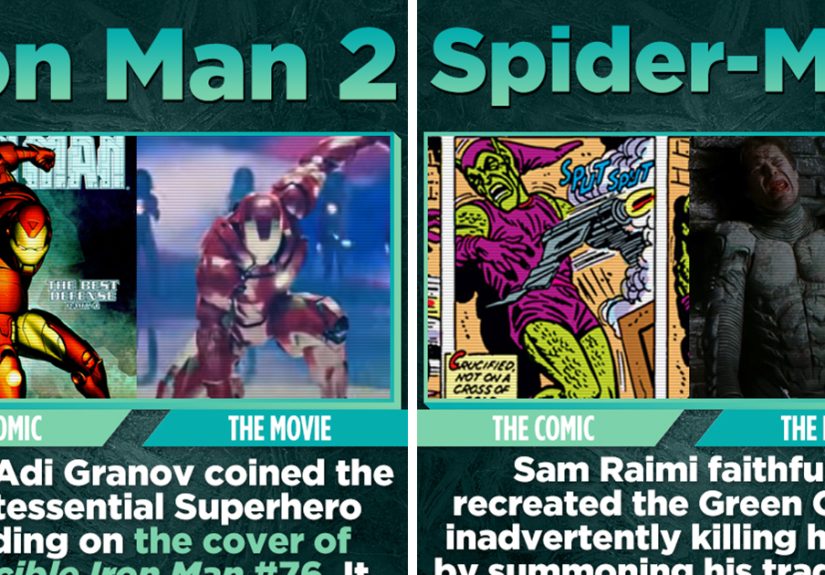
2. Tony Stark’s Suitcase Armor in Iron Man 2
The comic origin
Portable Iron Man armor has deep comic roots, especially in stories tied to Tony Stark’s more adaptable, quick-deploy suits. The Mark V in Iron Man 2 strongly echoes comic traditions around compact armor design, including the Silver Centurion era that readers instantly recognized.
How the MCU used it
The Monaco racetrack attack is all kinds of ridiculous in the best possible way: fast cars, electric whips, public panic, and Tony unfolding a whole suit of armor out of what looks like luxury luggage. It is one of those scenes where the MCU says, “Realism is taking the day off.”
That is exactly why it works. The sequence feels comic-booky in the most flattering sense. It is theatrical, sleek, and a little absurd, which is precisely the Iron Man vibe when he is operating at full showman capacity.
3. Hulk Punching Thor After the Team Pose in The Avengers
The comic origin
The MCU’s now-legendary circular hero shot in The Avengers ends with a perfect tag: Hulk casually clocking Thor. The beat recalls Marvel’s long-running tradition of Hulk ruining otherwise majestic superhero moments, and Marvel has pointed to Incredible Hulk #284 as one of the comic inspirations for that visual energy.
How the MCU used it
The scene starts as pure mythology. New York is on fire, the team is finally united, and the camera spins around Earth’s Mightiest Heroes like destiny itself is doing the cinematography. Then Hulk punches Thor because Hulk is apparently allergic to solemnity.
That punch matters because it proves the MCU understood something vital early on: Marvel comics are not just epic. They are epic and mischievous. Grandeur and goofiness can share the same panel, or the same frame.
4. Black Widow’s “Captured” Interrogation in The Avengers
The comic origin
Marvel has cited Black Widow #4 as a comic touchstone for Natasha Romanoff’s slick, under-control spycraft. The idea is simple and very Natasha: look vulnerable, stay three moves ahead, and let everyone else realize too late that they are the ones being played.
How the MCU used it
The opening interrogation scene in The Avengers is still one of Natasha’s best introductions. She is tied to a chair, apparently helpless, until the phone rings, she gets the information she needs, and the whole room suddenly belongs to her.
It is such a comic-book spy moment because it turns perception into a weapon. Natasha does not just win fights with kicks and gadgets. She wins because she understands exactly what everyone in the room thinks they are seeing, and then flips the table without even standing up first.
5. “Who the Hell Is Bucky?” in The Winter Soldier
The comic origin
Ed Brubaker’s Captain America run gave Marvel one of its best modern twists by revealing that Bucky Barnes had survived and become the Winter Soldier. The line “Who the hell is Bucky?” became iconic because it weaponized Steve Rogers’ own history against him.
How the MCU used it
Captain America: The Winter Soldier lifts the line almost directly, and it lands like a punch to the chest. Steve is not fighting a nameless assassin anymore. He is staring at a living ghost.
The brilliance of the scene is how cold it feels. No sentimental music swell. No immediate memory breakthrough. Just Steve realizing that the person in front of him used to be his best friend, and Bucky treating that identity like it belongs to someone else.
6. Captain America’s Shield Against Iron Man’s Repulsor in Civil War
The comic origin
The final issue of Civil War gave readers one of Marvel’s most famous hero-versus-hero images: Iron Man blasting at Captain America’s raised shield. It is less a fight pose than a thesis statement. Progress versus principle. Power versus conviction. Friends versus history.
How the MCU used it
The Siberia showdown in Captain America: Civil War recreates that image with brutal emotional force. In the comics, the larger conflict is about superhero registration. In the movie, it becomes painfully personal through Bucky and the Starks. But the visual remains the same because it still says everything at once.
And that is why the shot endures. It is not just “cool.” It is tragic. Marvel turned a cover image into emotional shrapnel.
7. Ant-Man Riding Hawkeye’s Arrow in Civil War
The comic origin
Avengers #223 gave readers a delightfully comic-book image: a tiny Ant-Man hitching a ride on Hawkeye’s arrow. It is the sort of team-up concept that sounds silly until you see it and immediately decide it rules.
How the MCU used it
The airport battle in Civil War is packed with fan service, but this moment might be the most joyful. Clint fires. Scott hangs on. Physics quietly leaves the building. Everyone watching has a great time.
This is the MCU at its most confident. It knows some ideas only work if the movie commits completely. No apology, no wink too hard at the audience. Just one Avenger turning another Avenger into a human dart. Beautiful teamwork, honestly.
8. Spider-Man Lifting the Rubble in Homecoming
The comic origin
Amazing Spider-Man #33 is sacred territory for Spider-Man fans. Trapped under wreckage, exhausted and terrified, Peter Parker refuses to give up. It is one of the defining moments in the character’s history because it distills Spider-Man down to pure willpower.
How the MCU used it
Spider-Man: Homecoming gives Tom Holland his version of that scene after the Vulture leaves Peter pinned beneath debris. For a second, he is just a scared kid. Then he looks at his reflection, steadies himself, and lifts.
No giant speech is needed. The scene works because Spider-Man has always been most heroic when he is terrified and chooses to act anyway. This is not a power fantasy moment. It is a resilience moment, which is exactly why it feels so faithful.
9. Spider-Man Webbing Thanos in the Face in Infinity War
The comic origin
Infinity Gauntlet #4 includes a memorable moment where Spider-Man attacks Thanos with the kind of brave, slightly reckless improvisation that only Spider-Man could think is a good opener against a cosmic tyrant.
How the MCU used it
On Titan in Avengers: Infinity War, Peter goes straight for the eyes. It is fast, funny, and surprisingly faithful. The move does not defeat Thanos, obviously, because Thanos is not exactly fragile. But it feels wonderfully Spider-Man: clever, desperate, and just cocky enough to count as a terrible idea.
That is what makes the scene pop. Even in a movie overloaded with gods, geniuses, and galactic killers, Marvel remembered that Spider-Man fights like a scrappy kid who read the room, then ignored the room, then swung anyway.
10. Killmonger Throwing T’Challa Over the Falls in Black Panther
The comic origin
Killmonger’s first comic appearances in Jungle Action established him as a genuine threat to T’Challa, including the image of Black Panther being hurled over a waterfall. It is a savage, humiliating visual because it does not just show defeat. It shows a king being displaced.
How the MCU used it
Black Panther reworks the circumstances into ritual combat at Warrior Falls, but keeps the image intact. Killmonger’s victory is not framed like a cheap shock. It is framed like a hostile takeover of myth itself.
That is why the moment sticks. The comic image was powerful. The film makes it operatic. By the time T’Challa falls, the audience knows Wakanda has not just lost a duel. It has lost its center.
11. Skurge’s Last Stand in Thor: Ragnarok
The comic origin
Walt Simonson’s Thor run gave Skurge the Executioner one of the greatest redemption moments in Marvel history: a hopeless stand against impossible odds, armed with modern rifles and raw courage. It is the kind of scene that can turn a side character into legend overnight.
How the MCU used it
Thor: Ragnarok gives Karl Urban’s Skurge a version of that heroic sacrifice. He faces down Hela’s forces, unloads both rifles, and finally becomes the warrior he always wanted to be.
It is an emotional curveball in a movie famous for jokes, neon chaos, and gladiator nonsense. But that is exactly why it lands. Beneath all the color and comedy, Ragnarok still makes room for one of Marvel’s most respected comic-book acts of redemption.
12. Thor and Korg Discover Falligar in Love and Thunder
The comic origin
Jason Aaron and Esad Ribic’s Thor: God of Thunder featured a haunting image of Thor finding the massive slain god Falligar the Behemoth, one of the story’s earliest signs that Gorr was not messing around.
How the MCU used it
Thor: Love and Thunder recreates the composition with surprising fidelity. Thor and Korg stand before the enormous dead god, and the frame practically screams “comic panel brought to life.”
The moment matters because it briefly shifts the movie into myth-horror mode. Even viewers who had not read the comic could feel the scale, the silence, and the threat. It is one of the clearest visual lifts in the entire later-era MCU.
13. Captain America Wielding Mjolnir in Endgame
The comic origin
Steve Rogers proving worthy enough to wield Mjolnir had already happened in the comics, including memorable appearances in The Mighty Thor and Fear Itself. Longtime readers knew the possibility was real, even if moviegoers were still clutching their seats in disbelief.
How the MCU used it
Then Avengers: Endgame pulled the pin. The hammer lifts. Thor looks confused. Steve catches Mjolnir. The internet explodes. The theater loses structural integrity.
This is one of the best examples of a comic payoff working for both readers and non-readers. Fans of the source material recognized the lineage. Casual audiences understood it instantly because the movies had spent years quietly building the idea that worthiness was not about muscle. It was about character.
14. Captain America Standing Alone Against Thanos in Endgame
The comic origin
Marvel comics have repeatedly returned to one core image of Steve Rogers: battered, outmatched, but still stepping forward. Infinity Gauntlet gave that spirit a memorable visual foundation that Endgame clearly channels.
How the MCU used it
Steve tightening the broken shield strap and facing Thanos’ army alone is one of the MCU’s defining heroic images. It is not flashy. It is not even hopeful in a conventional sense. It is simply Steve Rogers refusing to quit because quitting is not in the job description.
That is comic-book Captain America in a nutshell. The scene works so well because it does not need dialogue. The image says it all: this man will stand even when standing makes no tactical sense whatsoever.
15. Sam Wilson Receiving the Shield in Endgame
The comic origin
Sam Wilson taking up the Captain America mantle has a strong comic basis, especially in the storyline where Steve officially passes him the shield. It was a major turning point in Marvel publishing and one of the clearest modern examples of legacy done right.
How the MCU used it
At the end of Endgame, old Steve hands Sam the shield by the lake, and the moment lands with quiet authority. No fireball. No huge battle. No giant speech about destiny. Just trust passed from one man to another.
That restraint is what makes it powerful. Marvel understood that some moments do not need thunder. They need stillness. In comic terms, it feels like the final page of a great issue: simple, emotional, and impossible to forget.
What These 15 Scenes Say About the MCU
The smartest thing Marvel Studios ever learned was that comic accuracy is not just about costumes or continuity charts. It is about emotional accuracy. A scene feels true to the comics when it captures the same spirit, tension, or visual poetry that made the original memorable.
That is why these moments endure. Cap punching Hitler preserves the boldness of Golden Age comics. Spider-Man under the rubble preserves Peter Parker’s stubborn heart. Skurge’s sacrifice preserves the grandeur of old-school mythic Marvel. Sam receiving the shield preserves the idea that legacies can evolve without losing what made them meaningful in the first place.
In other words, the MCU did not become huge by ignoring the comics. It became huge by knowing exactly when to raid the treasure chest.
What It Feels Like to Watch These Comic Moments on Screen
There is a very specific kind of joy that comes from seeing a comic-book image survive the jump to live action. It is not the same feeling as watching a cool action scene, and it is definitely not the same as spotting a random background Easter egg. It is closer to recognition mixed with gratitude. You are not just seeing a hero do something awesome. You are seeing years, sometimes decades, of comic history suddenly become visible to millions of people at once.
For longtime Marvel readers, these scenes can feel almost surreal. You spend years with panels, splash pages, cover art, and legendary runs tucked into your memory. Then one day you are in a theater, someone next to you is holding a jumbo soda the size of a fire hydrant, and Captain America catches Mjolnir like the universe has been waiting for this exact second. That is not just fan service. That is validation. It is the feeling of a medium that used to be treated as niche suddenly being honored in the biggest way possible.
For newer fans, the experience works differently but just as well. You may not know the issue number or the artist, but you can still feel when a scene has that extra spark. It feels composed. Intentional. Mythic. The moment lands with unusual weight because it has already lived another life somewhere else. Even if you do not realize it consciously, you are often responding to the richness of that history.
That is part of why these comic-lifted scenes travel so well across generations. A parent who grew up reading Captain America can cheer at the same moment as a kid who only knows Steve Rogers from the movies. A comic collector can appreciate the exact panel reference, while a casual viewer just knows the shot looks incredible. Different doorways, same room.
There is also something charmingly human about it. For all the digital effects, cosmic armies, and reality-bending nonsense, these moments often work because they reduce heroes to one simple image: a man standing alone, a kid lifting rubble, a friend staring at a lost friend, a successor accepting a symbol. Comics have always understood the power of compression. One panel can hold a whole worldview. The best MCU homages preserve that instinct.
And honestly, there is a little thrill in catching the reference before your friend does. You see Ant-Man on Hawkeye’s arrow and think, “Oh, they actually did it.” You see Falligar’s corpse in Love and Thunder and realize Marvel did not just borrow the villain. It borrowed the mood. Those are the moments when adaptation becomes conversation.
That is why these scenes matter beyond nostalgia. They show respect. They acknowledge that before the box office, before the streaming charts, before the endless discourse about phases and multiverses, there were comics. Sometimes weird, sometimes messy, often brilliant comics. And every time the MCU lifts one of those iconic moments directly from the page, it reminds viewers that the roots are still alive under all that blockbuster polish.
Conclusion
The MCU has changed plenty on its way from page to screen, but its best moments often come from knowing when not to reinvent the wheel. Or the shield. Or the hammer. Or the guy clinging to the arrow for dear life.
These 15 scenes prove that Marvel’s most memorable adaptations happen when the studio trusts the power of the original image. Not every comic panel needs a one-to-one remake, but when the right one shows up at the right time, the effect is electric. It deepens the movie, rewards the readers, and gives the heroes a sense of legacy that no amount of CGI fireworks can fake.
That is the real magic trick. The MCU may be a modern movie machine, but when it is at its best, you can still see the paper beneath the armor.