Table of Contents >> Show >> Hide
- The World Before AutoCAD (A Quick Time Machine Ride)
- How to “Read” These Photos Like a Drafter
- 19 Amazing Vintage Photos That Capture Life Before AutoCAD
- 1) The War Production Board “Data Visualization” Drafting Room (1942)
- 2) The Pentagon Construction Drafting Room (1941–1942)
- 3) USGS Lithographic Draftsmen Correcting Printing Plates (1939)
- 4) Frank Lloyd Wright’s Desert Drafting RoomUnder Construction (1940)
- 5) Raymond Loewy Associates: Industrial Design Drafting Room (Mid-Century)
- 6) Morris Lapidus: The Architectural Drafting Room (NYC)
- 7) The Blueprint Stack: Working Drawings for Iconic Buildings
- 8) The Draftsman and the Planimeter (The Analog “Area Calculation” Tool)
- 9) The T-Square: The Original “Constraint System”
- 10) French Curves, Splines, and “Draw It Until It Looks Right” Geometry
- 11) Lettering Day: When Your Handwriting Had to Be a Font
- 12) The Checker’s Desk: Human “Clash Detection”
- 13) The Revision Overlay: Version Control With Tracing Paper
- 14) The Diazo/Ozalid Copy Room: Engineering Meets Chemistry
- 15) The Diazo Printer: Fast Copies, Serious Vapors
- 16) The Diazotype Sheet Itself: Blue Lines on White (and a Whiff of Ammonia)
- 17) NASA and the Culture of Drawing Standards
- 18) The Engineering Library: Microfilm Readers and Technical Memory (1960s)
- 19) The Drafting Room as a Team Sport (Not a Lone Genius Montage)
- Bonus: of “Experience” From the Pre-AutoCAD World
- Conclusion
Before AutoCAD (and before the words “just zoom in” became a complete sentence), design work had a very physical soundtrack:
pencils whispering on vellum, drafting brushes sweeping away eraser crumbs, and the occasional dramatic thunk of a T-square
being slapped into alignment like it owed someone money.
This isn’t a “back in my day” lecture. It’s a guided tour through the pre-CAD worldtold through vintage photos that capture
the real workflow behind buildings, bridges, airplanes, factories, and the mountains of paper that made them possible.
You’ll see drafting rooms that look like libraries, blueprint machines that smell like chemistry class, and teams doing
“version control” with colored pencils and sheer willpower.
The World Before AutoCAD (A Quick Time Machine Ride)
AutoCAD arrived in the early 1980s and helped pull drafting onto desktop computers. But for decades before that, “drawing”
wasn’t a casual verbit was a skilled trade. Accuracy came from instruments, patience, standards manuals, and muscle memory.
If a line was wrong, you didn’t hit Ctrl+Z. You erased it, re-inked it, and tried not to smear your entire afternoon across the sheet.
And while pre-CAD tools could look simplestraightedges, triangles, compasseswhat they enabled was anything but. These systems produced
tight tolerances, repeatable parts, and construction-ready plans at national scale. The work was slower, yes, but it was also deeply deliberate:
every line had a cost, so every line had to earn its paycheck.
How to “Read” These Photos Like a Drafter
A lot of vintage drafting photos look similar at first glance: people at angled tables, rulers everywhere, papers clipped down like they’re
trying to escape. Here’s what you’re usually seeing:
- Drafting boards and parallel rules: the original “snap to grid,” except it involved thumbs and faith.
- T-squares, triangles, and scales: for clean geometry, consistent angles, and accurate dimensions at different scales.
- Vellum, tracing paper, or film: translucent originals made for copying and layering revisions.
- Lettering guides and templates: because legible notes mattered as much as the drawing itself.
- Reprographics: blueprint and diazo processes that turned one “master” into many jobsite copies.
- Human “QA”: the moment in the photo where someone is staring at a drawing like it insulted their motherthis is checking work.
19 Amazing Vintage Photos That Capture Life Before AutoCAD
1) The War Production Board “Data Visualization” Drafting Room (1942)
One famous government-era image shows a drafting room producing charts, diagrams, and visual reports for wartime planningbasically the ancestor
of today’s dashboards, except built with drafting tools, ink, and a lot of careful lettering. The vibe is half design studio, half command center:
rows of desks, tools laid out like surgical instruments, and work that had to be both accurate and instantly understandable.
What this photo teaches: “visualization” didn’t start with software. It started with humans translating complex systems into clear graphicsby hand.
2) The Pentagon Construction Drafting Room (1941–1942)
Another striking photo from the early 1940s shows staff working in a drafting room during the Pentagon’s construction era. It’s a reminder that
massive projects weren’t “drawn” by one genius in a black turtleneckthey were documented by teams. In rooms like this, coordination mattered:
consistent symbols, consistent lettering, consistent sheet organization, and absolutely consistent coffee consumption.
What this photo teaches: before shared cloud files, coordination was a physical systemstandards, checkers, and disciplined drafting practices.
3) USGS Lithographic Draftsmen Correcting Printing Plates (1939)
In a vintage government image from Washington, D.C., lithographic draftsmen work directly on printing plates for mapscarefully correcting details
before mass reproduction. This is “edit mode” with consequences: a mistake here isn’t a typo; it becomes a nationwide problem. You can practically
feel the concentration through the photo. No earbuds. No distractions. Just tools, plates, and the pressure of permanence.
What this photo teaches: long before GIS software, map accuracy depended on human hands and very steady nerves.
4) Frank Lloyd Wright’s Desert Drafting RoomUnder Construction (1940)
A well-known architectural construction photo captures a detail of a drafting room at Frank Lloyd Wright’s winter quarters in Arizona.
It’s a wonderfully meta moment: a space being built specifically for drawing spaces. The photo is a reminder that drafting rooms were treated as
production environmentsdesigned for light, workflow, and the kind of focus that makes time stop.
What this photo teaches: good drafting wasn’t only about tools; it was about creating the right environment to think clearly.
5) Raymond Loewy Associates: Industrial Design Drafting Room (Mid-Century)
A vintage photo from a famous New York design firm shows a drafting room built for repetition: clean desks, consistent setups, and a workflow that
turns ideas into manufacturing-ready drawings. This isn’t “sketching.” It’s translationconverting a concept into dimensions, materials, tolerances,
and parts that factories can actually produce without guessing.
What this photo teaches: industrial design was always part art, part engineering, and part documentation.
6) Morris Lapidus: The Architectural Drafting Room (NYC)
Another classic New York image shows an architectural drafting room with the quiet intensity of a newsroom. The tools are familiarstraightedges,
triangles, stacks of drawingsbut the key detail is human: posture. People are leaned in, shoulders forward, eyes narrowed. That’s the universal
“I’m about to commit to this line forever” stance.
What this photo teaches: drafting demanded confidencebecause every correction took real time.
7) The Blueprint Stack: Working Drawings for Iconic Buildings
Some of the most jaw-dropping vintage images aren’t of peoplethey’re of paper. Archival photos and collections show massive sets of working drawings
for landmark buildings: structural plans, mechanical systems, electrical layouts, interior details, and revision after revision. One project could
mean hundreds of sheets, all coordinated, all traceable, all expected to “agree” with each other in the real world.
What this photo teaches: pre-AutoCAD documentation was heavyliterallyand project management was baked into sheet organization and discipline.
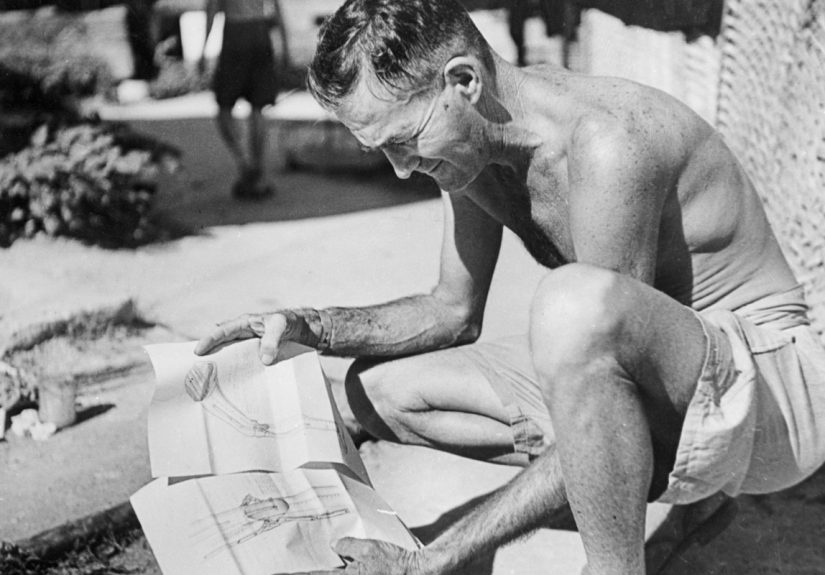
8) The Draftsman and the Planimeter (The Analog “Area Calculation” Tool)
A Smithsonian archival image shows a man hunched over a drafting table, planimeter in hand. The planimeter was used to measure area on a drawing,
turning geometry into numbers without digital computation. It’s one of those tools that looks like a gadget from a detective movie, but it did serious work:
calculating quantities, land areas, and design metrics straight from the paper.
What this photo teaches: “analysis” happened on paperusing instruments designed to extract measurements from drawings.
9) The T-Square: The Original “Constraint System”
Many vintage photos feature the humble T-square or a parallel rule system. It’s easy to underestimate this tool until you try to keep perfectly horizontal
lines consistent across a full-size sheet. A T-square wasn’t just a rulerit was a stabilizer. It controlled drift. It enforced discipline.
It was the stern parent of straight lines.
What this photo teaches: precision came from physical constraints, not software toggles.
10) French Curves, Splines, and “Draw It Until It Looks Right” Geometry
Curves were a whole saga before CAD. Vintage drafting photos often show French curves and flexible splines pinned down with weights.
This was how you made fair, smooth curves for everything from car bodies to airfoils. There’s a tactile intelligence here:
people weren’t only calculating curvesthey were feeling them with tools that made geometry visible.
What this photo teaches: the pre-AutoCAD world had its own kind of “parametric” thinkingjust expressed through hands and templates.
11) Lettering Day: When Your Handwriting Had to Be a Font
Drafting photos frequently show lettering guides, stencils, and careful note placement. Because the drawing wasn’t complete until the information
could be read. A beautifully drafted plan with sloppy notes is like a gourmet meal served on a trash can lidtechnically impressive, emotionally upsetting.
In many shops, lettering quality was trained like a craft.
What this photo teaches: readability was a professional requirement, not a nice-to-have.
12) The Checker’s Desk: Human “Clash Detection”
If you’ve ever seen a vintage photo where someone is examining a drawing with a scale, red pencil nearby, that’s likely the checking step.
Checkers verified dimensions, standards, notes, and consistency between sheets. This was manual clash detection: catching conflicts before a shop floor
or construction site discovered them in the most expensive way possible.
What this photo teaches: quality control was a dedicated role, not an afterthought.
13) The Revision Overlay: Version Control With Tracing Paper
Some of the best “process” photos show tracing overlays: a base drawing with translucent layers for changes. It’s elegant in a surprisingly modern way.
Instead of overwriting everything, you isolate updatesnew routing, changed geometry, revised notesthen merge carefully. The downside is obvious:
if someone sneezes, your entire version history becomes interpretive dance.
What this photo teaches: teams still needed modular change management, even without digital layers.
14) The Diazo/Ozalid Copy Room: Engineering Meets Chemistry
A CDC public-domain photo shows two women working at OZALID machines to create positive copy prints using a diazo processplacing translucent originals
with diazo-coated paper, exposing to UV, then developing with ammonia fumes. This was how one master became many distributable copies.
Efficient? Yes. Pleasant-smelling? Absolutely not.
What this photo teaches: reproduction was its own specialized workflowand it shaped how drawings were produced and stored.
15) The Diazo Printer: Fast Copies, Serious Vapors
Technical documentation from occupational safety investigations describes diazo printers operating like blueprint machines: intense lamps, light-sensitive paper,
and ammonia used as developer. In photos of copy rooms, you’ll often see big machines, big rolls of paper, and a setup that looks like it could develop
photos or launch a small satellite.
What this photo teaches: “printing” drawings wasn’t just pressing a buttonit involved materials, exposure, and chemical development.
16) The Diazotype Sheet Itself: Blue Lines on White (and a Whiff of Ammonia)
Some archival images focus on the prints: diazotypes (often called bluelines or whiteprints) with crisp lines on a light background.
These prints were widely used for reproducing line drawings and were commonly developed with ammonia. Anyone who’s handled a stack knows the signature:
the paper feels different, and sometimes the smell shows up uninvited like a party guest who brought opinions.
What this photo teaches: the medium of the copy influenced how drawings aged, were stored, and were shared.
17) NASA and the Culture of Drawing Standards
Pre-CAD engineering organizations relied on formal drawing practiceseverything from line conventions to dimensioning rules to signature blocks.
In vintage images and documents, you’ll see standards manuals nearby because they were part of the workflow. Standards weren’t bureaucracy;
they were interoperability. If multiple teams can read your drawing the same way, the project can move.
What this photo teaches: the discipline behind drafting is a big reason complex systems could be built reliably before modern CAD.
18) The Engineering Library: Microfilm Readers and Technical Memory (1960s)
In a NASA library photo from the early space age, staff operate a microfilm reader. This is the underrated side of “before AutoCAD”:
drawings and technical reports had to be stored, retrieved, and referenced at speed. Microfilm helped manage volume and preserve records,
turning walls of paper into something searchablewell, searchable by human beings with patience and strong opinions about indexing.
What this photo teaches: the pre-digital world still built information systemsthey were just made of film, catalogs, and process.
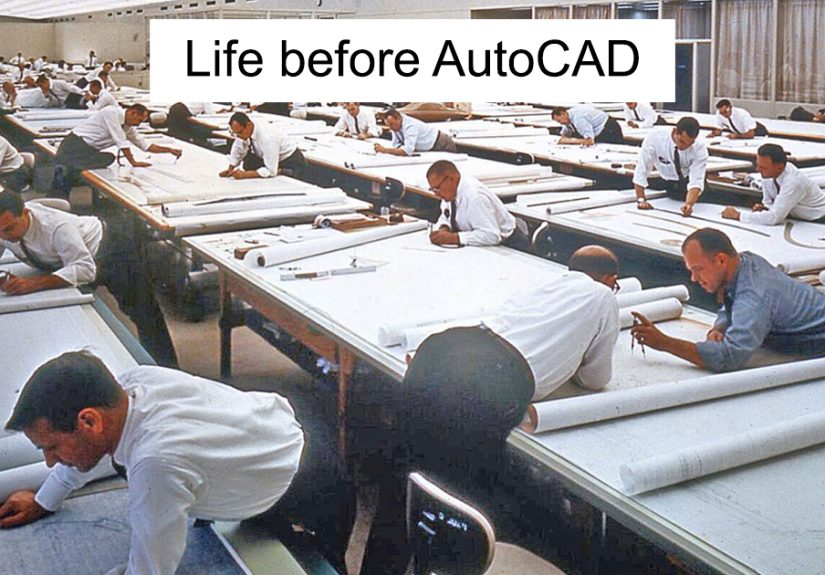
19) The Drafting Room as a Team Sport (Not a Lone Genius Montage)
The most consistent theme across vintage drafting photos is scale: not only the paper size, but the number of people involved.
Whether it’s government agencies, architecture studios, or engineering labs, the work is social. One person lays out geometry, another checks,
another copies, another updates a related sheet. The “model” was the collective discipline of the room.
What this photo teaches: AutoCAD changed tools, but the underlying truth remainsgood design is teamwork plus clarity.
Bonus: of “Experience” From the Pre-AutoCAD World
Even if you’ve never touched a drafting board, some of these photos trigger a strange kind of sensory memorylike you can hear them.
The soft scrape of a pencil. The little click of a triangle sliding into place. The brush that sweeps away eraser crumbs, which (somehow)
multiply faster than rabbits when you’re under deadline. In modern CAD, the mess is invisible. In the vintage world, the mess sat right there
on the table, politely reminding you that accuracy has a physical cost.
Ask anyone who learned drafting before software became the default, and they’ll talk about pace. Not “slow” exactlymore like intentional.
You planned your moves because revisions were expensive. You didn’t casually redraw an entire elevation because the window schedule changed.
You found the most surgical fix: an overlay, a carefully re-lettered note, a patch that preserved the rest of the sheet. It made you think
in systems: if this dimension changes, what else is downstream? That mental habit is basically parametric thinkingjust done in your head.
Then there’s the copy room experience, which deserves its own documentary series. In the photos of diazo/Ozalid machines, you can almost smell
the workflow: paper that must stay protected from light, originals aligned just right, exposure timed, then development that involves chemistry
you’d rather not breathe too deeply. It’s funny nowhow dramatic “printing” a drawing used to bebut it also explains why drawing sets were handled
with care. A smudge wasn’t cosmetic; it could become a misread dimension on a jobsite.
Another recurring experience is posture. Vintage drafting photos capture people leaning in, shoulders tight, head angled just so.
Part of it is precision, but part is negotiation with gravity: big sheets slide, tools drift, ink smears, and your elbow is the enemy.
The table angle matters. The light matters. The desk organization matters. Pre-AutoCAD drafting had ergonomics before the word became trendybecause
you simply couldn’t do eight focused hours without building a workspace that supported it.
And here’s the best part: the pride. Those rooms weren’t filled with people “making drawings.” They were producing instructions that the world
could build from. When you see a checker reviewing a sheet, or a drafter carefully lettering notes, that’s professional accountability.
The drawing was a contract with reality. Modern CAD is faster and more flexible, but the vintage experience teaches something timeless:
clarity is kindness. If your drawing communicates cleanly, fewer people suffer downstreamfabricators, builders, inspectors, clients, and your future self.
Conclusion
These vintage photos aren’t just nostalgiathey’re proof that sophisticated engineering and architecture thrived long before digital drafting.
The tools were analog, but the thinking was systematic: standards, checking, reproducible copies, and teamwork.
AutoCAD didn’t invent drafting discipline; it inherited itand then made it faster, easier to iterate, and much less dependent on eraser crumbs.