Table of Contents >> Show >> Hide
- Why Power Output Matters
- Method 1: Calculate Power Output Using Work and Time
- Method 2: Calculate Power Output Using Force and Speed or Torque and Rotation
- Method 3: Calculate Electrical Power Output Using Voltage and Current
- Power Output vs. Energy: The Classic Mix-Up
- Quick Cheat Sheet for Calculating Power Output
- How to Choose the Right Formula
- Conclusion
- Real-World Experiences With Calculating Power Output
- SEO Tags
Power output sounds like something shouted by a gym coach, an electrician, and a rocket engineer at the same time. In a way, it is. Whether you are checking a motor, sizing a generator, understanding a circuit, or just trying to make sense of the word “watts” on a device label, power output tells you how fast work is being done or energy is being delivered.
That is the big idea: power is not just energy. It is energy over time. A machine that does a lot of work slowly can use the same total energy as one that does it quickly, but the faster machine has more power output. Think of it as the difference between carrying ten grocery bags in one trip versus five exhausting trips while pretending you enjoy cardio.
In this guide, we will break down three practical ways to calculate power output: by using work and time, by using force and speed or torque and rotation, and by using voltage and current in electrical systems. Along the way, we will cover examples, common mistakes, and a few sanity checks so your answer does not come out looking like it was invented by a confused calculator.
Why Power Output Matters
Before diving into formulas, it helps to understand why this number matters in the real world. Power output is used to compare engines, motors, appliances, tools, solar panels, batteries, pumps, and industrial equipment. It tells you how much useful energy is being transferred per second. That is why power shows up in watts, kilowatts, megawatts, and horsepower.
If you are troubleshooting equipment, calculating power output can help you determine whether a machine is performing as expected. If you are shopping, it helps you compare products. If you are working with circuits, it can save components from overheating. And if you are a student, it is one of those topics that keeps popping up in physics and engineering because the universe apparently loves rate calculations.
Method 1: Calculate Power Output Using Work and Time
The Formula
Power = Work ÷ Time
P = W ÷ t
This is the most fundamental power formula. If you know how much work was done and how long it took, you can calculate average power output. In standard SI units, work is measured in joules, time is measured in seconds, and power is measured in watts.
One watt equals one joule per second. That means if a machine does 500 joules of work in 10 seconds, its average power output is 50 watts.
Example
Let’s say a motor lifts a box and does 1,200 joules of work in 8 seconds.
P = 1,200 ÷ 8 = 150 watts
That means the motor’s average power output is 150 W.
When to Use This Method
This method works best when the total work is known. It is especially useful in physics problems, lifting tasks, mechanical systems, and any situation where energy transfer happens over a measured time interval.
Helpful Tip
If you are given energy instead of work, you can often use the same idea. In many practical situations, power output = energy transferred ÷ time. That is why utility bills talk about energy in kilowatt-hours, while devices are labeled with power in watts. One tells you how much energy was used; the other tells you the rate at which it was used.
Common Mistakes
- Mixing up power and energy
- Using minutes instead of seconds without converting
- Forgetting that this formula gives average power unless the rate is constant
If a system’s output changes from moment to moment, this formula still gives a useful average. That is good enough for many real-world calculations, even if the machine behaves like it has mood swings.
Method 2: Calculate Power Output Using Force and Speed or Torque and Rotation
This method is where power output starts feeling more alive. Instead of working backward from total energy, you calculate power from how hard something pushes and how fast it moves. This is incredibly useful for vehicles, motors, turbines, conveyors, pumps, and rotating machinery.
Linear Motion Formula
Power = Force × Velocity
P = F × v
If the force acts in the same direction as the motion, you can multiply force by speed to get power output directly.
Example
A machine applies a force of 300 newtons to move an object at 2 meters per second.
P = 300 × 2 = 600 watts
So the machine’s power output is 600 W.
Rotational Motion Formula
Power = Torque × Angular Velocity
P = τ × ω
This is the go-to formula for rotating systems like engines, fans, drills, turbines, and electric motors. Torque is the twisting force, and angular velocity is how fast the object rotates.
Example
Suppose a motor produces 20 newton-meters of torque and spins at 50 radians per second.
P = 20 × 50 = 1,000 watts
The motor’s mechanical power output is 1,000 W, or 1 kilowatt.
Using RPM Instead of Radians per Second
In shops and garages, rotational speed is often given in RPM rather than radians per second. To use the torque formula, convert RPM like this:
Angular velocity (rad/s) = 2π × RPM ÷ 60
Once converted, plug the value into P = τ × ω.
Horsepower Shortcut
If you work with engines in U.S. customary units, you may also see horsepower. A quick conversion is:
1 horsepower ≈ 745.7 watts
That means a machine with a power output of 1,491 watts is roughly 2 horsepower. Not exactly race-car territory, but enough to make a respectable shop tool feel important.
When to Use This Method
Use this method when you know how much force is applied and how fast something is moving, or when you know torque and rotational speed. It is ideal for mechanical equipment where motion is continuous and measurable.
Method 3: Calculate Electrical Power Output Using Voltage and Current
If you are working with electrical devices, circuits, batteries, generators, or solar panels, this is the formula family you will use most often.
The Basic Formula
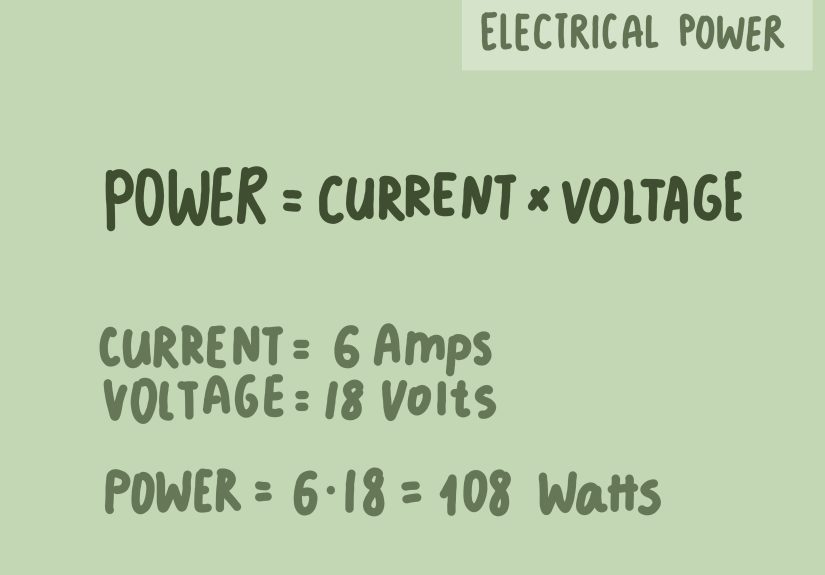
Power = Voltage × Current
P = V × I
Voltage is measured in volts, current is measured in amps, and power is measured in watts. This formula works beautifully for many basic DC calculations and for simple electrical loads.
Example
A device runs on 12 volts and draws 5 amps.
P = 12 × 5 = 60 watts
The electrical power output or consumption is 60 W.
Power Formulas Using Resistance
When resistance is part of the problem, you can combine the power equation with Ohm’s law to get two more useful formulas:
- P = I²R
- P = V² ÷ R
These are especially handy when you know resistance and either current or voltage.
Example Using Current and Resistance
A resistor carries 3 amps of current and has a resistance of 4 ohms.
P = 3² × 4 = 9 × 4 = 36 watts
So the resistor dissipates 36 W of power.
Example Using Voltage and Resistance
A heating element has 120 volts across it and a resistance of 30 ohms.
P = 120² ÷ 30 = 14,400 ÷ 30 = 480 watts
The power output is 480 W.
When to Use This Method
This method is best for electrical systems. It is used to size circuits, select components, estimate heat output, compare devices, and understand how much power a source is delivering to a load.
A Quick AC Caution
For simple resistive circuits, the formulas above are usually enough. But in more advanced AC systems, real power can depend on power factor. If you are working with motors, industrial loads, or utility systems, the “volts times amps” shortcut may need extra context. In other words, electricity occasionally likes to be dramatic.
Power Output vs. Energy: The Classic Mix-Up
Many people confuse power and energy, and honestly, the labels on appliances do not help. Here is the clean distinction:
- Power is the rate of energy transfer.
- Energy is the total amount transferred.
A 1,000-watt microwave does not use 1,000 watts forever like some kind of magical energy portal. It uses energy at a rate of 1,000 joules per second. If it runs for 10 minutes, the total energy used depends on that time.
This matters because calculating power output tells you how strong or capable a system is at a given moment, while energy tells you how much total work got done over a period.
Quick Cheat Sheet for Calculating Power Output
| Situation | Formula | Best Used For |
|---|---|---|
| Known work and time | P = W ÷ t | General physics and average power |
| Known force and speed | P = F × v | Linear mechanical motion |
| Known torque and angular velocity | P = τ × ω | Motors, engines, and rotating systems |
| Known voltage and current | P = V × I | Electrical circuits and devices |
| Known current and resistance | P = I²R | Resistors and heat dissipation |
| Known voltage and resistance | P = V² ÷ R | Electrical loads with known resistance |
How to Choose the Right Formula
If you are staring at a problem and feeling personally attacked by the variables, here is the easiest way to choose:
- Use P = W ÷ t when you know total work or energy over time.
- Use P = F × v or P = τ × ω when motion is involved.
- Use P = V × I, P = I²R, or P = V² ÷ R for electrical systems.
The best formula is not the fanciest one. It is the one that matches the information you already have. Good engineering often starts with not making your life harder than necessary.
Conclusion
Once you understand what power output really means, the formulas stop feeling random. They become different views of the same idea: how quickly energy is being transferred or work is being done. That is why the same concept shows up in engines, motors, circuits, appliances, and utility systems.
If you remember just one thing, make it this: power output is a rate. Work per time, force times velocity, torque times angular speed, or voltage times current are all ways of describing that same underlying story. The math changes depending on the system, but the meaning stays steady.
So the next time you see watts, horsepower, amps, volts, or torque on a spec sheet, you will know they are not just numbers tossed onto a label to look impressive. They are clues. And now you know how to turn those clues into a solid power output calculation without breaking a sweat, a circuit, or your patience.
Real-World Experiences With Calculating Power Output
In real life, calculating power output is rarely a neat classroom exercise with every number lined up politely. More often, it starts with a messy question. Why is this motor running hot? Why is the pump underperforming? Why is the battery draining so fast? Why does the treadmill sound like it is negotiating with gravity? Power calculations help answer those questions in a surprisingly practical way.
One of the most common situations happens in a workshop or garage. Imagine using a drill press that seems weaker than usual. The label says the motor should deliver a certain power rating, but the machine bogs down during normal use. By checking voltage and current, then calculating electrical power, you can figure out whether the issue is in the supply, the motor, or the mechanical load. Sometimes the math reveals that the power going in looks normal, which suggests the problem is not electrical at all. That is when belts, bearings, friction, or alignment become the usual suspects.
Power output calculations also show up when people compare generators or backup power systems. On paper, two generators can look similar, but their actual usable output may differ depending on load, efficiency, and how the power is being measured. A homeowner might assume a portable generator can run an air conditioner, refrigerator, lights, and a microwave all at once because the unit’s advertised wattage looks generous. Then reality arrives wearing work boots. Running power and starting surge are not the same thing, and a quick power estimate can prevent a dark, noisy lesson in overconfidence.
Solar setups offer another great example. A person might look at a 100-watt panel and expect it to produce 100 watts all day long, as if the sun signed a binding contract. But actual output changes with light intensity, angle, temperature, and system losses. By measuring voltage and current during different times of day, you can calculate real electrical power output instead of relying on ideal lab conditions. It is a simple exercise, but it teaches a powerful lesson: rated output and real output are cousins, not twins.
Fitness equipment provides some surprisingly relatable examples too. Many exercise bikes and rowing machines display power in watts. At first glance, that sounds overly technical, but it is actually useful feedback. Power output reflects how much work you are doing over time, not just how fast you are moving. Two people can pedal at the same speed, yet the one pushing harder produces more power. Suddenly the number on the screen is not just trivia. It is a brutally honest little scoreboard.
Even in office settings, power calculations matter more than people think. When selecting space heaters, computer power supplies, or server equipment, understanding wattage helps prevent overloads and inefficiency. A small misunderstanding between watts and watt-hours can lead to poor sizing decisions, overheated outlets, or battery backups that quit early. Nothing ruins the illusion of technical competence faster than plugging mission-critical equipment into a setup that was sized using vibes instead of math.
The more experience people gain, the more they realize power output is not just a formula on a page. It is a practical language for understanding performance. Whether you are working with engines, electronics, appliances, renewable energy, or sports equipment, calculating power output turns guesswork into evidence. And once you start using it that way, you stop seeing watts as abstract units and start seeing them as the truth hiding in plain sight.