Table of Contents >> Show >> Hide
- What Are Multivariable Linear Equations?
- Why Systems Matter
- Way 1: Solve by Substitution
- Way 2: Solve by Elimination
- Way 3: Solve Using Matrices
- How to Know Which Method to Choose
- Common Types of Solutions
- How to Check Your Answer
- Practical Tips for Solving Multivariable Linear Equations
- Real-Life Uses of Multivariable Linear Equations
- Experience-Based Notes: What Solving These Equations Feels Like in Practice
- Conclusion
- SEO Tags
Solving multivariable linear equations in algebra can feel a little like trying to organize a group project where every variable has “just one tiny question.” You have x asking where it belongs, y refusing to move unless z moves first, and z quietly hiding in the back row. Fortunately, algebra gives us reliable tools for bringing order to the chaos.
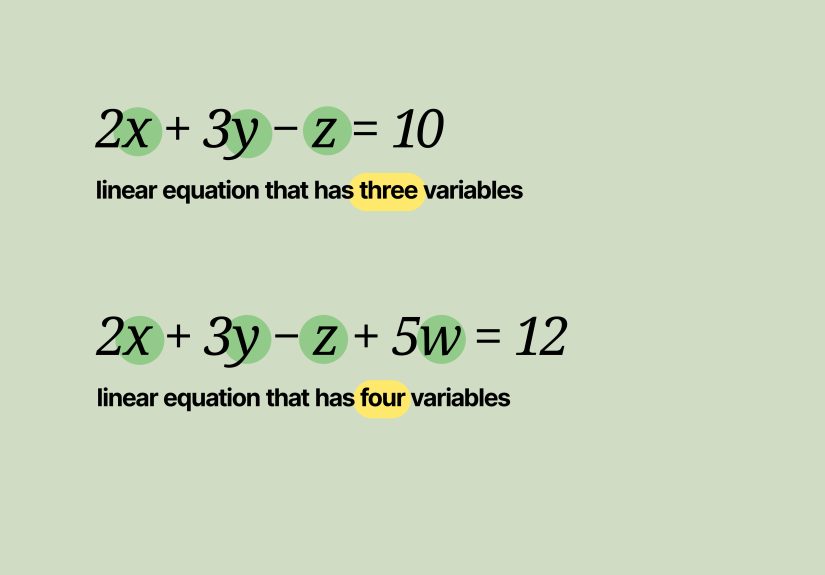
A multivariable linear equation is an equation with more than one unknown, such as 2x + 3y = 12 or x – 2y + z = 5. A single equation with multiple variables usually does not have one unique answer. Instead, you often need a system of linear equations, meaning two or more equations working together, to find values that satisfy all equations at the same time.
In this guide, we will explore 3 ways to solve multivariable linear equations in algebra: substitution, elimination, and matrix methods. Each method has its own personality. Substitution is the neat note-taker, elimination is the efficient problem-solver, and matrices are the spreadsheet-loving genius who shows up with a calculator and a plan.
What Are Multivariable Linear Equations?
A linear equation is an equation where each variable has an exponent of 1 and variables are not multiplied by each other. That means 3x + 4y = 10 is linear, but xy + 2 = 8 and x² + y = 9 are not linear.
When an equation has two or more variables, it becomes a multivariable equation. Common examples include:
- 2x + y = 7
- 3a – 5b + c = 12
- x + y + z = 6
To solve these equations, you are usually looking for an ordered pair, ordered triple, or larger set of values. For example, a solution to a two-variable system might be (x, y) = (2, 3). A solution to a three-variable system might be (x, y, z) = (1, 2, 3).
Why Systems Matter
A single equation like x + y = 10 has many solutions. If x is 1, y is 9. If x is 4, y is 6. If x is 10, y is 0. Algebra is generous like that.
But if you add another equation, such as x – y = 2, the possibilities shrink. Now you are looking for values that satisfy both equations at once. In this case, the solution is x = 6 and y = 4.
Systems of linear equations often show up in real-world problems involving prices, mixtures, distance, budgeting, business planning, science, and engineering. They help answer questions like: How many adult and child tickets were sold? How much of each ingredient should be mixed? How can two moving objects meet at the same point? Algebra may not cook dinner for you, but it can definitely help adjust the recipe.
Way 1: Solve by Substitution
How Substitution Works
The substitution method solves one equation for one variable, then substitutes that expression into another equation. It is especially useful when one variable already has a coefficient of 1 or -1, making it easy to isolate.
Think of substitution as replacing a mystery with a clue. Once you know what one variable equals, you plug that information into the other equation until only one variable remains.
Example of Substitution
Solve the system:
First, solve the first equation for x:
Now substitute 10 – y for x in the second equation:
Now substitute y = 4 back into one of the original equations:
So the solution is:
When to Use Substitution
Substitution works best when one equation is already solved for a variable, such as y = 2x + 1, or when a variable is easy to isolate. It is also a great beginner-friendly method because it shows the logic of solving systems step by step.
However, substitution can become messy when equations have large coefficients or fractions. If you find yourself surrounded by fractions like they are algebraic confetti, elimination may be a better choice.
Way 2: Solve by Elimination
How Elimination Works
The elimination method removes one variable by adding or subtracting equations. The goal is to create opposite coefficients so one variable disappears. It is a clean and powerful strategy, especially for systems where variables line up neatly in standard form.
Standard form usually looks like this:
For three variables, it looks like this:
With elimination, you combine equations in a way that cancels one variable. It is algebra’s version of saying, “You two cancel each other out, please leave the room.”
Example of Elimination with Two Variables
Solve the system:
Notice that 3y and -3y are opposites. Add the equations:
Now solve for x:
Substitute x = 4 into the first equation:
The solution is:
Example of Elimination with Three Variables
Now let’s look at a system with three variables:
Start by eliminating one variable from pairs of equations. Eliminate z by adding the first and third equations:
Next, eliminate z using the first and second equations. Subtract the first equation from the second:
Now solve the smaller two-variable system:
Solve the second equation for x:
Substitute into the first equation:
Then:
Finally, use the first original equation:
The solution is:
When to Use Elimination
Elimination is often the best method when equations are already arranged in standard form and the coefficients are easy to match. It is also excellent for three-variable systems because it can reduce the problem one variable at a time.
The main challenge is organization. One tiny arithmetic mistake can send the whole solution on a vacation to the wrong answer. Write each step clearly, line up your variables, and check your solution at the end.
Way 3: Solve Using Matrices
How Matrix Methods Work
Matrix methods are a structured way to solve systems of linear equations, especially when there are three or more variables. Instead of writing the variables over and over, you organize the coefficients and constants into an augmented matrix.
For example, the system:
can be written as the augmented matrix:
The goal is to use row operations to simplify the matrix until the solution becomes clear. This process is commonly called Gaussian elimination or Gauss-Jordan elimination, depending on how far you reduce the matrix.
The Three Basic Row Operations
Matrix solving relies on three legal moves:
- Switch two rows.
- Multiply a row by a nonzero number.
- Add or subtract a multiple of one row from another row.
These operations do not change the solution of the system. They simply rewrite the system in a more useful form. It is like reorganizing a messy backpack: same stuff, less chaos.
Why Matrices Are Useful
Matrices shine when a system has many variables. They also connect algebra to higher-level math, computer science, economics, statistics, physics, and engineering. Many calculators and software tools solve systems by using matrix-based methods behind the scenes.
Matrix methods are especially helpful because they are systematic. Once you learn the process, you can apply it to larger systems without inventing a new strategy every time. That makes matrices a favorite tool for anyone who likes repeatable steps and fewer “What now?” moments.
How to Know Which Method to Choose
Choosing the right method depends on the shape of the system. There is no award for using the most complicated method. In algebra, the best method is usually the one that gets you to the correct answer with the least drama.
Use Substitution When
- One equation is already solved for a variable.
- A variable has a coefficient of 1 or -1.
- The system has two variables and simple numbers.
Use Elimination When
- Equations are written in standard form.
- Coefficients already match or can easily be made to match.
- You are solving a system with three variables.
Use Matrices When
- The system has three or more variables.
- You want a highly organized method.
- You are using a calculator, spreadsheet, or computer algebra tool.
Common Types of Solutions
Not every system has one neat answer. Systems of linear equations can have different solution types:
One Solution
A system has one solution when all equations meet at exactly one point. For two variables, this means two lines intersect once. For three variables, it may mean three planes meet at one point.
No Solution
A system has no solution when the equations contradict each other. In two variables, this can happen when lines are parallel. For example:
The same expression cannot equal both 5 and 9 at the same time. Algebra may be flexible, but it is not that flexible.
Infinitely Many Solutions
A system has infinitely many solutions when equations describe the same relationship. For example:
The second equation is just the first equation multiplied by 2. They represent the same line, so every point on that line is a solution.
How to Check Your Answer
Checking your answer is not optional; it is the seat belt of algebra. Once you find values for the variables, substitute them into every original equation. If all equations are true, your solution works.
For example, if your solution is (x, y, z) = (1, 2, 3), check it in:
Substitute:
That equation checks out. Repeat the process for the other equations. If one does not work, go back and inspect your arithmetic. The error is often hiding in a sign change, because negative signs are tiny gremlins with excellent camouflage.
Practical Tips for Solving Multivariable Linear Equations
Keep Variables in the Same Order
Always line up variables consistently. If one equation is written as 2x + y – z = 4, try to keep the next equations in x, y, z order too. This makes elimination and matrices much easier.
Write Missing Variables with Zero Coefficients
If an equation is missing a variable, treat its coefficient as zero. For example:
can be written as:
This is especially important when creating matrices.
Avoid Rushing Fractions
Fractions are not scary, but they do demand respect. If fractions appear, slow down and simplify carefully. Many wrong answers are not caused by misunderstanding the method; they are caused by rushing through arithmetic.
Use Neat Work
Messy algebra is like trying to read a grocery list written during a roller-coaster ride. Give each step its own line. Label equations when solving larger systems. Clear work makes mistakes easier to find and correct.
Real-Life Uses of Multivariable Linear Equations
Multivariable linear equations are not just classroom decorations. They appear in everyday and professional situations where several unknowns interact.
In business, a company might use systems of equations to compare costs, revenue, and profit. In science, researchers may model relationships among variables in experiments. In engineering, systems help analyze forces, circuits, structures, and motion. In personal finance, they can help compare pricing plans or budget categories.
Even a simple shopping problem can become a system. Suppose you buy notebooks and pens. If you know the total number of items and the total price, you can create equations to find the cost or quantity of each item. Suddenly, algebra is standing in the checkout line with you, holding a calculator and judging your snack choices.
Experience-Based Notes: What Solving These Equations Feels Like in Practice
One of the most useful experiences when learning how to solve multivariable linear equations is realizing that the method matters less than the structure. Many students begin by asking, “Which formula do I use?” But systems of equations are often more about strategy than memorization. The equations themselves usually give clues. If one equation says y = 3x – 2, substitution is practically waving from across the room. If two equations contain +4y and -4y, elimination is already halfway done.
Another common experience is making one small arithmetic mistake and watching the entire solution collapse like a folding chair at a picnic. This is normal. It does not mean you are bad at algebra. It means algebra is very good at punishing tiny errors. The best fix is to slow down at the boring parts. Most mistakes happen not during the “big idea” step, but during simple arithmetic: distributing a negative sign, adding fractions, or copying a number incorrectly.
It also helps to develop the habit of checking solutions. At first, checking may feel like extra work, especially after you have already wrestled the problem into submission. But checking is where confidence comes from. When your values satisfy every original equation, you know the answer is correct. That feeling is surprisingly satisfying, like finding matching socks straight from the dryer.
When working with three-variable systems, organization becomes the secret weapon. Label equations as Equation 1, Equation 2, and Equation 3. Write down which variable you are eliminating. Keep your reduced two-variable equations separate from the original system. This prevents the classic “Where did that equation come from?” moment, which is rarely fun and usually happens five minutes before homework is due.
Matrices may feel intimidating at first because they look more advanced. But many learners eventually find them easier because matrices remove repeated writing. Instead of carrying x, y, and z through every step, you focus on coefficients. This can make large systems cleaner. The tradeoff is that matrix methods require careful row operations. One row accidentally changed in the wrong way can create a solution that looks official but is completely false. Algebra wearing a suit is still algebra.
In practice, the strongest students are not the ones who memorize the most steps. They are the ones who pause before solving and ask, “What is the easiest path?” Sometimes that path is substitution. Sometimes it is elimination. Sometimes it is a matrix. The goal is not to impress the equation. The equation does not care. The goal is to solve accurately, clearly, and efficiently.
The best way to improve is to practice mixed problems instead of only one type. If you only practice substitution problems, you may start trying to substitute everything, even when elimination would be faster. If you only practice elimination, you may miss easy substitution opportunities. Mixed practice builds judgment. Over time, you begin to recognize patterns automatically.
Finally, remember that solving multivariable linear equations is a skill that improves with repetition. The first few systems may feel slow. That is expected. With practice, the steps become familiar, the arithmetic becomes steadier, and the methods start to feel less like tricks and more like tools. And once the tools are in your hands, algebra becomes much less mysterious.
Conclusion
Learning 3 ways to solve multivariable linear equations in algebra gives you flexibility and confidence. Substitution helps when one variable is easy to isolate. Elimination is efficient when coefficients line up neatly. Matrix methods provide a powerful structure for larger systems.
The key is not to memorize blindly, but to understand what each method is doing. You are reducing complexity, one step at a time, until the unknowns become known. That is the heart of algebra: turning confusion into clarity, preferably with fewer fractions and fewer dramatic sighs.
Whether you are preparing for a test, helping with homework, or building a stronger foundation for advanced math, mastering these methods will make systems of equations much easier to handle. Start with clean organization, choose the method that fits the system, and always check your answer. Your future algebra self will thank you.
SEO Tags
Note: This article is written in original, standard American English and synthesized from widely accepted algebra concepts used in reputable educational resources.