Table of Contents >> Show >> Hide
- What Are Ionic Compounds, Exactly?
- Way 1: Write Simple Binary Ionic Compounds
- Way 2: Write Ionic Compounds with Variable-Charge Metals
- Way 3: Write Ionic Compounds with Polyatomic Ions
- Common Mistakes to Avoid
- A Quick Practice Set
- Why Learning to Write Ionic Compounds Matters
- Experience Corner: What Learning Ionic Compounds Usually Feels Like
- Conclusion
If ionic compounds have ever made you stare at a chemistry worksheet like it personally offended you, welcome to the club. At first glance, these compounds look like a jumble of capital letters, tiny numbers, and the occasional Roman numeral that seems to have wandered in from ancient history. But once you understand the pattern, writing ionic compounds becomes much less mysterious and a lot more mechanical in the best possible way.
The good news is that most ionic compounds follow a small set of predictable rules. You identify the positive ion, identify the negative ion, make sure the charges balance to zero, and write the cation first. That is the backbone. From there, the work usually falls into three common situations: writing simple binary ionic compounds, writing compounds with metals that can have more than one charge, and writing compounds that contain polyatomic ions. Master those three, and chemistry class gets noticeably less dramatic.
In this guide, we will walk through all three ways to write ionic compounds, show you how to name them correctly, and point out the mistakes that trip up students most often. We will also add plenty of examples, because chemistry is much kinder when it comes with receipts.
What Are Ionic Compounds, Exactly?
An ionic compound forms when positively charged ions, called cations, combine with negatively charged ions, called anions. The total charge must equal zero, which is why chemistry teachers keep repeating the phrase “balance the charges” like it is a sacred chant. In many introductory examples, the cation is a metal and the anion is a nonmetal, although some ionic compounds also contain polyatomic ions such as sulfate, nitrate, hydroxide, or ammonium.
Before you write anything, remember these core rules:
- The cation goes first, and the anion goes second.
- The final compound must be electrically neutral.
- You do not write the ion charges in the finished compound formula.
- You use subscripts to show how many ions are needed.
- You do not use Greek prefixes like mono-, di-, or tri- for ordinary ionic compounds.
Once those rules are locked in, the rest becomes pattern recognition.
Way 1: Write Simple Binary Ionic Compounds
The first and easiest category is the binary ionic compound. “Binary” just means the compound contains two elements: one positive ion and one negative ion. Think of classics like sodium chloride, magnesium oxide, or calcium fluoride. These are the chemistry equivalent of learning to ride a bike in an empty parking lot. No traffic. No chaos. Just fundamentals.
How to Write the Formula
Start by writing the symbol for the cation first, followed by the symbol for the anion. Then use the charges on those ions to determine how many of each you need so that the net charge equals zero.
Example 1: Sodium chloride
Sodium forms Na+. Chloride is Cl–. One positive charge balances one negative charge, so the formula is NaCl.
Example 2: Magnesium oxide
Magnesium forms Mg2+. Oxide is O2-. The charges already cancel in a one-to-one ratio, so the formula is MgO.
Example 3: Aluminum oxide
Aluminum forms Al3+. Oxide is O2-. To balance the charges, you need two aluminum ions for every three oxide ions. That gives you Al2O3.
A lot of students use the crossover trick here, where the magnitude of one ion’s charge becomes the subscript of the other ion. That can work as a shortcut, but only if you simplify when necessary. For example, calcium oxide is not Ca2O2; it simplifies to CaO.
How to Name the Compound
Naming a binary ionic compound is usually refreshingly boring, which is chemistry’s way of being nice. Use the name of the metal first, then change the nonmetal ending to -ide.
Examples:
- NaCl = sodium chloride
- MgBr2 = magnesium bromide
- K2S = potassium sulfide
- CaF2 = calcium fluoride
Notice what you do not do: you do not call CaF2 “calcium difluoride.” That prefix habit belongs to covalent compounds, not ionic ones. Ionic compounds care about charge balance, not prefix theater.
Way 2: Write Ionic Compounds with Variable-Charge Metals
This is where students often go from “I totally get this” to “Why is iron doing different things on different worksheets?” Some metals, especially many transition metals, can form more than one possible charge. Iron can be Fe2+ or Fe3+. Copper can be Cu+ or Cu2+. Tin can be Sn2+ or Sn4+. Chemistry loves options, even when students do not.
When a metal can have more than one charge, the compound name includes a Roman numeral in parentheses to show the metal’s charge. That numeral is not decorative. It is the clue that tells you how to write the correct formula.
How to Write the Formula from the Name
Example 1: Iron(III) chloride
Iron(III) means Fe3+. Chloride is Cl–. To make the compound neutral, you need three chloride ions for one iron ion. The formula is FeCl3.
Example 2: Copper(I) oxide
Copper(I) means Cu+. Oxide is O2-. Two copper ions balance one oxide ion, so the formula is Cu2O.
Example 3: Tin(IV) sulfide
Tin(IV) is Sn4+. Sulfide is S2-. The lowest whole-number ratio is one tin ion to two sulfide ions? Not quite. One Sn4+ and two S2- would total -4 and +4, yes, but that gives SnS2, which is already the simplest ratio. So the formula is SnS2.
How to Name the Compound from the Formula
If the formula is given, you may need to work backward and determine the metal’s charge. The anion charge is usually fixed, so you use the subscripts to calculate the cation charge.
Example: Fe2O3
Each oxide ion is O2-. Three oxide ions give a total negative charge of -6. Since there are two iron ions, the total positive charge must be +6, which means each iron ion is Fe3+. The name is iron(III) oxide.
Example: CuCl2
Each chloride ion is Cl–. Two chloride ions total -2. Therefore copper must be Cu2+. The name is copper(II) chloride.
This step is where many learners rush and guess. Resist the urge. Roman numerals in ionic nomenclature are earned through math, not vibes.
Way 3: Write Ionic Compounds with Polyatomic Ions
Now we arrive at the category that makes chemistry notes suddenly look crowded: polyatomic ions. These are groups of atoms bonded together that act as a single charged unit. Common examples include nitrate (NO3–), sulfate (SO42-), carbonate (CO32-), hydroxide (OH–), phosphate (PO43-), and ammonium (NH4+).
The key here is simple: treat the polyatomic ion as one unit. Do not break it apart just because it looks busy. Chemistry is already dramatic enough.
How to Write the Formula
Example 1: Calcium nitrate
Calcium is Ca2+. Nitrate is NO3–. Two nitrates are needed to balance the +2 charge, so the formula is Ca(NO3)2.
Example 2: Ammonium sulfate
Ammonium is NH4+. Sulfate is SO42-. Two ammonium ions are needed, so the formula is (NH4)2SO4.
Example 3: Aluminum phosphate
Aluminum is Al3+. Phosphate is PO43-. The charges cancel in a one-to-one ratio, so the formula is AlPO4.
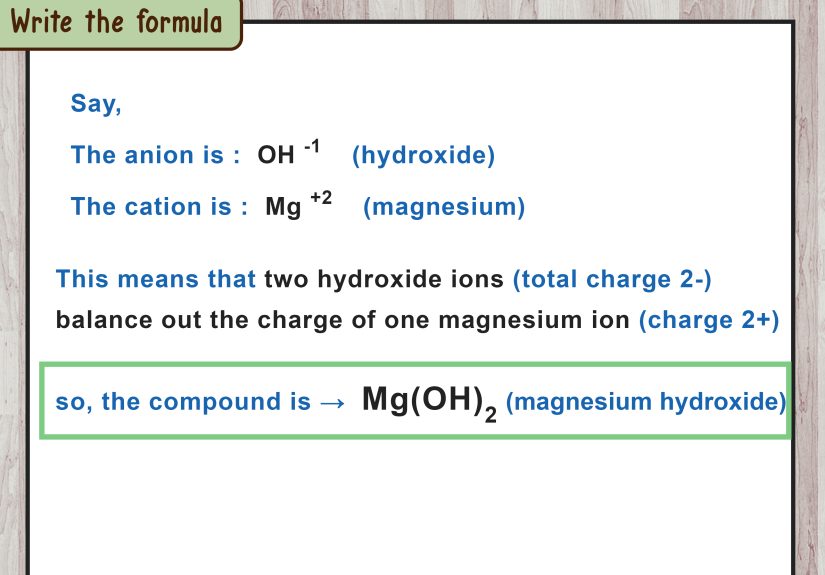
Notice the parentheses in Ca(NO3)2 and (NH4)2SO4. You use parentheses only when you need more than one of the same polyatomic ion. If there is just one sulfate, you write SO4, not (SO4). Parentheses are helpful, not ornamental.
How to Name the Compound
Naming compounds with polyatomic ions is straightforward once you know the ion names. Say the cation first, then the polyatomic anion name as it appears on the ion chart.
- NaNO3 = sodium nitrate
- KOH = potassium hydroxide
- (NH4)3PO4 = ammonium phosphate
- FeSO4 = iron(II) sulfate
Polyatomic ions also come with naming patterns that help you survive quizzes. In many oxyanions, -ate means more oxygen and -ite means fewer oxygen atoms. Prefixes like per- and hypo- can also appear in some ion families. Once you get used to nitrate versus nitrite or sulfate versus sulfite, those names stop feeling random and start feeling annoyingly logical.
Common Mistakes to Avoid
Even students who understand the rules can still make small errors that wreck the final answer. Here are the usual suspects:
- Forgetting charge balance: Every ionic compound must have a total charge of zero.
- Using prefixes: “Dicalcium chloride” is not a thing. Please do not invent it.
- Skipping Roman numerals: Iron chloride is incomplete if iron can have multiple charges.
- Misusing parentheses: MgSO4 is correct, not Mg(SO4).
- Not simplifying subscripts: Ca2O2 should be CaO.
- Breaking apart polyatomic ions: Nitrate stays nitrate. It does not become “N and O doing their own thing.”
A Quick Practice Set
Try these in your head, or at least pretend to before checking the answers.
Write the Formulas
- sodium sulfide = Na2S
- iron(III) bromide = FeBr3
- calcium carbonate = CaCO3
- copper(II) nitrate = Cu(NO3)2
Name the Compounds
- Li3N = lithium nitride
- PbO2 = lead(IV) oxide
- NaHCO3 = sodium hydrogen carbonate or sodium bicarbonate
- Fe3(PO4)2 = iron(II) phosphate
If you got most of those right, congratulations. You and ionic compounds are no longer enemies. Maybe cautious coworkers.
Why Learning to Write Ionic Compounds Matters
Ionic nomenclature is not just a classroom obstacle course. It is the language used to describe salts, minerals, laboratory reagents, medications, water-treatment chemicals, fertilizers, batteries, and countless industrial materials. If you cannot tell the difference between iron(II) chloride and iron(III) chloride, you are not just missing a tiny detail. You are talking about different substances with different chemical behavior.
That is why chemistry courses spend so much time drilling these rules. Writing ionic compounds trains you to connect names, charges, formulas, and patterns. It sharpens the part of your brain that sees structure instead of confusion. And once that skill clicks, later topics like reaction writing, solubility rules, and stoichiometry suddenly become much more manageable.
Experience Corner: What Learning Ionic Compounds Usually Feels Like
For a lot of students, the first experience with ionic compounds is oddly emotional for something involving metal ions. Day one usually starts with confidence. “Okay, sodium chloride, sure, I have met table salt before.” Then the worksheet escalates. Suddenly you are facing iron(III) phosphate, ammonium sulfate, copper(I) oxide, and something with parentheses that looks like chemistry is now sending passive-aggressive messages. That turning point is common.
One of the most relatable experiences is realizing that memorizing a few ion charges can save an absurd amount of time. Students often struggle at first because they treat every problem like a brand-new puzzle. After a while, patterns begin to repeat. Group 1 metals are usually +1. Group 2 metals are usually +2. Chloride is -1. Oxide is -2. Sulfate is -2. Nitrate is -1. Once those become familiar, writing formulas feels less like decoding a secret language and more like assembling something from known parts.
Another common experience is the dreaded Roman numeral mistake. Nearly everyone has had that moment of writing “iron oxide,” feeling pretty proud, and then discovering that the answer is incomplete because iron can have more than one charge. That small correction teaches a big lesson: chemistry rewards precision. It is not enough to be vaguely correct. You have to be specifically correct. Annoying? Sometimes. Useful? Absolutely.
Then there is the polyatomic-ion phase, where students often say some version of, “So I am just supposed to remember all of these?” The honest answer is: not all of them at once, and not perfectly on day one. Most learners get better when they stop trying to memorize one giant list and instead group ions by families and patterns. Nitrate and nitrite. Sulfate and sulfite. Phosphate and hydrogen phosphate. Ammonium as the major positive polyatomic ion. Those patterns turn a wall of information into smaller, more manageable pieces.
Tutoring sessions and study groups also reveal something interesting: students improve fastest when they say the logic out loud. “This ion is +2, this one is -1, so I need two of the anion.” Speaking the process makes fewer careless mistakes. It slows the brain down just enough to stop writing CaCl when the answer should be CaCl2. Chemistry may not care about your feelings, but it definitely punishes rushing.
There is also a satisfying moment that nearly every chemistry learner reaches. It happens when a formula that once looked intimidating becomes obvious at a glance. You see Cu(NO3)2 and immediately think, “Copper(II) nitrate.” You see Fe2O3 and know how to calculate the iron charge without panic. That shift feels small, but it is a real sign of progress. It means you are no longer memorizing isolated answers. You are understanding the system.
In the end, writing ionic compounds is one of those skills that starts out awkward, gets repetitive, and then becomes strangely satisfying. The students who improve most are usually not the ones with magical chemistry instincts. They are the ones who practice the rules, check the charges, learn a core set of common ions, and stay patient through the messy middle. So if ionic compounds feel clunky right now, that does not mean you are bad at chemistry. It usually just means you are still at the normal part where learning looks like effort. Keep going. The formulas really do start to make sense.
Conclusion
Writing ionic compounds gets much easier when you stop viewing it as a giant chemistry mystery and start treating it as a three-part system. First, learn how to write simple binary ionic compounds by balancing the charges between a metal and a nonmetal. Second, pay close attention to variable-charge metals and use Roman numerals correctly. Third, treat polyatomic ions as intact units and use parentheses only when more than one of that ion is needed. Those three methods cover most of the ionic-compound questions students see in general chemistry.
If you keep the cation first, make the total charge zero, and avoid unnecessary extras like prefixes or random parentheses, you will be in solid shape. Chemistry may still have a few tricks left, but at least ionic compounds will not be one of them.