Table of Contents >> Show >> Hide
- Why Change a Fraction Into a Decimal?
- Method 1: Use Division
- Method 2: Make an Equivalent Fraction With a Denominator of 10, 100, or 1,000
- Method 3: Use Common Fraction Benchmarks
- Method 4: Use a Calculator the Smart Way
- How to Know Whether a Decimal Will Terminate or Repeat
- What About Mixed Numbers?
- Common Mistakes to Avoid
- Quick Practice Examples
- Why This Skill Matters Beyond the Classroom
- Conclusion
- Experiences Related to Learning How to Change a Common Fraction Into a Decimal
- SEO Tags
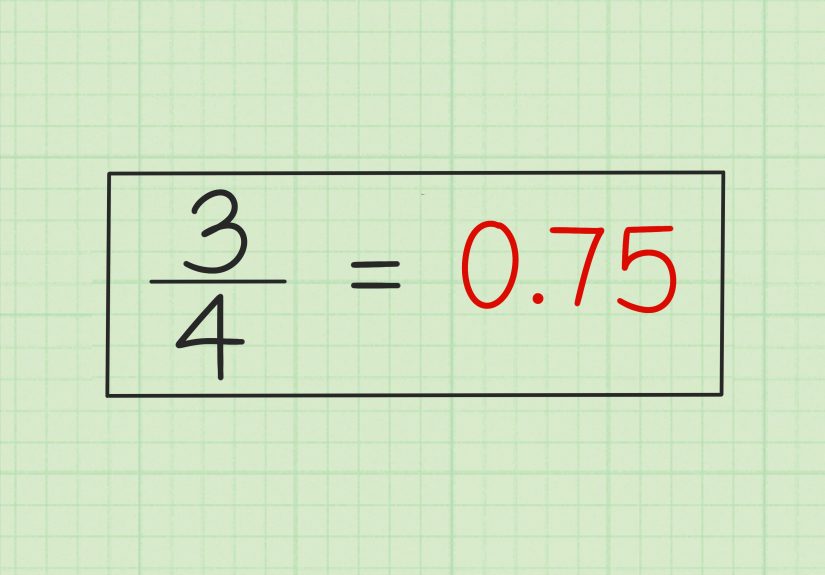
If fractions have ever made you feel like math is speaking in riddles, you are not alone. One minute you are staring at 3/4, and the next you are expected to know it is 0.75 without blinking. Rude. Fortunately, learning how to change a common fraction into a decimal is much easier once you know the patterns. In fact, there is more than one way to do it, which is great news for anyone who likes options and dislikes being trapped in a single math strategy.
In this guide, you will learn 4 ways to change a common fraction into a decimal, when each method works best, how to spot terminating and repeating decimals, and how to avoid the mistakes that love to show up right before a quiz. Whether you are a student, a parent helping with homework, or an adult trying to remember middle school math without breaking into a sweat, this article will walk you through it step by step.
Why Change a Fraction Into a Decimal?
Fractions and decimals are just two different ways to show the same value. Think of them as math’s version of two people giving the same directions with totally different personalities. Fractions are useful when you want to show exact parts of a whole, while decimals are often easier for comparing amounts, measuring money, reading data, and using calculators.
For example, it is often faster to compare 0.6 and 0.75 than to compare 3/5 and 3/4. Decimals also pop up everywhere in real life, including shopping, test scores, carpentry, science labs, and recipes. So yes, this skill really does escape the classroom and start freeloading in everyday life.
Method 1: Use Division
How it works
The most reliable way to change a fraction into a decimal is to divide the numerator by the denominator. In plain English, the top number goes inside the division symbol, and the bottom number goes outside.
If the division does not come out evenly at first, add a decimal point and zeros to keep going. That lets you find the decimal value instead of stopping with a remainder.
Example 1: Convert 3/4 into a decimal
Divide 3 by 4:
3 ÷ 4 = 0.75
So, 3/4 = 0.75.
Example 2: Convert 2/3 into a decimal
Divide 2 by 3:
2 ÷ 3 = 0.6666…
This decimal does not end. It repeats, so it is written as 0.666… or 0.6.
When to use this method
Use division when you want a method that always works. It is especially helpful for fractions like 7/12, 5/6, or 11/16, where turning the denominator into 10 or 100 is not the easiest route.
Method 2: Make an Equivalent Fraction With a Denominator of 10, 100, or 1,000
How it works
Some fractions are easy to convert because you can rewrite them as equivalent fractions with denominators like 10, 100, or 1,000. Once you do that, the decimal form is basically staring you in the face.
This method works best when the denominator can be multiplied by a whole number to become a power of 10.
Example 1: Convert 3/5 into a decimal
Ask yourself: what can you multiply 5 by to get 10?
5 × 2 = 10
Now multiply both top and bottom by 2:
3/5 = 6/10 = 0.6
Example 2: Convert 7/8 into a decimal
You cannot turn 8 into 10 with a whole number, but you can turn it into 1,000:
8 × 125 = 1,000
Multiply both numerator and denominator by 125:
7/8 = 875/1000 = 0.875
Example 3: Convert 11/25 into a decimal
Multiply 25 by 4 to get 100:
11/25 = 44/100 = 0.44
When to use this method
This is the speed-run method. Use it for fractions with denominators like 2, 4, 5, 8, 20, 25, 50, and sometimes 125. When it works, it is cleaner than long division and a lot less dramatic.
Method 3: Use Common Fraction Benchmarks
How it works
Some fractions appear so often that it makes sense to memorize their decimal forms. These common fraction to decimal conversions become mental shortcuts, and they save a surprising amount of time on homework, shopping math, and standardized tests.
Common fraction benchmarks worth knowing
1/2 = 0.5
1/4 = 0.25
3/4 = 0.75
1/5 = 0.2
2/5 = 0.4
3/5 = 0.6
4/5 = 0.8
1/8 = 0.125
3/8 = 0.375
5/8 = 0.625
7/8 = 0.875
Why this method helps
Once you know a few benchmark conversions, other fractions become easier too. For example, if you know 1/4 = 0.25, then 2 1/4 = 2.25 is easy. If you know 1/8 = 0.125, then 3/8 = 3 × 0.125 = 0.375.
This method is not about avoiding math. It is about becoming faster at it. Your brain loves patterns. Give it good ones.
Method 4: Use a Calculator the Smart Way
How it works
Yes, you can absolutely use a calculator. Just enter the numerator, press the division symbol, then enter the denominator. The screen will show the decimal.
Example
To convert 5/16 into a decimal, type:
5 ÷ 16 = 0.3125
Why this still counts as a method
Because real life has calculators. So do phones. So do computers. So does that one student in class who somehow always finishes first and pretends they “just guessed.”
That said, do not let the calculator do all the thinking. You still need to know whether the answer makes sense. For instance, 3/4 should be less than 1, so if your calculator says 7.5, something has gone terribly off the rails.
How to Know Whether a Decimal Will Terminate or Repeat
This is one of the most useful patterns in fraction-to-decimal conversion.
A decimal will terminate if the denominator, in simplest form, has only the prime factors 2 and/or 5.
Examples:
1/2 = 0.5 because 2 is a factor of 10
3/20 = 0.15 because 20 = 2 × 2 × 5
7/25 = 0.28 because 25 = 5 × 5
A decimal will repeat if the denominator has any prime factor other than 2 or 5.
Examples:
1/3 = 0.333…
5/6 = 0.8333…
4/11 = 0.363636…
This rule is incredibly helpful because it tells you what kind of answer to expect before you even start dividing.
What About Mixed Numbers?
A mixed number includes a whole number and a fraction, such as 2 3/4. You can convert it in two easy ways.
Option 1: Convert the fraction part only
3/4 = 0.75
So, 2 3/4 = 2.75
Option 2: Turn it into an improper fraction
2 3/4 = 11/4
Now divide:
11 ÷ 4 = 2.75
Both approaches work. Choose the one that feels less annoying in the moment.
Common Mistakes to Avoid
1. Dividing the wrong way
The numerator is divided by the denominator, not the other way around. For 3/4, it is 3 ÷ 4, not 4 ÷ 3.
2. Forgetting to simplify first
Sometimes simplifying helps you see the pattern faster. For example, 6/12 simplifies to 1/2, which is 0.5.
3. Misplacing the decimal point
When changing fractions like 44/100 into decimals, be careful with place value. 44/100 = 0.44, not 4.4.
4. Ignoring repeating decimals
Not every fraction becomes a neat, tidy decimal. Some keep going forever in a pattern, and that is perfectly normal.
Quick Practice Examples
Convert these common fractions into decimals
1/2 = 0.5
3/5 = 0.6
7/10 = 0.7
9/20 = 0.45
5/8 = 0.625
2/3 = 0.666…
4/11 = 0.363636…
The more examples you practice, the more natural the conversions feel. Eventually, many of them become instant recognition rather than full-on calculation.
Why This Skill Matters Beyond the Classroom
Changing a common fraction into a decimal is not just a school exercise. It shows up in prices, measurements, sports stats, medicine dosages, construction plans, and recipes. If a recipe says 3/4 cup, knowing that it is 0.75 helps when you use digital scales or measuring tools. If a tool measurement reads 5/8 inch, it helps to know that it is 0.625. If a discount is written as 1/4 off, recognizing that as 0.25 helps you calculate savings fast.
In short, fractions and decimals are both useful. But being able to move between them makes you more flexible, more accurate, and much less likely to panic when a worksheet suddenly decides to “mix formats for challenge.”
Conclusion
There is no single best way to change a fraction into a decimal. The best method depends on the fraction in front of you and how quickly you want the answer. Division is the universal method. Equivalent fractions are the shortcut stars. Benchmark fractions save time through memory. And calculators are useful as long as your brain still stays on the payroll.
If you remember one big idea, make it this: a fraction is another way to write division. Once that clicks, converting fractions to decimals becomes far less mysterious and much more manageable. And honestly, that is a lovely outcome for something involving both slashes and long division.
Experiences Related to Learning How to Change a Common Fraction Into a Decimal
One of the funniest things about learning fractions and decimals is that the skill often makes no emotional sense at first, then suddenly starts showing up everywhere. In classrooms, students often meet fraction-to-decimal conversion as a rule on a worksheet. It can feel random, mechanical, and slightly suspicious, like math invented one more step just to keep everyone humble. But once people start seeing where the skill appears in daily life, it stops feeling like a chore and starts feeling like a useful little superpower.
A common experience happens in the kitchen. Someone sees 3/4 cup on a measuring cup, then notices a food scale showing decimal values, and suddenly the brain starts connecting dots. Fractions are on one tool, decimals are on another, and both are trying to describe the same amount. That moment is huge because it turns an abstract idea into something tangible. The same thing happens in woodworking, sewing, or home improvement. A tape measure may show 1/2, 1/4, or 1/8, while a calculator or digital plan may use decimals. Once learners realize they are converting between two languages for the same measurement, the topic feels less like school math and more like practical thinking.
Another common experience is the confidence boost that comes from memorizing benchmark fractions. At first, people divide every single problem. Then they begin recognizing that 1/2 is 0.5, 1/4 is 0.25, and 3/4 is 0.75 without even thinking. That shift feels surprisingly rewarding. What used to require pencil, paper, and a tiny sigh now takes about two seconds. Learners often describe that stage as the point when math finally starts to feel faster instead of heavier.
There is also the very real experience of confusion around repeating decimals. Many people are perfectly happy converting 1/2 into 0.5, then become deeply offended when 2/3 turns into 0.666…. It feels unfinished, even though it is completely correct. But that confusion usually becomes an important learning moment. People begin to understand that not every decimal ends neatly, and that repeating patterns are part of how rational numbers behave. Oddly enough, that realization often makes students more relaxed. Once they know a repeating decimal is normal, they stop thinking they made a mistake every time the digits keep going.
Teachers and parents also notice that learning multiple methods helps different types of learners. Some people love long division because it is systematic. Others prefer equivalent fractions because it feels cleaner. Some thrive on memorized benchmarks. Others rely on calculators but use estimation to check whether the answer is reasonable. The best experience usually comes when learners realize they are allowed to choose the method that makes sense to them. That flexibility makes the topic more approachable and a lot less intimidating.
Over time, converting fractions into decimals becomes one of those skills people stop noticing because it becomes automatic. And that may be the best sign of real learning. What once looked like a strange math puzzle turns into a quick mental habit used in class, at work, in stores, in recipes, and in everyday problem-solving. Not bad for a skill that started with a fraction staring back from a page and daring everyone to divide it.