Table of Contents >> Show >> Hide
- Why Learning English Question Forms Matters
- 1. Forming Yes/No Questions
- 2. Forming Wh- Questions
- 3. Forming Tag Questions
- 4. Forming Indirect Questions
- Common Mistakes When Forming Questions in English
- Simple Tips to Master Question Formation
- What Real Learners Often Experience With English Questions
- Final Thoughts
- SEO Tags
Asking questions in English sounds easy until your brain suddenly decides to juggle five grammar balls at once. You know the moment: you want to say something simple like “Where is the bathroom?” and your mouth tries “Where the bathroom is?” English question formation can feel like a game show where the prize is basic communication and the penalty is awkward silence.
The good news is that English questions are not random. They follow recognizable patterns. Once you understand the main structures, you can ask questions more naturally in conversations, emails, meetings, classrooms, and everyday life. Better still, you will stop sounding like a robot that swallowed a grammar workbook.
In this guide, we’ll break down four common ways to form a question in English: yes/no questions, wh- questions, tag questions, and indirect questions. Along the way, we’ll look at grammar rules, easy formulas, common mistakes, and realistic examples. If you’ve ever wondered why English sometimes says Do you like coffee? but sometimes says Who called?, you’re in the right place.
Why Learning English Question Forms Matters
If statements are the bricks of English, questions are the doors. They help you open conversations, get information, show interest, solve problems, and avoid wandering around a train station pretending you totally know where you’re going. In real life, strong question skills matter because they help you do all of the following:
- start and maintain conversations
- ask for directions, help, and clarification
- participate in class or at work
- sound more polite and confident
- understand formal and informal English better
Once you see the patterns, question formation becomes much less mysterious. Let’s look at the four big ones.
1. Forming Yes/No Questions
Yes/no questions are questions that can usually be answered with yes or no. These are often the first question types English learners meet, and for good reason: they are everywhere.
The basic pattern
In many yes/no questions, an auxiliary verb comes before the subject.
Formula: Auxiliary verb + subject + main verb?
- Do you live here?
- Did she finish the report?
- Have they arrived?
- Can he swim?
- Will we need tickets?
When to use do, does, and did
Here is where English gets a little dramatic. If the main verb is in the simple present or simple past, and it is not a form of to be, English usually uses do-support.
- You like pizza. → Do you like pizza?
- She likes pizza. → Does she like pizza?
- They went home. → Did they go home?
Notice something sneaky: after does or did, the main verb goes back to its base form.
- Correct: Does she like coffee?
- Incorrect: Does she likes coffee?
Questions with the verb to be
When the main verb is a form of to be, you do not need do. You simply invert the verb and the subject.
- She is ready. → Is she ready?
- They were late. → Were they late?
This is one of the nicest parts of English grammar. No extra helper. No drama. Just a clean flip.
2. Forming Wh- Questions
Wh- questions ask for specific information instead of a yes-or-no answer. They usually begin with words like who, what, where, when, why, which, whose, and how.
The basic pattern
Formula: Wh-word + auxiliary verb + subject + main verb?
- Where do you work?
- Why did she leave early?
- How can I help you?
- What have they decided?
This structure is similar to yes/no questions, but it adds a question word at the beginning.
When the wh-word is the subject
Now for one of the most important rules in English question forms: if the wh-word is the subject of the sentence, you usually do not use do-support or normal inversion.
- Someone called. → Who called?
- Something happened. → What happened?
- Someone wants dessert. → Who wants dessert?
That is why Who did call? sounds odd in normal conversation unless you are adding strong emphasis. English is basically saying, “Relax, the question word is already doing enough work.”
Common wh- question mistakes
- Incorrect: Where you are going?
- Correct: Where are you going?
- Incorrect: Why she left?
- Correct: Why did she leave?
- Incorrect: What did happened?
- Correct: What happened?
If you are not sure, ask yourself two things: Is there an auxiliary verb? And is the wh-word the subject? Those two questions solve a lot of headaches.
3. Forming Tag Questions
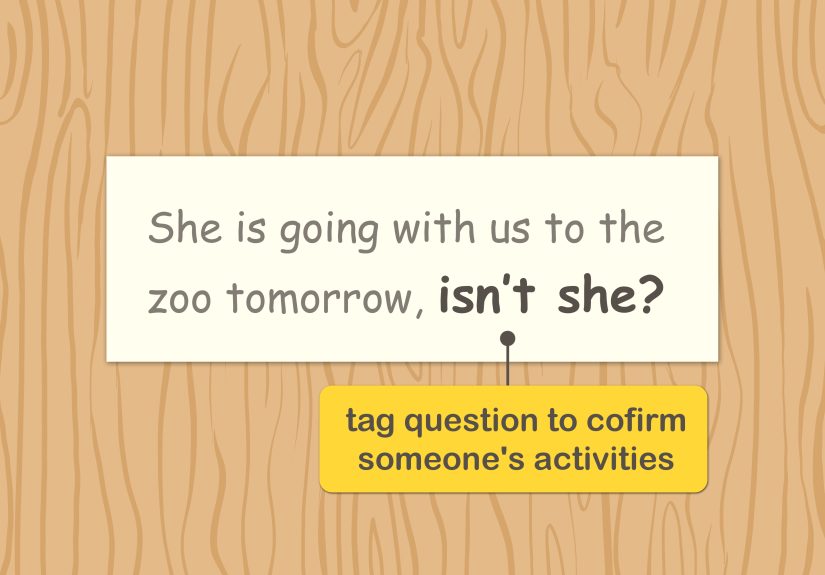
Tag questions turn a statement into a short question. They are extremely common in spoken English and are often used to check information, invite agreement, or keep a conversation flowing.
The basic pattern
Formula: Statement, auxiliary verb + pronoun?
- You’re coming, aren’t you?
- She can drive, can’t she?
- They left already, didn’t they?
The positive-negative rule
In standard English, a positive statement usually takes a negative tag, and a negative statement usually takes a positive tag.
- He is your brother, isn’t he?
- She isn’t tired, is she?
- You like tea, don’t you?
- They didn’t call, did they?
Match the auxiliary and the tense
The tag should match the verb in the statement. If the statement does not already have an auxiliary verb, use do, does, or did.
- Mark plays guitar, doesn’t he?
- The kids laughed, didn’t they?
There is also one famously weird exception:
- I’m late, aren’t I?
Yes, it looks strange. Yes, native speakers still use it. English sometimes enjoys being “special.”
4. Forming Indirect Questions
Indirect questions are often more polite and softer than direct questions. They are useful in customer service, professional writing, formal conversations, and basically any situation where you do not want to sound like a police detective.
The basic idea
An indirect question usually begins with a phrase such as:
- Could you tell me…
- Do you know…
- I was wondering…
- Can you explain…
- Would you mind telling me…
After that opening phrase, the embedded question usually uses statement word order, not direct-question order.
- Direct: Where is the nearest bank?
- Indirect: Could you tell me where the nearest bank is?
- Direct: When does the class start?
- Indirect: Do you know when the class starts?
This is one of the biggest mistakes learners make. They keep the direct-question order inside the indirect question.
- Incorrect: Could you tell me where is the station?
- Correct: Could you tell me where the station is?
Do indirect questions always end with a question mark?
Not always. It depends on the whole sentence.
- Question mark: Could you tell me where the station is?
- Period: I wonder where the station is.
So the embedded clause is indirect, but the full sentence may still be a direct question if it begins with something like Could you tell me…?
Common Mistakes When Forming Questions in English
Even advanced learners sometimes trip over the same banana peels. Here are the most common problems:
1. Forgetting the auxiliary verb
Incorrect: You like this movie?
Correct: Do you like this movie?
2. Using the wrong verb form after does or did
Incorrect: Did she went home?
Correct: Did she go home?
3. Mixing direct and indirect word order
Incorrect: Can you tell me where are my keys?
Correct: Can you tell me where my keys are?
4. Misbuilding tag questions
Incorrect: He is tired, doesn’t he?
Correct: He is tired, isn’t he?
5. Overusing whom
Whom is still correct in some formal situations, especially after prepositions, but in everyday speech many people simply use who. If your goal is clear, natural modern English, accuracy matters more than sounding like a Victorian butler.
Simple Tips to Master Question Formation
- Memorize patterns, not just rules. Learn chunks like Do you…?, Where do…?, Could you tell me…?, and isn’t it?
- Practice with transformation drills. Turn statements into questions. Example: She works here. → Does she work here?
- Listen to real English. Movies, podcasts, interviews, and everyday dialogue are full of question forms.
- Read your questions out loud. If the rhythm sounds wrong, the structure may be wrong too.
- Pay attention to politeness. Direct questions are fine with friends. Indirect questions are often better in formal or unfamiliar settings.
What Real Learners Often Experience With English Questions
One of the most interesting things about learning how to form questions in English is that progress often arrives in small, slightly embarrassing episodes. Many learners first discover the importance of question order not in a textbook, but in real life. Someone asks for directions, you try to respond, and suddenly your brain offers three versions at once: Where you go?, Where are you going?, and a silent panic-induced smile. That moment may feel awkward, but it is also where real learning begins.
In classrooms, students often do well on grammar exercises and then freeze in live conversation. On paper, Does he work here? seems easy. In conversation, though, learners are busy thinking about vocabulary, pronunciation, confidence, and whether the other person is speaking at the speed of a caffeinated auctioneer. Because of that, many students accidentally drop the helper verb and say things like He work here? This is common, normal, and fixable.
Another common experience happens with wh- questions. Learners understand the rule, but English still pulls little tricks. A student may correctly say Where do you live? and then immediately ask Who did call? because the pattern feels similar. Later they discover that who is the subject in that sentence, so English does not need did. This is one of those grammar moments where learners look personally betrayed by the language, and honestly, fair enough.
Tag questions create a different kind of experience. Many learners recognize them when native speakers use them, but they hesitate to produce them. That is because tag questions are not just grammar tools; they are social tools. It’s cold today, isn’t it? can sound friendly, conversational, and inviting. Used naturally, tags make English feel warmer and less mechanical. Used badly, they can sound like you are interrogating someone in a detective drama. Timing matters.
Indirect questions tend to show up when learners become more advanced and more polite. This usually happens at work, in customer service, in interviews, or in professional emails. A learner who once asked Where is the file? begins asking Could you tell me where the file is? That shift is not just grammatical growth. It reflects social awareness, confidence, and a better sense of tone. In other words, the learner is not only learning English; they are learning how English behaves in different situations.
Perhaps the most encouraging experience is the moment questions stop feeling like equations and start feeling automatic. You no longer build every sentence piece by piece. You just say, What time does it start? or Do you need help? or You’ve been here before, haven’t you? That fluency comes from repetition, mistakes, correction, and everyday use. So if English questions still feel messy right now, do not panic. Most learners have been there, confused, determined, and one auxiliary verb away from success.
Final Thoughts
Learning the four ways to form a question in English gives you a solid foundation for clearer communication. Start with yes/no questions when you need confirmation. Use wh- questions when you need details. Add tag questions when you want a more natural, conversational tone. Choose indirect questions when you want to sound more polite or professional.
English question formation may seem fussy at first, but the patterns are manageable once you spot them. Practice them in speech, in writing, and in daily conversations. Before long, asking accurate English questions will feel less like defusing a grammar bomb and more like second nature.