Table of Contents >> Show >> Hide
- Why Tamegroute Ceramics Feel So Different
- My 5 Favorite Tamegroute Pieces
- How to Style Tamegroute Without Going Full Theme Restaurant
- What to Know Before You Buy
- Why Tamegroute Keeps Turning Up in Stylish Homes
- Longer Personal Experience: What It Feels Like to Live With Tamegroute Ceramics
- Final Thoughts
If you have ever looked at a shelf full of polished, perfect ceramics and thought, “This is lovely, but where is the drama?” allow me to introduce you to Tamegroute ceramics from Morocco. These are not shy little wallflowers. They are moody, earthy, glossy in odd places, matte in others, and gloriously uninterested in symmetry. In other words, they are the ceramics equivalent of a person who shows up to dinner in a linen shirt, says something smart, and somehow gets away with chipped nail polish.
Tamegroute pottery comes from southern Morocco and is famous for its unmistakable green glaze, though “green” hardly tells the whole story. Depending on the firing, minerals, and mood of the kiln gods, the color can lean olive, moss, swampy jade, tobacco green, or almost bronze. The point is not perfection. The point is personality. That is exactly why designers, stylists, collectors, and home cooks keep falling for it.
In this guide, we are diving into what makes Tamegroute ceramics special, why this handmade Moroccan pottery has such a devoted following, and the five forms I would happily invite into my house without a second thought. We will also cover how to style it, what to know before buying it, and why living with these pieces feels a little like living with tiny sculptures that also happen to hold lemons.
Why Tamegroute Ceramics Feel So Different
The first thing to know about Tamegroute pottery is that it does not look machine-made because it is not machine-made. Traditional pieces are shaped by hand, often from local clay, then glazed and fired in ways that create subtle color shifts, drips, uneven edges, and those famous imperfections collectors love. In a world where everything seems to come vacuum-sealed, algorithm-tested, and optimized into blandness, that handmade irregularity is half the appeal.
The second thing to know is that the glaze matters. A lot. Tamegroute is best known for a signature green glaze created through a mineral-rich mixture and a firing process that gives every piece a slightly different finish. That is why two bowls from the same workshop can look like cousins rather than twins. One might be deep olive with a glossy lip; another might be a dusty green with smoky brown undertones. For people who love design with texture and history, that variation is not a flaw. It is the whole magic trick.
There is also a place factor at work here. Tamegroute is not just a style name slapped onto a trendy product photo. It refers to a real place with a pottery tradition that has been associated with the region for centuries. That geographic and cultural specificity gives the work a rootedness that generic “Moroccan-inspired” decor usually lacks. One is a tradition. The other is often just a mood board with better lighting.
And then there is the tactile quality. Tamegroute ceramics often look ancient in the best possible way. The surfaces can be glossy, sandy, pitted, rippled, and slightly unpredictable, sometimes all in the same piece. They have visual weight, yes, but also emotional weight. Even a small bowl can make a table feel more collected, more human, and less like it came straight from a page labeled “Neutral Starter Pack.”
My 5 Favorite Tamegroute Pieces
1. Pedestal Bowls That Make Fruit Feel More Important Than It Is
If I had to pick one gateway object into the world of handmade Moroccan ceramics, it would be a pedestal bowl. Not because it is the most practical object ever made, but because it turns ordinary clutter into a still life. Lemons? Elevated. Shallots? Suddenly poetic. A random pile of clementines? Congratulations, you now live like someone who casually owns linen napkins.
A Tamegroute pedestal bowl works because the form is simple enough to show off the glaze. The broad open top lets that layered green finish catch the light, while the footed base adds a sculptural silhouette that feels old-world and modern at the same time. Put one in a kitchen, and it reads as functional decor. Put one on a dining table, and it becomes a centerpiece that does not beg for attention but definitely gets it.
This is one of the easiest ways to use Tamegroute in a home that is otherwise fairly restrained. Even if your space leans minimalist, a single green pedestal bowl can bring warmth and texture without turning the room into a market stall fantasy. It is the kind of object that says, “I appreciate craft,” not, “I bought twelve matching themed accessories and now I am in too deep.”
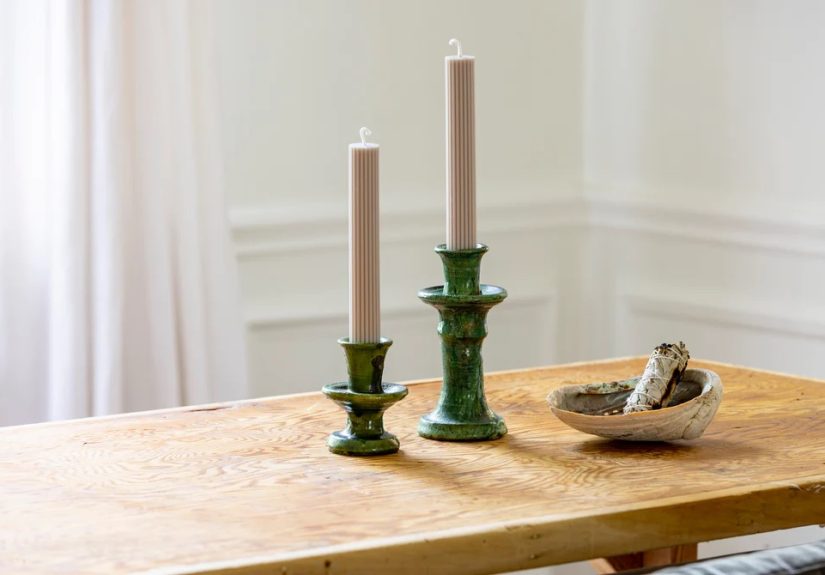
2. Candleholders With Deliciously Uneven Charm
Tamegroute candleholders are wildly lovable because they make no attempt to be sleek. Their edges can be chunky, their glaze can pool unpredictably, and their silhouettes often feel a little primitive in the best sense. If Scandinavian taper holders are the polished overachievers of tabletop decor, Tamegroute candlesticks are the charismatic artists who show up late and somehow save the whole party.
These work beautifully on a mantel, dining table, or open shelf because they add verticality without feeling stiff. The green glaze also looks amazing with candlelight. It deepens, softens, and catches shadows in a way that makes the whole piece feel more alive after sunset. Pair them with ivory tapers for a classic look, or go moodier with rust, burgundy, or tobacco-colored candles if you want your table to look like it has secrets.
They are also excellent for mixing. You do not need a perfect pair. In fact, a mismatched grouping is often better. Different heights, slightly different greens, one straighter and one wobblier, that is the point. Tamegroute rewards the collector’s eye, not the perfectionist’s blood pressure.
3. Serving Platters That Do More Than Hold Food
A good Tamegroute serving platter earns its keep in two lanes at once: tabletop and display. On one day it holds roasted vegetables, flatbread, or a pile of grilled peaches. On the next, it leans casually against a backsplash or sits empty on a console like a piece of functional sculpture. This is the sort of multitasking I respect.
What makes these platters special is the broad surface area. More surface means more glaze drama: tonal shifts, darker rims, tiny pinholes, and all those lovely irregular markings that make each piece unique. In design terms, a platter is one of the easiest ways to get maximum visual impact from green glazed ceramics without taking up much vertical space.
They also fit beautifully into layered tablescapes. If you like the collected look, not the overly coordinated one, a Tamegroute platter can play surprisingly well with plain white dishes, striped linens, wood boards, and hammered brass. It does not need a matching set around it. It prefers interesting company.
4. Sculptural Vases That Look Good Even When You Forget the Flowers
Some vases are basically unemployed without flowers. Tamegroute vases are not. Their shapes, heft, and surface variation mean they can sit empty and still feel complete. That makes them ideal for people who love a beautiful home but do not always remember to buy eucalyptus every Saturday like the internet keeps suggesting.
A Tamegroute vase can soften a modern room, add soul to a clean-lined entryway, or make a built-in shelf feel less staged. The glaze helps, of course, but so does the form. Many pieces have that slightly off-center, hand-formed silhouette that instantly reads as artisanal rather than mass-produced. You notice the human hand in them, and that matters.
For styling, I especially love them with branches, loose garden clippings, or one dramatic stem. Tamegroute already has enough personality. It does not need a full florist’s convention exploding out of the top. Let the vase do half the talking.
5. Small Bowls and Cups That Turn Everyday Routines Into Rituals
Not every favorite has to be a showpiece. Some of the best Moroccan pottery moments happen in miniature: a tiny bowl for flaky salt, a cup for espresso, a little dish for olives, dates, or pistachios. These are the pieces that sneak craft into daily life without requiring a shelf styling seminar.
Small-format Tamegroute pieces are especially appealing because they make the material feel accessible. You can start with one and see whether you love living with it. Spoiler: you probably will. There is something oddly satisfying about reaching for a slightly irregular cup in the morning instead of a generic mug that looks like it came free with a conference tote bag.
They are also the easiest pieces to scatter through a home. One near the stove, one on a bedside table for jewelry, one in the bathroom for cotton rounds, one on a desk for paper clips if you are feeling fancy. Handmade objects have a way of making even boring tasks feel less boring. No bowl can answer your emails, sadly, but it can at least judge them from the desk with style.
How to Style Tamegroute Without Going Full Theme Restaurant
The best way to use Tamegroute ceramics from Morocco is with restraint. Because the glaze is so expressive, a few pieces go a long way. Start with one standout object, maybe a bowl or candleholder, and let it contrast with quieter materials like oak, linen, plaster, marble, or matte black accents. The contrast is what makes the glaze sing.
These ceramics are especially strong in kitchens and dining rooms because they feel both useful and decorative. A pedestal bowl on a counter, candlesticks on a table, a vase on open shelving, easy. But they also work in living rooms, bedrooms, and even bathrooms, where their earthy finish can break up overly polished surfaces.
Color-wise, Tamegroute loves warm neutrals, chalky whites, tobacco browns, rust, camel, and dusty pink. It can also look stunning against deep blue or in rooms with other natural materials. What you want to avoid is too much fake rusticity all at once. One or two soulful pieces feel considered. Twenty pieces plus a pile of lanterns starts to look like your house is about to charge for mint tea.
What to Know Before You Buy
First, expect variation. That is not a customer service issue; it is the product. Slight waviness, glaze pooling, uneven rims, and surface pitting are part of the visual language of authentic handmade Tamegroute. If you want exact duplicates, this is probably not your pottery lane, and that is okay. The beauty here is in the irregularity.
Second, read care notes carefully. Some pieces are best treated as decorative objects, while others are sold for tabletop use. If you plan to serve food in them regularly, confirm the seller’s guidance on food use, washing, and heat exposure. Handmade ceramics deserve a little respect anyway. Hand washing is a small price to pay for living with something that does not look like it rolled off an assembly line at 3:14 p.m.
Third, buy the piece that has presence, not just the piece that matches your sofa. Tamegroute ceramics work best when they bring contrast and character into a room. The whole point is that they feel discovered. Trust the object that makes you pause a little longer.
Why Tamegroute Keeps Turning Up in Stylish Homes
Designers and stylists keep returning to Tamegroute because it does something many trendy home accessories cannot: it adds color, craft, age, and texture in one shot. It does not feel disposable, and it does not feel trend-chasing, even when it is having a very visible moment. The pieces have enough history and soul to survive beyond whatever the algorithm decides is fashionable next week.
That staying power matters. A good Tamegroute bowl or candleholder can move from a rustic kitchen to a more modern apartment and still make sense. It can sit next to vintage wood, polished stone, or sleek contemporary furniture and somehow keep everyone on speaking terms. That flexibility is rare. So is a glaze color that manages to look earthy and glamorous at the same time.
If you ask me, that is why Tamegroute decor has real longevity. It is not just beautiful. It is useful, tactile, and emotionally legible. You can see the hand in it. You can see the fire in it. And in a home filled with flat-pack sameness, that feels pretty wonderful.
Longer Personal Experience: What It Feels Like to Live With Tamegroute Ceramics
Living with Tamegroute ceramics is different from living with polished, factory-perfect tabletop pieces, and I mean that as a full-throated compliment. The experience starts the moment you take one out of the box. Instead of a slick, identical object that looks exactly like the product photo, you get something slightly unpredictable. The rim may wobble a little. The glaze might look darker on one side. Tiny pits or drips may catch the light in a way you did not expect. And almost immediately, that difference makes the piece feel more personal.
One of the things people rarely mention is how much these ceramics change the mood of a room without demanding attention. Put a Tamegroute bowl on a kitchen counter, and suddenly the counter looks less like a work surface and more like part of a home. Add a candleholder to a dining table, and the whole setup feels warmer even before the candle is lit. There is a visual softness to the glaze, but there is also a kind of gravity to it. It pulls your eye in. It makes you notice texture, shadow, and little color shifts you might otherwise miss.
I also think these pieces improve with repetition. The first time you use a Tamegroute bowl for fruit, it feels decorative. The tenth time, it starts to feel like part of your routine. You stop thinking of it as “the special bowl” and start thinking of it as the bowl that always holds lemons, or sea salt, or apricots in summer. That is when handmade objects really prove themselves. They stop being precious and start becoming familiar.
There is also something deeply satisfying about the contrast between roughness and beauty. Tamegroute is not precious in the dainty sense. It is beautiful, yes, but it is often thick, weighty, and a little rugged. That combination makes it easy to live with. A vase can feel artistic without feeling fragile in spirit. A platter can look storied without acting like it belongs under museum lighting. It is décor you can actually use, which is a refreshing concept in an era where half of interior styling seems one breeze away from collapse.
And then there is the emotional side. Handmade ceramics have a way of slowing you down just a little. You notice the cup in your hand. You notice the way light hits the glaze at breakfast. You notice that your bedside dish for rings is not generic, and somehow that tiny fact improves the routine by two percent. Is that scientifically measurable? Probably not. Is it real? Absolutely.
If you collect over time, the experience gets even better. Tamegroute pieces rarely look too matched, so every new addition feels like part of a living collection rather than part of a boxed set. A bowl from one shop can sit beside a candlestick from another and still feel harmonious. The shared spirit is there, even when the forms differ. That makes collecting fun instead of stressful.
Most of all, living with Tamegroute ceramics reminds you that a home does not have to be perfect to be beautiful. In fact, it is often better when it is not. A shelf with a slightly uneven green vase on it has more life than one stacked with flawless but forgettable objects. Tamegroute brings in the kind of beauty that feels earned, not manufactured. And honestly, that is my favorite kind.
Final Thoughts
If you are drawn to interiors that feel layered, soulful, and a little less obedient than showroom styling, Tamegroute ceramics deserve your attention. They bring history, handcraft, color, and utility into a home all at once. Better yet, they make everyday spaces feel collected rather than decorated.
My five favorites are still the pedestal bowl, the candleholder, the serving platter, the sculptural vase, and the humble small bowl or cup. Each one captures something essential about the appeal of Tamegroute: beauty with texture, function with character, and imperfection with serious charm. Which is to say, the exact opposite of a sad beige bowl with no backstory.